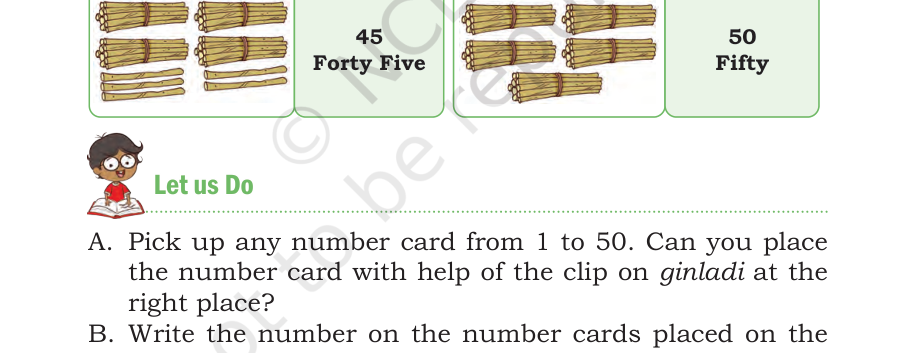
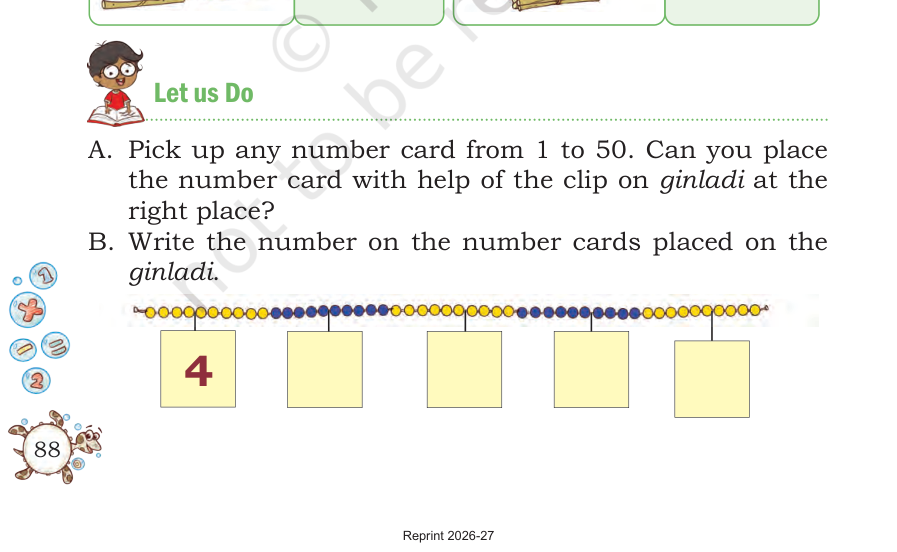
Pick up any number card from 1 to 50. Can you place the number card with help of the clip on ginladi at the right place?
Original NCERT question visual - PDF page 5
Solution
For the card 27: count 2 groups of 10 beads (20), then 7 more beads, and clip the card on the 27th bead. For 43: count 4 groups of 10 (40), then 3 more beads. (sample answer)
Question BNCERT PDF page 5
Write the number on the number cards placed on the ginladi.
Original NCERT question visual - PDF page 5
Solution
The cards show 4, 15, 26, 36 and 46.
Each colour group on the ginladi has 10 beads. Count the full groups as tens and then the extra beads, e.g. 1 group + 5 beads = 15.
Question CNCERT PDF page 6
Count and write the numbers. i. 4 garlands of 10 flowers and 5 loose flowers ii. 4 bundles of 10 daatun and 7 loose daatun iii. 3 pencil stands with 10 pencils each and 2 more pencils
Solution
i. 40 + 5 = 45 flowers
ii. 40 + 7 = 47 daatun
iii. 30 + 2 = 32 pencils
Question 3NCERT PDF page 6
Fill up the tens frames to show the number. One has already been done for you. 29 (done for you) 41 Forty one 30 Thirty
Original NCERT question visual - PDF page 6
Solution
29: 2 full tens frames and 9 boxes in the third frame (already done). The book prints 'Twenty one' under 29 by mistake – 29 is twenty-nine.
41: fill 4 tens frames completely and 1 box of the fifth frame (4 tens + 1 = 41).
30: fill 3 tens frames completely and leave the fourth frame empty (3 tens = 30).
Question 4Fill in the blanksNCERT PDF page 7
Fill up the missing numbers on the milestones along the road. (The milestones 34, 39, 42 and 46 are given.)
Original NCERT question visual - PDF page 7
Solution
The milestones go from 32 to 46: 32, 33, 34, 35, 36, 37, 38, 39, 40, 41, 42, 43, 44, 45, 46.
Farha said that she has packed more than fifty amazing things in her matchbox. Can you collect some items and see how many a matchbox can hold?
Solution
A matchbox can hold many tiny things such as seeds, rice grains, beads, small pebbles and pins. For example, it can hold about 60 mustard seeds or about 55 rice grains. (sample answer)
Question 5NCERT PDF page 8
Numbers from 51 – 99: Ankita is pasting mirrors on her house. Help her to find out how many mirrors she has used in the design.
Solution
There are 7 tree designs. The first 6 trees have 10 mirrors each: 60 mirrors. The last tree (which she is still making) has 8 mirrors. So she has used 60 + 8 = 68 mirrors (not counting the one in her hand).
Question 6NCERT PDF page 8
Count and write the numbers from 51 to 100 (bundles of 10 daatun and loose daatun). Fill the empty boxes.
Solution
51 to 60: Fifty Three = 53, Fifty Four = 54, Fifty Five = 55, Fifty Six = 56, Fifty Seven = 57, Fifty Eight = 58
Count the bundles as tens and the loose daatun as ones, e.g. 5 bundles and 3 loose = 53.
Project Work
Farha said that she has packed more than fifty amazing things in her
matchbox. Her friends wondered what these things could be. They had
a big surprise when she opened her box.
Can you collect some items and see how many a matchbox can hold?
Question 1NCERT PDF page 11
Let us Do: Tie a ginladi from one end to the other. Choose a random number (1 to 99) card. Attach the number card at the appropriate place on the ginladi with a clip. Play with your friends using other cards also.
Original NCERT question visual - PDF page 11
Solution
For the card 24 (as in the picture): count 2 groups of 10 beads (20) and then 4 more beads, and clip the card on the 24th bead. For 57: count 5 groups of 10 (50) and then 7 more beads. (sample answer)
Question 2NCERT PDF page 12
Count and write the numbers. i. 4 bundles of 10 daatun and 8 loose daatun ii. 8 full tens frames and a frame with 3 boxes filled iii. 6 rods of 10 cubes and 6 loose cubes
Solution
i. 40 + 8 = 48
ii. 80 + 3 = 83
iii. 60 + 6 = 66
Question 2NCERT PDF page 12
Make a slide and ladder game by filling the missing numbers in the 1 to 100 board.
Original NCERT question visual - PDF page 12
Solution
Missing numbers (row by row from the bottom):
1–10: 4, 7, 10
11–20: 14
21–30: 23, 26, 29
31–40: 35, 39
41–50: 44, 46, 47, 49
51–60: 55, 57, 60
61–70: 64, 67, 70
71–80: 75, 78
81–90: 85, 89
91–100: 91, 93, 94, 99
Look at the Picture
Let us Talk
Original NCERT question visual - PDF page 13
Question ANCERT PDF page 13
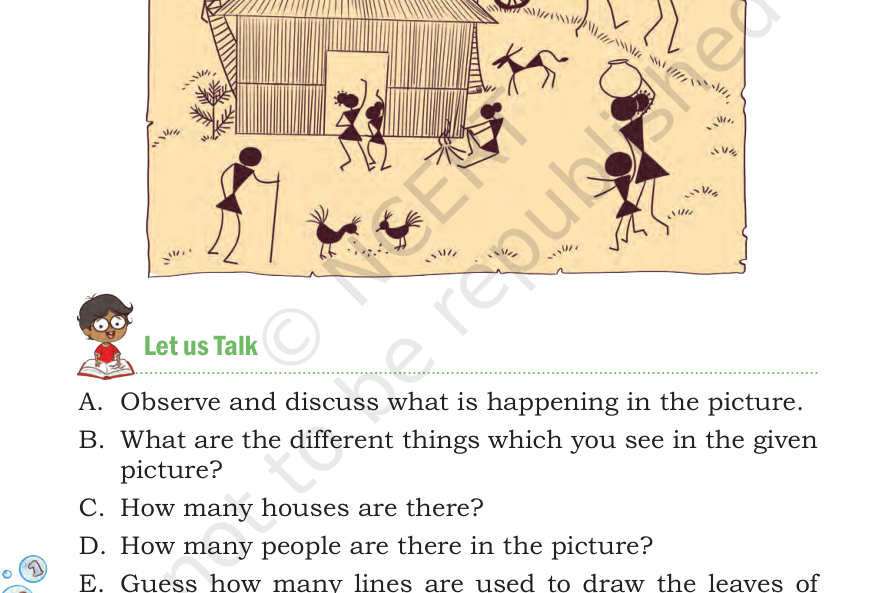
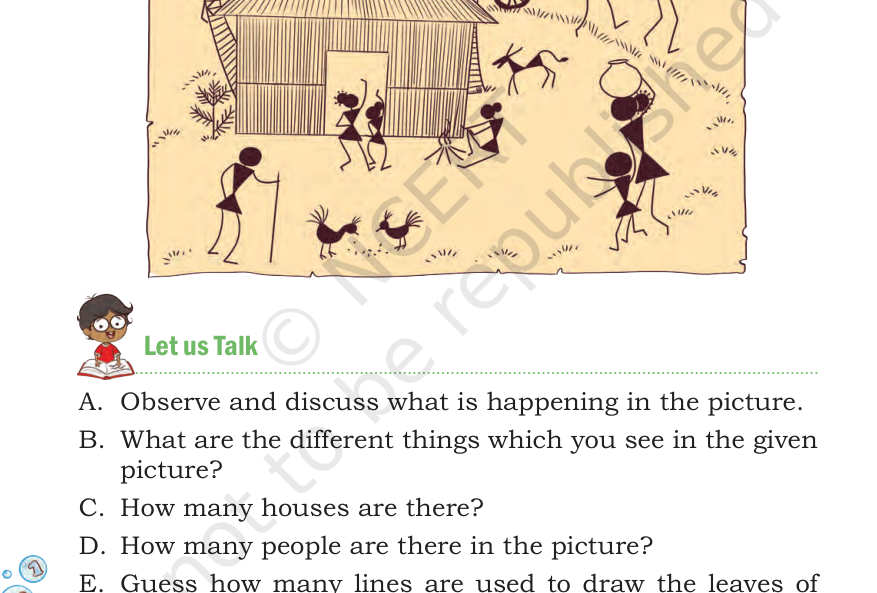
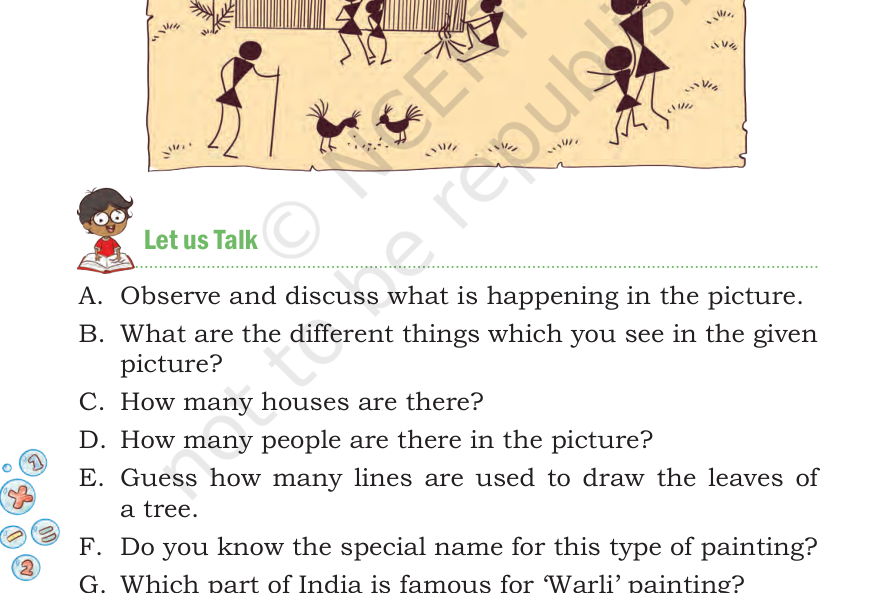
Look at the Picture. A. Observe and discuss what is happening in the picture.
Original NCERT question visual - PDF page 13
Solution
It shows daily life in a village. A man is climbing a coconut tree, two women are carrying loads on their heads, two people are dancing near the door of the hut, a woman is cooking on a fire, an old man is walking with a stick, a woman carries a pot of water with a child beside her, and there is a bullock cart.
Question BNCERT PDF page 13
What are the different things which you see in the given picture?
Original NCERT question visual - PDF page 13
Solution
I see a hut, two coconut trees, the sun, a nest hanging from a tree, a bullock cart, a goat, two hens, a small plant, a fire and many people.
Question CNCERT PDF page 13
How many houses are there?
Original NCERT question visual - PDF page 13
Solution
There is 1 house (a hut) in the picture.
Question DNCERT PDF page 13
How many people are there in the picture?
Original NCERT question visual - PDF page 13
Solution
There are about 10 people in the picture (9 big figures and 1 small figure near the bullock cart).
Question ENCERT PDF page 13
Guess how many lines are used to draw the leaves of a tree.
Original NCERT question visual - PDF page 13
Solution
Each coconut leaf is drawn with one long line in the middle and many short straight lines on both sides – about 10 to 12 short lines on each leaf. (Guess first, then count.)
Question FNCERT PDF page 13
Do you know the special name for this type of painting?
Original NCERT question visual - PDF page 13
Solution
It is called Warli painting.
Question GNCERT PDF page 13
Which part of India is famous for ‘Warli’ painting?
Original NCERT question visual - PDF page 13
Solution
Maharashtra (western India).
Question 8NCERT PDF page 14
Make your own warli drawing.
Original NCERT question visual - PDF page 14
Solution
Draw Warli figures with simple shapes: a circle for the head, two triangles joined at the tips for the body, and lines for the arms and legs. For example, draw people dancing in a circle around a tree, with a hut and the sun. (sample answer)