Skip to content

Ch 12 · Surface Areas and Volumes

Solved Examples

Exercise 1 of 3
Questions on this page

Chapter 12: Surface Areas and Volumes - Solved Examples

Official NCERT Mathematics · Class 10 · Reprint 2026-27

Example 1NCERT PDF page 3

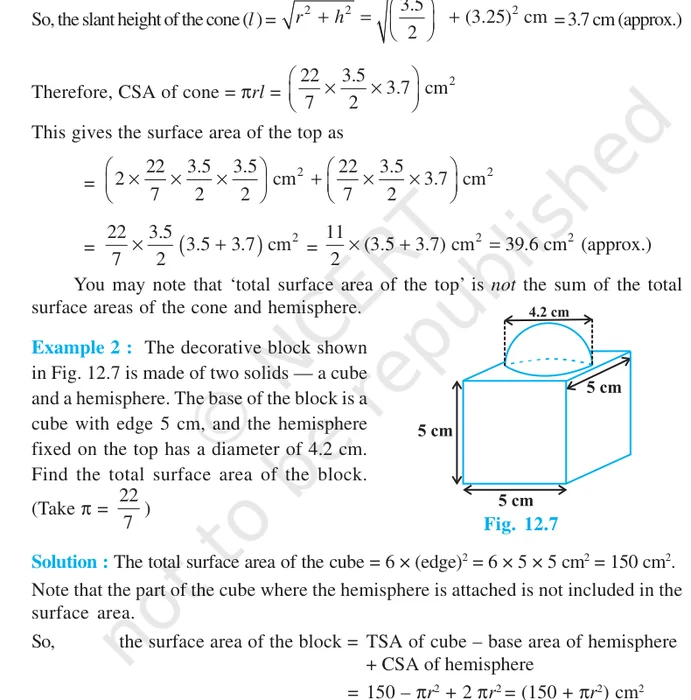
Rasheed got a playing top (lattu) as his birthday present, which surprisingly had no colour on it. He wanted to colour it with his crayons. The top is shaped like a cone surmounted by a hemisphere (see Fig. 12.6). The entire top is 5 cm in height and the diameter of the top is 3.5 cm. Find the area he has to colour. (Take $\pi=\dfrac{22}{7}$)

Solution

CBSE board-style solution

The top is a cone with a hemisphere on its base. So TSA of the top $=$ CSA of hemisphere $+$ CSA of cone (the flat circle where they join is not on the surface).

Radius $r=\dfrac{3.5}{2}=1.75$ cm.

CSA of hemisphere $=2\pi r^2=2\times\dfrac{22}{7}\times\dfrac{3.5}{2}\times\dfrac{3.5}{2}\ \text{cm}^2=19.25\ \text{cm}^2$
Height of cone $=5-1.75=3.25$ cm
Slant height $l=\sqrt{r^2+h^2}=\sqrt{(1.75)^2+(3.25)^2}=\sqrt{13.625}\approx3.7$ cm
CSA of cone $=\pi rl=\dfrac{22}{7}\times\dfrac{3.5}{2}\times3.7\ \text{cm}^2=20.35\ \text{cm}^2$
Surface area of the top $=19.25+20.35=\dfrac{11}{2}(3.5+3.7)=39.6\ \text{cm}^2$ (approx.)

Note that the total surface area of the top is not the sum of the total surface areas of the cone and the hemisphere.

$\boxed{\text{Area to be coloured}\approx39.6\text{ cm}^2}$
Example 2NCERT PDF page 4

The decorative block shown in Fig. 12.7 is made of two solids — a cube and a hemisphere. The base of the block is a cube with edge 5 cm, and the hemisphere fixed on the top has a diameter of 4.2 cm. Find the total surface area of the block. (Take $\pi=\dfrac{22}{7}$)

NCERT Figure 12.7
NCERT Fig. 12.7 - cropped from PDF page 4
Solution

CBSE board-style solution

Total surface area of the cube $=6\times(\text{edge})^2=6\times5\times5=150\ \text{cm}^2$. The part of the cube where the hemisphere is attached is not on the surface, and the hemisphere adds its curved surface. Here $r=\dfrac{4.2}{2}=2.1$ cm.

Surface area of block $=$ TSA of cube $-$ base area of hemisphere $+$ CSA of hemisphere
$=150-\pi r^2+2\pi r^2=150+\pi r^2$
$=\left(150+\dfrac{22}{7}\times2.1\times2.1\right)\text{cm}^2=(150+13.86)\ \text{cm}^2=163.86\ \text{cm}^2$

$\boxed{\text{Total surface area of the block}=163.86\text{ cm}^2}$

Example 3NCERT PDF page 5

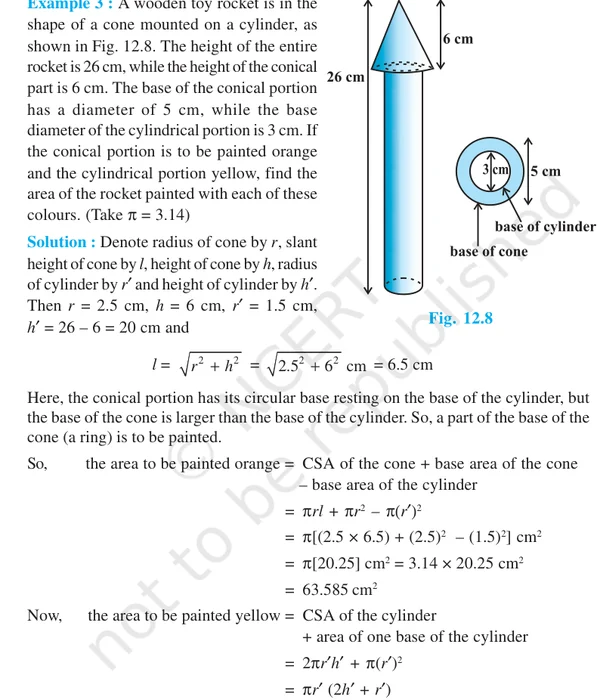
A wooden toy rocket is in the shape of a cone mounted on a cylinder, as shown in Fig. 12.8. The height of the entire rocket is 26 cm, while the height of the conical part is 6 cm. The base of the conical portion has a diameter of 5 cm, while the base diameter of the cylindrical portion is 3 cm. If the conical portion is to be painted orange and the cylindrical portion yellow, find the area of the rocket painted with each of these colours. (Take $\pi=3.14$)

NCERT Figure 12.8
NCERT Fig. 12.8 - cropped from PDF page 5
Solution

CBSE board-style solution

For the cone: $r=\dfrac52=2.5$ cm, $h=6$ cm. For the cylinder: $r'=\dfrac32=1.5$ cm, $h'=26-6=20$ cm.

Slant height of cone $l=\sqrt{r^2+h^2}=\sqrt{2.5^2+6^2}=\sqrt{42.25}=6.5$ cm

The base of the cone is larger than the base of the cylinder, so a ring of the cone's base is also painted orange.

Orange area $=$ CSA of cone $+$ base of cone $-$ base of cylinder
$=\pi rl+\pi r^2-\pi r'^2=\pi\left[(2.5\times6.5)+2.5^2-1.5^2\right]$
$=3.14\times(16.25+6.25-2.25)=3.14\times20.25=63.585\ \text{cm}^2$
Yellow area $=$ CSA of cylinder $+$ one base of cylinder
$=2\pi r'h'+\pi r'^2=\pi r'(2h'+r')=(3.14\times1.5)(2\times20+1.5)$
$=4.71\times41.5=195.465\ \text{cm}^2$

$\boxed{\text{Orange: }63.585\text{ cm}^2;\ \text{yellow: }195.465\text{ cm}^2}$

Example 4NCERT PDF page 6

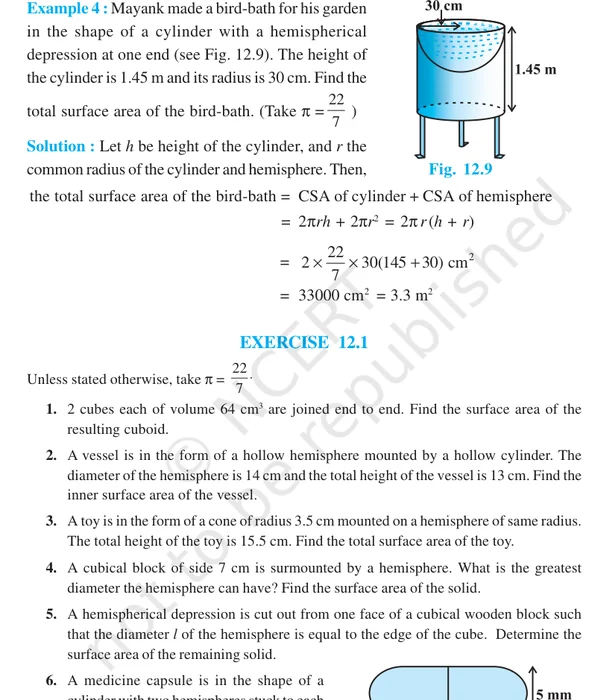
Mayank made a bird-bath for his garden in the shape of a cylinder with a hemispherical depression at one end (see Fig. 12.9). The height of the cylinder is 1.45 m and its radius is 30 cm. Find the total surface area of the bird-bath. (Take $\pi=\dfrac{22}{7}$)

NCERT Figure 12.9
NCERT Fig. 12.9 - cropped from PDF page 6
Solution

CBSE board-style solution

Let $h$ be the height of the cylinder and $r$ the common radius of the cylinder and the hemisphere: $h=1.45\text{ m}=145$ cm, $r=30$ cm. The depression replaces one circular face of the cylinder, so the surface is made up of the curved surface of the cylinder and the curved surface of the hemispherical depression.

TSA of bird-bath $=$ CSA of cylinder $+$ CSA of hemisphere
$=2\pi rh+2\pi r^2=2\pi r(h+r)$
$=2\times\dfrac{22}{7}\times30\times(145+30)\ \text{cm}^2$
$=33000\ \text{cm}^2=3.3\ \text{m}^2$

$\boxed{\text{Total surface area}=3.3\text{ m}^2}$

Example 5NCERT PDF page 7

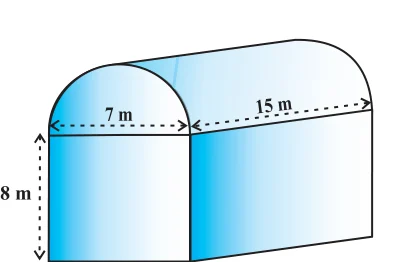
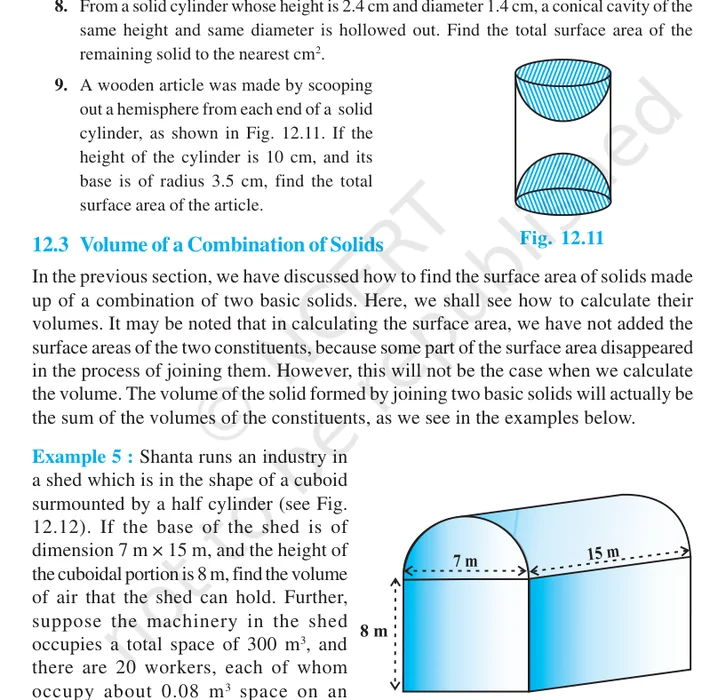
Shanta runs an industry in a shed which is in the shape of a cuboid surmounted by a half cylinder (see Fig. 12.12). If the base of the shed is of dimension $7\text{ m}\times15\text{ m}$, and the height of the cuboidal portion is 8 m, find the volume of air that the shed can hold. Further, suppose the machinery in the shed occupies a total space of $300\ \text{m}^3$, and there are 20 workers, each of whom occupy about $0.08\ \text{m}^3$ space on an average. Then, how much air is in the shed? (Take $\pi=\dfrac{22}{7}$)

NCERT Figure 12.12
NCERT Fig. 12.12 - cropped from PDF page 7
NCERT Figure 12.12
NCERT Fig. 12.12 - cropped from PDF page 7
NCERT Figure 12.11
NCERT Fig. 12.11 - cropped from PDF page 7
Solution

CBSE board-style solution

The volume of air in the shed (with no people or machinery) is the volume of the cuboid plus half the volume of a cylinder. Cuboid: $15\times7\times8$ m. Half cylinder: diameter $7$ m (so $r=3.5$ m) and height (length) $15$ m.

Volume $=15\times7\times8+\dfrac12\times\dfrac{22}{7}\times\dfrac72\times\dfrac72\times15$
$=840+288.75=1128.75\ \text{m}^3$
Space taken by machinery $=300\ \text{m}^3$
Space taken by workers $=20\times0.08=1.6\ \text{m}^3$
Air in the shed $=1128.75-(300+1.6)=827.15\ \text{m}^3$

$\boxed{\text{Volume of the shed}=1128.75\text{ m}^3;\ \text{air with machinery and workers}=827.15\text{ m}^3}$

Example 6NCERT PDF page 8

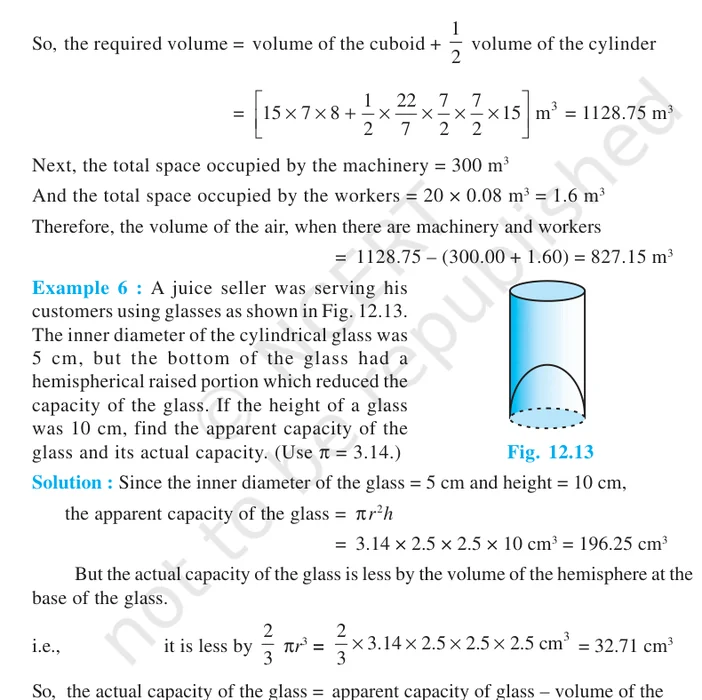
A juice seller was serving his customers using glasses as shown in Fig. 12.13. The inner diameter of the cylindrical glass was 5 cm, but the bottom of the glass had a hemispherical raised portion which reduced the capacity of the glass. If the height of a glass was 10 cm, find the apparent capacity of the glass and its actual capacity. (Use $\pi=3.14$)

NCERT Figure 12.13
NCERT Fig. 12.13 - cropped from PDF page 8
Solution

CBSE board-style solution

Inner diameter $=5$ cm, so $r=2.5$ cm; height $=10$ cm.

Apparent capacity $=\pi r^2h=3.14\times2.5\times2.5\times10=196.25\ \text{cm}^3$

The actual capacity is less by the volume of the hemispherical raised portion:

$\dfrac23\pi r^3=\dfrac23\times3.14\times2.5\times2.5\times2.5\ \text{cm}^3=32.71\ \text{cm}^3$
Actual capacity $=196.25-32.71=163.54\ \text{cm}^3$

$\boxed{\text{Apparent capacity}=196.25\text{ cm}^3;\ \text{actual capacity}=163.54\text{ cm}^3}$

Example 7NCERT PDF page 9

A solid toy is in the form of a hemisphere surmounted by a right circular cone. The height of the cone is 2 cm and the diameter of the base is 4 cm. Determine the volume of the toy. If a right circular cylinder circumscribes the toy, find the difference of the volumes of the cylinder and the toy. (Take $\pi=3.14$)

Solution

CBSE board-style solution

The radius of the hemisphere (and of the cone) is $\dfrac12\times4=2$ cm; the cone's height is $2$ cm.

Volume of the toy $=\dfrac23\pi r^3+\dfrac13\pi r^2h$
$=\left[\dfrac23\times3.14\times(2)^3+\dfrac13\times3.14\times(2)^2\times2\right]\text{cm}^3=25.12\ \text{cm}^3$

The circumscribing cylinder has radius $2$ cm and height $=AO+OP=2+2=4$ cm.

Volume of cylinder $=\pi r^2h=3.14\times2^2\times4=50.24\ \text{cm}^3$
Difference $=50.24-25.12=25.12\ \text{cm}^3$

$\boxed{\text{Volume of toy}=25.12\text{ cm}^3;\ \text{difference of volumes}=25.12\text{ cm}^3}$