Skip to content

Ch 2 · Polynomials

Solved Examples

Exercise 1 of 3
Questions on this page

Chapter 2: Polynomials - Solved Examples

Official NCERT Mathematics · Class 10 · Reprint 2026-27

Example 1NCERT PDF page 8

Look at the graphs in Fig. 2.9 given below. Each is the graph of y = p(x), where p(x) is a polynomial. For each of the graphs, find the number of zeroes of p(x). Fig. 2.9
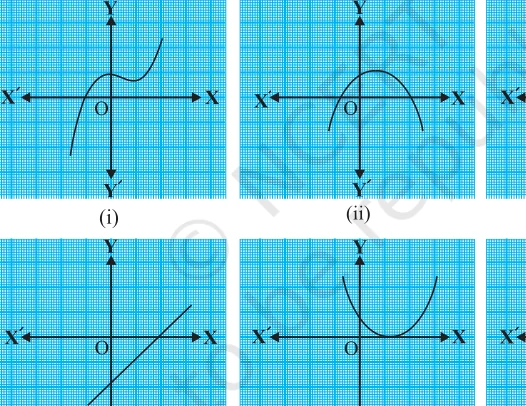
NCERT Figure 2.9
NCERT Fig. 2.9 - cropped from PDF page 8
NCERT Figure 2.9
NCERT Fig. 2.9 - cropped from PDF page 8
Solution

CBSE board-style solution

The number of zeroes of $p(x)$ is the number of points where the graph of $y=p(x)$ meets the $x$-axis.

Reading the graphs

(i) The number of zeroes is $1$, as the graph intersects the $x$-axis at one point only.

(ii) The number of zeroes is $2$, as the graph intersects the $x$-axis at two points.

(iii) The number of zeroes is $3$. Why? The curve meets the $x$-axis at three different points, so there are three values of $x$ with $p(x)=0$.

(iv) The number of zeroes is $1$. Why? The graph is a straight line and it cuts the $x$-axis at exactly one point.

(v) The number of zeroes is $1$. Why? The parabola just touches the $x$-axis at a single point, so there is only one point (and one zero) on the axis.

(vi) The number of zeroes is $4$. Why? The curve meets the $x$-axis at four different points.

$\boxed{\text{(i) }1,\ \text{(ii) }2,\ \text{(iii) }3,\ \text{(iv) }1,\ \text{(v) }1,\ \text{(vi) }4}$

Example 2NCERT PDF page 11

Find the zeroes of the quadratic polynomial $x^2+7x+10$, and verify the relationship between the zeroes and the coefficients.

Solution

CBSE board-style solution

Factorise
$x^2+7x+10=(x+2)(x+5)$

The value of the polynomial is zero when $x+2=0$ or $x+5=0$, that is, when $x=-2$ or $x=-5$. So the zeroes are $-2$ and $-5$.

Verify the relationship
Sum of zeroes $=-2+(-5)=-7=-\dfrac{7}{1}=-\dfrac{\text{coefficient of }x}{\text{coefficient of }x^2}$
Product of zeroes $=(-2)(-5)=10=\dfrac{10}{1}=\dfrac{\text{constant term}}{\text{coefficient of }x^2}$

$\boxed{\text{Zeroes: }-2,\ -5;\ \text{sum}=-\dfrac ba=-7,\ \text{product}=\dfrac ca=10}$

Example 3NCERT PDF page 11

Find the zeroes of the polynomial $x^2-3$ and verify the relationship between the zeroes and the coefficients.

Solution

CBSE board-style solution

Factorise using $a^2-b^2=(a-b)(a+b)$
$x^2-3=(x-\sqrt3)(x+\sqrt3)$

The value is zero when $x=\sqrt3$ or $x=-\sqrt3$, so the zeroes are $\sqrt3$ and $-\sqrt3$.

Verify the relationship

Here $a=1,\ b=0,\ c=-3$.

Sum of zeroes $=\sqrt3+(-\sqrt3)=0=-\dfrac{0}{1}=-\dfrac ba$
Product of zeroes $=\sqrt3\times(-\sqrt3)=-3=\dfrac{-3}{1}=\dfrac ca$

$\boxed{\text{Zeroes: }\sqrt3,\ -\sqrt3;\ \text{sum}=0,\ \text{product}=-3}$

Example 4NCERT PDF page 12

Find a quadratic polynomial, the sum and product of whose zeroes are $-3$ and $2$, respectively.

Solution

CBSE board-style solution

Let the polynomial be $ax^2+bx+c$ with zeroes $\alpha$ and $\beta$.

$\alpha+\beta=-3=-\dfrac ba$
$\alpha\beta=2=\dfrac ca$

Taking $a=1$, we get $b=3$ and $c=2$.

$\boxed{x^2+3x+2}$ is one such polynomial.

Any other polynomial with the same sum and product of zeroes has the form $k(x^2+3x+2)$, where $k$ is a non-zero real number.

Example 5NCERT PDF page 13

Verify that $3,\ -1,\ -\dfrac13$ are the zeroes of the cubic polynomial $p(x)=3x^3-5x^2-11x-3$, and then verify the relationship between the zeroes and the coefficients.

Solution

CBSE board-style solution

Compare with $ax^3+bx^2+cx+d$: $a=3,\ b=-5,\ c=-11,\ d=-3$.

Check that the three numbers are zeroes
$p(3)=3(27)-5(9)-11(3)-3=81-45-33-3=0$
$p(-1)=3(-1)-5(1)-11(-1)-3=-3-5+11-3=0$
$p\left(-\dfrac13\right)=3\left(-\dfrac1{27}\right)-5\left(\dfrac19\right)-11\left(-\dfrac13\right)-3=-\dfrac19-\dfrac59+\dfrac{11}3-3=-\dfrac23+\dfrac{11}3-3=0$

So $3,\ -1,\ -\dfrac13$ are the zeroes. Take $\alpha=3,\ \beta=-1,\ \gamma=-\dfrac13$.

Verify the relationships
$\alpha+\beta+\gamma=3-1-\dfrac13=\dfrac53=-\dfrac{(-5)}{3}=-\dfrac ba$
$\alpha\beta+\beta\gamma+\gamma\alpha=(3)(-1)+(-1)\left(-\dfrac13\right)+\left(-\dfrac13\right)(3)=-3+\dfrac13-1=-\dfrac{11}3=\dfrac ca$
$\alpha\beta\gamma=(3)(-1)\left(-\dfrac13\right)=1=-\dfrac{(-3)}{3}=-\dfrac da$

$\boxed{\text{All three relationships hold.}}$