Official NCERT Mathematics · Class 10 · Reprint 2026-27
Example 1NCERT PDF page 10
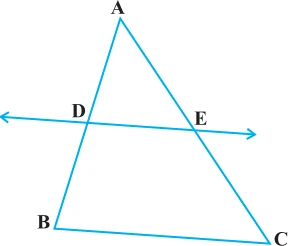
If a line intersects sides AB and AC of a $\triangle ABC$ at D and E respectively and is parallel to BC, prove that $\dfrac{AD}{AB}=\dfrac{AE}{AC}$ (see Fig. 6.13).
NCERT Fig. 6.13 - cropped from PDF page 10
Solution
CBSE board-style solution
$DE\parallel BC$ (given), so by Theorem 6.1 (Basic Proportionality Theorem):
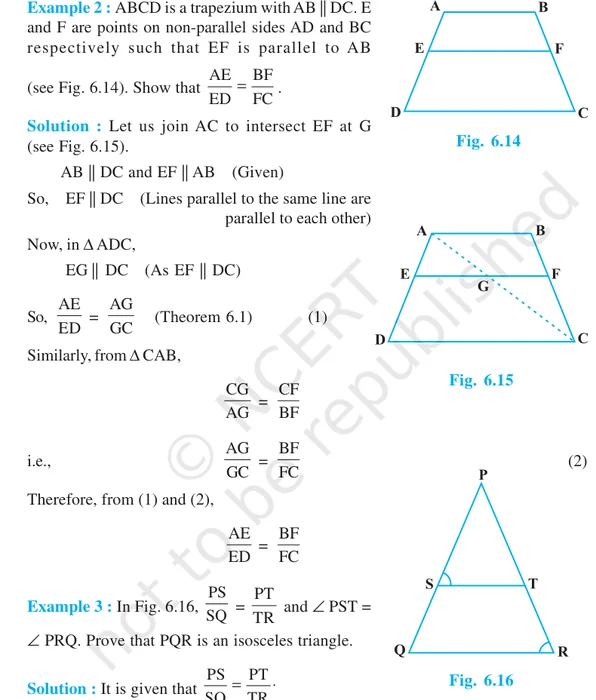
ABCD is a trapezium with $AB\parallel DC$. E and F are points on non-parallel sides AD and BC respectively such that EF is parallel to AB (see Fig. 6.14). Show that $\dfrac{AE}{ED}=\dfrac{BF}{FC}$.
NCERT Fig. 6.14 - cropped from PDF page 11
Solution
CBSE board-style solution
Join AC to meet EF at G (Fig. 6.15).
$AB\parallel DC$ and $EF\parallel AB$, so $EF\parallel DC$ (lines parallel to the same line are parallel to each other).
In $\triangle ADC$, $EG\parallel DC$, so by Theorem 6.1: $\dfrac{AE}{ED}=\dfrac{AG}{GC}$ (1)
In $\triangle CAB$, $GF\parallel AB$, so by Theorem 6.1: $\dfrac{CG}{GA}=\dfrac{CF}{FB}$, i.e. $\dfrac{AG}{GC}=\dfrac{BF}{FC}$ (2)
From (1) and (2): $\dfrac{AE}{ED}=\dfrac{BF}{FC}$.
Hence shown.
Example 3NCERT PDF page 11
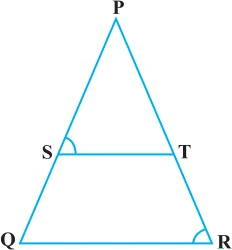
In Fig. 6.16, $\dfrac{PS}{SQ}=\dfrac{PT}{TR}$ and $\angle PST=\angle PRQ$. Prove that PQR is an isosceles triangle.
NCERT Fig. 6.16 - cropped from PDF page 11
Solution
CBSE board-style solution
It is given that $\dfrac{PS}{SQ}=\dfrac{PT}{TR}$, so $ST\parallel QR$ (Theorem 6.2, converse of the Basic Proportionality Theorem).
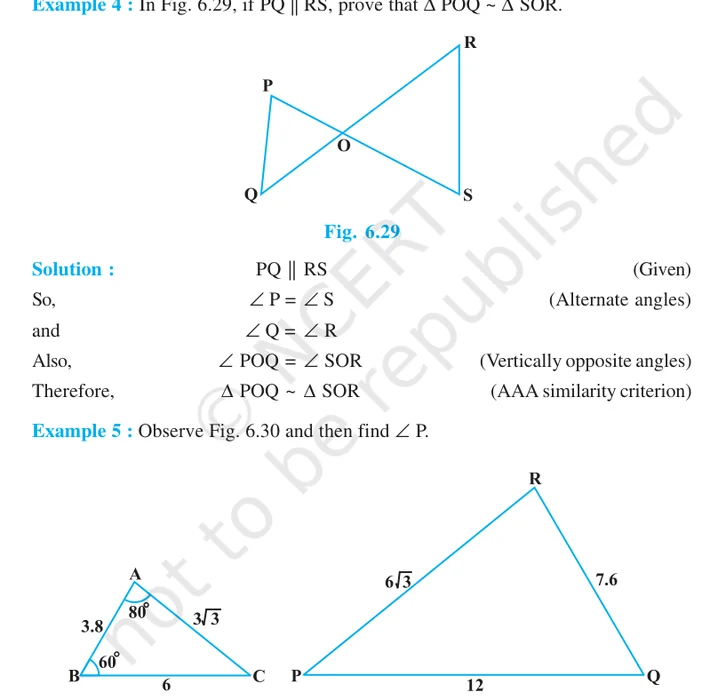
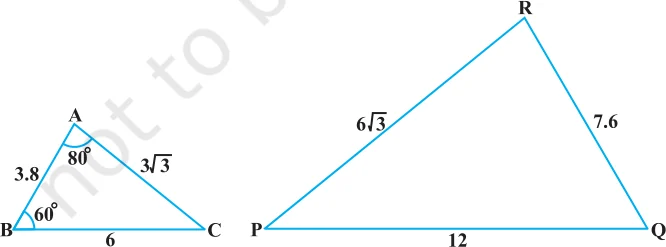
So $\dfrac{AB}{RQ}=\dfrac{BC}{QP}=\dfrac{CA}{PR}$ and $\triangle ABC\sim\triangle RQP$ (SSS similarity). Corresponding angles are equal: $\angle C=\angle P$.
But $\angle C=180^\circ-\angle A-\angle B=180^\circ-80^\circ-60^\circ=40^\circ$ (angle sum property).
$\boxed{\angle P=40^\circ}$
Example 6NCERT PDF page 20
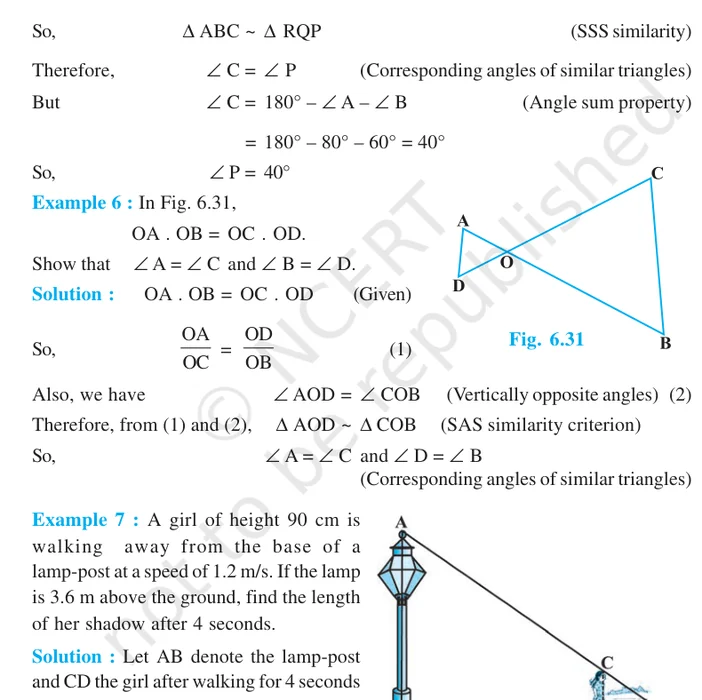
In Fig. 6.31, $OA\cdot OB=OC\cdot OD$. Show that $\angle A=\angle C$ and $\angle B=\angle D$.
NCERT Fig. 6.31 - cropped from PDF page 20
Solution
CBSE board-style solution
$OA\cdot OB=OC\cdot OD$ (given), so $\dfrac{OA}{OC}=\dfrac{OD}{OB}$ (1)
Also $\angle AOD=\angle COB$ (vertically opposite angles) (2)
From (1) and (2), $\triangle AOD\sim\triangle COB$ (SAS similarity criterion).
Therefore $\angle A=\angle C$ and $\angle D=\angle B$ (corresponding angles of similar triangles).
Hence shown.
Example 7NCERT PDF page 20
A girl of height 90 cm is walking away from the base of a lamp-post at a speed of 1.2 m/s. If the lamp is 3.6 m above the ground, find the length of her shadow after 4 seconds.
Solution
CBSE board-style solution
Let AB be the lamp-post and CD the girl after 4 seconds; DE is her shadow. Let $DE=x$ m.
Distance walked: $BD=1.2\times4=4.8$ m. Heights: $AB=3.6$ m, $CD=90\text{ cm}=0.9$ m.
In $\triangle ABE$ and $\triangle CDE$: $\angle B=\angle D=90^\circ$ (lamp-post and girl are vertical) and $\angle E=\angle E$ (common). So $\triangle ABE\sim\triangle CDE$ (AA similarity).
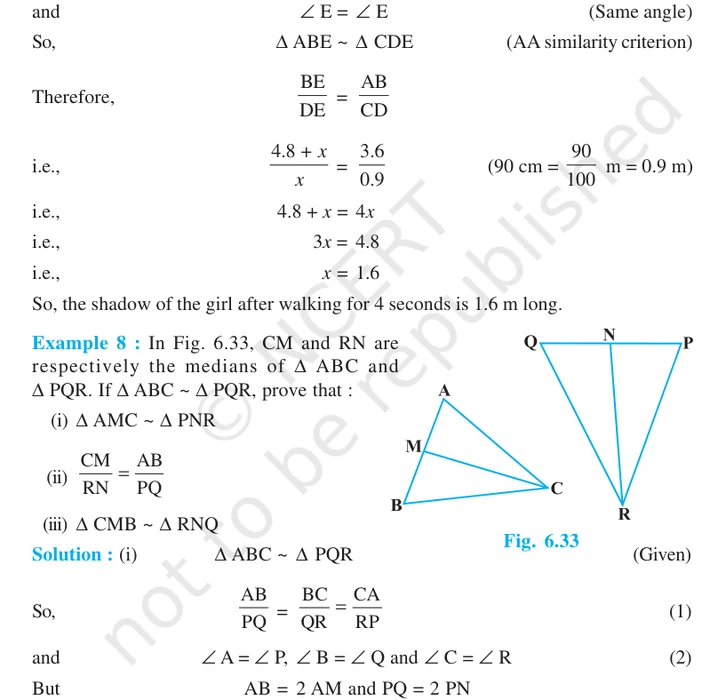
In Fig. 6.33, CM and RN are respectively the medians of $\triangle ABC$ and $\triangle PQR$. If $\triangle ABC\sim\triangle PQR$, prove that: (i) $\triangle AMC\sim\triangle PNR$ (ii) $\dfrac{CM}{RN}=\dfrac{AB}{PQ}$ (iii) $\triangle CMB\sim\triangle RNQ$
NCERT Fig. 6.33 - cropped from PDF page 21
Solution
CBSE board-style solution
$\triangle ABC\sim\triangle PQR$ (given), so $\dfrac{AB}{PQ}=\dfrac{BC}{QR}=\dfrac{CA}{RP}$ (1) and $\angle A=\angle P,\ \angle B=\angle Q,\ \angle C=\angle R$ (2).
(i)
$AB=2AM$ and $PQ=2PN$ (CM and RN are medians). From (1): $\dfrac{2AM}{2PN}=\dfrac{CA}{RP}$, i.e. $\dfrac{AM}{PN}=\dfrac{CA}{RP}$ (3). Also $\angle MAC=\angle NPR$ from (2) (4). From (3) and (4), $\triangle AMC\sim\triangle PNR$ (SAS similarity) (5).
(ii)
From (5): $\dfrac{CM}{RN}=\dfrac{CA}{RP}$ (6). But $\dfrac{CA}{RP}=\dfrac{AB}{PQ}$ from (1) (7). So $\dfrac{CM}{RN}=\dfrac{AB}{PQ}$ (8).
(iii)
From (1), $\dfrac{AB}{PQ}=\dfrac{BC}{QR}$, so by (8) $\dfrac{CM}{RN}=\dfrac{BC}{QR}$ (9). Also $\dfrac{CM}{RN}=\dfrac{AB}{PQ}=\dfrac{2BM}{2QN}=\dfrac{BM}{QN}$ (10). From (9) and (10): $\dfrac{CM}{RN}=\dfrac{BC}{QR}=\dfrac{BM}{QN}$, so $\triangle CMB\sim\triangle RNQ$ (SSS similarity).