Alternative: $AD^2+DC^2=34+34=68=AC^2$, so $\angle D=90^\circ$ (converse of Pythagoras). A quadrilateral with four equal sides and one right angle is a square.
Hence ABCD is a square.
Example 3NCERT PDF page 5
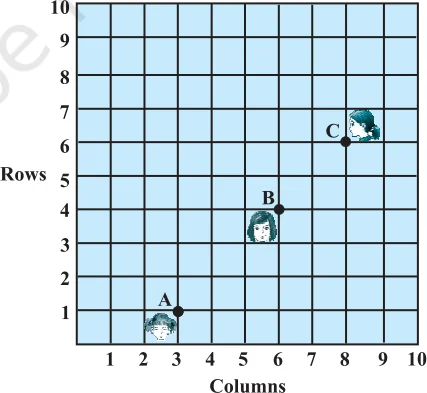
Fig. 7.6 shows the arrangement of desks in a classroom. Ashima, Bharti and Camella are seated at $A(3,1)$, $B(6,4)$ and $C(8,6)$ respectively. Do you think they are seated in a line? Give reasons for your answer.
NCERT Fig. 7.6 - cropped from PDF page 5NCERT Fig. 7.6 - cropped from PDF page 5
Check: $PA=\sqrt{36+16}=\sqrt{52}$ and $PB=\sqrt{16+36}=\sqrt{52}$.
$\boxed{\text{The required point is }(0,9).}$
Example 6NCERT PDF page 10
Find the coordinates of the point which divides the line segment joining the points $(4,-3)$ and $(8,5)$ in the ratio $3:1$ internally.
Solution
CBSE board-style solution
Section formula: for $m_1:m_2$, $P=\left(\dfrac{m_1x_2+m_2x_1}{m_1+m_2},\ \dfrac{m_1y_2+m_2y_1}{m_1+m_2}\right)$. Here $(x_1,y_1)=(4,-3)$, $(x_2,y_2)=(8,5)$, $m_1:m_2=3:1$.
In what ratio does the point $(-4,6)$ divide the line segment joining the points $A(-6,10)$ and $B(3,-8)$?
Solution
CBSE board-style solution
Let $(-4,6)$ divide AB internally in the ratio $m_1:m_2$. By the section formula, $(-4,6)=\left(\dfrac{3m_1-6m_2}{m_1+m_2},\ \dfrac{-8m_1+10m_2}{m_1+m_2}\right)$.
From the $x$-coordinate: $-4=\dfrac{3m_1-6m_2}{m_1+m_2}\Rightarrow-4m_1-4m_2=3m_1-6m_2\Rightarrow7m_1=2m_2$, so $m_1:m_2=2:7$.
Check with the $y$-coordinate (divide by $m_2$, $\frac{m_1}{m_2}=\frac27$): $\dfrac{-8\cdot\frac27+10}{\frac27+1}=\dfrac{\frac{54}7}{\frac97}=6$ ✓
Alternatively: take the ratio $k:1$. Then $-4=\dfrac{3k-6}{k+1}\Rightarrow-4k-4=3k-6\Rightarrow7k=2$, so $k:1=2:7$.
$\boxed{\text{The point divides AB in the ratio }2:7.}$
Example 8NCERT PDF page 11
Find the coordinates of the points of trisection (i.e., points dividing in three equal parts) of the line segment joining the points A(2, – 2) and B(– 7, 4).
Solution
CBSE board-style solution
Let P and Q be the points of trisection, so $AP=PQ=QB$. Then P divides AB in the ratio $1:2$ and Q divides AB in the ratio $2:1$. Here $A(2,-2)$, $B(-7,4)$.
A point on the y-axis has $x=0$: $\dfrac{5-k}{k+1}=0\Rightarrow k=5$.
Then $y=\dfrac{-4(5)-6}{6}=-\dfrac{26}{6}=-\dfrac{13}{3}$.
$\boxed{\text{Ratio }5:1;\ \text{point of intersection }\left(0,-\dfrac{13}{3}\right)}$
Example 10NCERT PDF page 12
If the points $A(6,1)$, $B(8,2)$, $C(9,4)$ and $D(p,3)$ are the vertices of a parallelogram, taken in order, find the value of $p$.
Solution
CBSE board-style solution
The diagonals of a parallelogram bisect each other, so the mid-point of AC equals the mid-point of BD.
Mid-point of AC $=\left(\dfrac{6+9}{2},\dfrac{1+4}{2}\right)=\left(\dfrac{15}2,\dfrac52\right)$ Mid-point of BD $=\left(\dfrac{8+p}{2},\dfrac{2+3}{2}\right)=\left(\dfrac{8+p}2,\dfrac52\right)$
Equating the $x$-coordinates: $\dfrac{15}2=\dfrac{8+p}2\Rightarrow p=7$.