Chapter 8: Introduction to Trigonometry - Solved Examples Official NCERT Mathematics · Class 10 · Reprint 2026-27
Example 1 NCERT PDF page 6
Given $\tan A=\dfrac43$, find the other trigonometric ratios of the angle $A$.
Solution
CBSE board-style solution Draw a right $\triangle ABC$, right-angled at B (Fig. 8.8). $\tan A=\dfrac{BC}{AB}=\dfrac43$, so take $BC=4k$ and $AB=3k$ for a positive number $k$.
$AC^2=AB^2+BC^2=(3k)^2+(4k)^2=25k^2\Rightarrow AC=5k$
$\sin A=\dfrac{BC}{AC}=\dfrac{4k}{5k}=\dfrac45$
$\boxed{\sin A=\dfrac45,\ \cos A=\dfrac35,\ \cot A=\dfrac34,\ \operatorname{cosec}A=\dfrac54,\ \sec A=\dfrac53}$
Example 2 NCERT PDF page 6
If $\angle B$ and $\angle Q$ are acute angles such that $\sin B=\sin Q$, then prove that $\angle B=\angle Q$.
Solution
CBSE board-style solution Take two right triangles $ABC$ (right angle at C) and $PQR$ (right angle at R) with $\sin B=\sin Q$ (Fig. 8.9).
$\sin B=\dfrac{AC}{AB}$ and $\sin Q=\dfrac{PR}{PQ}$, so $\dfrac{AC}{AB}=\dfrac{PR}{PQ}$. Let this common ratio be $\dfrac{AC}{PR}=\dfrac{AB}{PQ}=k$ (1)
By Pythagoras, $BC=\sqrt{AB^2-AC^2}$ and $QR=\sqrt{PQ^2-PR^2}$. So
$\dfrac{BC}{QR}=\dfrac{\sqrt{AB^2-AC^2}}{\sqrt{PQ^2-PR^2}}=\dfrac{\sqrt{k^2PQ^2-k^2PR^2}}{\sqrt{PQ^2-PR^2}}=k$ (2)
From (1) and (2): $\dfrac{AC}{PR}=\dfrac{AB}{PQ}=\dfrac{BC}{QR}$. By the SSS similarity criterion (Theorem 6.4), $\triangle ACB\sim\triangle PRQ$, and therefore $\angle B=\angle Q$.
Hence proved.
Example 3 NCERT PDF page 7
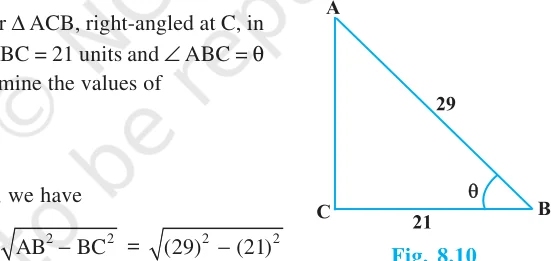
Consider $\triangle ACB$, right-angled at C, in which $AB=29$ units, $BC=21$ units and $\angle ABC=\theta$ (see Fig. 8.10). Determine the values of (i) $\cos^2\theta+\sin^2\theta$, (ii) $\cos^2\theta-\sin^2\theta$.
NCERT Fig. 8.10 - cropped from PDF page 7 Solution
CBSE board-style solution $AC=\sqrt{AB^2-BC^2}=\sqrt{29^2-21^2}=\sqrt{(29-21)(29+21)}=\sqrt{8\times50}=\sqrt{400}=20$ units
So $\sin\theta=\dfrac{AC}{AB}=\dfrac{20}{29}$ and $\cos\theta=\dfrac{BC}{AB}=\dfrac{21}{29}$.
(i) $\cos^2\theta+\sin^2\theta=\dfrac{21^2+20^2}{29^2}=\dfrac{441+400}{841}=\dfrac{841}{841}=1$
$\boxed{\text{(i) }1\qquad\text{(ii) }\dfrac{41}{841}}$
Example 4 NCERT PDF page 8
In a right triangle ABC, right-angled at B, if tan A = 1, then verify that 2 sin A cos A = 1.
Solution
CBSE board-style solution In $\triangle ABC$ (Fig. 8.11), $\tan A=\dfrac{BC}{AB}=1$, so $BC=AB$. Let $AB=BC=k$ ($k>0$).
$AC=\sqrt{AB^2+BC^2}=\sqrt{k^2+k^2}=\sqrt2\,k$
Verified: $2\sin A\cos A=1$.
Example 5 NCERT PDF page 8
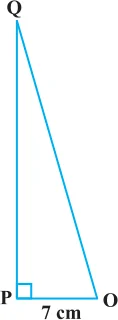
In △ OPQ, right-angled at P, OP = 7 cm and OQ – PQ = 1 cm (see Fig. 8.12). Determine the values of sin Q and cos Q.
NCERT Fig. 8.12 - cropped from PDF page 8 Solution
CBSE board-style solution In right $\triangle OPQ$ (right angle at P), $OQ^2=OP^2+PQ^2$. Since $OQ-PQ=1$, $OQ=1+PQ$ (why? it is given).
$(1+PQ)^2=OP^2+PQ^2$
$\sin Q=\dfrac{OP}{OQ}=\dfrac7{25}$
$\boxed{\sin Q=\dfrac7{25},\quad\cos Q=\dfrac{24}{25}}$
Example 6 NCERT PDF page 13
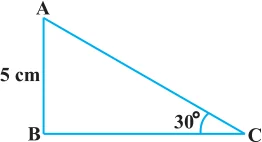
In △ ABC, right-angled at B, AB = 5 cm and ∠ ACB = 30° (see Fig. 8.19). Determine the lengths of the sides BC and AC.
NCERT Fig. 8.19 - cropped from PDF page 13 Solution
CBSE board-style solution To find $BC$ choose the ratio containing $BC$ and the given side $AB$. For angle C, $AB$ is the opposite side and $BC$ the adjacent side, so
$\tan C=\dfrac{AB}{BC}\Rightarrow\tan30^\circ=\dfrac5{BC}\Rightarrow\dfrac1{\sqrt3}=\dfrac5{BC}\Rightarrow BC=5\sqrt3$ cm
To find $AC$: $\sin30^\circ=\dfrac{AB}{AC}$ (opposite over hypotenuse), so $\dfrac12=\dfrac5{AC}\Rightarrow AC=10$ cm.
Check by Pythagoras: $AC=\sqrt{AB^2+BC^2}=\sqrt{25+75}=\sqrt{100}=10$ cm.
$\boxed{BC=5\sqrt3\text{ cm},\quad AC=10\text{ cm}}$
Example 7 NCERT PDF page 14
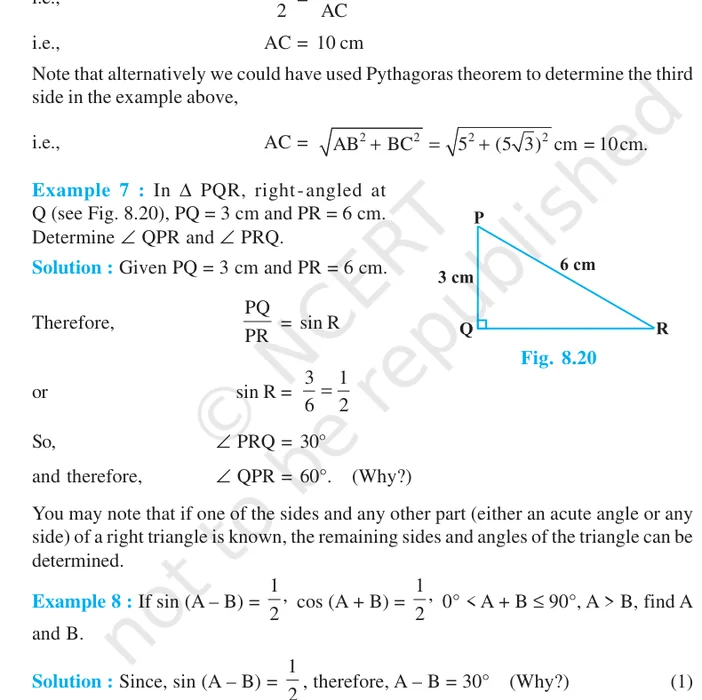
In △ PQR, right-angled at Q (see Fig. 8.20), PQ = 3 cm and PR = 6 cm. Determine ∠ QPR and ∠ PRQ.
NCERT Fig. 8.20 - cropped from PDF page 14 Solution
CBSE board-style solution Given $PQ=3$ cm and $PR=6$ cm. Side $PQ$ is opposite to angle $R$ and $PR$ is the hypotenuse, so
$\sin R=\dfrac{PQ}{PR}=\dfrac36=\dfrac12$
$\boxed{\angle QPR=60^\circ,\quad\angle PRQ=30^\circ}$
Example 8 NCERT PDF page 14
If $\sin(A-B)=\dfrac12$, $\cos(A+B)=\dfrac12$, $0^\circB$, find $A$ and $B$.
Solution
CBSE board-style solution $\sin(A-B)=\dfrac12\Rightarrow A-B=30^\circ$ (1) [since $\sin30^\circ=\tfrac12$]
Adding (1) and (2): $2A=90^\circ\Rightarrow A=45^\circ$. Then $B=60^\circ-45^\circ=15^\circ$.
$\boxed{A=45^\circ,\quad B=15^\circ}$
Example 9 NCERT PDF page 17
Express the ratios cos A, tan A and sec A in terms of sin A.
Solution
CBSE board-style solution From $\cos^2A+\sin^2A=1$: $\cos^2A=1-\sin^2A$, so $\cos A=\sqrt{1-\sin^2A}$ (positive, as $A$ is acute).
$\tan A=\dfrac{\sin A}{\cos A}=\dfrac{\sin A}{\sqrt{1-\sin^2A}}$
$\boxed{\cos A=\sqrt{1-\sin^2A},\ \ \tan A=\dfrac{\sin A}{\sqrt{1-\sin^2A}},\ \ \sec A=\dfrac1{\sqrt{1-\sin^2A}}}$
Example 10 NCERT PDF page 17
Prove that sec A (1 – sin A)(sec A + tan A) = 1.
Solution
CBSE board-style solution LHS $=\sec A(1-\sin A)(\sec A+\tan A)$
Hence proved.
Example 11 NCERT PDF page 18
Prove that $\dfrac{\cot A-\cos A}{\cot A+\cos A}=\dfrac{\operatorname{cosec}A-1}{\operatorname{cosec}A+1}$.
Solution
CBSE board-style solution LHS $=\dfrac{\frac{\cos A}{\sin A}-\cos A}{\frac{\cos A}{\sin A}+\cos A}=\dfrac{\cos A\left(\frac1{\sin A}-1\right)}{\cos A\left(\frac1{\sin A}+1\right)}$
Hence proved.
Example 12 NCERT PDF page 18
Prove that $\dfrac{\sin\theta-\cos\theta+1}{\sin\theta+\cos\theta-1}=\dfrac1{\sec\theta-\tan\theta}$, using the identity $\sec^2\theta=1+\tan^2\theta$.
Solution
CBSE board-style solution Divide the numerator and denominator of the LHS by $\cos\theta$ to bring in $\sec\theta$ and $\tan\theta$:
LHS $=\dfrac{\tan\theta-1+\sec\theta}{\tan\theta+1-\sec\theta}=\dfrac{(\tan\theta+\sec\theta)-1}{\tan\theta-\sec\theta+1}$
Replace $1$ in the numerator by $\sec^2\theta-\tan^2\theta=(\sec\theta+\tan\theta)(\sec\theta-\tan\theta)$:
$=\dfrac{(\tan\theta+\sec\theta)-(\sec\theta+\tan\theta)(\sec\theta-\tan\theta)}{\tan\theta-\sec\theta+1}$
Finally, $(\sec\theta+\tan\theta)(\sec\theta-\tan\theta)=\sec^2\theta-\tan^2\theta=1$, so $\sec\theta+\tan\theta=\dfrac1{\sec\theta-\tan\theta}=$ RHS.
Hence proved.