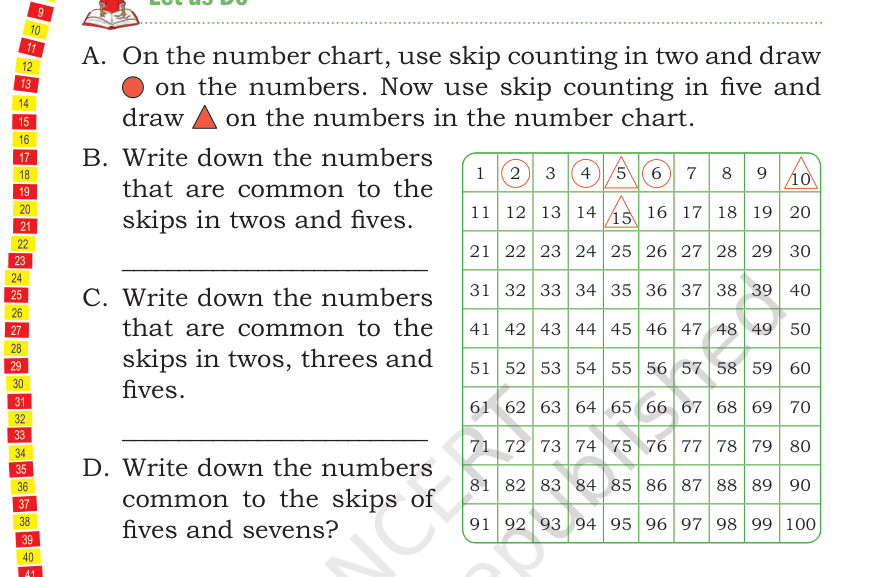
On the number chart, use skip counting in two and draw on the numbers. Now use skip counting in five and draw on the numbers in the number chart.
Original NCERT question visual - PDF page 4
Solution
Skip count in 2s (2, 4, 6, …) and in 5s (5, 10, 15, …) on the number chart and mark them.
Question BNCERT PDF page 4
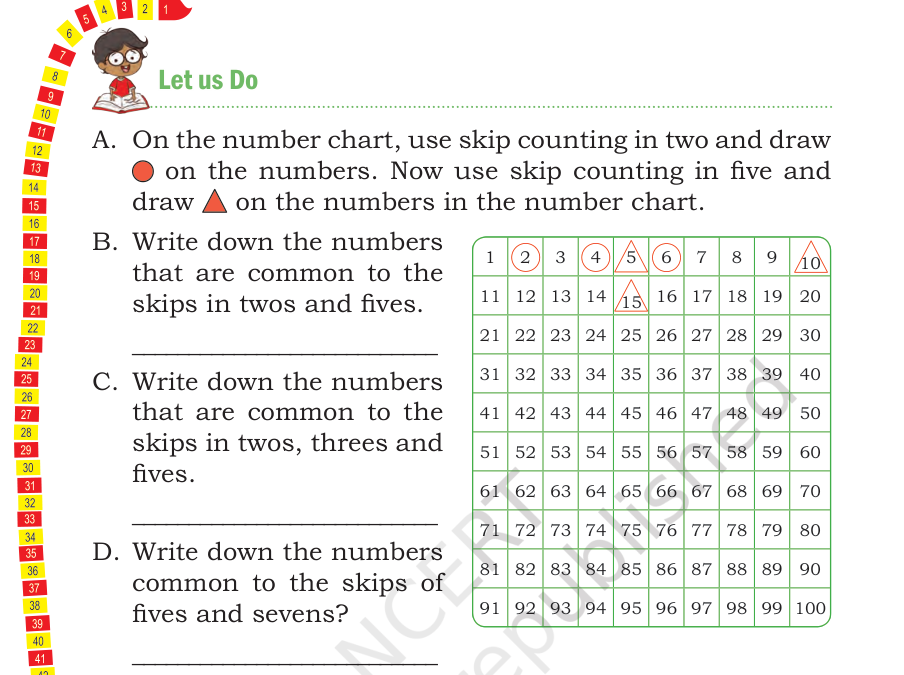
Write down the numbers that are common to the skips in twos and fives.
Original NCERT question visual - PDF page 4
Solution
Numbers common to skips in 2s and 5s (up to 100): 10, 20, 30, 40, 50, 60, 70, 80, 90, 100.
Question CNCERT PDF page 4
Write down the numbers that are common to the skips in twos, threes and fives.
Original NCERT question visual - PDF page 4
Solution
Common to 2s, 3s and 5s (up to 100): 30, 60, 90.
Question DNCERT PDF page 4
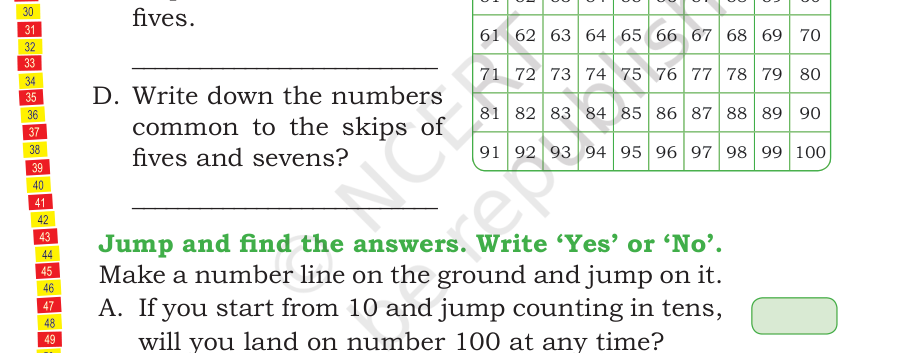
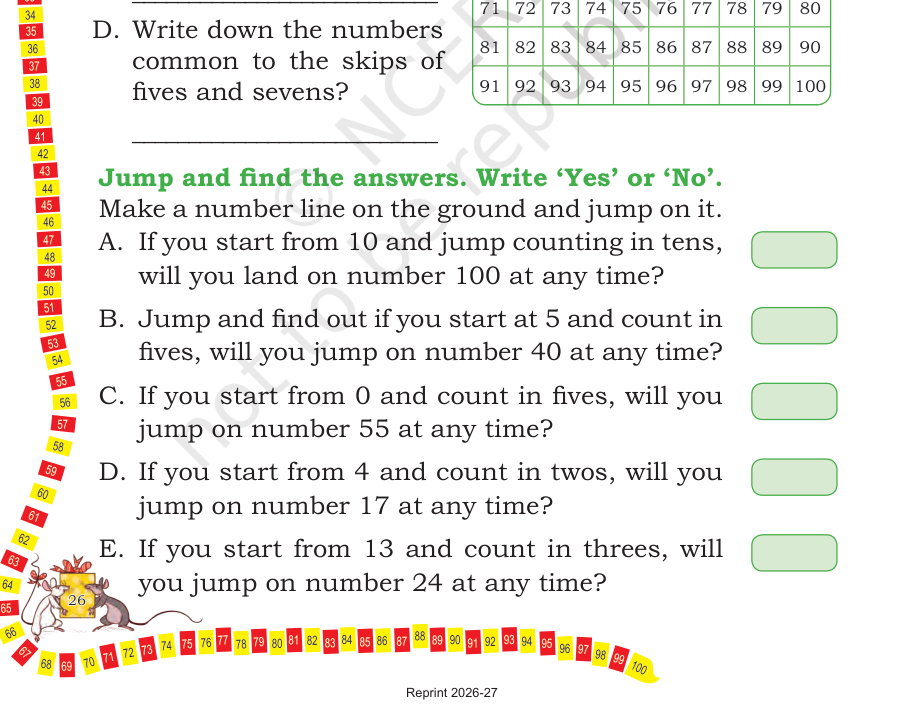
Write down the numbers common to the skips of fives and sevens. (Then: Jump and find the answers. Write ‘Yes’ or ‘No’. Make a number line on the ground and jump on it.)
Original NCERT question visual - PDF page 4
Solution
Common to 5s and 7s (up to 100): 35, 70.
Question ANCERT PDF page 4
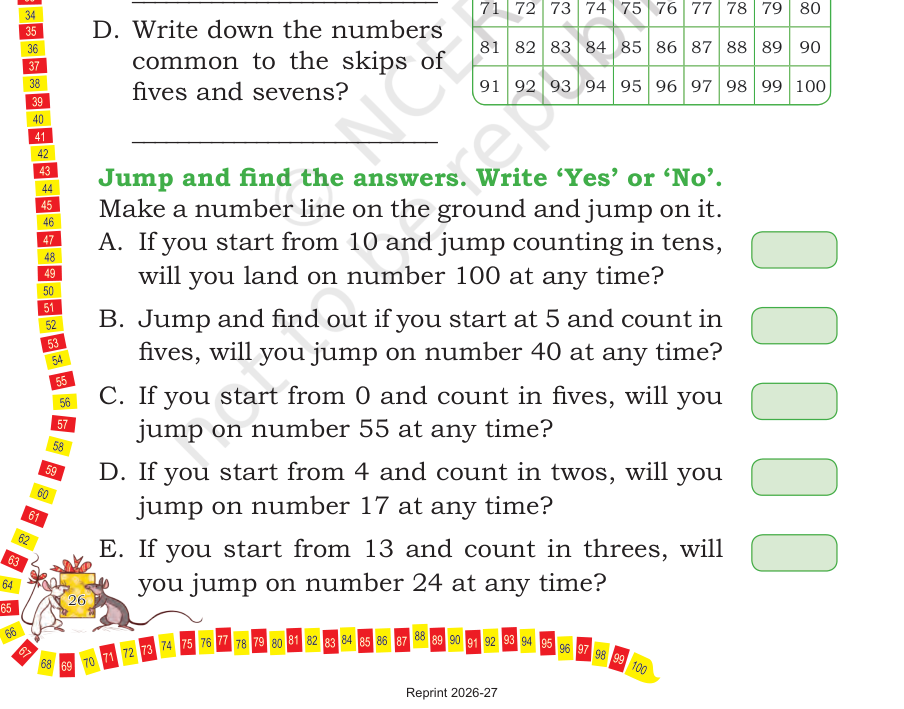
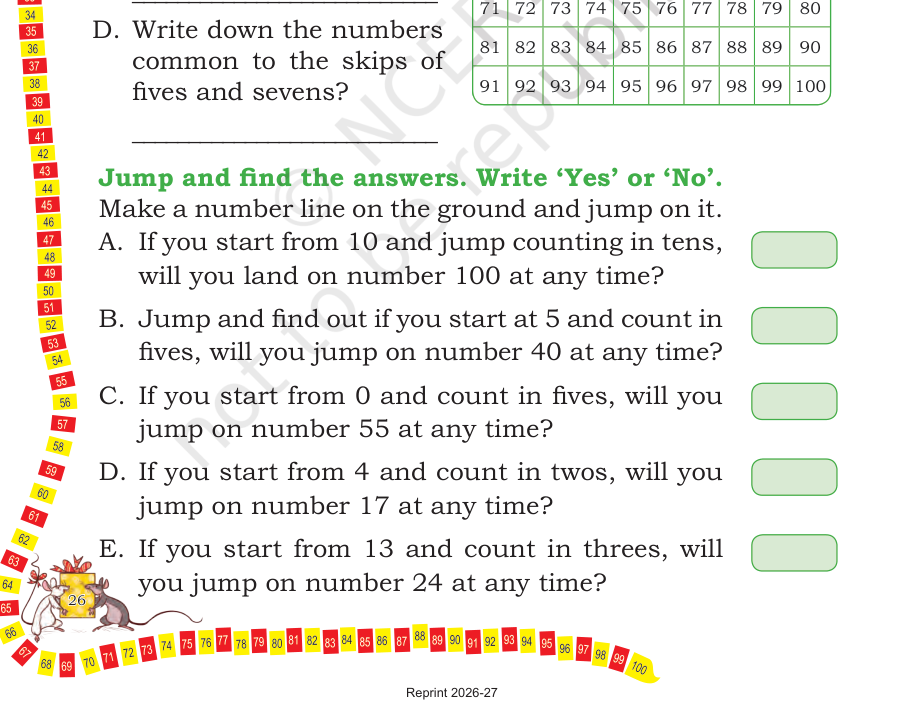
If you start from 10 and jump counting in tens, will you land on number 100 at any time?
Original NCERT question visual - PDF page 4
Solution
Yes (10, 20, 30, … 100).
Question BNCERT PDF page 4
Jump and find out if you start at 5 and count in fives, will you jump on number 40 at any time?
Original NCERT question visual - PDF page 4
Solution
Yes (5, 10, 15, … 40).
Question CNCERT PDF page 4
If you start from 0 and count in fives, will you jump on number 55 at any time?
Original NCERT question visual - PDF page 4
Solution
Yes (0, 5, 10, … 55).
Question DNCERT PDF page 4
If you start from 4 and count in twos, will you jump on number 17 at any time?
Original NCERT question visual - PDF page 4
Solution
No — counting in 2s from 4 gives only even numbers; 17 is odd.
Question ENCERT PDF page 4
If you start from 13 and count in threes, will you jump on number 24 at any time?
Original NCERT question visual - PDF page 4
Solution
No — counting in threes from 13 gives 13, 16, 19, 22, 25 …, so it jumps over 24.
Question 6Fill in the blanksNCERT PDF page 5
Let us jump backward. What comes just before 10? What comes just before 9? Complete the pattern: 10, 9, 8, ____, ____, ____, ____, ____, ____, ____
Original NCERT question visual - PDF page 5
Solution
Just before 10 is 9; just before 9 is 8. Pattern: 10, 9, 8, 7, 6, 5, 4, 3, 2, 1, 0.
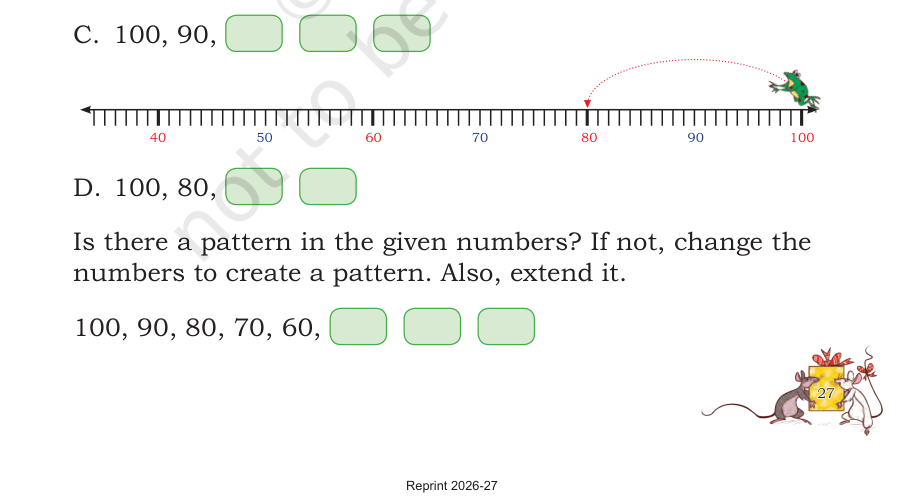
D. 100, 80, ____, ____ Is there a pattern in the given numbers? If not, change the numbers to create a pattern. Also, extend it: 100, 90, 80, 70, 60, ____, ____, ____
Original NCERT question visual - PDF page 5
Solution
D. 100, 80, 60, 40 (take away 20 each time). Yes, 100, 90, 80, 70, 60 is a pattern (take away 10): next 50, 40, 30.
Question ANCERT PDF page 6
Rizwan is counting numbers from 20 onwards. Will he say the number 19 in his count? Explain why?
Original NCERT question visual - PDF page 6
Solution
No. He starts at 20 and counts forwards (21, 22, …), so 19 never comes.
Question BNCERT PDF page 6
Chavi is counting numbers in twos from 10 onwards. Will she say 43? Explain why?
Original NCERT question visual - PDF page 6
Solution
No. Counting in 2s from 10 gives only even numbers; 43 is odd.
Question CNCERT PDF page 6
Mala is counting backwards from 20. How many steps will it take to reach 0? Explain why?
Original NCERT question visual - PDF page 6
Solution
20 steps, because she counts 19, 18, … down to 0, one step each.
Question DNCERT PDF page 6
Viraaj is counting backwards in twos from 20. How many steps will it take to reach 0?
Original NCERT question visual - PDF page 6
Solution
10 steps (20, 18, 16, 14, 12, 10, 8, 6, 4, 2, 0).
Question 5NCERT PDF page 7
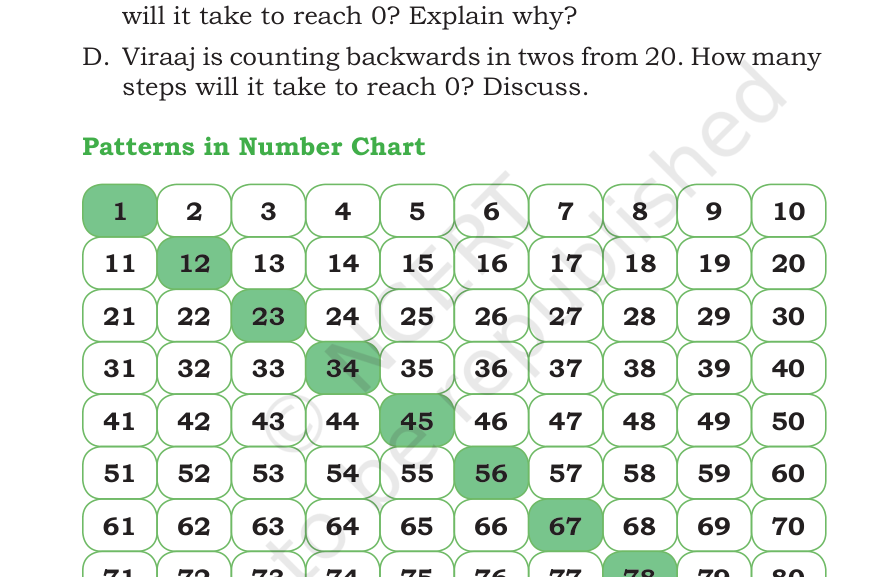
Look at the number chart and write: ___ comes just before 10, ___ just before 20, ___ just before 30, ___ just before 40. Do you see any pattern? Write the pattern. Now look at the numbers coloured green in the number chart: 1, 12, 23, ___, ___, ___, ___, ___, ___, ___. What pattern do you notice?
Original NCERT question visual - PDF page 7
Solution
9 comes just before 10, 19 before 20, 29 before 30, 39 before 40. Pattern: 9, 19, 29, 39, 49, 59, 69, 79, 89, 99 (all end in 9; add 10 each time). Green numbers: 1, 12, 23, 34, 45, 56, 67, 78, 89, 100 (add 11 each time; they go down the chart diagonally).
Question ANCERT PDF page 7
Lakshanya made a number window and placed it on the number chart. A. If the centre of the window is placed on 28, which number will be on the top of it?
Original NCERT question visual - PDF page 7
Solution
On top of 28 is 18 (10 less).
Question BNCERT PDF page 7
B. Which number will be below it?
Original NCERT question visual - PDF page 7
Solution
Below 28 is 38 (10 more).
Question CNCERT PDF page 7
C. Which number will be on its right?
Original NCERT question visual - PDF page 7
Solution
On the right of 28 is 29 (1 more).
Question DNCERT PDF page 7
D. Which number will be on its left?
Original NCERT question visual - PDF page 7
Solution
On the left of 28 is 27 (1 less).
Question ENCERT PDF page 8
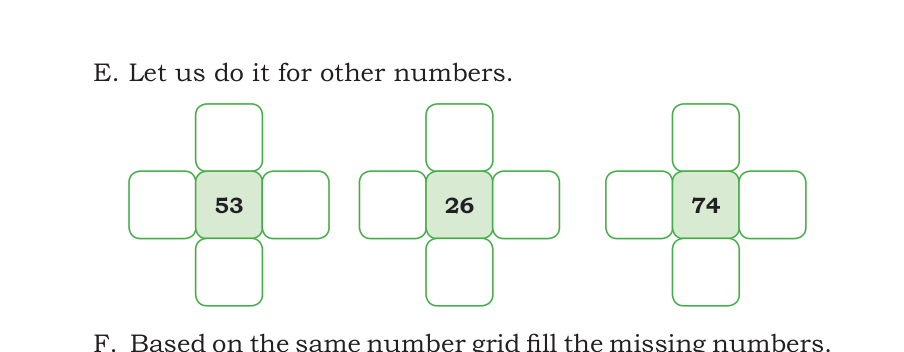
E. Let us do it for other numbers: write the numbers above, below, left and right of 53, 26 and 74.
Original NCERT question visual - PDF page 8
Solution
53: top 43, below 63, right 54, left 52
26: top 16, below 36, right 27, left 25
74: top 64, below 84, right 75, left 73
Question FNCERT PDF page 8
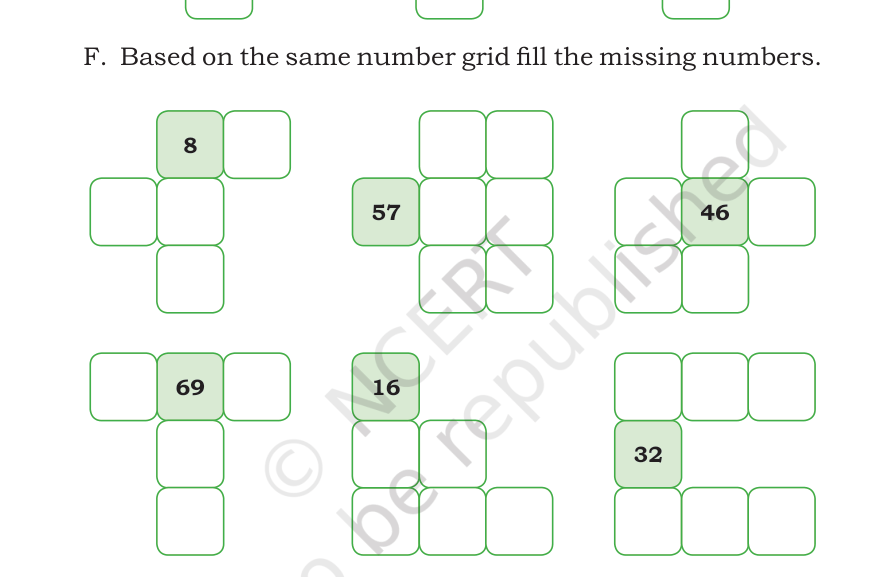
F. Based on the same number grid, fill the missing numbers in the shapes around 8, 57, 46, 69, 16, 32, 65, 36 and 55.
Original NCERT question visual - PDF page 8
Solution
Rule: above = 10 less, below = 10 more, left = 1 less, right = 1 more.
8: right 9; below 18; left of 18 is 17; below 18 is 28.
57: right 58, 59; above them 48, 49; below them 68, 69.
46: above 36, left 45, right 47, below 56.
69: left 68, right 70, below 79, then 89.
16: below 26, 27; then 36, 37, 38.
32: above 22, 23, 24; below 42, 43, 44.
65: left 64; below 75; then 85, 86.
36: below 46, 56; then 57, 58; up from 58: 48, 38.
55: above 44, 45, 46; below 64, 65, 66.
Question 7NCERT PDF page 9
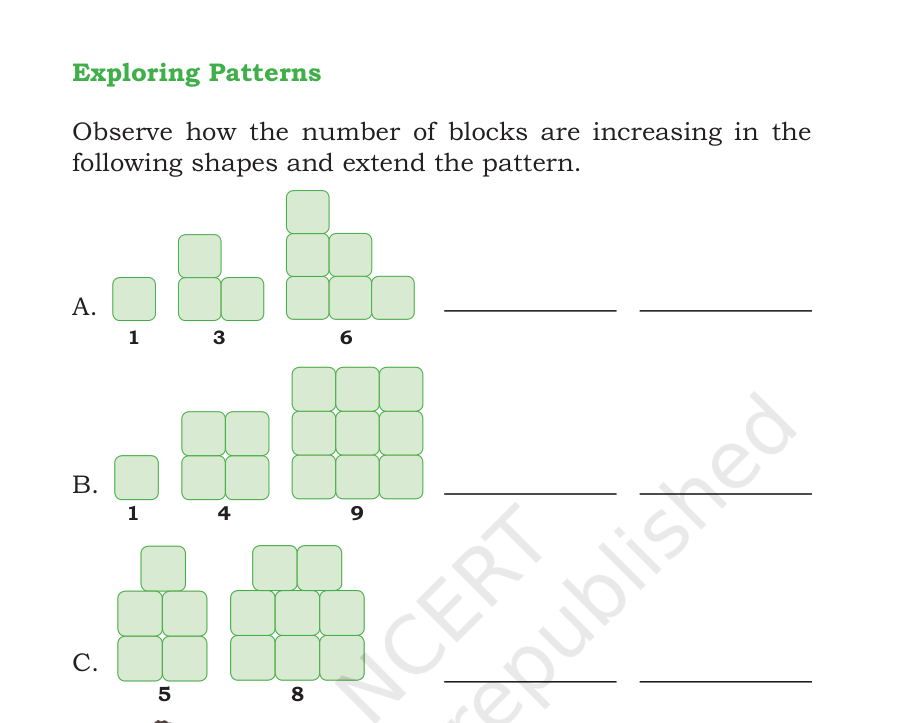
Observe how the number of blocks are increasing in the following shapes and extend the pattern.
Original NCERT question visual - PDF page 9
Solution
A grows by 2, 3, 4, 5 blocks (triangles of blocks); B makes squares (1, 4, 9, 16, 25); C grows by 3 blocks each time. The next numbers are in the cards below.