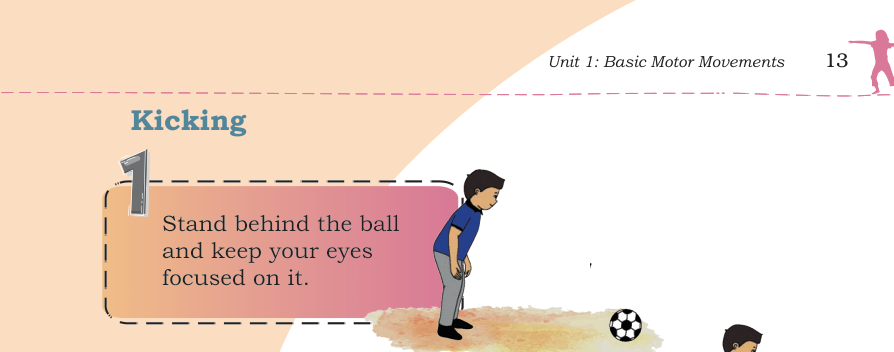
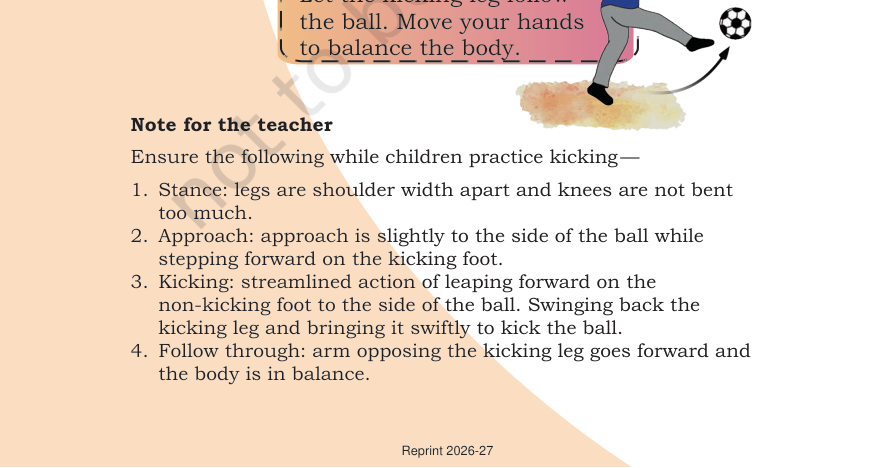
Approach: approach is slightly to the side of the ball while stepping forward on the kicking foot.
Original NCERT question visual - PDF page 2
Answer
Approach the ball slightly from the side.
Question 3NCERT PDF page 2
What is the correct kicking action?
Original NCERT question visual - PDF page 2
Answer
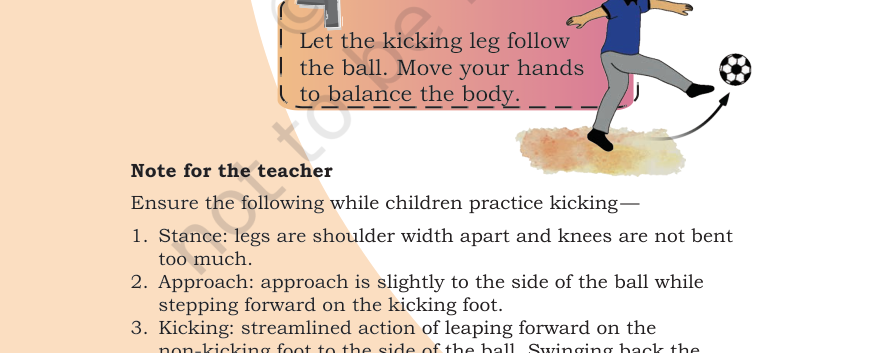
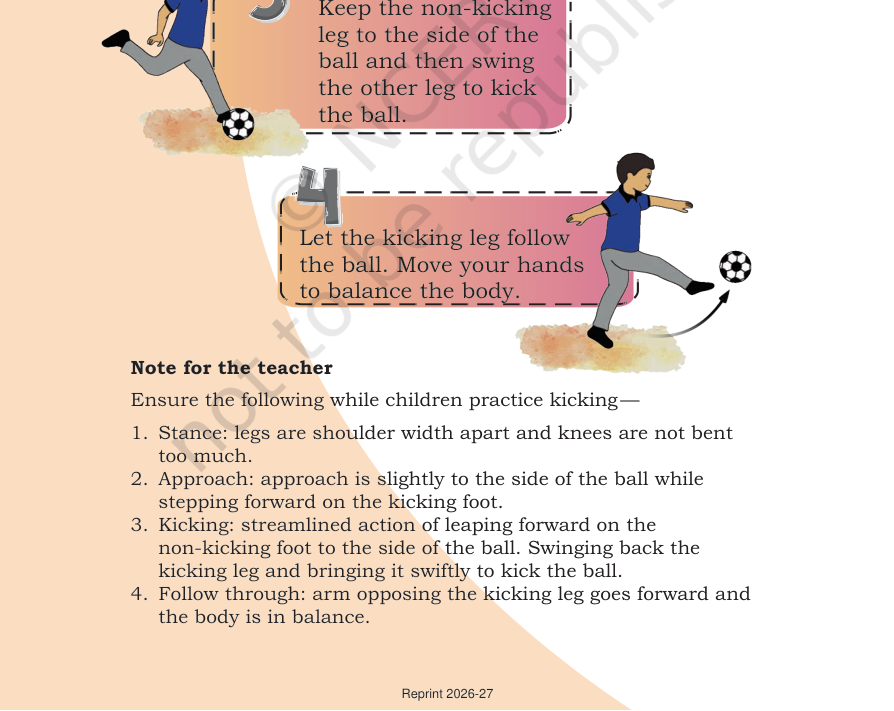
Step forward on the non-kicking foot and place it to the side of the ball. Swing the kicking leg back and bring it forward swiftly to kick the ball.
Question 4NCERT PDF page 2
Follow through: arm opposing the kicking leg goes forward and the body is in balance.
Original NCERT question visual - PDF page 2
Answer
Follow through: the opposite arm goes forward and the body stays balanced.
Question 5NCERT PDF page 3
What are the steps of receiving a ball with the foot?
Original NCERT question visual - PDF page 3
Answer
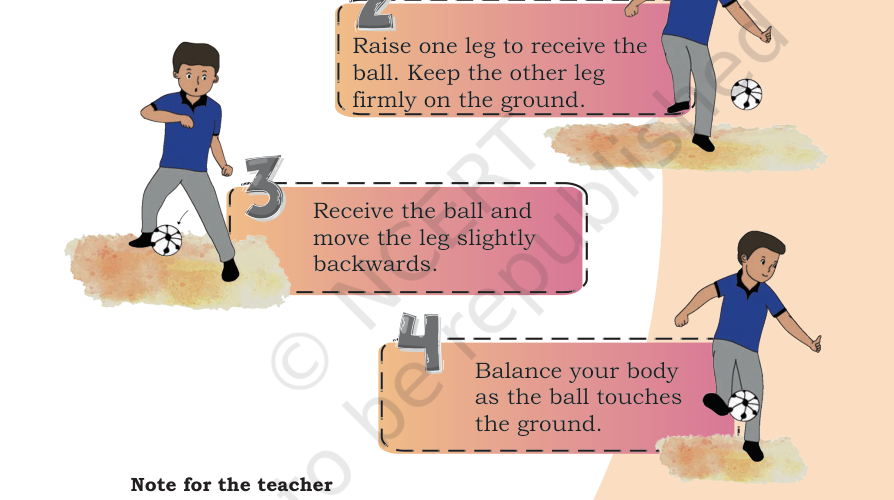
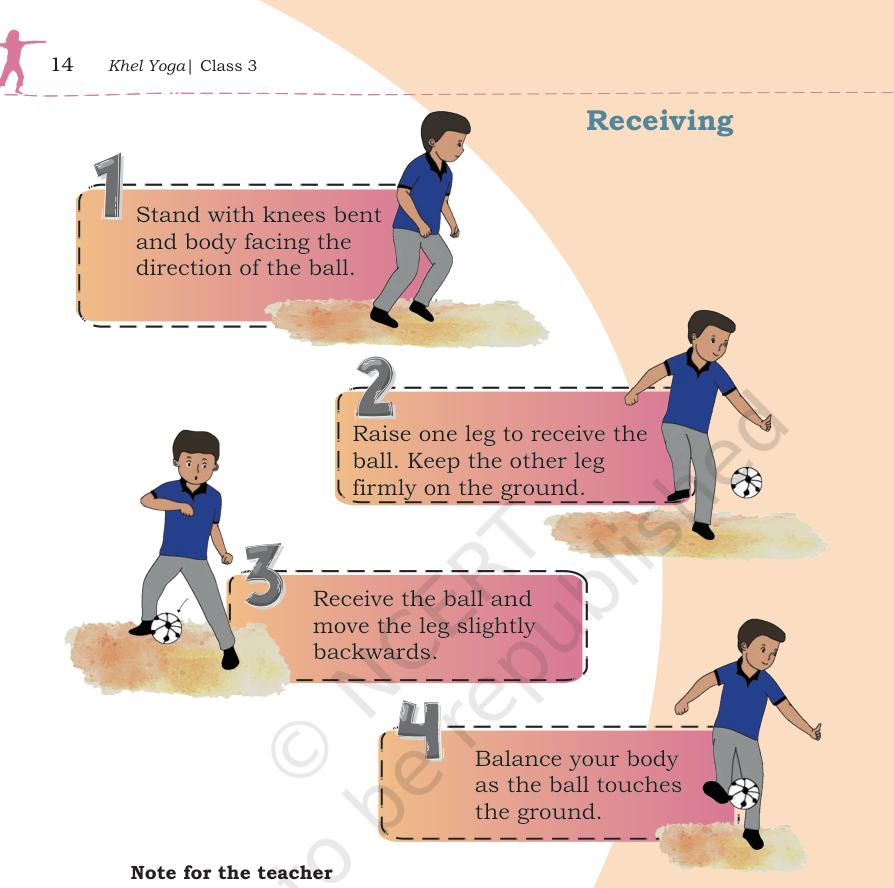
Stand with knees bent and the body facing the direction of the ball.
Raise one leg to receive the ball; keep the other leg firmly on the ground.
Receive the ball and move the leg slightly backwards.
Balance your body as the ball touches the ground.
Question 1NCERT PDF page 3
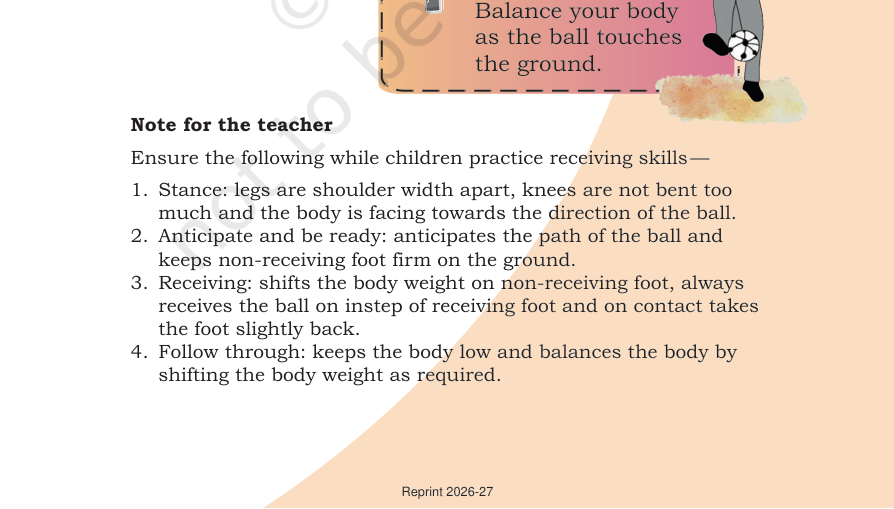
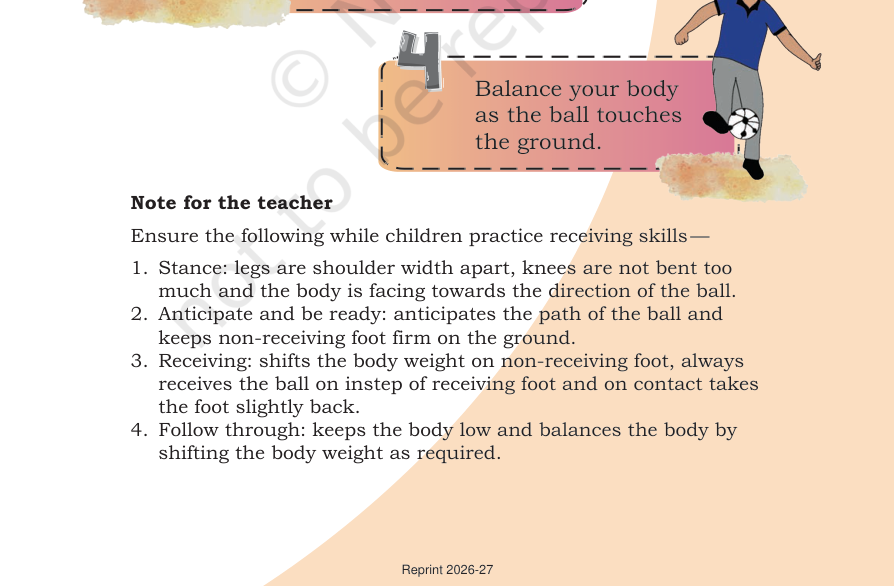
Stance: legs are shoulder width apart, knees are not bent too much and the body is facing towards the direction of the ball.
Original NCERT question visual - PDF page 3
Answer
Stance: feet apart, body facing the ball.
Question 2NCERT PDF page 3
Anticipate and be ready: anticipates the path of the ball and keeps non-receiving foot firm on the ground.
Original NCERT question visual - PDF page 3
Answer
Watch the ball's path and keep the standing foot firm.
Question 3NCERT PDF page 3
Receiving: shifts the body weight on non-receiving foot, always receives the ball on instep of receiving foot and on contact takes the foot slightly back.
Original NCERT question visual - PDF page 3
Answer
Receive on the inside of the foot (instep) and pull the foot back a little on contact.
Question 4NCERT PDF page 3
Follow through: keeps the body low and balances the body by shifting the body weight as required.
Original NCERT question visual - PDF page 3
Answer
Stay low and shift your weight to stay balanced.
Question 5NCERT PDF page 4
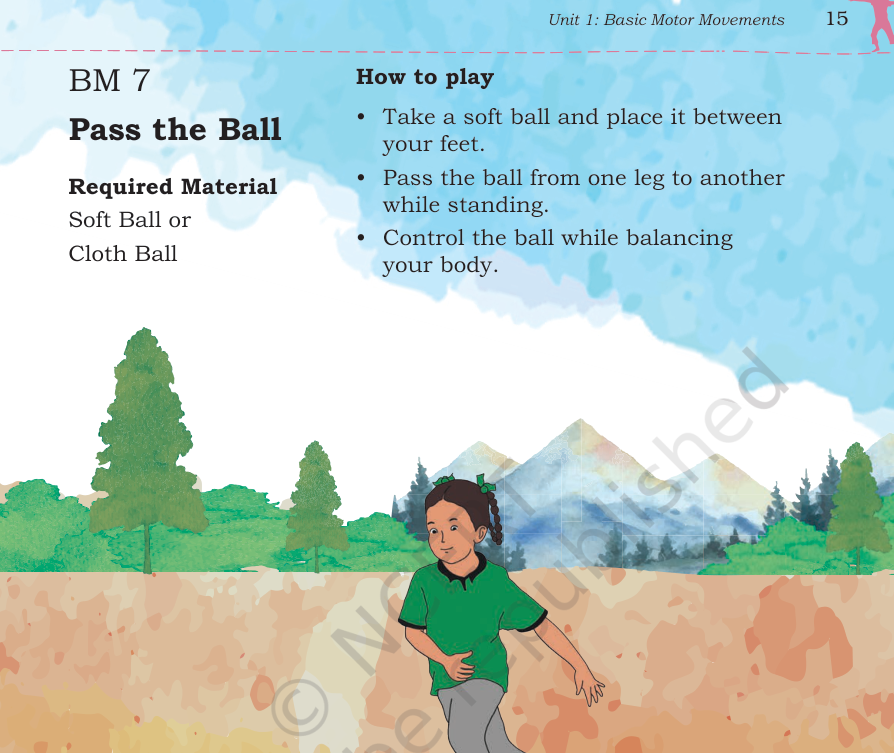
Pass the Ball (BM 7): how do you start?
Original NCERT question visual - PDF page 4
Answer
Take a soft ball and place it between your feet.
Question 6NCERT PDF page 4
Pass the Ball: what do you do next, and what material is needed?
Original NCERT question visual - PDF page 4
Answer
Pass the ball from one leg to the other while standing. Material: a soft ball or cloth ball.
Question 7NCERT PDF page 4
Pass the Ball: what is the last step? Give the variations and the purpose of the activity.
Original NCERT question visual - PDF page 4
Answer
Last step: control the ball while balancing your body.
Variations: increase the distance between the feet; walk, jog, run or side-step while passing the ball from one leg to the other.
Purpose: to learn transferring skills, imitation and anticipation.
Question 8NCERT PDF page 5
Shadow Ball (BM 8): how do you begin?
Original NCERT question visual - PDF page 5
Answer
Take a soft ball and pair up with a classmate.
Question 9NCERT PDF page 5
Shadow Ball: how is it played?
Original NCERT question visual - PDF page 5
Answer
One partner takes the lead and walks ahead dribbling the ball while the other follows. On the blow of the whistle, both face each other and kick the ball towards the partner. Material: a soft ball or cloth ball.
Question 10NCERT PDF page 5
Shadow Ball: what happens next? Give the variation and the purpose of the game.
Original NCERT question visual - PDF page 5
Answer
The partners change roles and continue.
Variation: use the weaker leg to hit the ball.
Purpose: to develop coordination and emotional control.
Question 11NCERT PDF page 6
Flick the Ball (BM 9): how do you begin?
Original NCERT question visual - PDF page 6
Answer
Take a soft ball and find a partner from your class.
Question 12NCERT PDF page 6
Flick the Ball: how do you flick the ball, and what material is needed?
Original NCERT question visual - PDF page 6
Answer
Stand facing your partner and flick the ball up using the top of your foot. Material: a soft ball or cloth ball.
Question 13NCERT PDF page 6
Flick the Ball: what does the partner do?
Original NCERT question visual - PDF page 6
Answer
When one player flicks the ball, the partner catches it and flicks it back.
Question 14NCERT PDF page 6
Flick the Ball: which legs should you use? Give the variations and the purpose of the activity.
Original NCERT question visual - PDF page 6
Answer
Try to use alternate legs (left and right) to flick up the ball.
Variations: hit a target while flicking the ball; flick the ball twice or thrice before catching it.
Purpose: to develop the small muscles used in the flicking action.
Question 15NCERT PDF page 7
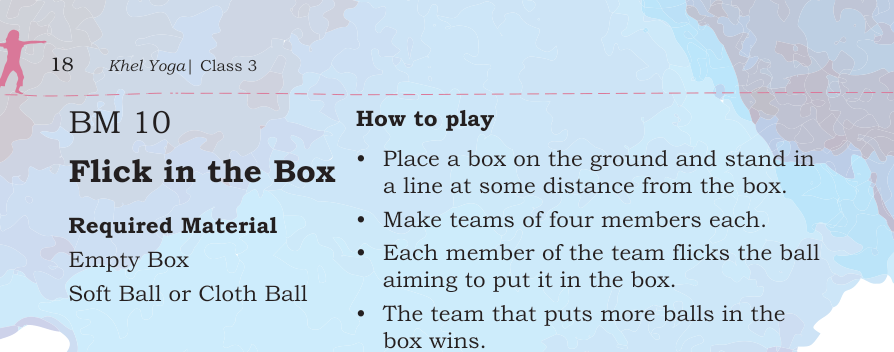
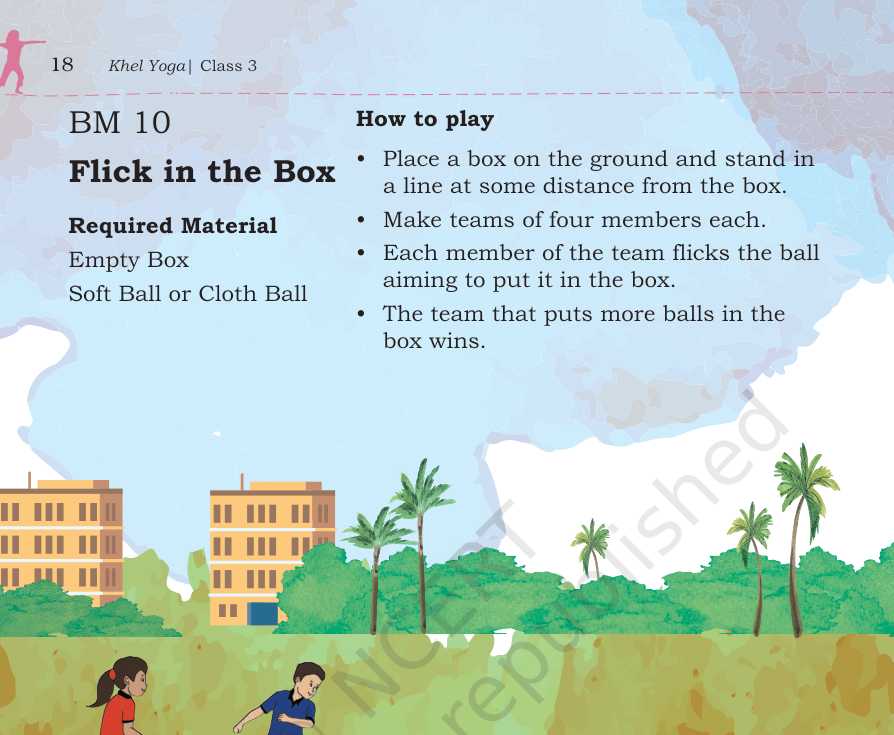
Flick in the Box (BM 10): how is the game set up?
Original NCERT question visual - PDF page 7
Answer
Place a box on the ground. The players stand in a line at some distance from the box.
Question 16NCERT PDF page 7
Flick in the Box: how many members are in each team, and what material is needed?
Original NCERT question visual - PDF page 7
Answer
Each team has four members. Material: an empty box and a soft ball or cloth ball.
Question 17NCERT PDF page 7
Flick in the Box: what does each player try to do?
Original NCERT question visual - PDF page 7
Answer
Each member of the team flicks the ball with the foot, aiming to put it in the box.
Question 18NCERT PDF page 7
Flick in the Box: which team wins? Give the variations and the purpose of the game.
Original NCERT question visual - PDF page 7
Answer
Winner: the team that puts more balls in the box.
Variations: place boxes at different distances and give different scores for different boxes; use a hoop to make the target area bigger.
Purpose: to develop a sense of distance and the power needed to flick an object to a certain distance and height.
Question 19NCERT PDF page 8
Monkey in the Middle (BM 11): how is it played?
Original NCERT question visual - PDF page 8
Answer
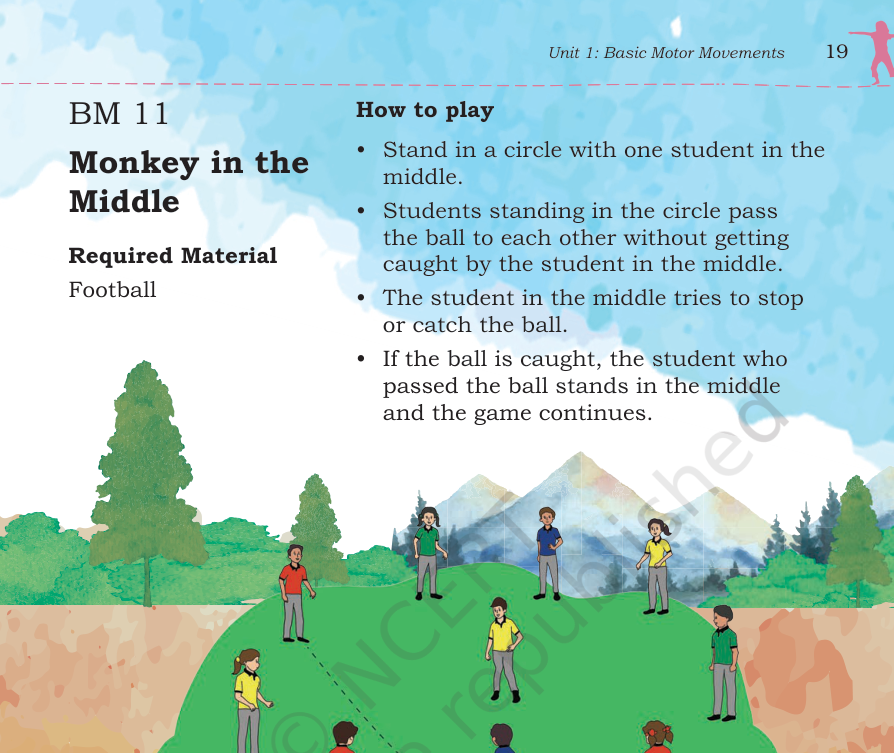
Students stand in a circle with one student in the middle. The students in the circle pass the ball to each other without letting the student in the middle catch it, while the middle student tries to stop or catch the ball. Material: a football.
Question 20NCERT PDF page 8
Monkey in the Middle: what happens if the ball is caught? Give the variations and the purpose of the game.
Original NCERT question visual - PDF page 8
Answer
If the ball is caught, the student who passed it goes to the middle and the game continues.
Variations: have two students in the middle; flick the ball or use the head or shoulders to pass it.
Purpose: fun-filled learning and development of teamwork and silent (hidden) communication.
Question 21NCERT PDF page 9
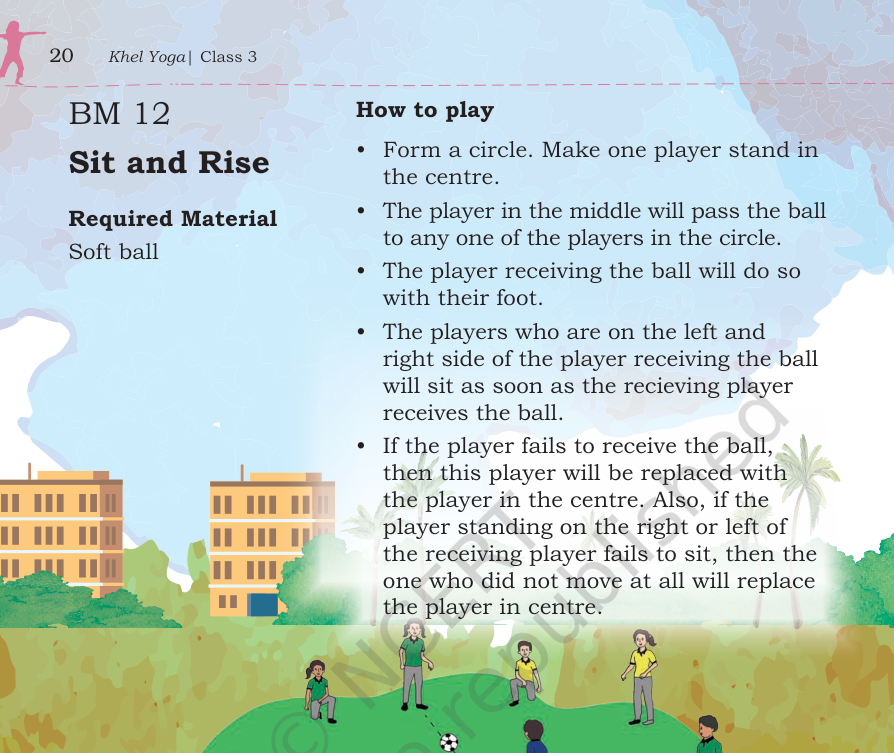
Sit and Rise (BM 12): how do the players stand?
Original NCERT question visual - PDF page 9
Answer
The players form a circle, and one player stands in the centre.
Question 22NCERT PDF page 9
Sit and Rise: who passes the ball, and what material is needed?
Original NCERT question visual - PDF page 9
Answer
The player in the centre passes the ball to any one of the players in the circle. Material: a soft ball.
Question 23NCERT PDF page 9
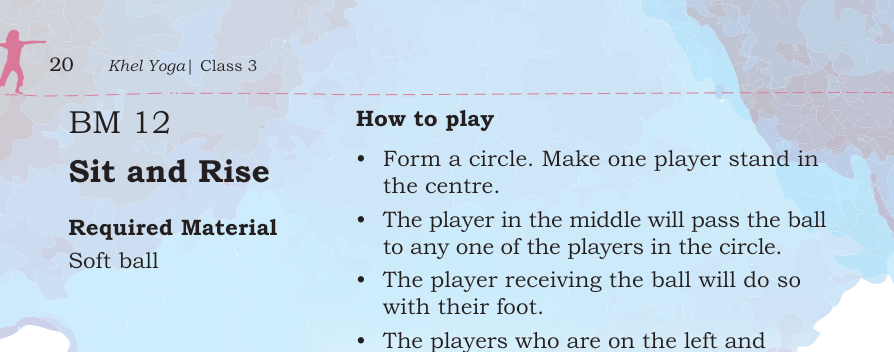
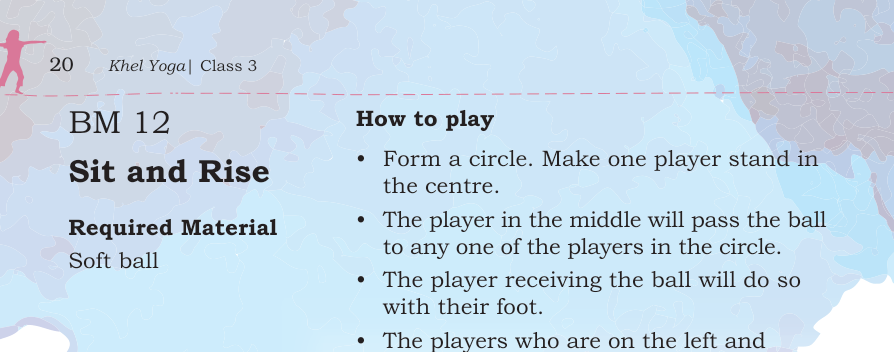
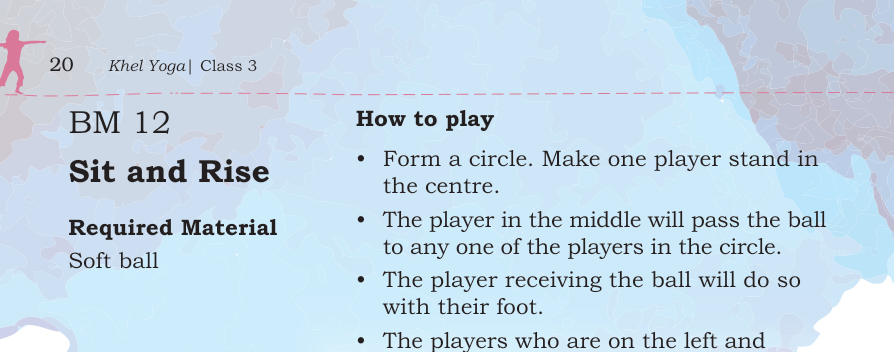
• The player receiving the ball will do so with their foot.
Original NCERT question visual - PDF page 9
Answer
The receiver stops the ball with the foot.
Question 24NCERT PDF page 9
• The players who are on the left and right side of the player receiving the ball will sit as soon as the recieving player receives the ball.
Original NCERT question visual - PDF page 9
Answer
Players on the receiver's left and right must sit immediately.
Question 25NCERT PDF page 9
Sit and Rise: when does a player swap places with the centre player? Give the variation and the purpose of the game.
Original NCERT question visual - PDF page 9
Answer
If the receiving player fails to receive the ball, that player replaces the centre player.
If a player on the left or right of the receiver fails to sit, the one who did not move replaces the centre player.
Variation: receive the ball with your head or chest.
Purpose: thinking skills and the ability to guess what will happen next from the actions of others.