Relax your eyes with Palming Our eyes are constantly seeing things; they get tired. We should regularly relax them. Simple palming procedure
Original NCERT question visual - PDF page 14
Answer
Our eyes work all day, so relax them regularly with palming.
Question 1NCERT PDF page 14
Rub both palms until they become warm.
Original NCERT question visual - PDF page 14
Answer
Rub your palms together until warm.
Question 2NCERT PDF page 14
Make a cup shape of the palms and place them gently over the eyes. (Do not put pressure on the eyeballs.)
Original NCERT question visual - PDF page 14
Answer
Cup the palms gently over your eyes without pressing.
Question 3NCERT PDF page 14
Keep the eyes closed.
Original NCERT question visual - PDF page 14
Answer
Keep the eyes closed.
Question 4NCERT PDF page 14
Keep the palms on eyes for 10–15 seconds, then gently remove the hands.
Original NCERT question visual - PDF page 14
Answer
Hold for 10–15 seconds, then remove the hands slowly.
Question 1NCERT PDF page 15
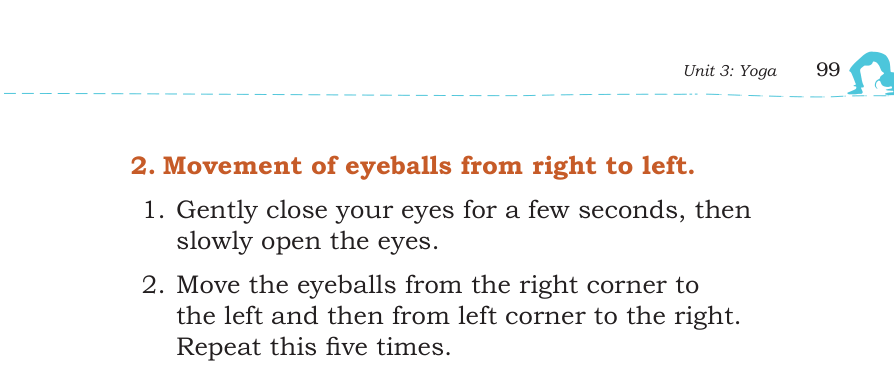
Gently close your eyes for a few seconds, then slowly open the eyes.
Original NCERT question visual - PDF page 15
Answer
Close your eyes for a few seconds, then open slowly.
Question 2NCERT PDF page 15
Move the eyeballs from the right corner to the left and then from left corner to the right. Repeat this five times.
Original NCERT question visual - PDF page 15
Answer
Move the eyes right to left and back, five times.
Question 3NCERT PDF page 15
Do simple palming after the practice.
Original NCERT question visual - PDF page 15
Answer
Do palming afterwards.
Question 2NCERT PDF page 15
Move the eyeballs fully down and then slowly move them up. Repeat this five times .
Original NCERT question visual - PDF page 15
Answer
Move the eyes fully down, then slowly up, five times.
Question 2NCERT PDF page 16
Move the eyeballs up on the right corner and down on the left corner. Repeat the practice thrice.
Original NCERT question visual - PDF page 16
Answer
Move eyes up-right to down-left, three times.
Question 3NCERT PDF page 16
Slowly open the eyes and move the eyeballs left up and right down. Repeat the practice thrice.
Original NCERT question visual - PDF page 16
Answer
Move eyes up-left to down-right, three times.
Question 4NCERT PDF page 16
Do simple palming after the practice.
Original NCERT question visual - PDF page 16
Answer
Do palming afterwards.
Question 2NCERT PDF page 17
Move the eyeballs fully to the right, then take them down, then move to the left and then up. This forms a circle. Slowly move the eyeballs in a circle five times.
Original NCERT question visual - PDF page 17
Answer
Rotate the eyes in a circle — right, down, left, up — five times.
Question 3NCERT PDF page 17
Relax the eyes with simple palming.
Original NCERT question visual - PDF page 17
Answer
Relax with palming.
Question 4NCERT PDF page 17
Now let us rotate the eyes in the other direction. Move the eyeballs to the full left, then take them down, then move them to the right and then up. This completes the circle. Slowly move the eyeballs in the circle five times.
Original NCERT question visual - PDF page 17
Answer
Rotate in the other direction five times.
Question 5NCERT PDF page 17
Close your eyes for a while and then slowly open them.
Original NCERT question visual - PDF page 17
Answer
Close the eyes for a while, then open slowly.
Question 6NCERT PDF page 17
Relax the eyes with simple palming. Note for the teacher Encourage the children to keep their backs erect. There should be only eyeball movement in this exercise and no neck movement.
Original NCERT question visual - PDF page 17
Answer
Relax with palming. Move only the eyes, not the neck.
Question 7NCERT PDF page 18
Do you like to play and enjoy with your friends? What do we learn through the Krida Yoga games?
Original NCERT question visual - PDF page 18
Answer
Yes! Through Krida Yoga games such as Chain of Names, Mind Game, Japa-Tapa, Power of Breath, Rishi Patanjali Says, Shabda Grahi and Sundar-Uttam, we learn about different aspects of Yoga like memory, attention, breath control and awareness.
Question 8NCERT PDF page 19
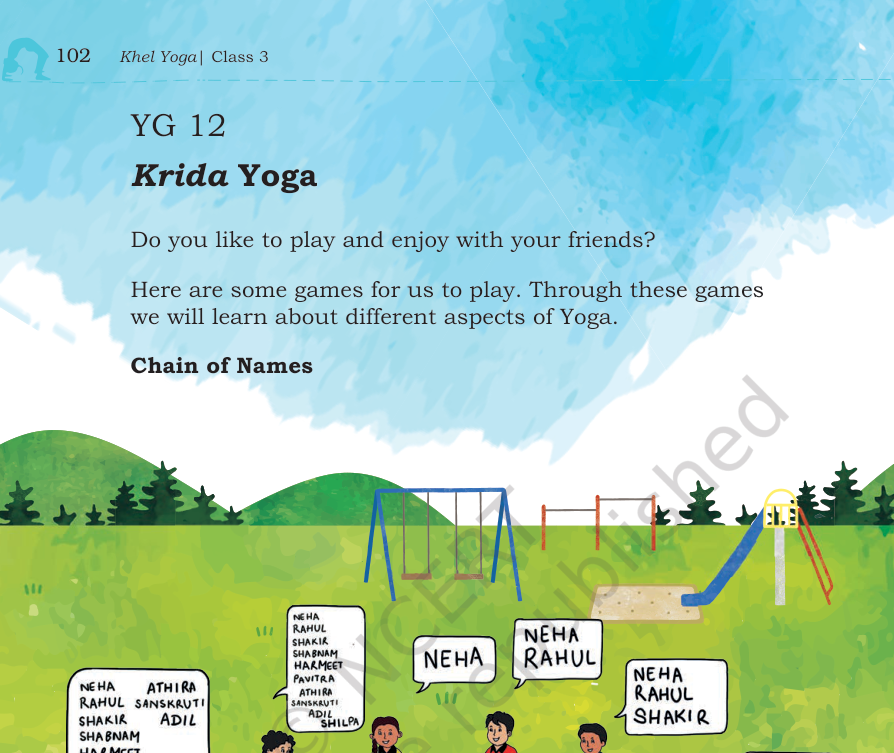
• Students sit in a circle and say their name aloud along with the names of previous students to create a garland of names.
Original NCERT question visual - PDF page 19
Answer
Chain of Names: sit in a circle and build a garland of names.
Question 9NCERT PDF page 19
Chain of Names: how is the garland of names made? What is the purpose of the game?
Original NCERT question visual - PDF page 19
Answer
The first student says her/his name. The next student repeats the first name and adds her/his own. Each student says all the earlier names and then adds her/his own, till everyone has recalled all the names. Purpose: to improve memory and awareness.
Question 10NCERT PDF page 19
• Use the names of fruits or vegetables.
Original NCERT question visual - PDF page 19
Answer
Variation: use fruit or vegetable names.
Question 11NCERT PDF page 19
• Say the names in reverse order.
Original NCERT question visual - PDF page 19
Answer
Variation: say the names in reverse order.
Question 12NCERT PDF page 19
• Say the names with eyes closed.
Original NCERT question visual - PDF page 19
Answer
Variation: say them with eyes closed.
Question 13NCERT PDF page 20
• Students sit in a circle and count the numbers aloud in a sequence. At every multiple of five each student on their turn says “Bharat” instead of a number.
Original NCERT question visual - PDF page 20
Answer
Bharat game: count in turn; say "Bharat" instead of every multiple of 5.
Question 14NCERT PDF page 20
• Students who do not say “Bharat” on their turn at a multiple of five are out.
Original NCERT question visual - PDF page 20
Answer
Whoever forgets to say "Bharat" is out.
Question 15NCERT PDF page 20
Mind Game: how long does the counting go on, and what is the purpose of the game?
Original NCERT question visual - PDF page 20
Answer
The counting continues around the circle as long as the children enjoy it. Purpose: to improve concentration and awareness.
Question 16NCERT PDF page 20
• Use different multiples and different names.
Original NCERT question visual - PDF page 20
Answer
Variation: use other multiples and words.
Question 17NCERT PDF page 21
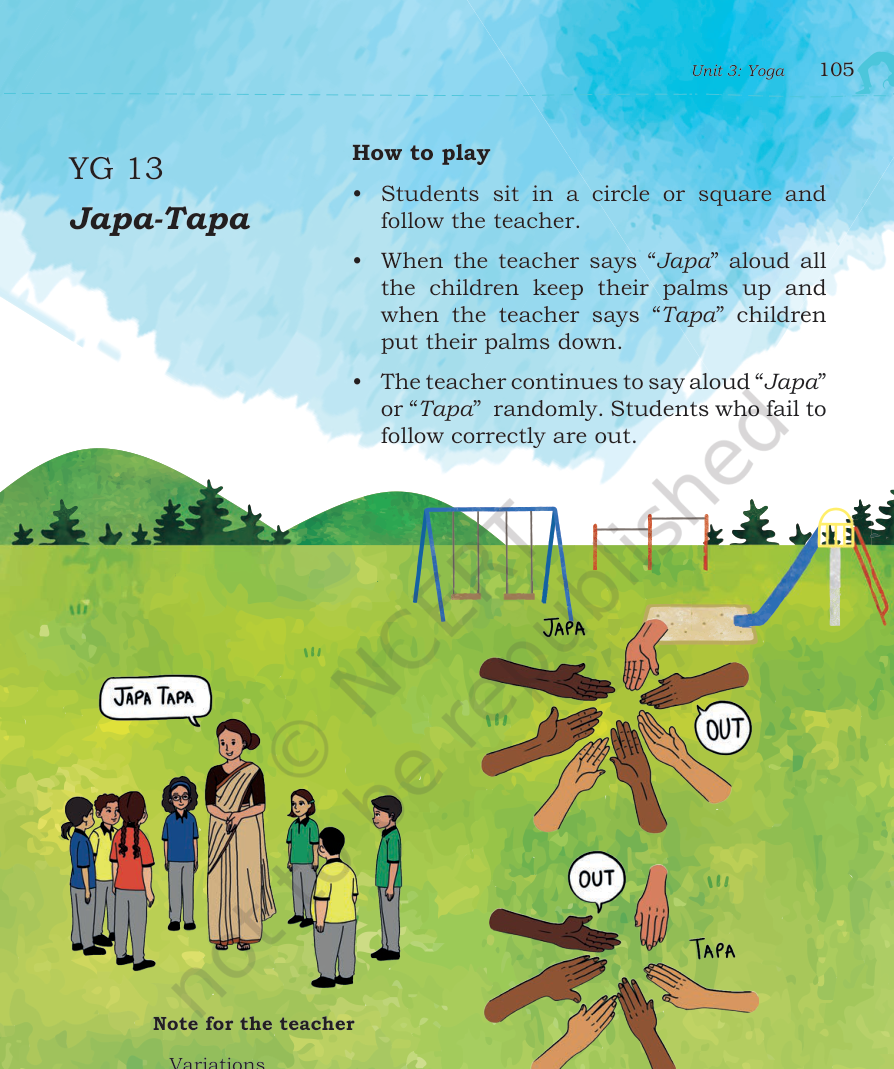
• Students sit in a circle or square and follow the teacher.Japa-Tapa
Original NCERT question visual - PDF page 21
Answer
Japa-Tapa: sit in a circle and follow the teacher.
Question 18NCERT PDF page 21
• When the teacher says “Japa” aloud all the children keep their palms up and when the teacher says “Tapa” children put their palms down.
Original NCERT question visual - PDF page 21
Answer
"Japa" = palms up; "Tapa" = palms down.
Question 19NCERT PDF page 21
Japa-Tapa: who is out?
Original NCERT question visual - PDF page 21
Answer
The teacher keeps saying 'Japa' or 'Tapa' in any order. Students who do not follow correctly (palms up for Japa, palms down for Tapa) are out.
Question 20NCERT PDF page 21
• Making a fist and releasing the fist.
Original NCERT question visual - PDF page 21
Answer
Variation: make and release a fist.
Question 21NCERT PDF page 21
• Elbow extension and flexion.
Original NCERT question visual - PDF page 21
Answer
Variation: bend and straighten the elbows.
Question 22NCERT PDF page 21
• Instead of Japa-Tapa, use Lava-Kusha, Nala-Nila, etc.
Original NCERT question visual - PDF page 21
Answer
Variation: use Lava-Kusha or Nala-Nila.
Question 23NCERT PDF page 22
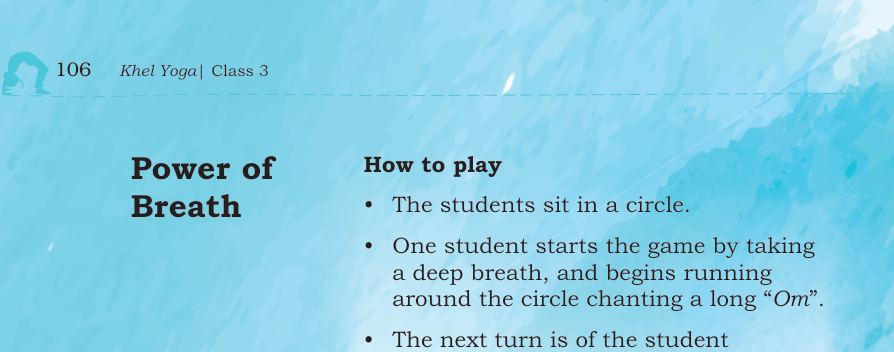
• One student starts the game by taking a deep breath, and begins running around the circle chanting a long “Om”.
Original NCERT question visual - PDF page 22
Answer
One student takes a deep breath and runs around the circle chanting a long "Om".
Question 24NCERT PDF page 22
Power of Breath: whose turn is next, and what is the purpose of the game?
Original NCERT question visual - PDF page 22
Answer
The next turn is of the student sitting where the first student finishes chanting 'Om'. The game goes on till everyone has had a turn. Purpose: to train the voice and increase the length of the breath.
Question 25NCERT PDF page 23
Rishi Patanjali Says: how is the game played?
Original NCERT question visual - PDF page 23
Answer
Students stand in a circle and follow the teacher's instructions only when the instruction begins with 'Patanjali says'. Students who act on an instruction without 'Patanjali says' are out.
Question 26NCERT PDF page 23
• Use Netaji instead of Patanjali.
Original NCERT question visual - PDF page 23
Answer
Variation: use "Netaji says".
Question 27NCERT PDF page 23
• Eye exercises like opening and closing the eyes.
Original NCERT question visual - PDF page 23
Answer
Variation: eye exercises like opening and closing eyes.
Question 28NCERT PDF page 23
• Postures like Tadasana, Utkatasana, Padahastasana.
Original NCERT question visual - PDF page 23
Answer
Variation: postures like Tadasana, Utkatasana, Padahastasana.
Question 29NCERT PDF page 24
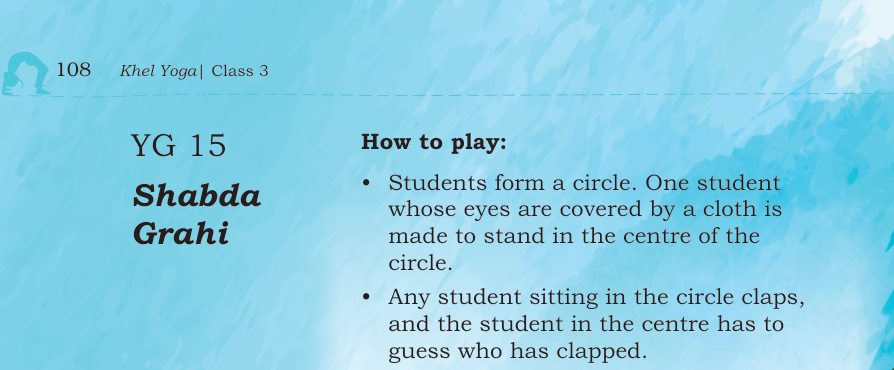
Shabda Grahi: how does the game begin?
Original NCERT question visual - PDF page 24
Answer
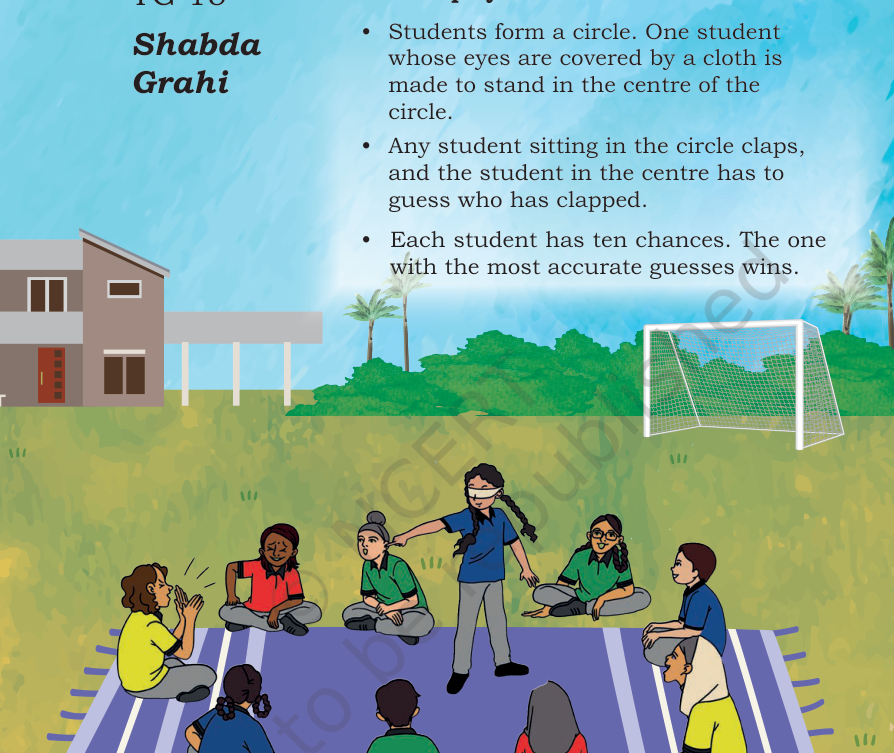
Students form a circle. One student, whose eyes are covered with a cloth, stands in the centre of the circle.
Question 30NCERT PDF page 24
• Any student sitting in the circle claps, and the student in the centre has to guess who has clapped.
Original NCERT question visual - PDF page 24
Answer
Someone claps; the centre student guesses who.
Question 31NCERT PDF page 24
Shabda Grahi: how many chances does each student get, and who wins?
Original NCERT question visual - PDF page 24
Answer
Each student gets ten chances. The one with the most correct guesses wins. The teacher may also ask students to make a sound instead of clapping.
Question 32NCERT PDF page 25
Sundar-Uttam: how does the game begin?
Original NCERT question visual - PDF page 25
Answer
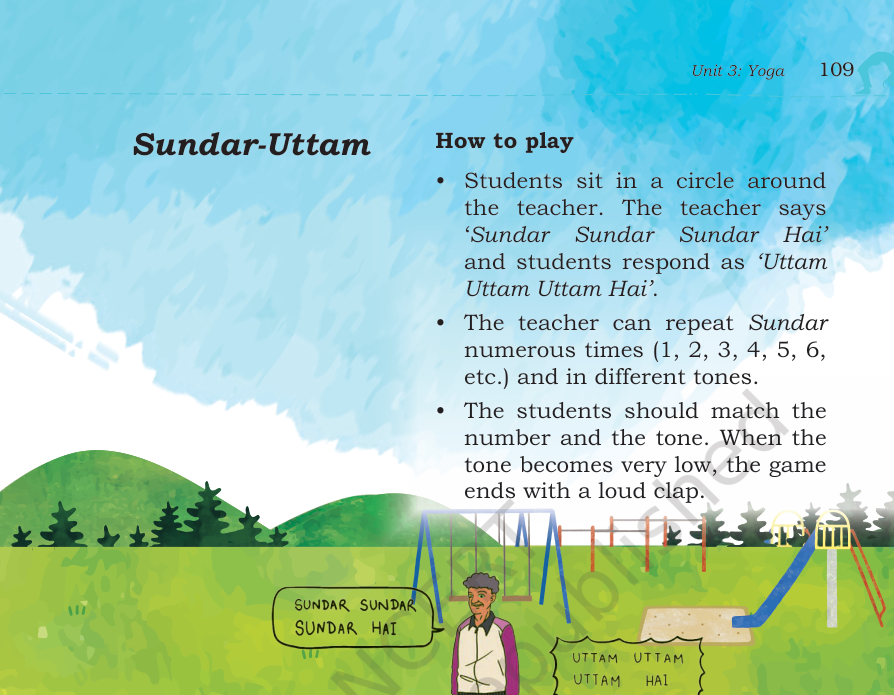
Students sit in a circle around the teacher. The teacher says 'Sundar Sundar Sundar Hai', and the students reply 'Uttam Uttam Uttam Hai'.
Question 33NCERT PDF page 25
• The teacher can repeat Sundar numerous times (1, 2, 3, 4, 5, 6, etc.) and in different tones.
Original NCERT question visual - PDF page 25
Answer
The teacher changes how many times and in what tone.
Question 34NCERT PDF page 25
Sundar-Uttam: what must the students do, and how does the game end?
Original NCERT question visual - PDF page 25
Answer
Students match the count and tone; the game ends with a loud clap.
Question 35NCERT PDF page 27
Teachers' section: how much time does NCFSE 2023 suggest for Physical Education and Well-being, and how are the activities planned?
Original NCERT question visual - PDF page 27
Answer
NCFSE 2023 lists Physical Education and Well-being as a separate subject and suggests at least 90 hours (about 135 periods of 40 minutes each). The motor movement activities, games and Yoga sessions are planned side by side through the year, and teachers may adjust the suggested plan to their needs.
Question 36NCERT PDF page 28
How is the Khel Yoga (Class 3) book organised?
Original NCERT question visual - PDF page 28
Answer
The book is divided into 3 units — Basic Motor Movements, Our Games and Yoga. Each unit has chapters and activities.