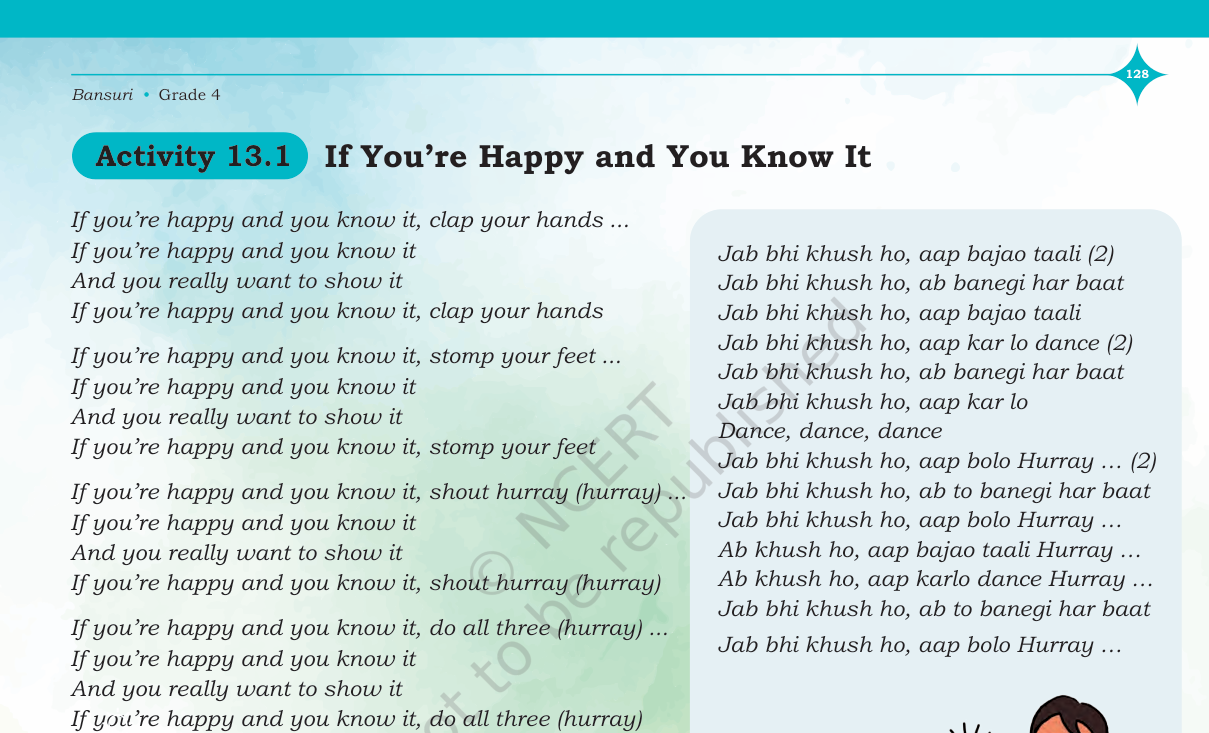
Activity 13.1: Sing the song “If You’re Happy and You Know It” (clap your hands, stomp your feet, shout hurray, do all three). Can you write the words for this song in your language? Work with your friends to write and then sing it together.
Original NCERT question visual - PDF page 2
Answer
The book itself gives a Hindi version: “Jab bhi khush ho, aap bajao taali … Jab bhi khush ho, aap kar lo dance … Jab bhi khush ho, aap bolo Hurray.”
(sample answer) In our language we keep the same tune and the same actions in each verse: clap your hands, stomp your feet, shout hurray, and in the last verse do all three.
Question 2NCERT PDF page 3
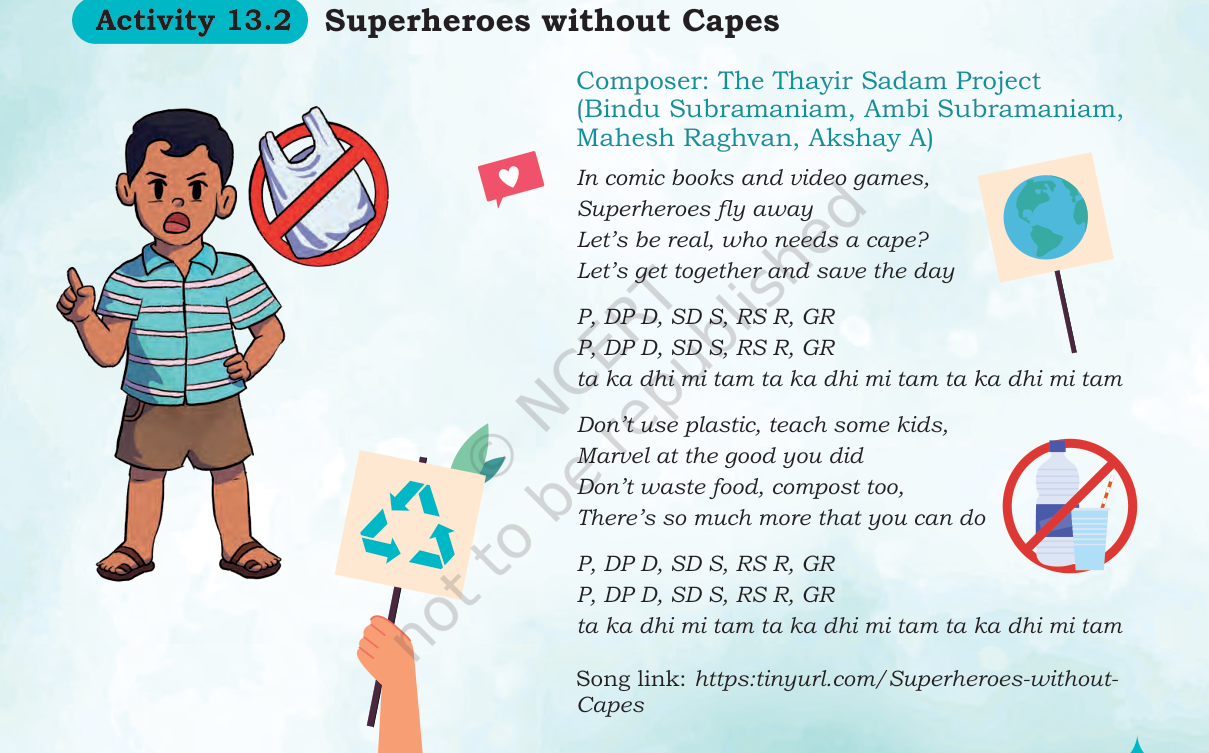
Activity 13.2: Learn and sing the song “Superheroes without Capes”. Between the verses, sing the notes “P, DP D, SD S, RS R, GR” and recite “ta ka dhi mi tam”. What does the song ask us to do to be real superheroes?
Original NCERT question visual - PDF page 3
Answer
The song says we do not need a cape to be a superhero. We can save the day by not using plastic, teaching some kids, not wasting food and making compost. After each verse we sing the notes P, DP D, SD S, RS R, GR twice and recite “ta ka dhi mi tam” three times.
Question 3NCERT PDF page 5
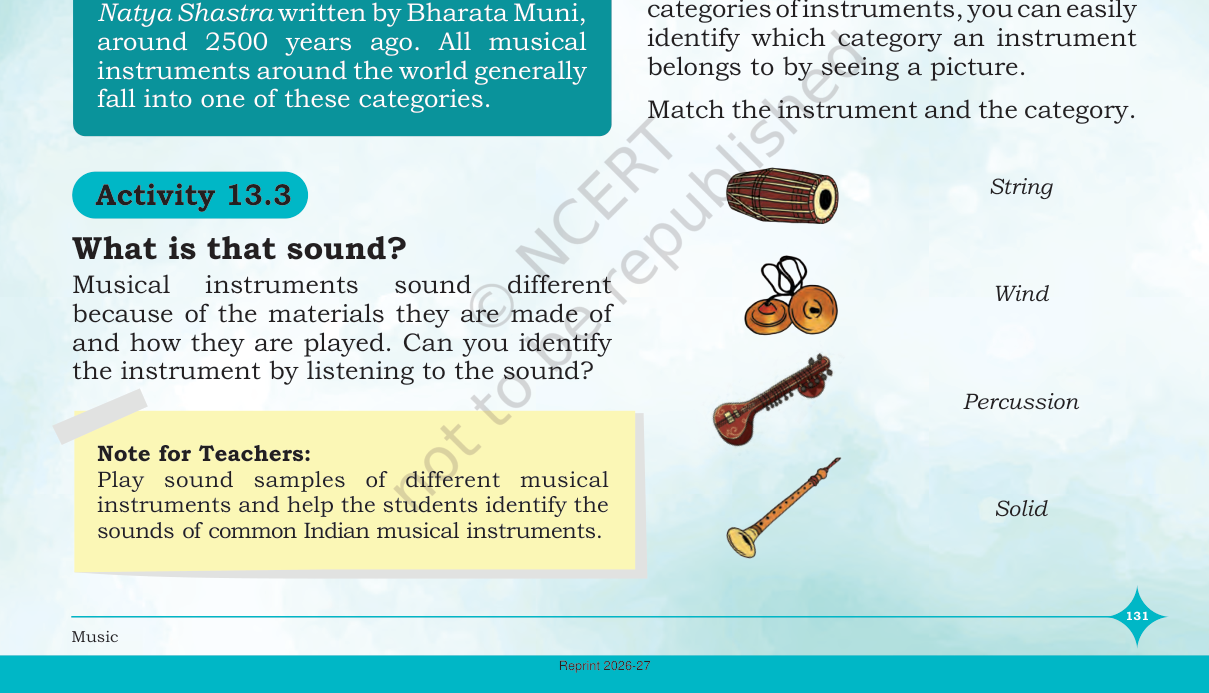
Activity 13.4 — Classify the Instrument: Match each instrument in the picture (a dholak drum, a pair of cymbals, a sitar-like string instrument, and a shehnai) with its category: String, Wind, Percussion, Solid.
Original NCERT question visual - PDF page 5
Answer
Dholak (drum) — Percussion (a stretched membrane vibrates; Avanaddha vadya)
Sitar / veena — String (the string vibrates; Tata vadya)
Shehnai — Wind (the air inside a tube vibrates; Sushira vadya)
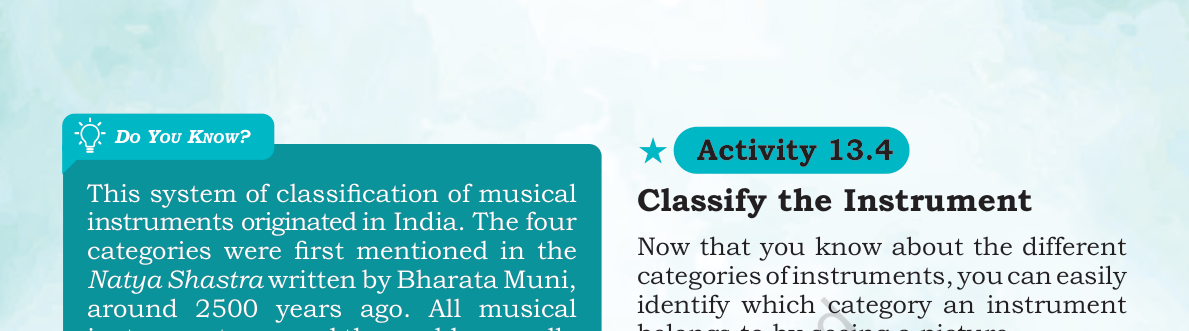
This four-way classification began in India; it was first mentioned in the Natya Shastra by Bharata Muni, around 2500 years ago.
Question 4NCERT PDF page 5
Activity 13.3 — What is that sound? Musical instruments sound different because of the materials they are made of and how they are played. Can you identify the instrument by listening to the sound?
Original NCERT question visual - PDF page 5
Answer
All sound is made by vibrations, and each kind of instrument vibrates in a different way, so each sounds different.
(sample answer) A twangy, plucked sound — veena or sitar (string). A soft, breathy sound — bansuri (wind). A deep “dha dhin” beat — tabla (percussion). A bright ringing “chhan” — manjira (solid).
Question 5NCERT PDF page 6
Activity 13.5 — Exploring Musical Instruments: Can you name the different musical instruments you know? Bring a musical instrument to the class. Observe its shape, size, and colour. Does the instrument have decorative elements like carvings or paint? Does it have a label that shows its place of origin or the name of the manufacturer? Gently touch and feel the instrument. Describe its parts in your own words. Find an audio or video recording of the instrument being played and listen carefully to its sound. Draw a picture of the instrument.
Original NCERT question visual - PDF page 6
Answer
(sample answer) Instruments I know: tabla, harmonium, bansuri, dholak, veena and guitar. I brought a dholak.
It is a barrel-shaped wooden drum, about as long as my arm, brown with red and yellow painted bands.
It has painted stripes but no carvings, and no maker’s label.
Parts: a hollow wooden body, a skin stretched over each end, and ropes with metal rings that tighten the skins.
In a recording, one side gives a deep “dhum” and the other side a sharp “ta”. I drew the dholak lying on its side.
Question 6NCERT PDF page 7
Activity 13.6 — Make Your Own Instrument (harmonica). You need 2 popsicle sticks, 1 long strip of paper, 2 rubber bands and 1 toothpick. How do you make it, and how do you play it?
Original NCERT question visual - PDF page 7
Answer
Trace and cut a strip of paper in the shape of a popsicle stick.
Place it over one popsicle stick.
Place the other popsicle stick under it and tie one side with a rubber band.
Break a toothpick in half and push one half between the sticks near the tied end.
Hold the other half of the toothpick at the open end and tie that end with the second rubber band.
If there is a slight gap between the two sticks, the harmonica is ready. Hold it against your mouth and blow out or draw in air: the paper strip vibrates and makes a buzzing sound.