Skip to content

Ch 3 · Aqua World

Activities

Exercise 2 of 3

Activities

Question 1NCERT PDF page 2
Activity 3.1 Droplets, Ripples, and Waves:
How do you feel when you sit by an ocean, sea, river, pond or lake?
What kind of lines and patterns do water droplets, ripples and waves make? Draw the patterns.
NCERT Class 4 arts chapter 3, page 2
Original NCERT question visual - PDF page 2
Answer
  • (sample answer) I feel calm, cool and happy when I sit by a lake and listen to the water.
  • Droplets make small round or tear-drop shapes and dots; ripples make circles inside circles that spread outwards; waves make wavy, curved and zigzag lines that repeat one after another.
Question 2NCERT PDF page 3
Activity 3.2 Shells and Scales: Draw outlines of three or more aquatic animals. Add the patterns you see on each of these animals. Compare their patterns and discuss their similarities and differences.
NCERT Class 4 arts chapter 3, page 3
Original NCERT question visual - PDF page 3
Answer

(sample answer) I drew a fish, a turtle and a crab. The fish has overlapping, curved scales; the turtle’s shell has six-sided (hexagon) blocks; the crab has spots and bumps. Similarity: all three patterns repeat over the body and are symmetrical on both sides. Difference: fish scales are small and curved, the turtle’s blocks are large with straight edges, and the crab’s spots are scattered.

Question 3NCERT PDF page 4
Activity 3.3 Reflections in Water: When you look into a mirror, doesn’t your reflection look exactly like you? Look at the picture on the bottom right of the page.
Whose reflection do you see in the water?
Draw the animal by mirroring its reflection.
Colour your artwork.
Original NCERT question visual, chapter 3, page 4
Original NCERT question visual - PDF page 4
Answer
  • We see the upside-down reflection of an elephant (with its trunk curving) in the water.
  • Draw the elephant the right way up, standing above the water line, so that it and its reflection match like a mirror image.
  • (sample answer) I coloured the elephant grey, the water blue with lighter ripple lines, and the lotus flowers pink with green leaves.
Question 4NCERT PDF page 6
Activity 3.4 Underwater Professionals: Imagine the aquatic world having professions such as bus drivers, teachers, lawyers, carpenters, chefs, doctors and actors — for example a teacher crab, a doctor fish, a chef tortoise, a crocodile actor, an octopus fashion model, a lawyer shark. Choose other professions or other aquatic animals and draw them.
Answer

(sample answer) I drew a dolphin bus driver wearing a cap and steering a bus full of little fish, a starfish traffic police using its five arms to show the way, and a jellyfish carpenter holding a hammer and a saw in its long tentacles.

Question 5NCERT PDF page 4
Draw a picture showing the lion from the Panchatantra story peeping into the well, and draw its reflection too.
NCERT Class 4 arts chapter 3, page 4
Original NCERT question visual - PDF page 4
Answer

(sample answer) I drew a round well made of stones, with the lion Bhasuraka leaning over the edge and roaring. Inside the well, on the dark blue water, I drew the same lion upside down with its mouth open, so the reflection looks like a second lion — just as the hare tricked him into believing.

Question 6NCERT PDF page 8
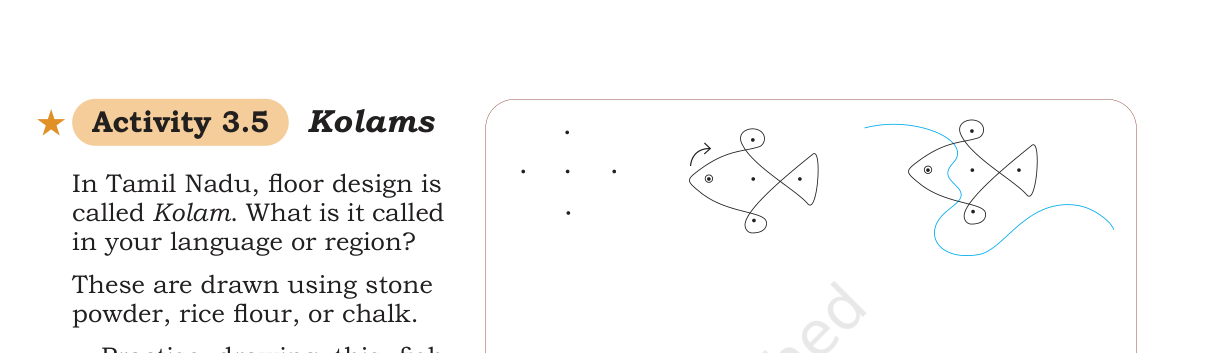
Activity 3.5 Kolams: In Tamil Nadu, a floor design is called Kolam. What is it called in your language or region? What are these designs drawn with?
Practise drawing the fish Kolam using dots and lines.
Create other aquatic animals using dots and lines. After practising on paper, make them on the floor.
NCERT Class 4 arts chapter 3, page 8
Original NCERT question visual - PDF page 8
Answer

Floor designs have different names in different regions, for example Rangoli (Maharashtra, Gujarat), Alpana (West Bengal), Mandana (Rajasthan) and Muggu (Andhra Pradesh, Telangana). They are drawn using stone powder, rice flour or chalk.

  • (sample answer) I made a grid of dots and joined them with curved lines to form the fish’s body, fins and tail.
  • (sample answer) I made a turtle Kolam with a dot grid for the shell and loops for its legs, and drew it at my doorstep with rice flour.
Question 7NCERT PDF page 9
Draw a snake Kolam by following the steps. Carefully observe the overlapping lines, then add patterns on the body and colour it. Next, create the Kolam using a piece of thread or a thick rope, using coloured threads and ropes to make it attractive. Help friends who find the pattern difficult.
NCERT Class 4 arts chapter 3, page 9
Original NCERT question visual - PDF page 9
Answer

(sample answer) I drew the dots first, then one long line that loops around the dots, crossing over and under itself to make the snake’s coiled body, with a head at one end and a thin tail at the other. I filled the body with zigzag and dot patterns in green and yellow. Then I laid a red and a yellow rope along the same path on the floor and showed my friend where the rope goes over and where it goes under.

Question 8NCERT PDF page 10
Activity 3.6 Mobile — A Moving Artwork: Does this activity have something to do with the mobile phone? What is a mobile? Create your own mobile with animal forms, using a variety of materials and origami turtles, fish, frogs and other creatures.
NCERT Class 4 arts chapter 3, page 10
Original NCERT question visual - PDF page 10
Answer

No, it has nothing to do with a mobile phone. A mobile is a decorative hanging object that moves.

(sample answer) I folded origami turtles, fish and frogs from coloured paper, tied each one to a thread of a different length, and hung the threads from two crossed sticks. When the fan is switched on, the sea creatures turn and sway.