Vidushaka helps you recall the three concepts you learnt in theatre last year. Name them, and say what you did with each one in school or at home during the holidays.
Answer
Giving meaning to gestures and postures (body language) — (sample answer) I showed my family I was tired by drooping my shoulders and walking slowly, without saying a word.
Telling stories and enacting them (storytelling and role-play) — (sample answer) I told my cousins the story of the thirsty crow and we acted it out.
Using everyday objects with new meaning (creativity and improvisation) — (sample answer) I used a broom as a guitar and a steel plate as a steering wheel in our pretend play.
Question 2NCERT PDF page 4
How does Vidushaka greet the children? What secret does he share about his years in theatre?
Original NCERT question visual - PDF page 4
Answer
He greets them with “Swagatam, my little stars!” His secret is that, of everything he has done in theatre for many years, his favourite part has been working with children, because it is so much fun — that is why he could not wait to come back.
Question 3NCERT PDF page 6
What does ‘exploring’ mean in theatre? Theatre is teamwork, so why is individual focus still important?
Original NCERT question visual - PDF page 6
Answer
Exploring means finding out — for example, finding out more about a story, how the audience liked our show, and how we can make the show better.
In theatre we work together: everyone solves problems together and shares the joy of success. But each member must still put in equal effort and stay focused on what they should do, without being distracted by others. If you are not clear about your own part, you cannot help others when they are in trouble.
Question 4NCERT PDF page 7
Activity 5.1 “Ram says …”: What are the rules of this game? What should you do when you hear
(a)“Ram says hands up” and
(b)just “look up”?
Original NCERT question visual - PDF page 7
Answer
You follow only those instructions that begin with “Ram says …”. If you hear an instruction without “Ram says”, you do not follow it and continue doing the previous action.
(a) “Ram says hands up” — raise your hands.
(b) “look up” — do not tilt your head up; keep your hands raised until you hear “Ram says …”.
The game is played in a group but tests individual skill; practising it makes you alert and focused.
Question 5NCERT PDF page 8
In the “Ram says” game, what kinds of instructions are given at the basic level and at the advanced level?
Original NCERT question visual - PDF page 8
Answer
Basic: simple instructions like “walk”, “jump”, “make a happy face”, “make an angry face”, “walk like an elephant”, “sniff like a dog”.
Advanced: working in groups of four, five or six to make shapes like rectangles, triangles and circles, or letters of Hindi, English and regional languages; and acting out situations like a flock of birds pecking at seeds or a tortoise walking in the forest from the Panchatantra.
The teacher mixes up instructions, so you must stay alert to catch the one without “Ram says”.
Question 6NCERT PDF page 9
In Vidushaka’s story about the “Ram says” game, why did at least half the group get out when Sunita teacher shouted “Now clap your hands!”? Why was Raju right when he said, “Well, Ram didn’t say stop!”?
Original NCERT question visual - PDF page 9
Answer
Sunita teacher had said “Ram says, pat your head and rub your belly at the same time.” When she shouted “Now clap your hands!”, she had not said “Ram says”, so clapping was a mistake — the children should have kept patting and rubbing. Raju kept patting and rubbing for a full minute after everyone else stopped. He was right, because no instruction beginning with “Ram says” had told them to stop.
Question 7NCERT PDF page 9
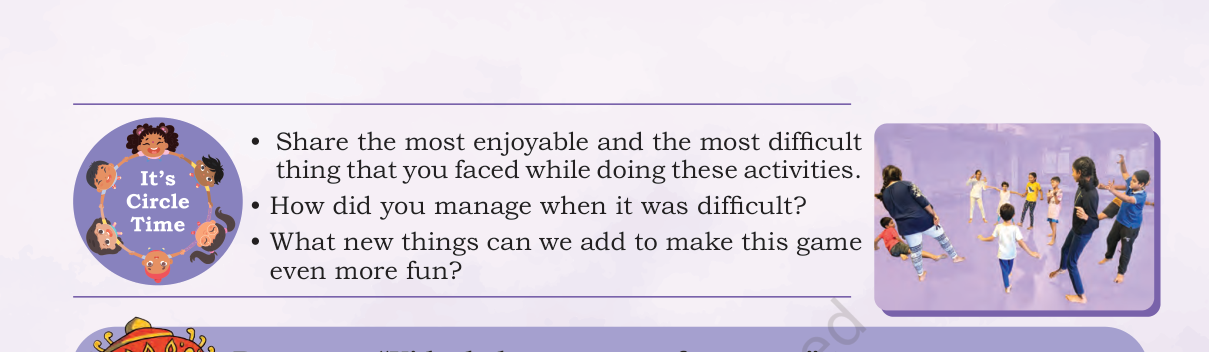
Think about the “Ram says” activities. Share the most enjoyable and the most difficult thing that you faced while doing these activities. How did you manage when it was difficult? What new things can we add to make this game even more fun?
Original NCERT question visual - PDF page 9
Answer
(sample answer) Most enjoyable: making shapes like a triangle with my group. Most difficult: not clapping when the teacher said “clap” without “Ram says”.
(sample answer) I listened carefully to the first two words of every instruction and did not copy what others were doing.
(sample answer) We could give instructions faster, let two leaders give instructions at the same time, or use sounds like a bell instead of words.
Question 8NCERT PDF page 10
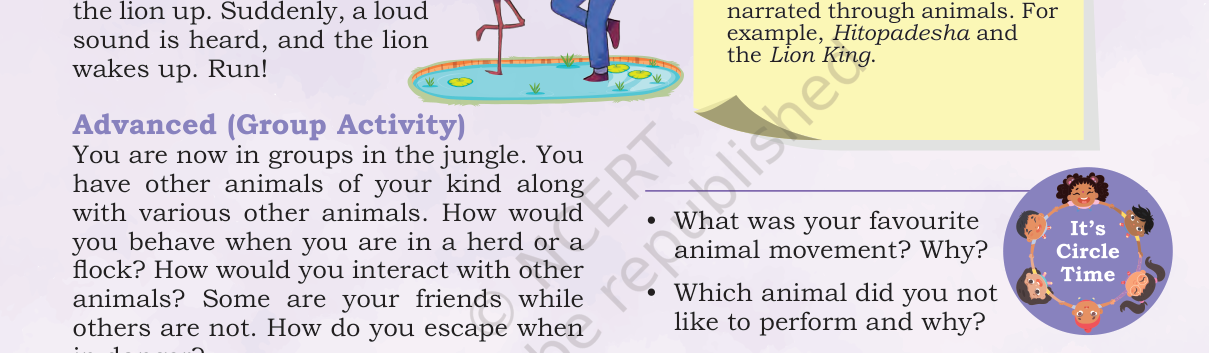
Activity 5.2 Wild Walks and Animal Antics (Basic, individual): Assume that you are an animal, but do not announce it to the class. Imitate its body movements — the speed of its walk, its eating style, sleeping and other behaviours — so that your friends can guess which animal you are. Then, as the same animal, walk carefully near the lion’s cave looking for food without waking him. Suddenly a loud sound is heard and the lion wakes up. Run!
Original NCERT question visual - PDF page 10
Answer
The movements must match the animal: for example, a sloth is slow and a dog is relatively fast.
(sample answer) I chose a rabbit. I hopped quickly with both feet together, twitched my nose, nibbled with small quick bites and slept curled up in a ball. My friends guessed “rabbit”. Near the lion’s cave I hopped very slowly on tiptoe, and when the loud sound came I darted away in a zigzag.
Question 9NCERT PDF page 11
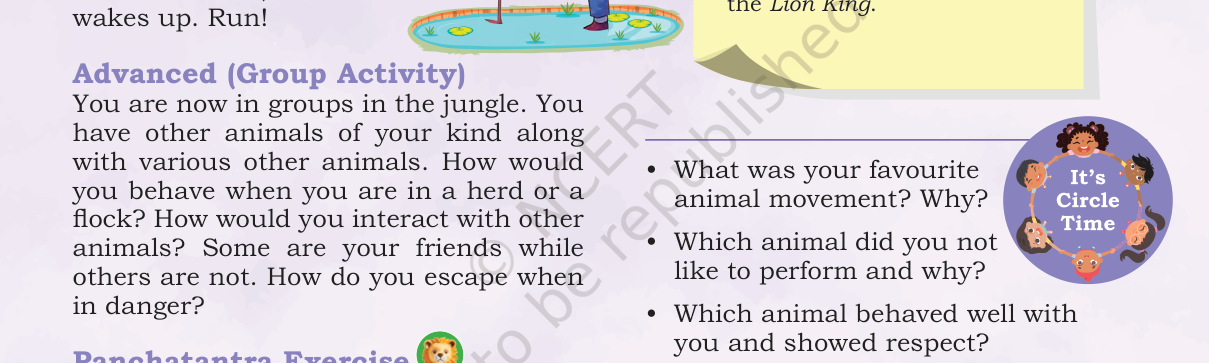
Advanced (group activity): You are in the jungle with other animals of your kind and various other animals. How would you behave when you are in a herd or a flock? How would you interact with other animals — some friends, some not? How do you escape when in danger?
Original NCERT question visual - PDF page 11
Answer
(sample answer) As elephants in a herd, we walk close together behind the oldest elephant and keep the babies in the middle. We let deer and birds drink at the pond with us, but we stamp and trumpet loudly to warn a tiger away. In danger, we form a circle around the young ones and then move away together.
Question 10NCERT PDF page 11
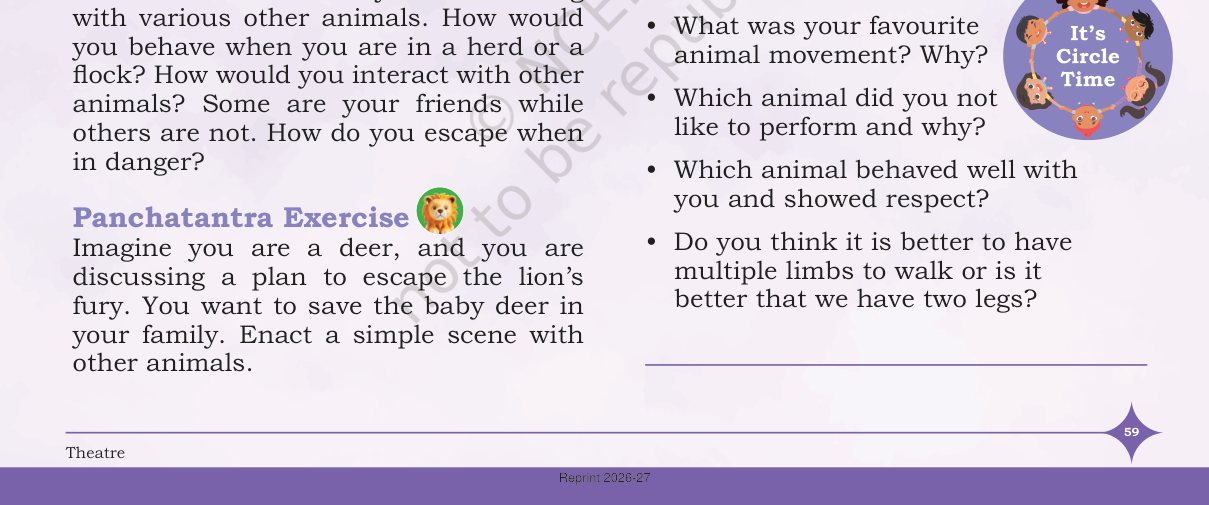
After the animal activities, answer: What was your favourite animal movement? Why? Which animal did you not like to perform and why? Which animal behaved well with you and showed respect? Do you think it is better to have multiple limbs to walk, or is it better that we have two legs?
Original NCERT question visual - PDF page 11
Answer
(sample answer) Hopping like a frog, because it was bouncy and funny.
(sample answer) A snake, because crawling on the floor was hard and tiring.
(sample answer) The elephant moved slowly and made way for me to drink water.
(sample answer) Four legs give better balance and speed, but two legs leave our hands free to hold, carry and make things, so two legs suit us better.
Question 11NCERT PDF page 11
Panchatantra Exercise: Imagine you are a deer, discussing a plan with other animals to escape the lion’s fury. You want to save the baby deer in your family. Enact a simple scene.
Original NCERT question visual - PDF page 11
Answer
(sample answer) Mother deer: “The lion is hunting near the river. Let us hide our baby in the tall grass.” Monkey: “I will watch from the tree and chatter loudly when he comes.” Father deer: “Then we will all run in different directions to confuse him, and come back for the baby when he has gone.” The monkey shouts a warning, the deer scatter, and the baby stays safely hidden.