• Would the model still look like the original building?
Original NCERT question visual - PDF page 1
Solution
Yes, if the main shapes are the same; but if important parts are removed or changed, it will not look like the original.
Question 2NCERT PDF page 1
• In what ways could you make the model even better?
Original NCERT question visual - PDF page 1
Solution
Use more blocks of the right shapes, keep the same proportions, add details like windows and doors, and colour it like the real building.
Question 3Fill in the blanksNCERT PDF page 2
showing the main buildings on the street. I have made something. Look at my Qutub Minar. Do you think it looks like the Qutub Minar?................... What shape would you use if you made a model of the Qutub Minar? Why?...............……………………………. How many such shapes will you use? ............................ Do you know: The Qutub Minar is a World Heritage site and the tallest building made up of bricks. It has 5 storeys and 379 stairs. Earlier, people made buildings with clay bricks, stone blocks or wood. Today we also use concrete blocks, hollow blocks, etc. What is common to all of these bricks? ………..
Original NCERT question visual - PDF page 2
Solution
Yes, it looks like the Qutub Minar. I would use cylinders (or cones) stacked one above the other, getting smaller towards the top, because the Qutub Minar is a tall round tower that narrows upwards. It has 5 storeys, so I would use 5 such shapes. All bricks are cuboids (they have rectangular faces).
Question 1NCERT PDF page 3
Make a sphere-like shape with paper strips. Diksha has folded open and flattened a box to see what an open box looks like. This is called the net of the box. If you fold along the dotted lines, you will get the box back.
Original NCERT question visual - PDF page 3
Solution
Join paper strips in circles crossing at the top and bottom to make a ball-like (sphere-like) shape. A net is a flat shape that folds to make a solid.
Question 2Fill in the blanksNCERT PDF page 3
Use the nets given at the end of the book to Net of a box make the models shown below. Prisms Pyramids Triangular Triangular Prism Pyramid Pentagonal Pyramid Square Pyramid Hexagonal Square Prism Prism What shape of face is common to What shape of face is common to all the prisms? _________________ all the pyramids? _______________ What other shapes do these All the triangular faces meet at prisms have? _________________ _________________ point. How many such faces each? Identify any other shape in each _________________ of the pyramids _________________ Is a cube also a prism? What is the difference between a prism and a pyramid? Discuss.
Original NCERT question visual - PDF page 3
Solution
Common face of all prisms: rectangle. Prisms also have two identical end faces (triangles, squares, pentagons, hexagons). Common face of all pyramids: triangle; all triangular faces meet at one point (the apex). Each pyramid has one base face (triangle, square, pentagon). Yes, a cube is also a prism (a square prism). A prism has two identical end faces joined by rectangles; a pyramid has one base and triangular faces meeting at a point.
Question 3Fill in the blanksNCERT PDF page 4
Now try to make the above shapes using straws and plasticine/ thread and fill in the table. Number of Number of Number of Shapes faces (F) corners (V) edges (E) Cube/Square Prism Cuboid/Rectangular Prism Triangular Pyramid Square Pyramid Triangular Prism Identify any relationship that you may find between the number of faces (F), edges (E), and corners (V). Calculate F+V–E in each case. What do you notice? Sort 3D shapes by the number of flat faces. Write their names here. Number of 1 flat 2 flat 4 flat 5 flat 6 flat 8 flat faces face faces faces faces faces faces Name of the shape Can you construct a 3D shape with 3 flat faces? Now sort 3D shapes by the number of straight edges. Write their names here. Number of 6 straight 8 straight 9 straight edges 12 straight edges edges edges edges Name of the shape
Original NCERT question visual - PDF page 4
Solution
Cube/Square prism: F 6, V 8, E 12. Cuboid: F 6, V 8, E 12. Triangular pyramid: F 4, V 4, E 6. Square pyramid: F 5, V 5, E 8. Triangular prism: F 5, V 6, E 9. In each case F + V – E = 2.
By flat faces: 1 – cone; 2 – cylinder; 4 – triangular pyramid; 5 – square pyramid, triangular prism; 6 – cube, cuboid; 8 – hexagonal prism. A solid with only 3 flat faces is not possible (with a curved face, a half-cylinder has 3 flat faces).
Take a die. Look at the face that has number 1. The face numbered 6 is opposite to the face numbered 1. What is the face opposite to the a) face numbered 2? …..… b) face numbered 3? …….. c) face numbered 4? ……..
Original NCERT question visual - PDF page 5
Solution
a) 5 b) 4 c) 3 (opposite faces of a die add up to 7).
Question 2Fill in the blanksNCERT PDF page 5
a) Which faces have common edges with the face numbered 1? ............................ b) Which face has no common edge with the face numbered 1? ...........................
Original NCERT question visual - PDF page 5
Solution
a) Faces 2, 3, 4 and 5 share an edge with face 1. b) Face 6 has no common edge with face 1.
Question 3Fill in the blanksNCERT PDF page 5
Look at three different views of the same cube. a) What colour is the face that is opposite to the red face? …………................ b) What colour is the face that is opposite to the yellow face? .......................………….. Follow these instructions for the shapes along the border.
Original NCERT question visual - PDF page 5
Solution
Look at the three views: the colours that appear next to a face cannot be opposite to it. The colour that never appears beside red is opposite red, and the one that never appears beside yellow is opposite yellow.
Question 1NCERT PDF page 5
Colour all shapes with a rectangular face in red.
Original NCERT question visual - PDF page 5
Solution
Colour cube, cuboid, prisms and square pyramid red (they have rectangular faces).
Question 2NCERT PDF page 5
Draw a smiley on shapes with a triangular face.
Original NCERT question visual - PDF page 5
Solution
Draw a smiley on pyramids and triangular prisms.
Question 3NCERT PDF page 5
Draw a star on shapes with a curved face.
Original NCERT question visual - PDF page 5
Solution
Draw a star on the cylinder, cone and sphere.
Question 4NCERT PDF page 5
Colour all shapes with no corner in blue.
Original NCERT question visual - PDF page 5
Solution
Colour the sphere (and cylinder) blue – they have no corners.
Question 5NCERT PDF page 5
Circle the shapes that have the same opposite faces.
Original NCERT question visual - PDF page 5
Solution
Circle the cube, cuboid, prisms and cylinder – their opposite faces are the same.
Question 6NCERT PDF page 6
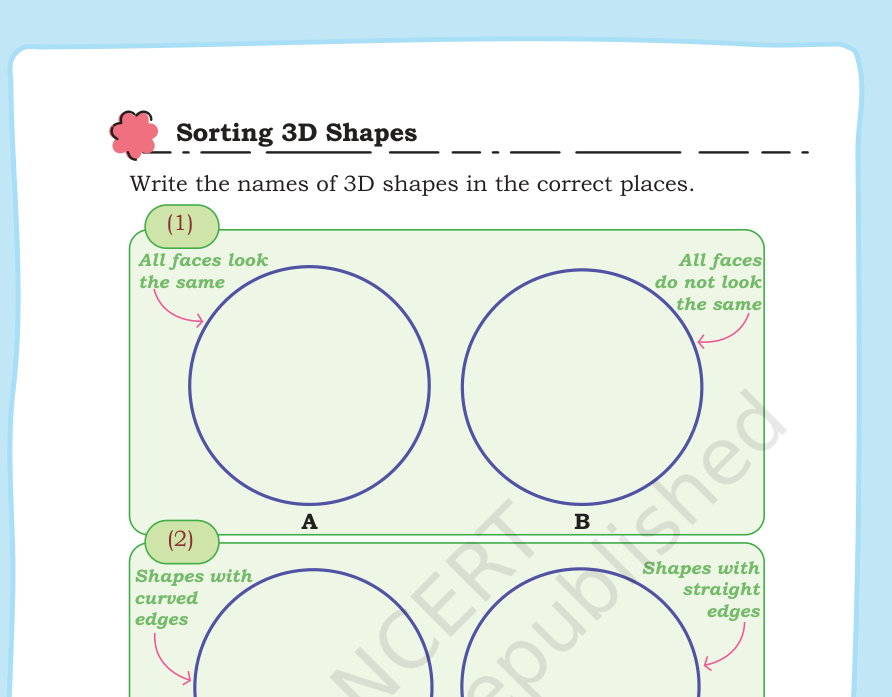
Write the names of 3D shapes in the correct places. (1) All faces look All faces the same do not look the same A B (2) Shapes with Shapes with straight curved edges edges A B (3) Shapes with Shapes with triangular rectangular faces faces A B Shapes with both rectangular and triangular faces
Original NCERT question visual - PDF page 6
Solution
(1) All faces look the same: cube, triangular pyramid (tetrahedron). Faces not the same: cuboid, square pyramid, prisms, cone, cylinder.
(3) Triangular faces: triangular pyramid. Rectangular faces: cube, cuboid. Both: triangular prism and rectangular (square) pyramid – write them where the circles overlap.
Question 7NCERT PDF page 7
In which circle did you write triangular prism and rectangular pyramid? Let us sort shapes in another way. Using circles like those on the previous page, can you sort shapes into the categories “Shapes with curved faces” and “Shapes with flat faces”? Build with Cubes Build these models with the cubes from the Jaadui Pitara Kit or any other similar material.
Original NCERT question visual - PDF page 7
Solution
Triangular prism and rectangular pyramid go in the overlapping part (both rectangular and triangular faces). Curved faces: sphere, cylinder, cone. Flat faces: cube, cuboid, prisms, pyramids (cylinder and cone go in the overlap).
Question ANCERT PDF page 7
B. C. D. Cube Towers How many cubes are there in each of these cube towers?
Original NCERT question visual - PDF page 7
Solution
Count the cubes layer by layer, including hidden cubes underneath, and add.
Question 2NCERT PDF page 8
Drawing Cubes on a Triangular Dot Paper Can you complete the following cubes?
Original NCERT question visual - PDF page 8
Solution
Join the dots to draw the missing edges so each figure shows a complete cube (3 visible faces).
Question 1NCERT PDF page 8
Match the pictures to the descriptions and name the shapes. a) I have 5 faces and 5 corners. I have 8 edges. 1 of my faces is a square and 4 of my faces are triangles..…………. b) I have 1 flat face, 1 curved face, and 1 edge.…………. c) I have 1 curved face. I have no edges or corners.……. d) I have 2 flat faces, 1 curved face, and 2 edges. I have no corners.…………. e) I have 5 faces, 6 corners, and 9 edges, and 2 of my faces are triangles.…………. f) I have 6 faces, 12 edges, and 8 corners.………….
Original NCERT question visual - PDF page 8
Solution
a) Square pyramid b) Cone c) Sphere d) Cylinder e) Triangular prism f) Cube (or cuboid)
Question 2NCERT PDF page 8
Each one is different. How? Discuss.
Original NCERT question visual - PDF page 8
Solution
They differ in the number and shape of faces, edges and corners, and in whether their faces are flat or curved.
Question 3Match the followingNCERT PDF page 9
Match the following nets to the appropriate solids given below. (1) (2) (3) (4)
Original NCERT question visual - PDF page 9
Solution
Match each net to the solid it folds into: a net with 6 squares – cube; 4 triangles – triangular pyramid; 2 triangles + 3 rectangles – triangular prism; 2 circles + 1 rectangle – cylinder.
Question (a)NCERT PDF page 9
(b) (c) (d)
NCERT textbook page 9
Solution
Write the matching net number under each solid.
Question 4NCERT PDF page 9
Which of these nets can be folded to make a solid of the kind given below?
Original NCERT question visual - PDF page 9
Solution
Imagine folding each net; it works only if no faces overlap and every face has a partner on the opposite side. Tick the nets that fold correctly.
Question 5NCERT PDF page 9
Nitesh cuts up a net on the folds. Here are its pieces. Which solid has the above pieces in its net?
Original NCERT question visual - PDF page 9
Solution
The pieces (e.g. 2 triangles and 3 rectangles) belong to a triangular prism; count the face shapes to name the solid.
Question 6NCERT PDF page 10
drawing. boat drawing?
Original NCERT question visual - PDF page 10
Solution
Name the 2D shapes used in the drawing: squares, rectangles, triangles, circles, etc.
Question 7NCERT PDF page 15
In what ways are rectangle and square different from these shapes?
Original NCERT question visual - PDF page 15
Solution
A rectangle and a square have 4 sides and 4 right angles. Other shapes (triangle, pentagon, circle) have a different number of sides or no corners. A square is a special rectangle with all 4 sides equal.
Question 8NCERT PDF page 16
Try to make this 5-sided shape with all sides equal
Original NCERT question visual - PDF page 16
Solution
Use 5 equal straws joined with clay to make a pentagon.
Question 9Fill in the blanksNCERT PDF page 16
(Pentagon) Are these right angles? Does the shape of the pentagon change if we gently push one of its sides. Yes/No How does this change the angles? Can you make a circle using straws? Look at the picture. The lengths of the straws in this picture are ……………. (Equal/Unequal) What will happen if we take straws of unequal lengths? Let Us Make Can you use a scale to draw a circular shape? Let us see. Mark a point A. Draw many points that are at an A equal distance from point A. Connect the dots freehand. What do you get? ................ The point A is the centre and the line from the centre to the border of the circle is the radius.
Original NCERT question visual - PDF page 16
Solution
No, the angles of a pentagon are not right angles (they are more than a right angle). Yes, its shape changes when pushed – some angles get bigger and some smaller. A circle cannot be made with straight straws; with many very short equal straws we get a shape close to a circle. The straws are equal in length; unequal straws give an uneven shape. Joining points at an equal distance from A gives a circle.
Question 1Fill in the blanksNCERT PDF page 17
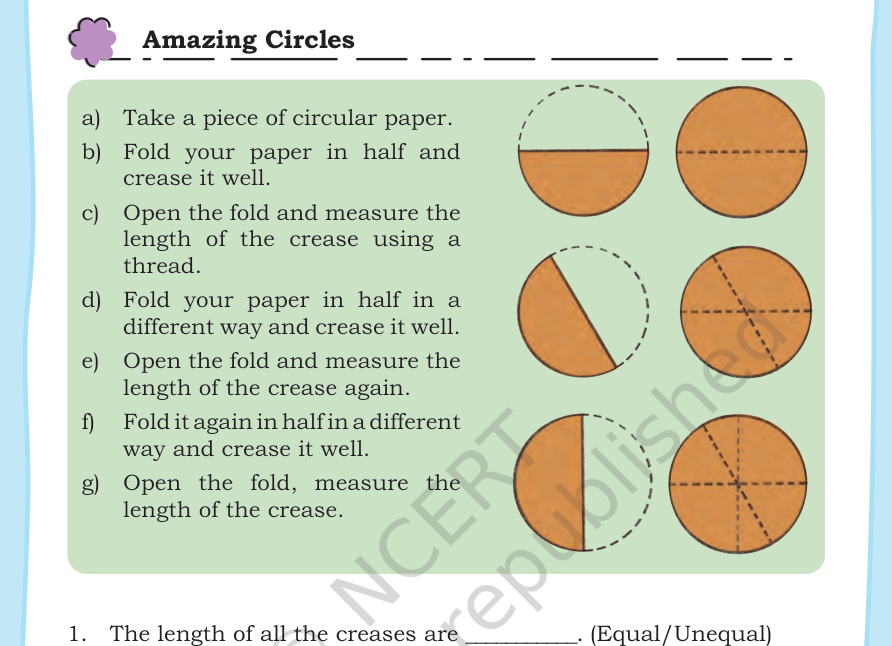
The length of all the creases are ___________. (Equal/Unequal)
Original NCERT question visual - PDF page 17
Solution
Equal
Question 2NCERT PDF page 17
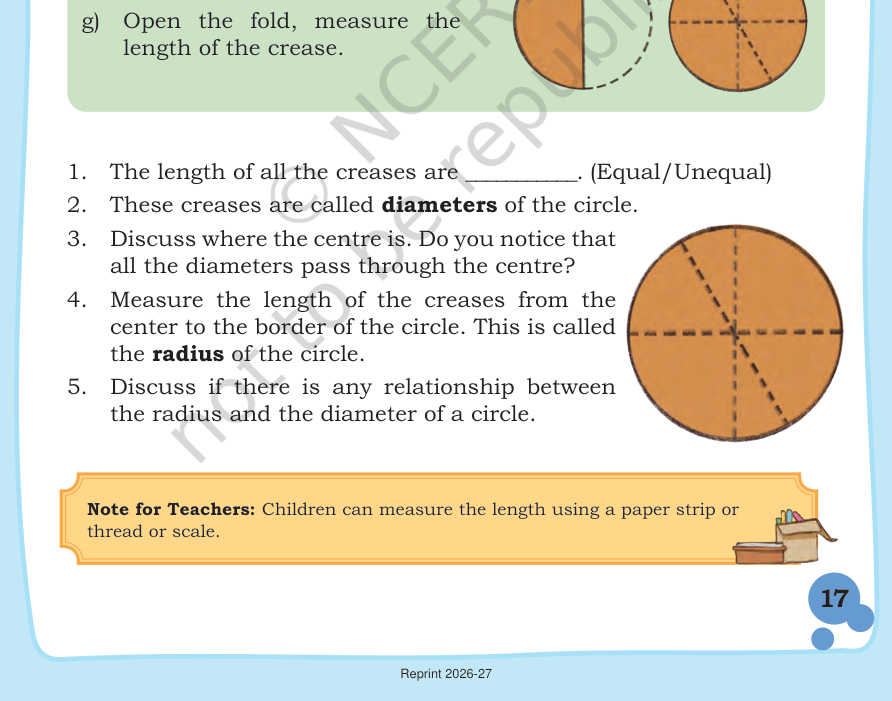
These creases are called diameters of the circle.
Original NCERT question visual - PDF page 17
Solution
These creases are called diameters.
Question 3NCERT PDF page 17
Discuss where the centre is. Do you notice that all the diameters pass through the centre?
Original NCERT question visual - PDF page 17
Solution
The centre is the point where all the creases cross. Yes, all diameters pass through the centre.
Question 4NCERT PDF page 17
Measure the length of the creases from the center to the border of the circle. This is called the radius of the circle.
Original NCERT question visual - PDF page 17
Solution
The length from the centre to the edge is the radius; all radii of a circle are equal.
Question 5NCERT PDF page 17
Discuss if there is any relationship between the radius and the diameter of a circle.
Original NCERT question visual - PDF page 17
Solution
The diameter is twice the radius (diameter = 2 × radius).