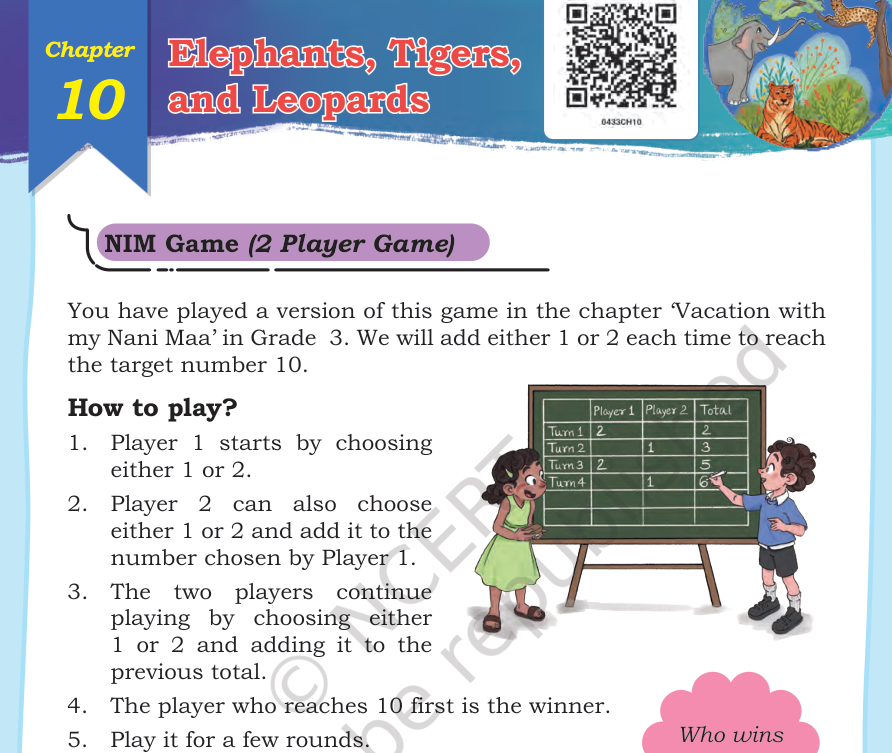
NIM Game (2 players): Players take turns to choose 1 or 2 and add it to the total. The player who reaches 10 first is the winner. Play it for a few rounds. Can you win the game if a) the other player has reached a total of 6 and it is your turn? b) the other player has reached a total of 7 and it is your turn? c) the other player has reached a total of 8 and it is your turn? Who wins in each of these cases?
Original NCERT question visual - PDF page 1
Solution
a) Yes, I win. I add 1 to make 7. The other player can only make 8 or 9, and then I reach 10.
b) No (if the other player plays well). If I make 8, they add 2; if I make 9, they add 1 – they reach 10 and win.
c) Yes, I win. I add 2 and reach 10 straight away.
Tip: try to reach 1, 4, 7 and then 10.
Question 5NCERT PDF page 2
Play the game to reach other target numbers (like 10, 11 or 12) by adding 1 or 2 each time. Can you find a number in each case when you are sure that you can win?
Original NCERT question visual - PDF page 2
Solution
Target 10: once you reach 7 you are sure to win (also aim for 1 and 4 before it).
Target 11: reach 8 (and before that 2 and 5).
Target 12: reach 9 (and before that 3 and 6).
The safe number is always 3 less than the target, because the other player can add only 1 or 2.
Question 1NCERT PDF page 2
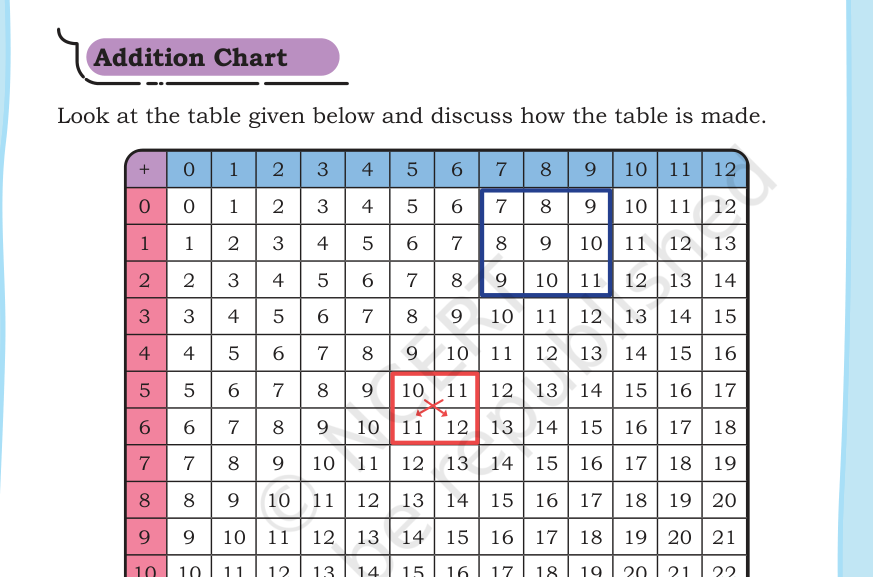
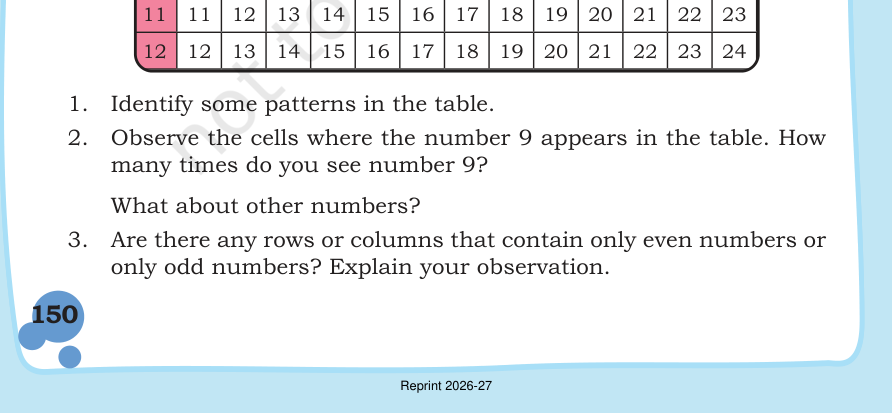
Addition Chart: Look at the table (rows and columns 0 to 12, each cell = row number + column number) and discuss how it is made. Identify some patterns in the table.
Original NCERT question visual - PDF page 2
Solution
Numbers increase by 1 along each row and column; the same number appears along slanting lines; the table is symmetrical about the main diagonal.
Question 2NCERT PDF page 2
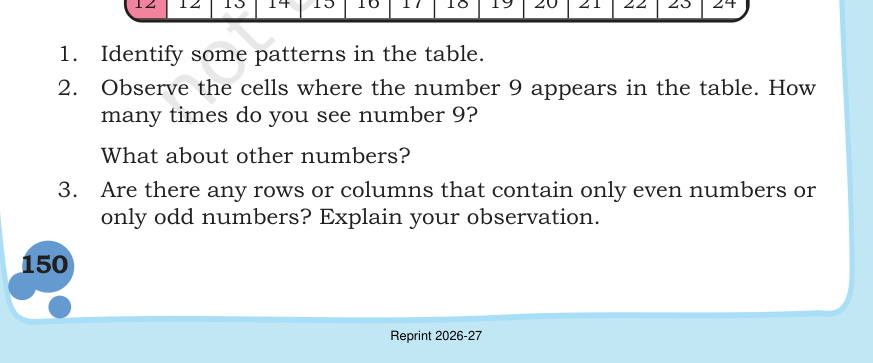
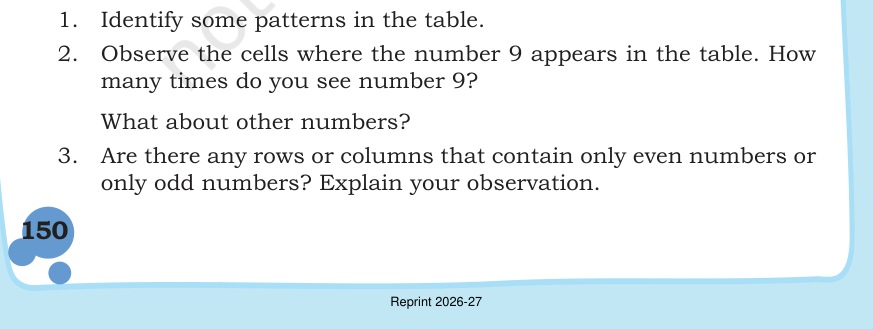
Observe the cells where the number 9 appears in the table. How many times do you see number 9? What about other numbers?
Original NCERT question visual - PDF page 2
Solution
9 appears 10 times (0 + 9, 1 + 8, 2 + 7, … 9 + 0), along a slanting line. Every number appears along a slanting line; 12 appears the most times (13 times), and 0 and 24 appear only once.
Question 3NCERT PDF page 2
Are there any rows or columns that contain only even numbers or only odd numbers? Explain your observation.
Original NCERT question visual - PDF page 2
Solution
No. Every row and column has both even and odd numbers, alternating, because adding 1 changes even to odd and odd to even.
Question 4NCERT PDF page 3
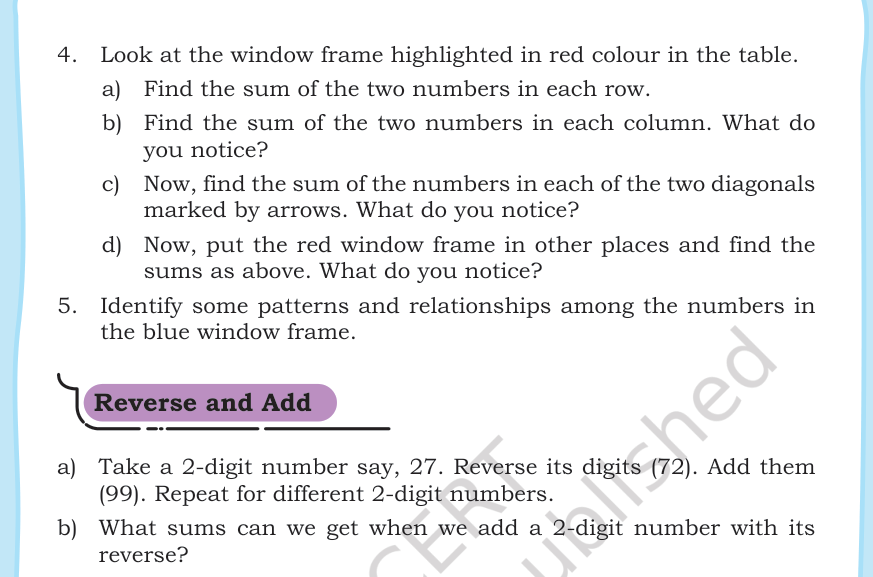
Look at the red window frame in the table (10, 11 in the top row; 11, 12 in the bottom row). a) Find the sum of the two numbers in each row. b) Find the sum of the two numbers in each column. What do you notice? c) Find the sum of the numbers in each of the two diagonals. What do you notice? d) Put the red window frame in other places and find the sums as above. What do you notice?
Original NCERT question visual - PDF page 3
Solution
a) 10 + 11 = 21 and 11 + 12 = 23.
b) 10 + 11 = 21 and 11 + 12 = 23 – the column sums are the same as the row sums, and the second sum is 2 more than the first.
c) 10 + 12 = 22 and 11 + 11 = 22 – the two diagonal sums are equal.
d) The same thing happens everywhere: row sums equal column sums, and the two diagonal sums are always equal.
Question 5NCERT PDF page 3
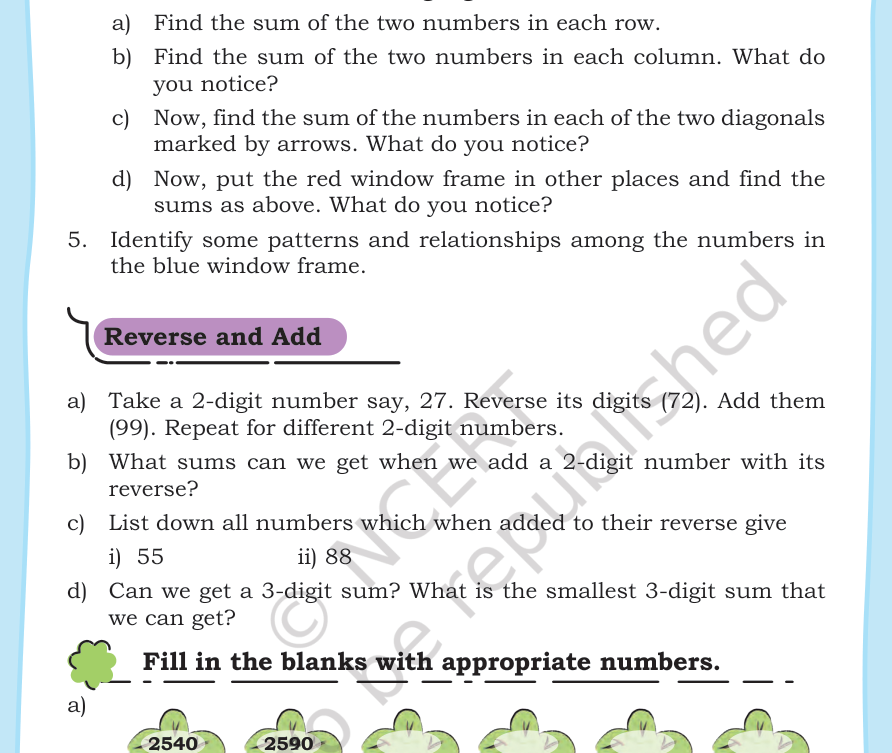
Identify some patterns and relationships among the numbers in the blue window frame (7, 8, 9 / 8, 9, 10 / 9, 10, 11). Reverse and Add: a) Take a 2-digit number, say 27. Reverse its digits (72). Add them (99). Repeat for different 2-digit numbers. b) What sums can we get when we add a 2-digit number and its reverse? c) List all numbers which when added to their reverse give i) 55 ii) 88 d) Can we get a 3-digit sum? What is the smallest 3-digit sum that we can get?
Original NCERT question visual - PDF page 3
Solution
Blue frame: numbers go up by 1 to the right and downwards; the slanting line from top-right to bottom-left is all 9s; opposite corners add up to 18 (7 + 11, 9 + 9), twice the middle number 9.
d) Yes. The smallest 3-digit sum is 110 (19 + 91 = 110).
Question 6Fill in the blanksNCERT PDF page 3
Fill in the blanks with appropriate numbers. a) 2540, 2590, ___, ___, ___, ___ b) 354, 1354, ___, ___, ___, ___, ___ c) 7645, 7670, ___, ___, 7745, ___, ___, ___
Solution
a) Add 50 each time: 2540, 2590, 2640, 2690, 2740, 2790
b) Add 1000 each time: 354, 1354, 2354, 3354, 4354, 5354, 6354
c) Add 25 each time: 7645, 7670, 7695, 7720, 7745, 7770, 7795, 7820
Question 1NCERT PDF page 4
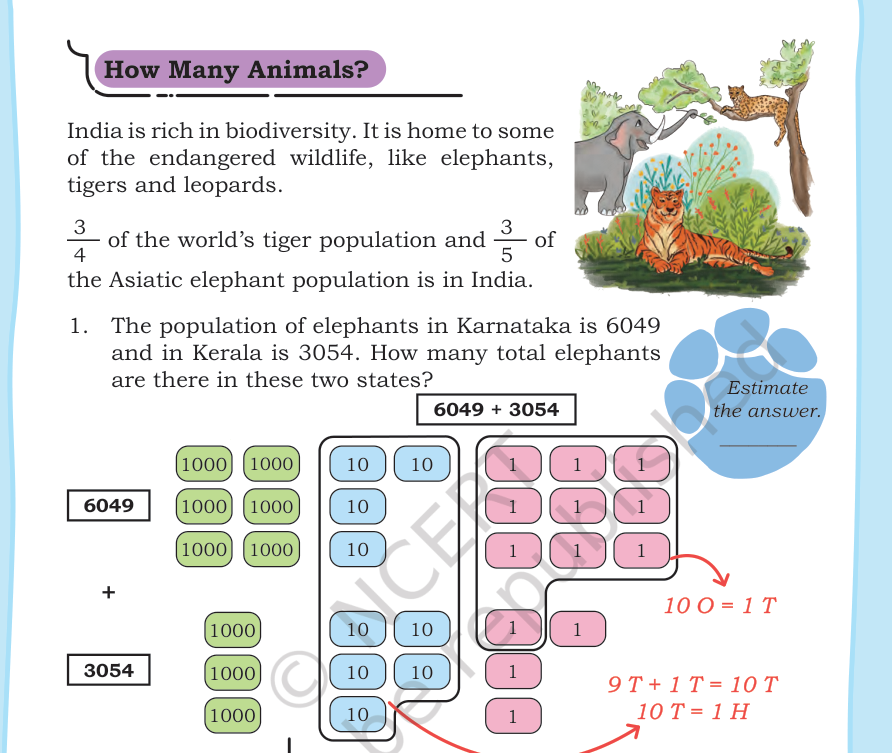
How Many Animals? The population of elephants in Karnataka is 6049 and in Kerala is 3054. How many elephants are there in these two states in all? Estimate the answer first.
Original NCERT question visual - PDF page 4
Solution
Estimate: 6000 + 3000 = 9000. Exact: 6049 + 3054 = 9 Th + 0 H + 9 T + 13 O = 9 Th + 1 H + 0 T + 3 O = 9103. There are 9103 elephants in Karnataka and Kerala.
Question 2NCERT PDF page 5
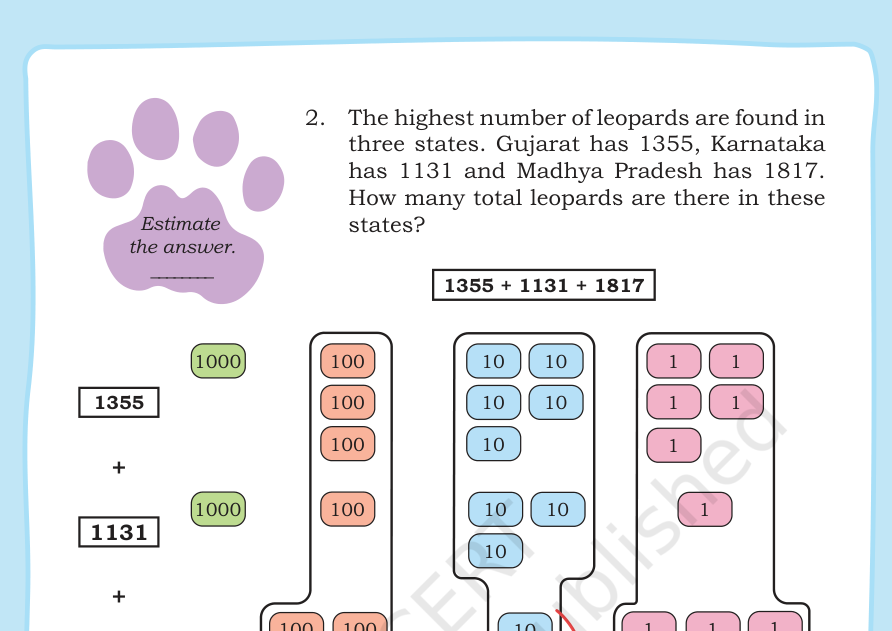
The highest numbers of leopards are found in three states. Gujarat has 1355, Karnataka has 1131 and Madhya Pradesh has 1817. How many leopards are there in these three states in all? Estimate the answer first.
Original NCERT question visual - PDF page 5
Solution
Estimate: 1400 + 1100 + 1800 = 4300. Exact: 1355 + 1131 + 1817 = 3 Th + 12 H + 9 T + 13 O = 4 Th + 3 H + 0 T + 3 O = 4303 leopards.
Question 3NCERT PDF page 6
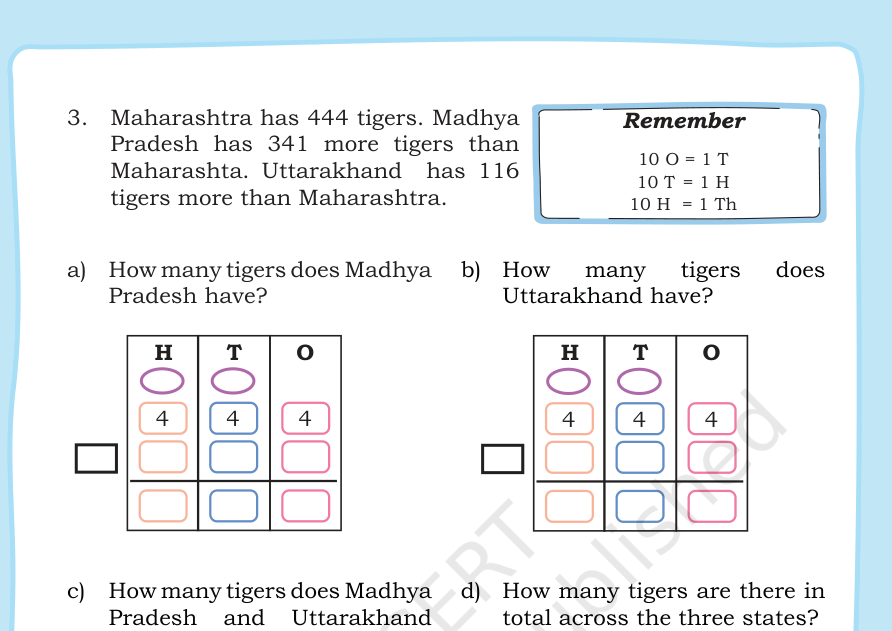
Maharashtra has 444 tigers. Madhya Pradesh has 341 more tigers than Maharashtra. Uttarakhand has 116 more tigers than Maharashtra. a) How many tigers does Madhya Pradesh have? b) How many tigers does Uttarakhand have? c) How many tigers do Madhya Pradesh and Uttarakhand have in total? d) How many tigers are there in total across the three states?
Original NCERT question visual - PDF page 6
Solution
a) 444 + 341 = 785 b) 444 + 116 = 560 c) 785 + 560 = 1345 d) 444 + 785 + 560 = 1789
Question 1NCERT PDF page 7
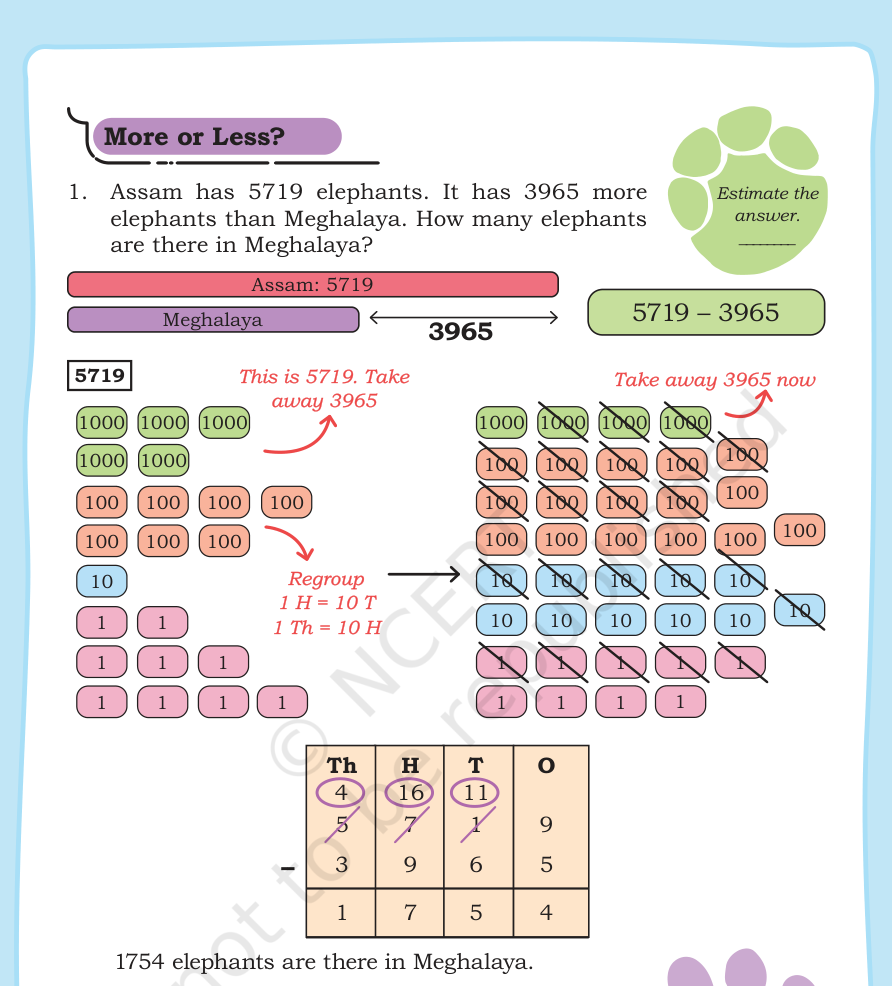
More or Less? Assam has 5719 elephants. It has 3965 more elephants than Meghalaya. How many elephants are there in Meghalaya? Estimate the answer first.
Original NCERT question visual - PDF page 7
Solution
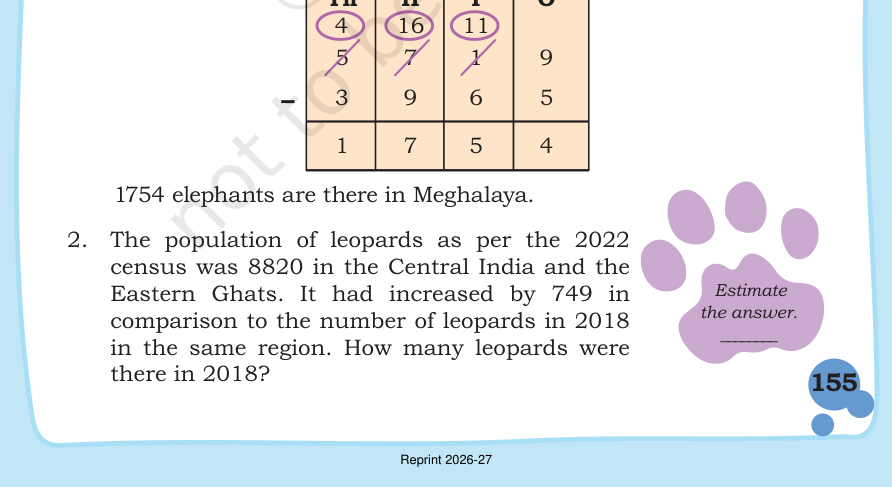
Estimate: 5700 – 4000 = 1700. Exact: 5719 – 3965 = 1754 (regroup 1 H = 10 T and 1 Th = 10 H). There are 1754 elephants in Meghalaya.
Question 2NCERT PDF page 7
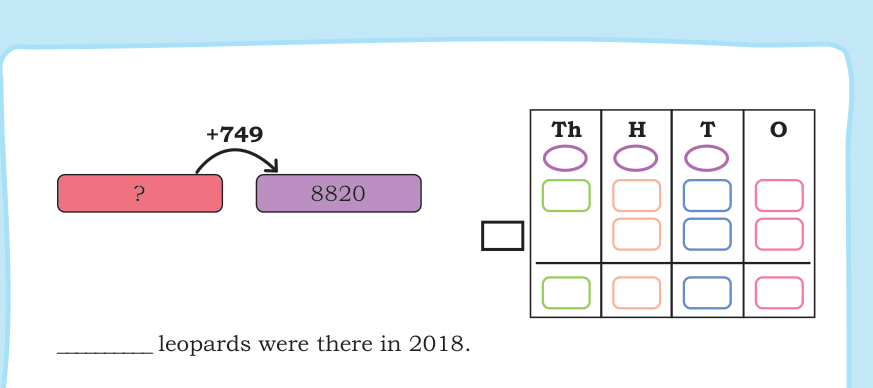
The population of leopards as per the 2022 census was 8820 in Central India and the Eastern Ghats. It had increased by 749 compared to the number of leopards in 2018 in the same region. How many leopards were there in 2018? Estimate the answer first.
Original NCERT question visual - PDF page 7
Solution
Estimate: 8800 – 700 = 8100. Exact: 8820 – 749 = 8071. There were 8071 leopards in 2018.
Question 3NCERT PDF page 8
Write the number of animals on the map of India based on the data from the problems in the previous pages.
Original NCERT question visual - PDF page 8
Solution
Tigers: Maharashtra 444, Madhya Pradesh 785, Uttarakhand 560; no. of tigers in these states = 1789.
Elephants: Assam 5719, Meghalaya 1754, Karnataka 6049, Kerala 3054; no. of elephants in Karnataka and Kerala = 9103.
Leopards: Gujarat 1355, Karnataka 1131, Madhya Pradesh 1817; no. of leopards in these states = 4303.