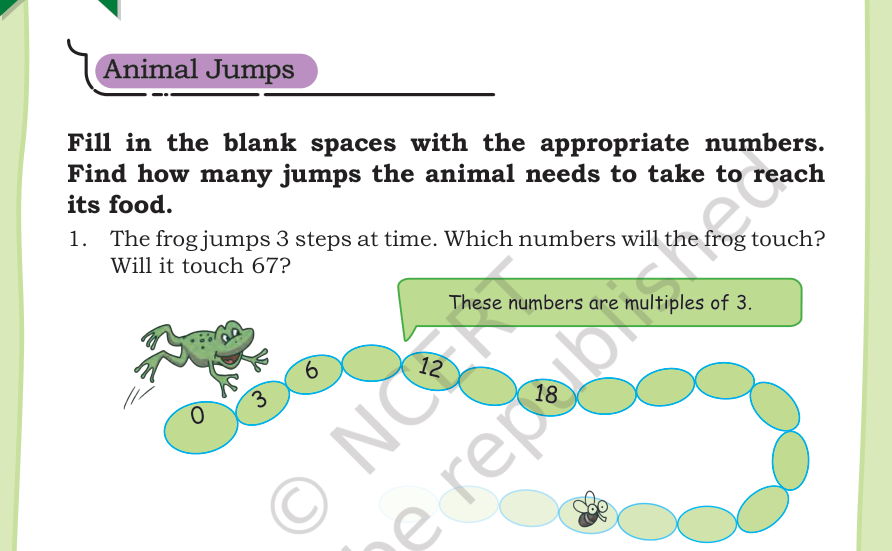
Animal Jumps: Fill in the numbers on the path and find how many jumps the animal needs to reach its food. The frog jumps 3 steps at a time, starting from 0. Which numbers will the frog touch? Will it touch 67?
Original NCERT question visual - PDF page 1
Solution
The frog touches 3, 6, 9, 12, 15, 18, 21, 24, 27, 30, … These numbers are multiples of 3. No, it will not touch 67, because it lands on 66 and then jumps to 69.
Question 2NCERT PDF page 1
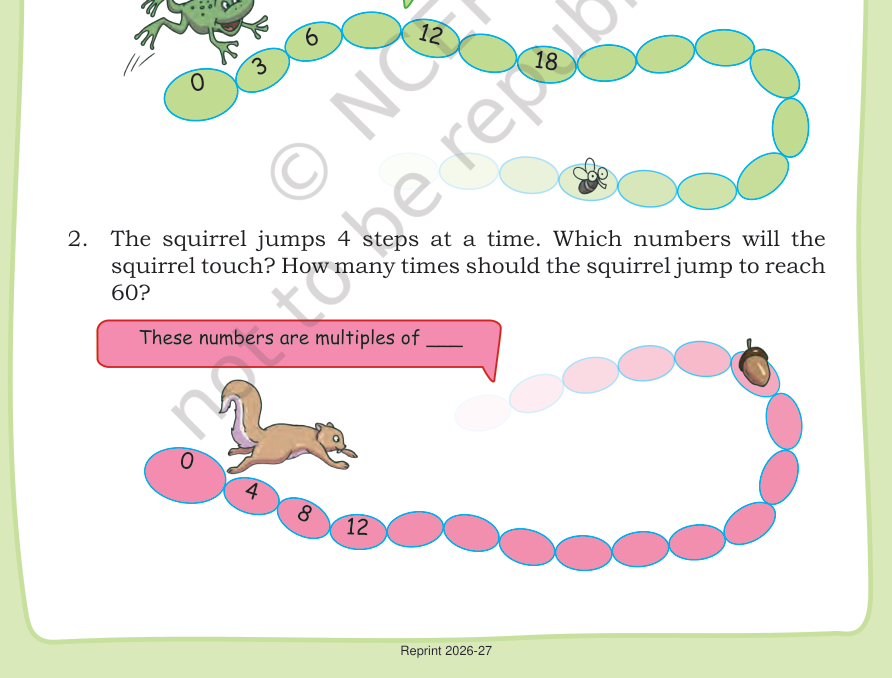
The squirrel jumps 4 steps at a time. Which numbers will the squirrel touch? How many times should the squirrel jump to reach 60? These numbers are multiples of ___.
Original NCERT question visual - PDF page 1
Solution
The squirrel touches 4, 8, 12, 16, 20, 24, … These are multiples of 4. To reach 60 it jumps 60 ÷ 4 = 15 times.
Question 3NCERT PDF page 2
The rabbit jumps 6 steps at a time. Which numbers will the rabbit touch? What is the smallest 3-digit number on which the rabbit will land? How many times did the rabbit jump to reach this number? These numbers are multiples of ___.
Original NCERT question visual - PDF page 2
Solution
6, 12, 18, 24, … (multiples of 6). The smallest 3-digit number is 102, reached in 17 jumps.
Question 4NCERT PDF page 2
The kangaroo jumps 8 steps at a time. Which numbers will the kangaroo touch? These numbers are multiples of ___. Are there numbers that both the rabbit and the kangaroo will touch?
Original NCERT question visual - PDF page 2
Solution
8, 16, 24, 32, 40, 48, … – multiples of 8. Yes, both the rabbit and the kangaroo touch 24, 48, 72, 96, …
Question 5NCERT PDF page 2
To reach 48, how many times did the rabbit jump? How many times did the kangaroo jump to reach the same number? What did you observe?
Original NCERT question visual - PDF page 2
Solution
Rabbit: 48 ÷ 6 = 8 jumps. Kangaroo: 48 ÷ 8 = 6 jumps. The animal with the longer jump needs fewer jumps.
Question 6NCERT PDF page 3
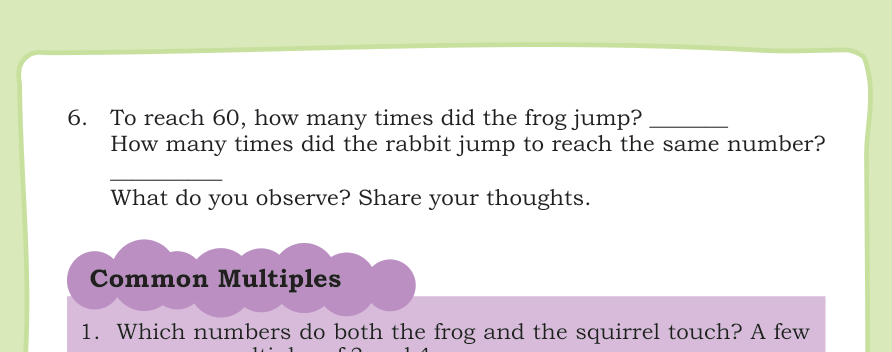
To reach 60, how many times did the frog jump? How many times did the rabbit jump to reach the same number? What do you observe?
Original NCERT question visual - PDF page 3
Solution
Frog: 60 ÷ 3 = 20 jumps. Rabbit: 60 ÷ 6 = 10 jumps. The rabbit's jump (6) is double the frog's jump (3), so it needs half as many jumps.
Question 1NCERT PDF page 3
Common Multiples: Which numbers do both the frog and the squirrel touch? A few common multiples of 3 and 4 are ___.
Original NCERT question visual - PDF page 3
Solution
12, 24, 36, 48, …
Question 2NCERT PDF page 3
Which numbers do both the rabbit and the kangaroo touch? A few common multiples of 6 and 8 are ___.
Original NCERT question visual - PDF page 3
Solution
24, 48, 72, 96, …
Question 7NCERT PDF page 3
If the cat and the rat land on the same number, the cat will catch the rat. The cat is now on 6 and the rat on 12. When the cat jumps 3 steps forward, the rat jumps 2 steps forward. Will the cat catch the rat? If yes, at which number?
Original NCERT question visual - PDF page 3
Solution
Yes. Cat: 9, 12, 15, 18, 21, 24. Rat: 14, 16, 18, 20, 22, 24. After 6 jumps both land on 24, so the cat catches the rat at 24.
Question 8NCERT PDF page 3
Find multiplication and division sentences in the number grid (read across from left to right, or down from top to bottom) and shade them. How many can you find? Two examples are done for you: 2 × 2 = 4 (row 2) and 10 × 2 = 20 (column 1).
That makes 17 sentences in all, including the 2 examples.
Question 1NCERT PDF page 4
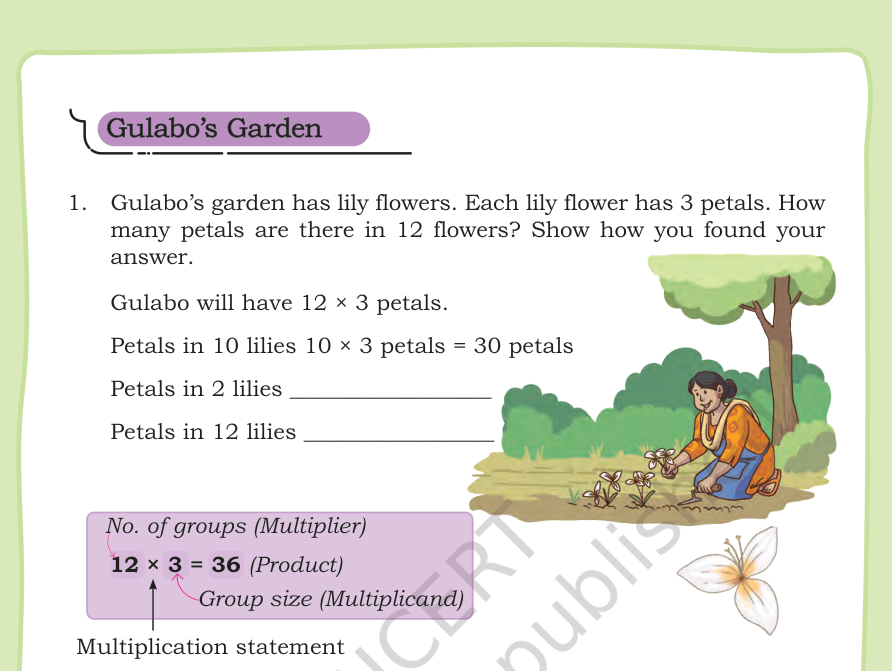
Gulabo's garden has lily flowers. Each lily flower has 3 petals. How many petals are there in 12 flowers? Show how you found your answer. Petals in 10 lilies = 10 × 3 = 30 petals Petals in 2 lilies = ___ Petals in 12 lilies = ___
Original NCERT question visual - PDF page 4
Solution
Petals in 2 lilies = 2 × 3 = 6. Petals in 12 lilies = 30 + 6 = 36. So, 12 × 3 = 36 petals.
Question 2NCERT PDF page 4
In a hibiscus flower there are 5 petals. Gulabo counted all the petals and found them to be 80. How many flowers did she have? 5 petals – 1 flower; 10 petals – 2 flowers; 50 petals – 10 flowers. Then, 80 petals are ___ flowers.
Original NCERT question visual - PDF page 4
Solution
80 – 50 = 30 petals are 6 more flowers, so 80 petals are 10 + 6 = 16 flowers.
Question 3NCERT PDF page 5
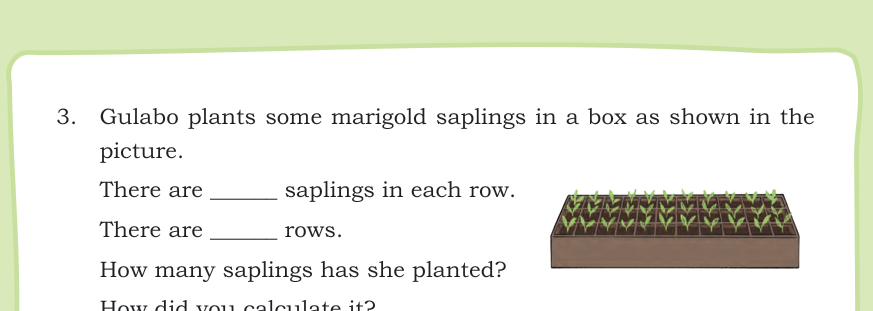
Gulabo plants some marigold saplings in a box as shown in the picture. There are ___ saplings in each row. There are ___ rows. How many saplings has she planted? How did you calculate it? Write the mathematical statement.
Original NCERT question visual - PDF page 5
Solution
There are 11 saplings in each row and 3 rows. She has planted 3 × 11 = 33 saplings. (11 + 11 + 11 = 33)
Question 4NCERT PDF page 5
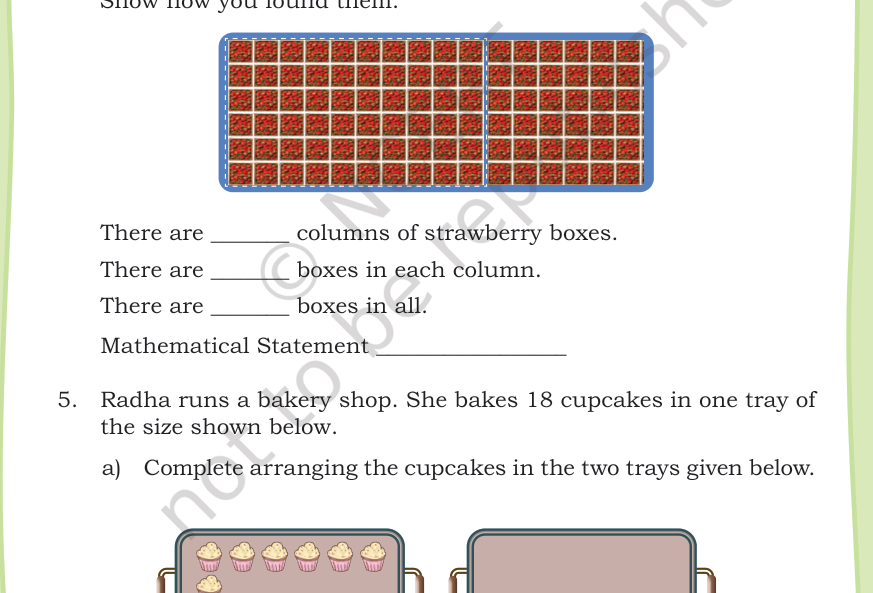
"Dailyfresh" supermarket has kept boxes of strawberries in a big tray. How many boxes of strawberries does the supermarket have? Show how you found them. There are ___ columns of strawberry boxes. There are ___ boxes in each column. There are ___ boxes in all.
Original NCERT question visual - PDF page 5
Solution
There are 16 columns with 6 boxes in each column. 10 columns have 10 × 6 = 60 boxes and 6 columns have 6 × 6 = 36 boxes. In all, 16 × 6 = 60 + 36 = 96 boxes.
Question 5NCERT PDF page 5
Radha runs a bakery shop. She bakes 18 cupcakes in one tray of the size shown. a) Complete arranging the cupcakes in the two trays.
Original NCERT question visual - PDF page 5
Solution
Each tray holds 3 rows of 6 cupcakes: 3 × 6 = 18. Fill the first tray to 3 full rows of 6 and draw the same 3 rows of 6 in the second tray.
Question 6NCERT PDF page 6
b) Radha can use two such trays (18 cupcakes each) in her oven at a time. How many cupcakes can she make in one attempt? c) She has made 108 cupcakes for a special order. How many trays has she baked? d) Her square tray holds 36 mini cupcakes. Write the number of columns, the number of cupcakes in each column and the multiplication statement. Find different ways of arranging 36, 8, 12 and 24 cupcakes in rows and columns.
Original NCERT question visual - PDF page 6
Solution
b) 18 + 18 = 36 cupcakes.
c) 108 ÷ 18 = 6 trays (6 × 18 = 108).
d) 6 columns, 6 cupcakes in each column: 6 × 6 = 36.
The Doubling Magic: Magician Anvi pulled out 23 flowers. After her magic, how many flowers are there now? What magic did Anvi do? Complete the table. Flowers before magic: 23, 10, 51, 95, 150, 199, 425, 500, ___, ___, ___ Flowers after magic: 46, ___, ___, ___, ___, ___, ___, ___, 222, 410, 500 Also find: a) Double of 32 b) Double of 14 c) Double of 26 d) Double of 17 e) Double of 39 f) Double of 45
Original NCERT question visual - PDF page 7
Solution
There are now 46 flowers. Anvi doubled the number of flowers.
Before magic for the last three: 111 → 222, 205 → 410, 250 → 500.
a) 64 b) 28 c) 52 d) 34 e) 78 f) 90
Question 1NCERT PDF page 7
Guess what will be the ones digit of the following numbers when doubled. a) 28 b) 56 c) 45 d) 17
Original NCERT question visual - PDF page 7
Solution
a) 6 (56) b) 2 (112) c) 0 (90) d) 4 (34)
Question 2NCERT PDF page 7
Give examples of numbers that when doubled give the following digits in the ones place: a) 0 b) 2 c) 4 d) 6 e) 8 Can we get 3, 5, 7, 9 as the ones digit after doubling? What do we notice about the numbers we get after doubling – even or odd?
Original NCERT question visual - PDF page 7
Solution
a) 0: 5, 10, 15 b) 2: 1, 6, 11 c) 4: 2, 7, 12 d) 6: 3, 8, 13 e) 8: 4, 9, 14
No, 3, 5, 7 and 9 never come in the ones place after doubling. Doubling always gives an even number.
Question 3NCERT PDF page 8
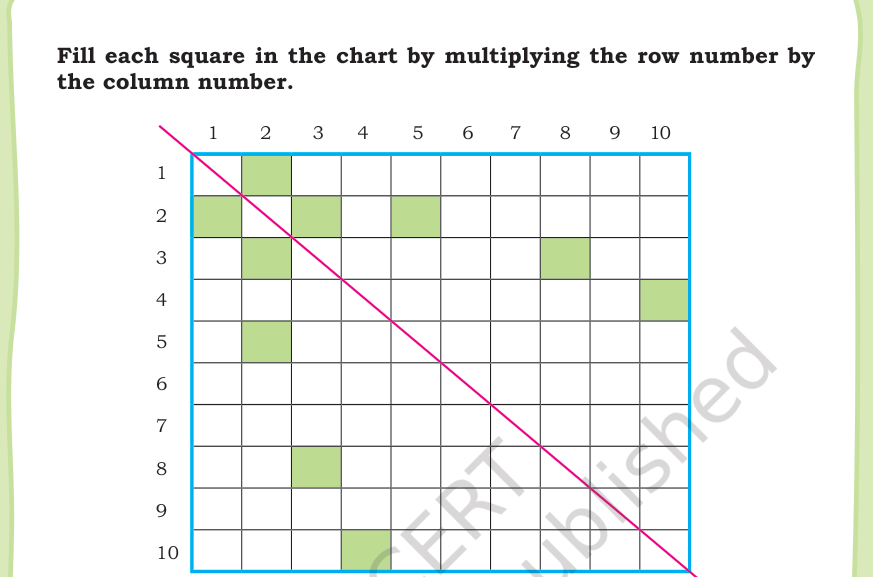
Fill each square in the chart (rows and columns 1 to 10) by multiplying the row number by the column number. What do you notice about the numbers shaded in green? Why is this happening?
Original NCERT question visual - PDF page 8
Solution
The green numbers (on the diagonal) are 1, 4, 9, 16, 25, 36, 49, 64, 81, 100 – a number multiplied by itself (square numbers).
Question 1NCERT PDF page 8
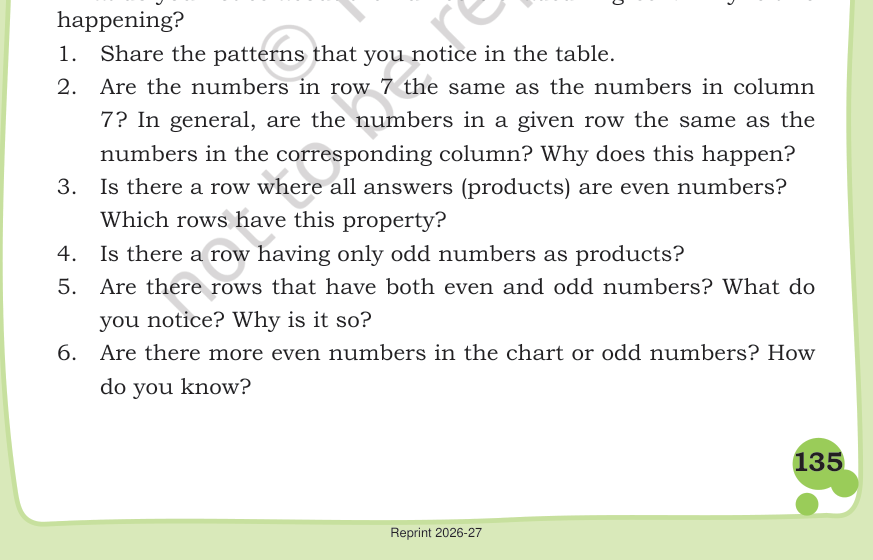
Share the patterns that you notice in the table.
Original NCERT question visual - PDF page 8
Solution
Each row goes up by the row number; the table is the same on both sides of the diagonal; row 5 ends in 5 or 0; row 10 ends in 0.
Question 2NCERT PDF page 8
Are the numbers in row 7 the same as the numbers in column 7? In general, are the numbers in a given row the same as the numbers in the corresponding column? Why does this happen?
Original NCERT question visual - PDF page 8
Solution
Yes, row 7 and column 7 are the same because 7 × 3 = 3 × 7 (order does not change the product).
Question 3NCERT PDF page 8
Is there a row where all answers (products) are even numbers? Which rows have this property?
Original NCERT question visual - PDF page 8
Solution
Yes. Rows 2, 4, 6, 8 and 10 have only even products.
Question 4NCERT PDF page 8
Is there a row having only odd numbers as products?
Original NCERT question visual - PDF page 8
Solution
No row has only odd products (every row has even products like ×2).
Question 5NCERT PDF page 8
Are there rows that have both even and odd numbers? What do you notice? Why is it so?
Original NCERT question visual - PDF page 8
Solution
Yes, rows 1, 3, 5, 7 and 9 have both even and odd products: odd × odd = odd, odd × even = even.
Question 6NCERT PDF page 8
Are there more even numbers in the chart or odd numbers? How do you know?
Original NCERT question visual - PDF page 8
Solution
More even numbers: 75 even and 25 odd products, because a product is odd only when both numbers are odd (5 × 5 = 25 cases).
Question 7NCERT PDF page 9
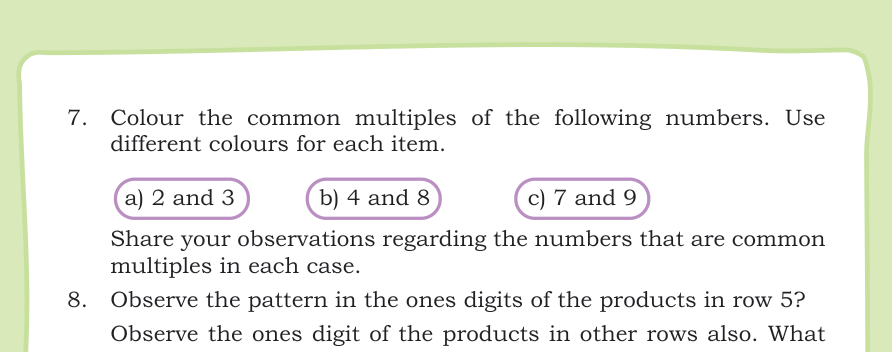
Colour the common multiples of the following numbers. Use different colours for each item. a) 2 and 3 b) 4 and 8 c) 7 and 9 Share your observations regarding the numbers that are common multiples in each case.
Original NCERT question visual - PDF page 9
Solution
a) 2 and 3: 6, 12, 18, 24, … (multiples of 6) b) 4 and 8: 8, 16, 24, 32, … (multiples of 8) c) 7 and 9: 63 (and 126 beyond the chart). Common multiples of two numbers are multiples of a bigger number.
Question 8NCERT PDF page 9
Observe the pattern in the ones digits of the products in row 5? Observe the ones digit of the products in other rows also. What patterns do you notice?
Original NCERT question visual - PDF page 9
Solution
Row 5: ones digits are 5, 0, 5, 0, … Other rows also repeat, e.g. row 2: 2, 4, 6, 8, 0; row 4: 4, 8, 2, 6, 0.
Question 9Fill in the blanksNCERT PDF page 9
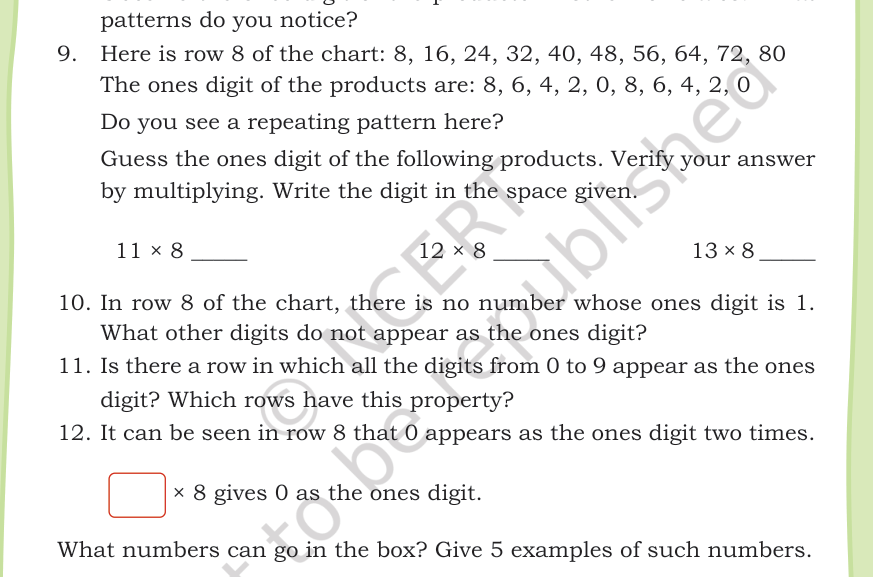
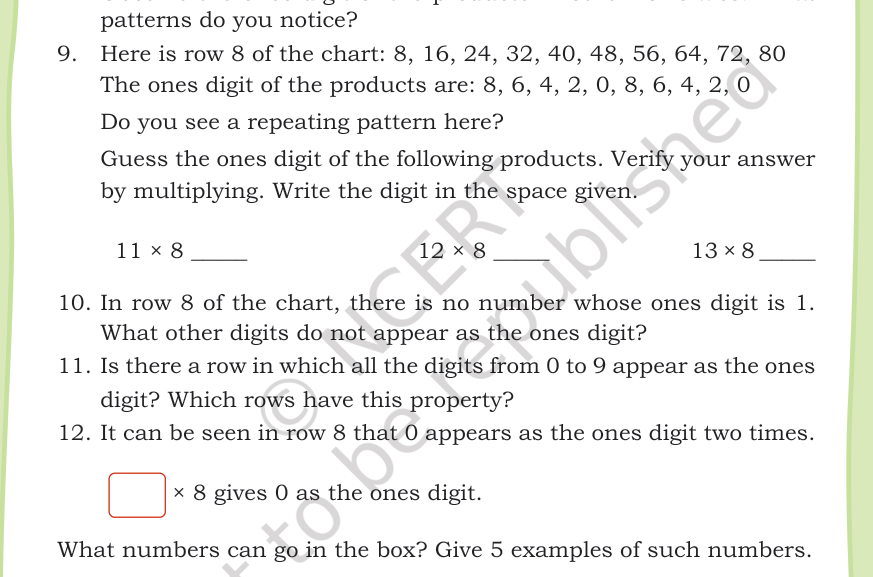
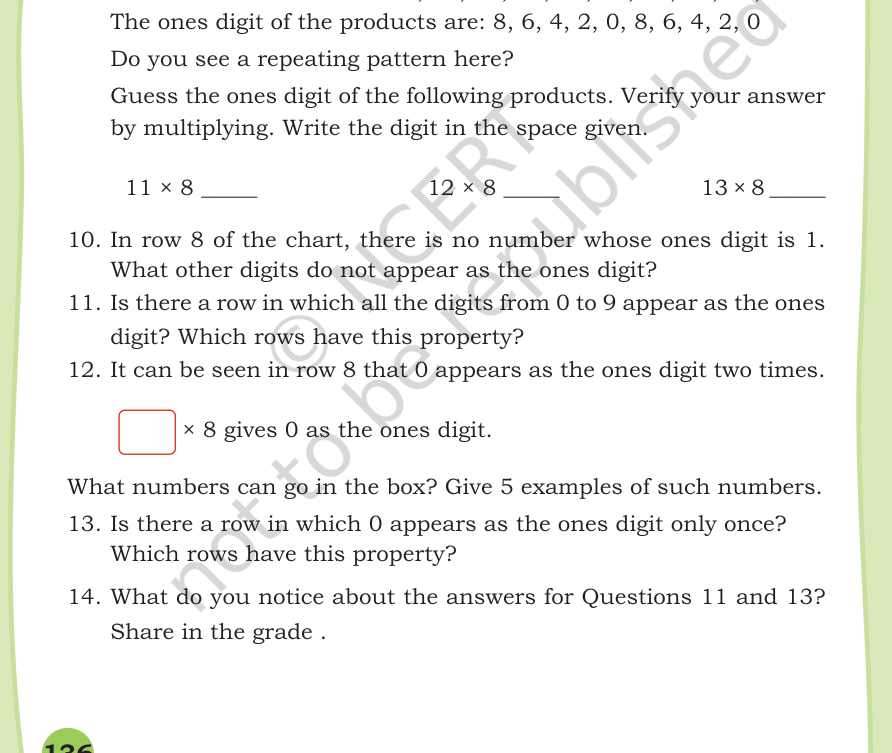
Here is row 8 of the chart: 8, 16, 24, 32, 40, 48, 56, 64, 72, 80 The ones digit of the products are: 8, 6, 4, 2, 0, 8, 6, 4, 2, 0 Do you see a repeating pattern here? Guess the ones digit of the following products. Verify your answer by multiplying. Write the digit in the space given. 11 × 8 _____ 12 × 8 _____ 13 × 8 _____
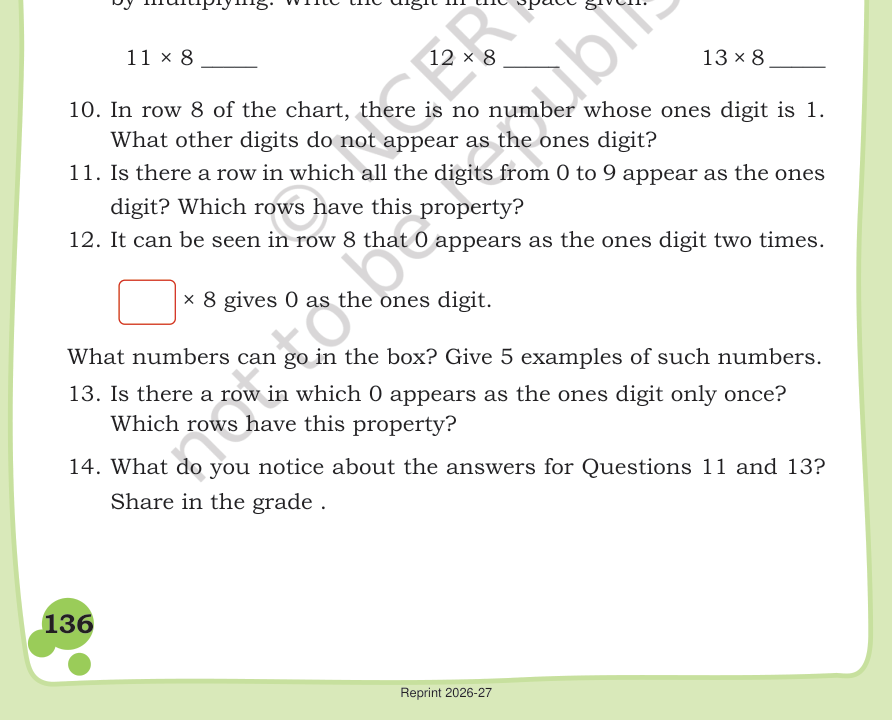
In row 8 of the chart, there is no number whose ones digit is 1. What other digits do not appear as the ones digit?
Original NCERT question visual - PDF page 9
Solution
1, 3, 5, 7 and 9 never appear as ones digits in row 8.
Question 11NCERT PDF page 9
Is there a row in which all the digits from 0 to 9 appear as the ones digit? Which rows have this property?
Original NCERT question visual - PDF page 9
Solution
Yes, rows 1, 3, 7 and 9 have all the digits 0–9 in the ones place.
Question 12NCERT PDF page 9
It can be seen in row 8 that 0 appears as the ones digit two times. ☐ × 8 gives 0 as the ones digit. What numbers can go in the box? Give 5 examples of such numbers.
Original NCERT question visual - PDF page 9
Solution
5, 10, 15, 20, 25 (any multiple of 5).
Question 13NCERT PDF page 9
Is there a row in which 0 appears as the ones digit only once? Which rows have this property?
Original NCERT question visual - PDF page 9
Solution
Yes, rows 1, 3, 7 and 9.
Question 14NCERT PDF page 9
What do you notice about the answers for Questions 11 and 13? Share in the grade .
Original NCERT question visual - PDF page 9
Solution
They are the same rows (1, 3, 7, 9) – the numbers that are not multiples of 2 or 5.
Question 1NCERT PDF page 10
Let us count the number of wheels in tricycles (3 wheels each). Wheels in 10 tricycles = 10 × 3 = ___ Wheels in 10 more tricycles = 10 × 3 = ___ Wheels in 20 tricycles = 20 × 3 = ___ + ___ = ___
Let us count the number of wheels in cars (4 wheels each). Wheels in 10 cars = 10 × 4 = ___. Wheels in 30 cars = 30 × 4 = ___ + ___ + ___ = ___. What happens when the number of groups is a multiple of 10? Solve in a similar way: a) 10 × 6 b) 40 × 6 c) 10 × 8 d) 60 × 8 e) 6 × 8 f) 60 × 8 g) 4 × 6 h) 40 × 8
Original NCERT question visual - PDF page 10
Solution
10 × 4 = 40 wheels; 30 cars = 40 + 40 + 40 = 120 wheels. a) 60 b) 240 c) 80 d) 480 e) 48 f) 480 g) 24 h) 320. When the number of groups is a multiple of 10, multiply the single digits and add a 0.
Question 1NCERT PDF page 11
Radha is packing cupcakes in boxes of 4. She has packed 18 boxes. How many cupcakes are there in the packed boxes? 10 boxes contain 10 × 4 = ___ cupcakes. 8 boxes contain 8 × 4 = ___ cupcakes. 18 boxes contain ___ + ___ = ___ cupcakes.
Original NCERT question visual - PDF page 11
Solution
10 × 4 = 40; 8 × 4 = 32; 40 + 32 = 72 cupcakes.
Question 2NCERT PDF page 11
8 bamboo rods are needed to make a bullock cart. How many bamboo rods are needed for 23 carts?
Original NCERT question visual - PDF page 11
Solution
20 carts need 20 × 8 = 160 rods; 3 carts need 3 × 8 = 24 rods. So 23 carts need 160 + 24 = 184 bamboo rods.
Question 1NCERT PDF page 12
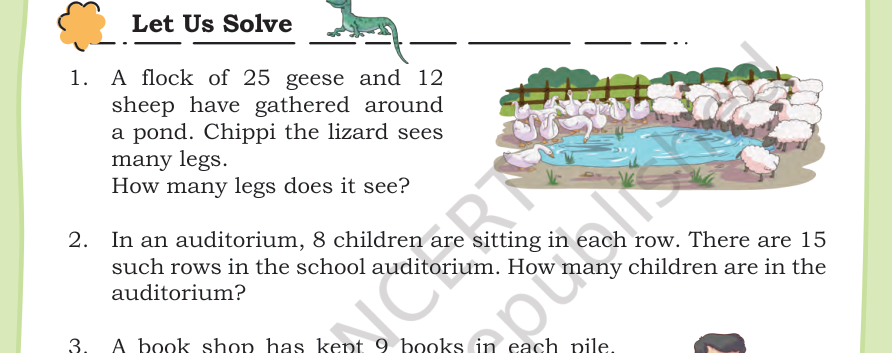
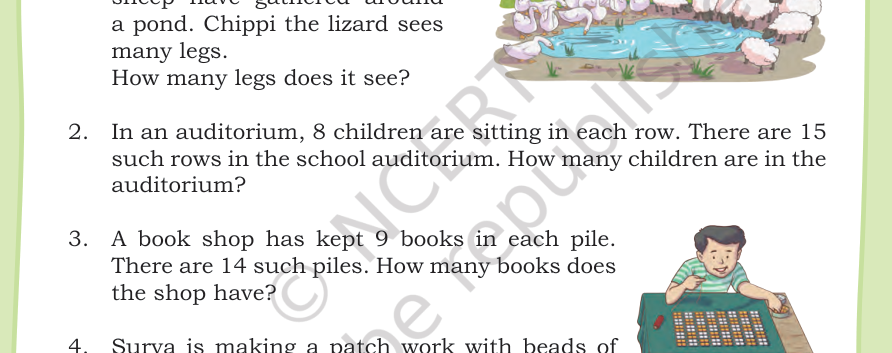
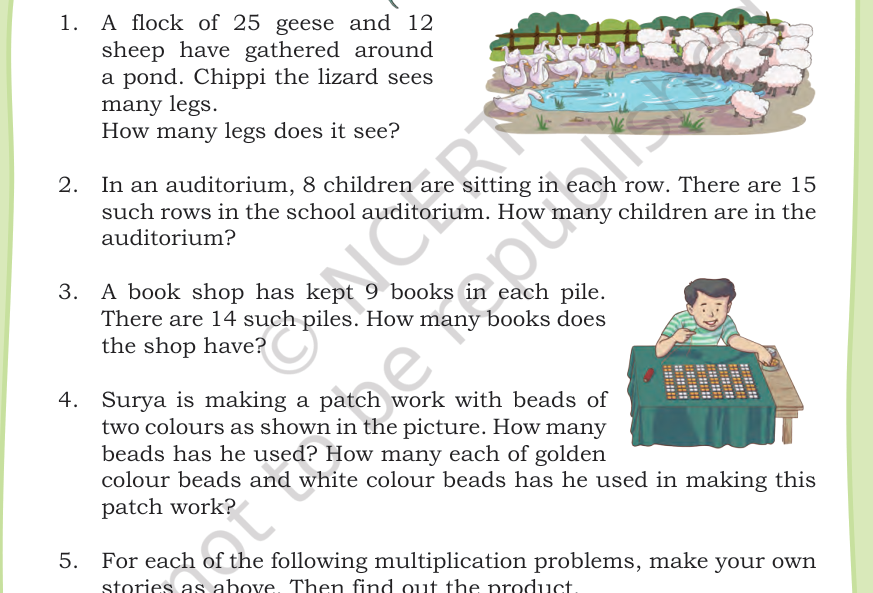
A flock of 25 geese and 12 sheep have gathered around a pond. Chippi the lizard sees many legs. How many legs does it see?
In an auditorium, 8 children are sitting in each row. There are 15 such rows in the school auditorium. How many children are in the auditorium?
Original NCERT question visual - PDF page 12
Solution
15 × 8 = 120 children.
Question 3NCERT PDF page 12
A book shop has kept 9 books in each pile. There are 14 such piles. How many books does the shop have?
Original NCERT question visual - PDF page 12
Solution
14 × 9 = 126 books.
Question 4NCERT PDF page 12
Surya is making a patch work with beads of two colours as shown in the picture. How many beads has he used? How many golden beads and how many white beads has he used?
Original NCERT question visual - PDF page 12
Solution
The patch has 10 rows of 16 beads: 10 × 16 = 160 beads. The beads are in blocks of 4 (2 × 2), with 40 blocks in a checker pattern – 20 golden blocks and 20 white blocks. So golden beads = 20 × 4 = 80 and white beads = 20 × 4 = 80. (80 + 80 = 160)
Question 5NCERT PDF page 12
For each of the following multiplication problems, make your own stories as above. Then find out the product. a) 34 × 3 b) 75 × 5 c) 46 × 6 d) 50 × 9
Original NCERT question visual - PDF page 12
Solution
a) 34 × 3 = 102 b) 75 × 5 = 375 c) 46 × 6 = 276 d) 50 × 9 = 450. Story for a): 3 boxes have 34 pencils each – 102 pencils in all.
Question 1NCERT PDF page 13
A factory has ordered 58 wheels for the small tempos that they make. Each tempo has 3 wheels. In how many tempos can they fix the wheels?
Original NCERT question visual - PDF page 13
Solution
Number of tempos = 58 ÷ 3. 30 wheels for 10 tempos (28 left), 15 wheels for 5 tempos (13 left), 9 wheels for 3 tempos (4 left), 3 wheels for 1 tempo (1 left). So 10 + 5 + 3 + 1 = 19 tempos, and 1 wheel is left over.