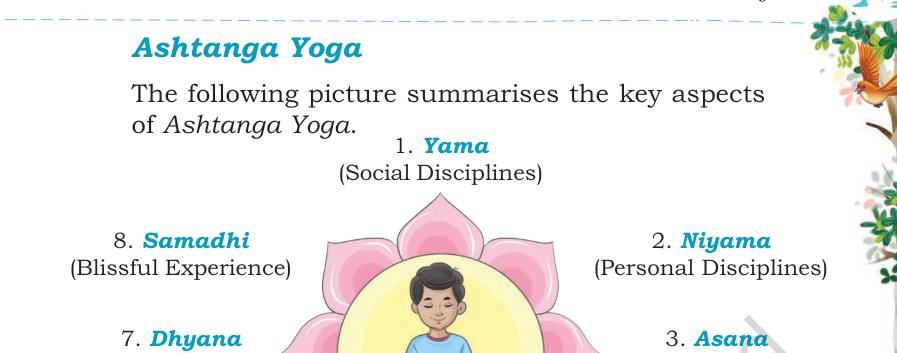
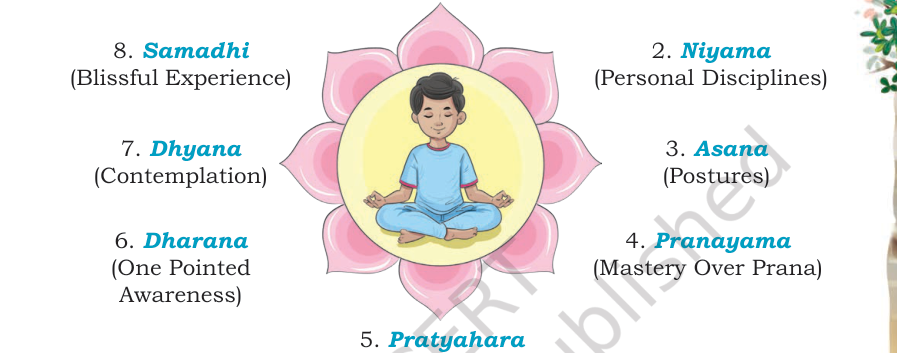
What is the fifth limb of Ashtanga Yoga? What is the meaning of the shloka in praise of Patanjali?
Original NCERT question visual - PDF page 7
Answer
5. Pratyahara — mastery over the senses.
The eight limbs in order: Yama, Niyama, Asana, Pranayama, Pratyahara, Dharana, Dhyana, Samadhi.
Meaning of the shloka (Yogena cittasya…): I bow to the great sage Patanjali, who purified the mind through Yoga, speech through grammar and the body through Ayurveda.
Question 1NCERT PDF page 10
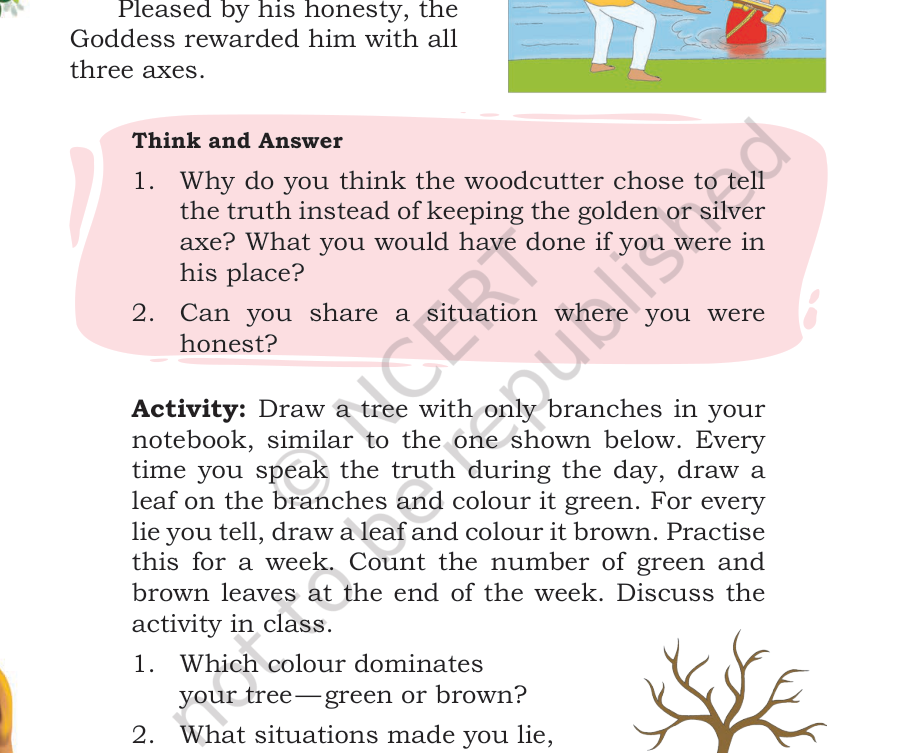
Satya activity: Draw a tree with only branches. For every truth you speak in a day, draw a green leaf; for every lie, draw a brown leaf. Do this for a week. Which colour dominates your tree — green or brown?
Original NCERT question visual - PDF page 10
Answer
(sample answer) My tree is mostly green — I counted 30 green leaves and 4 brown leaves, because I tried to be truthful most of the time.
Question 2NCERT PDF page 10
What situations made you lie, and why?
Original NCERT question visual - PDF page 10
Answer
(sample answer) I lied once about finishing my homework, because I was afraid of being scolded. I should have told the truth.
Question 3NCERT PDF page 10
What did you learn from this activity?
Original NCERT question visual - PDF page 10
Answer
(sample answer) I learnt that telling the truth makes me feel light and trusted, while lies make me worried. I want my tree to be fully green.
Question 1NCERT PDF page 11
What is Saucha?
Original NCERT question visual - PDF page 11
Answer
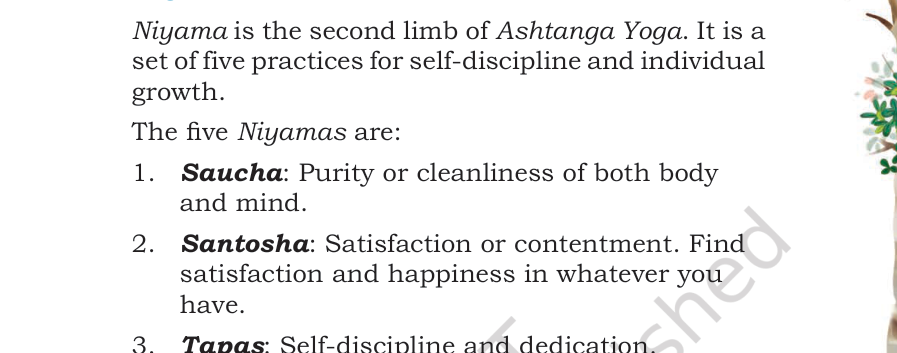
Saucha is the first Niyama. It means purity or cleanliness of both body and mind.
Question 2NCERT PDF page 11
What is Santosha?
Original NCERT question visual - PDF page 11
Answer
Santosha means satisfaction or contentment — finding satisfaction and happiness in whatever you have.
Question 3NCERT PDF page 11
What is Tapas?
Original NCERT question visual - PDF page 11
Answer
Tapas means self-discipline and dedication.
Question 4NCERT PDF page 11
What is Swadhyaya?
Original NCERT question visual - PDF page 11
Answer
Swadhyaya means studying daily and reading inspiring books.
Question 5NCERT PDF page 11
What is Ishvarapranidhana? What is Niyama?
Original NCERT question visual - PDF page 11
Answer
Ishvarapranidhana means dedicating your deeds to God.
Niyama is the second limb of Ashtanga Yoga — a set of five practices for self-discipline and personal growth: Saucha, Santosha, Tapas, Swadhyaya and Ishvarapranidhana.
Question 6NCERT PDF page 13
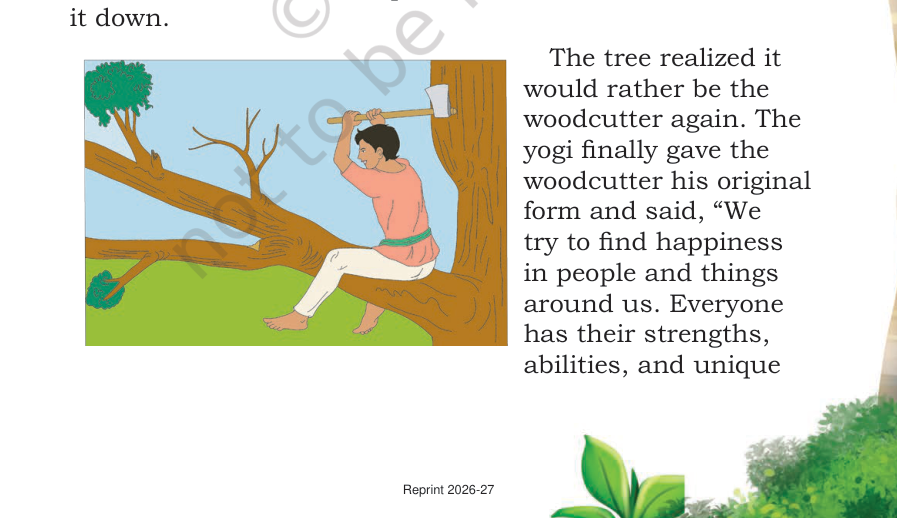
In the story ‘In Search of Happiness’, what did the woodcutter wish to become one after another, and what did the yogi teach him at the end?
Original NCERT question visual - PDF page 13
Answer
Seeing a rich man, he wished to be rich.
Seeing the king, he wished to be a king.
Unable to bear the hot sun, he wished to be the sun.
When clouds covered the sun, he wished to be a cloud.
When the rain could not move a strong tree, he wished to be a tree.
When a woodcutter came to chop the tree, he wished to be a woodcutter again.
The yogi taught him that we keep looking for happiness in people and things around us, but everyone has their own strengths, abilities and nature. We should be content with ourselves and what we have instead of always wishing for something else.
Question 1NCERT PDF page 14
Why do you think the woodcutter was never satisfied with what he had?
Original NCERT question visual - PDF page 14
Answer
He kept comparing himself with others and always thought someone else was richer or stronger, so every time he got a wish he wanted something more. He did not value what he already had.
Question 2NCERT PDF page 14
What did you learn from the story?
Original NCERT question visual - PDF page 14
Answer
I learnt that wanting more and more brings unhappiness. Santosha — being content with ourselves and what we have — brings peace and joy.
Question 3NCERT PDF page 14
Santosha activity: Discuss what you wish to have (a toy, a bicycle, a dress, a trip, special food). Then write or draw five things you already have that make you happy.
Original NCERT question visual - PDF page 14
Answer
(sample answer) I wish for a new bicycle. Five things I already have that make me happy: my family, my best friend, my storybooks, my cricket bat and my pet cat.
Question 1NCERT PDF page 14
What makes you really happy?
Original NCERT question visual - PDF page 14
Answer
(sample answer) Playing with my friends, spending time with my family and helping others make me really happy.
Question 2NCERT PDF page 14
Does wanting more stop you from enjoying what you already have?
Original NCERT question visual - PDF page 14
Answer
(sample answer) Yes. When I keep thinking about a new toy, I forget to enjoy the toys and books I already have.
Question 3NCERT PDF page 14
Do you always try to fulfil your desires, or do you enjoy what you already have?
Original NCERT question visual - PDF page 14
Answer
(sample answer) I try to enjoy what I already have, and I ask only for things I really need.