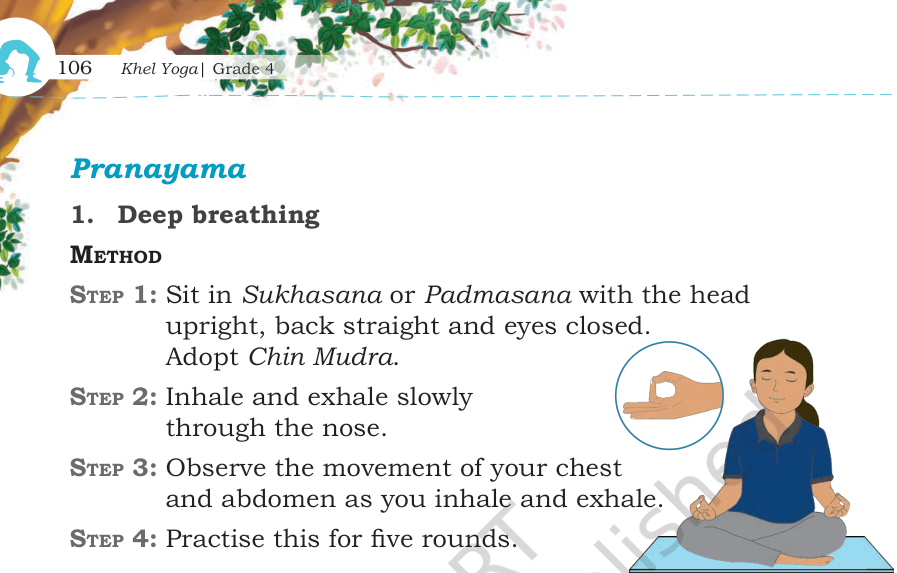
Sit in Sukhasana or Padmasana with the head upright, back straight and eyes closed. Keep the hands in Chin Mudra.
Inhale and exhale slowly through the nose.
Observe the movement of your chest and abdomen as you breathe in and out.
Practise for five rounds.
Question 2NCERT PDF page 34
Write the method of Om chanting.
Original NCERT question visual - PDF page 34
Answer
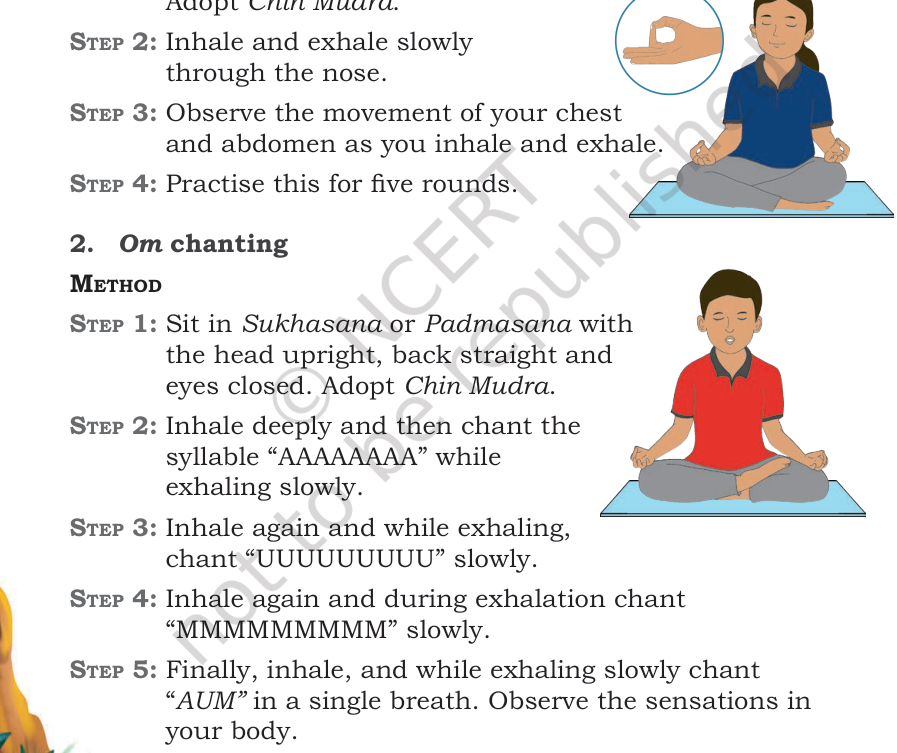
Sit in Sukhasana or Padmasana, head upright, back straight, eyes closed, hands in Chin Mudra.
Inhale deeply and chant “AAAA…” while exhaling slowly.
Inhale again and chant “UUUU…” while exhaling.
Inhale again and chant “MMMM…” while exhaling.
Finally inhale and chant “AUM” in a single breath while exhaling slowly. Observe the sensations in your body.
Practise for five rounds.
Question 3NCERT PDF page 35
Write the method of Anuloma Viloma Pranayama.
Original NCERT question visual - PDF page 35
Answer
Sit in Sukhasana or Padmasana with the head upright, back straight and eyes closed.
Make Nasika Mudra with the right hand; keep the left hand on the left thigh in Chin Mudra.
Close the right nostril with the right thumb and inhale slowly through the left nostril.
Close the left nostril with the ring and little fingers and exhale through the right nostril.
Inhale through the right nostril, close it, and exhale through the left nostril.
This is one round. Repeat for five rounds.
Question 4NCERT PDF page 35
Write the method of Bhramari Pranayama.
Original NCERT question visual - PDF page 35
Answer
Sit in Sukhasana or Padmasana with the head upright, back straight and eyes closed.
Gently close the ears by pressing the tragus (small flap at the front of the ear) with the index fingers.
Inhale deeply through the nose.
Exhale slowly making the humming sound of a bee (MMMM). Feel the vibrations in your head.
Repeat for five rounds.
Question 5NCERT PDF page 36
What are Hasta Mudras? Identify the two mudras shown in the pictures.
Original NCERT question visual - PDF page 36
Answer
Hasta Mudras are special ways of positioning the hands and fingers during Pranayama or Dhyana. For example, in Chin Mudra the tip of the index finger gently touches the tip of the thumb; it helps calm the mind and improve concentration.
First picture (index and middle fingers folded, thumb, ring and little fingers straight): Nasika Mudra.
Second picture (both palms joined together): Namaskara Mudra.
Question 1NCERT PDF page 37
What are Kriyas? What is Karnarandra Dhauti, and how is it done?
Original NCERT question visual - PDF page 37
Answer
Kriyas are yogic techniques that clean the body from within.
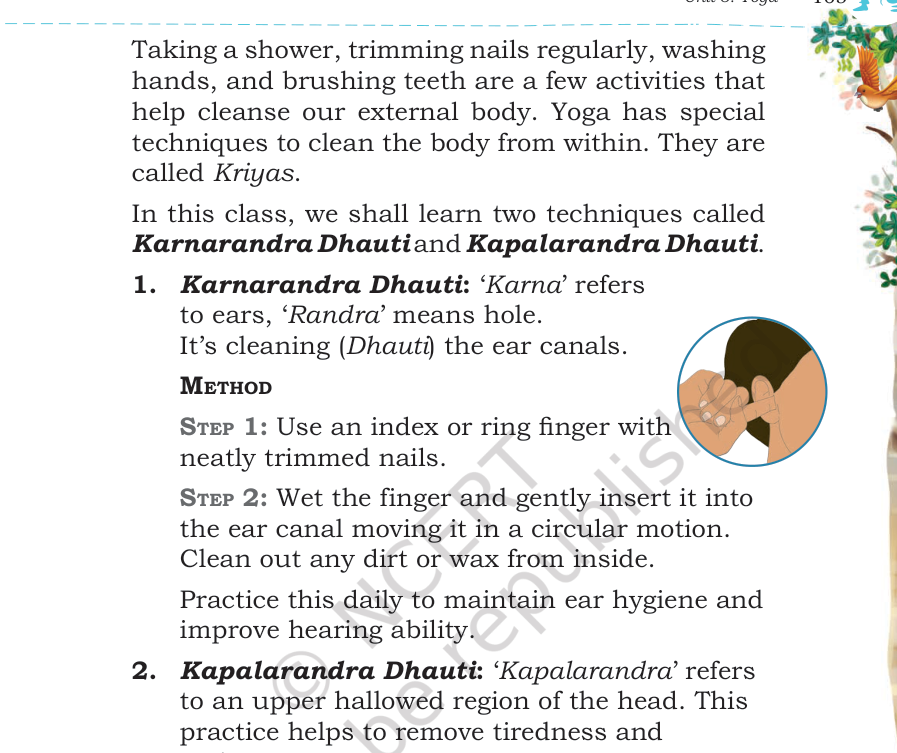
Karnarandra Dhauti: ‘Karna’ means ear and ‘Randra’ means hole — it is cleaning the ear canals.
Use the index or ring finger with neatly trimmed nails.
Wet the finger, gently insert it into the ear canal and move it in a circular motion to clean out dirt or wax.
Practised daily, it keeps the ears clean and improves hearing.
Question 2NCERT PDF page 37
What is Kapalarandra Dhauti, and how is it done?
Original NCERT question visual - PDF page 37
Answer
‘Kapalarandra’ is the upper hollow region of the head. This practice removes tiredness and makes us active.
Make a cup with the right palm and fill some water in it.
Bend forward slightly and gently pat the middle of the head 3 to 4 times with the wet palm, so that the hair also becomes wet.
It is done daily while bathing in the morning.
Question 1NCERT PDF page 38
Krida Yoga: Which limb of Ashtanga Yoga do these yogic games develop, and what is their purpose?
Original NCERT question visual - PDF page 38
Answer
They develop Dharana, the sixth limb of Ashtanga Yoga, which means focusing the mind on one thing. The games reduce distractions and are meant to improve attention and concentration.
Question 2NCERT PDF page 38
Lakshyam: How are the students grouped?
Original NCERT question visual - PDF page 38
Answer
The students are put in pairs.
Question 3NCERT PDF page 38
Lakshyam: What does the first student of the pair hold?
Original NCERT question visual - PDF page 38
Answer
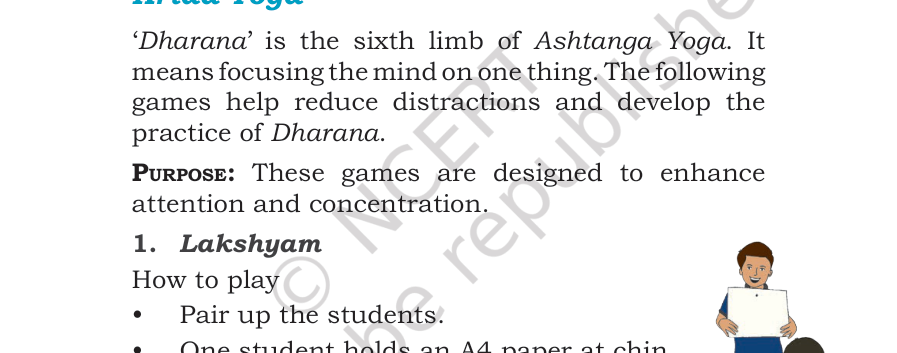
An A4 sheet of paper with a dot marked on it, held at chin level.
Question 4NCERT PDF page 38
Lakshyam: Where does the other student stand, and what must they do?
Original NCERT question visual - PDF page 38
Answer
They stand 5 feet away and focus only on the dot.
Question 5NCERT PDF page 38
Lakshyam: How does the student holding the paper try to distract the other?
Original NCERT question visual - PDF page 38
Answer
By making funny faces.
Question 6NCERT PDF page 39
Lakshyam: What must the second student try to do?
Original NCERT question visual - PDF page 39
Answer
Keep the focus on the dot without laughing at the distractions.
Question 7NCERT PDF page 39
Lakshyam: When do the partners switch roles?
Original NCERT question visual - PDF page 39
Answer
After one minute.
Question 8NCERT PDF page 39
Lakshyam: Who is the winner of a pair?
Original NCERT question visual - PDF page 39
Answer
The student who keeps focus on the dot for the longest time.
Question 9NCERT PDF page 39
Lakshyam: How does the game continue after one pair has played?
Original NCERT question visual - PDF page 39
Answer
Another pair plays, and the game continues until the winner is decided.
Question 2NCERT PDF page 39
Kanduka Tadanam: What does the name mean, and what materials are needed?
Original NCERT question visual - PDF page 39
Answer
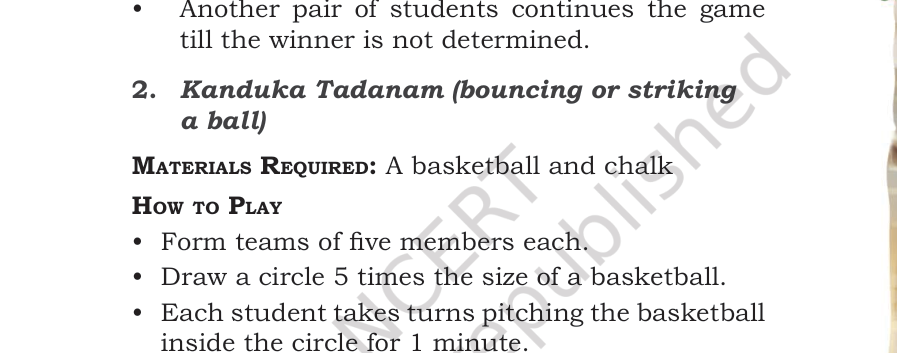
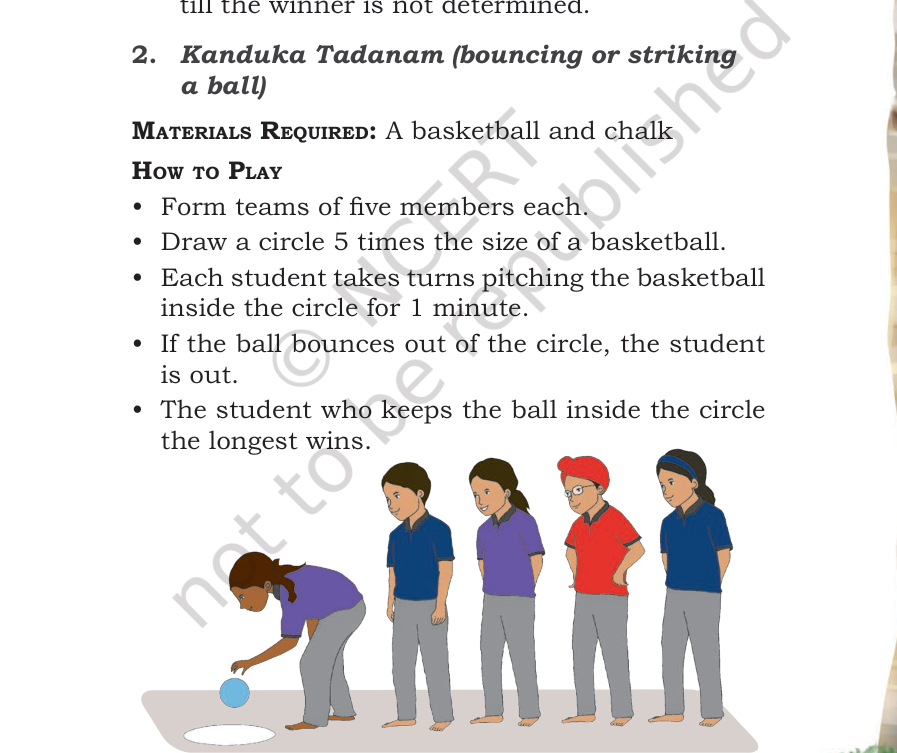
Kanduka Tadanam means bouncing or striking a ball. Materials: a basketball and chalk.
Question 3NCERT PDF page 39
Kanduka Tadanam: How are the teams formed?
Original NCERT question visual - PDF page 39
Answer
Teams of five members each.
Question 4NCERT PDF page 39
Kanduka Tadanam: How big is the circle drawn?
Original NCERT question visual - PDF page 39
Answer
A circle 5 times the size of a basketball is drawn with chalk.
Question 5NCERT PDF page 39
Kanduka Tadanam: What does each student do in their turn?
Original NCERT question visual - PDF page 39
Answer
Each student bounces (pitches) the basketball inside the circle for 1 minute.
Question 6NCERT PDF page 39
Kanduka Tadanam: When is a student out?
Original NCERT question visual - PDF page 39
Answer
When the ball bounces outside the circle.
Question 7NCERT PDF page 39
Kanduka Tadanam: Who wins?
Original NCERT question visual - PDF page 39
Answer
The student who keeps the ball bouncing inside the circle for the longest time.
Question 8NCERT PDF page 46
How many periods does NCF-SE 2023 recommend for physical education, and how many periods a week does the suggested timetable assume?
Original NCERT question visual - PDF page 46
Answer
150 periods in the year. The timetable assumes at least 5 periods of 40 minutes each per week.
Question 9NCERT PDF page 46
What does NCF-SE recommend about block periods?
Original NCERT question visual - PDF page 46
Answer
It recommends block periods (2 periods together) for Physical Education and Well-being.
Question 10NCERT PDF page 46
What are the two scenarios for period allocation? How is a 40-minute period used in the three session types of Scenario 1?
Original NCERT question visual - PDF page 46
Answer
Scenario 1: five single periods per week. Scenario 2: two block periods for motor skills and team games plus one single period for yoga.
Type 1 (more game practice): warm-up 5, game 25, circle time 5 minutes.
Type 2 (more circle time): warm-up 5, game 15, cool-down 5, circle time 15 minutes.
Type 3 (gamified drills on one skill): warm-up 5, game 25, cool-down 5, circle time 5 minutes.
Question 11NCERT PDF page 48
How should you begin a Yoga session?
Original NCERT question visual - PDF page 48
Answer
Sit comfortably in Sukhasana with your back straight.
Close your eyes, relax your face and become aware of your breath.
Place your hands in Chin Mudra, watch your natural breath, then take a deep, slow breath and chant ‘Om’ as you exhale.
Chant the opening prayer at the start of the session (and the closing prayer at the end).
Notice how you feel after chanting.
Rub your palms, place them over your closed eyes and gently open your eyes into the warmth of your hands.
Question 16NCERT PDF page 48
What is the opening prayer of a Yoga session, and what does it mean?
Original NCERT question visual - PDF page 48
Answer
Om Saha Navavatu, Saha Nau Bhunaktu, Saha Viryam Karavavahai, Tejasvinavadhitamastu, Ma Vidvishavahai, Om Shantih Shantih Shantih.
Meaning: May we both (teacher and student) be protected and nourished. May we practise with great energy. May our studies be fruitful and bright. May we not hate each other. Peace, peace, peace.
Question 17NCERT PDF page 49
What are the general instructions to begin and end a Yoga session? What does the closing prayer mean?
Original NCERT question visual - PDF page 49
Answer
Sit in a comfortable Sukhasana.
Keep the back straight, eyes closed and a gentle smile on the face.
Place the hands in Chin Mudra, observe the breath for a few seconds, then breathe in deeply and chant ‘Om’ as you exhale.
Place the hands in Namaskara Mudra and chant the prayer.
Observe the changes after chanting.
Rub the palms, make a cup and place it on the eyes.
Closing prayer (Om Sarve Bhavantu Sukhinah…) means: may all be happy, may all be free from illness, may all see what is good, may no one suffer; let there be peace everywhere.