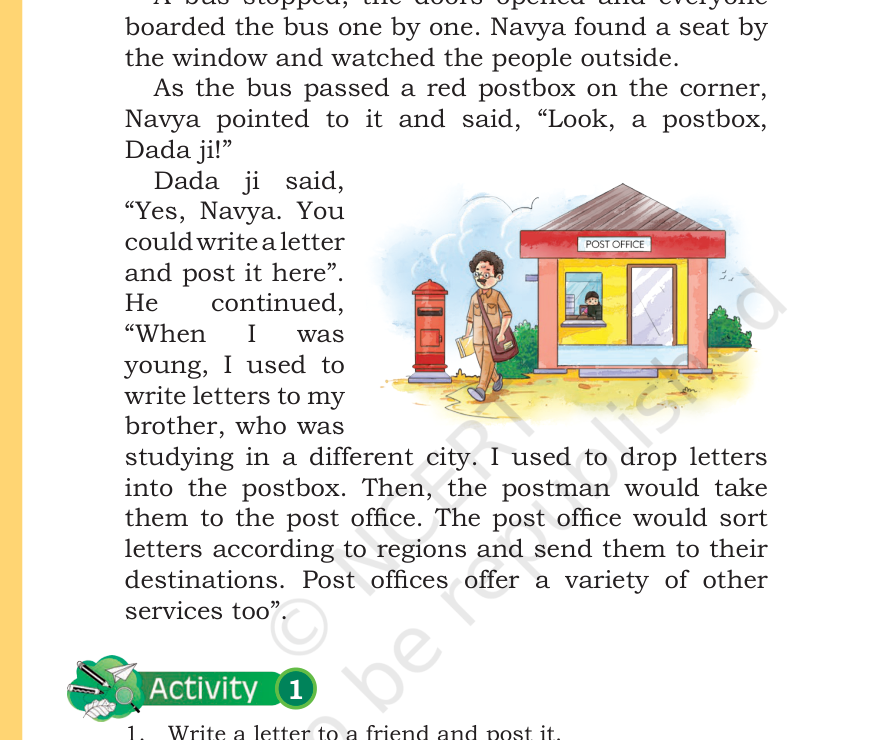
(sample answer) “Dear Riya, I hope you are well. Yesterday we planted saplings in our school park. Please write back and tell me about your school. Your friend, Navya.” Fold the letter, put it in an envelope, write your friend’s address with the PIN code, stick a stamp and drop it in the red postbox.
Question 1NCERT PDF page 3
Have you or your family members ever sent, or received a letter or a parcel?
Original NCERT question visual - PDF page 3
Answer
(sample answer) Yes. My grandmother sends a rakhi to my father by post every year, and we received a parcel of books from my uncle.
Question 2NCERT PDF page 3
How does the post office help people stay connected with each other?
Original NCERT question visual - PDF page 3
Answer
The post office delivers letters and parcels, sends money and provides savings services, so people stay connected even when they live far away.
Question 1Fill in the blanksNCERT PDF page 4
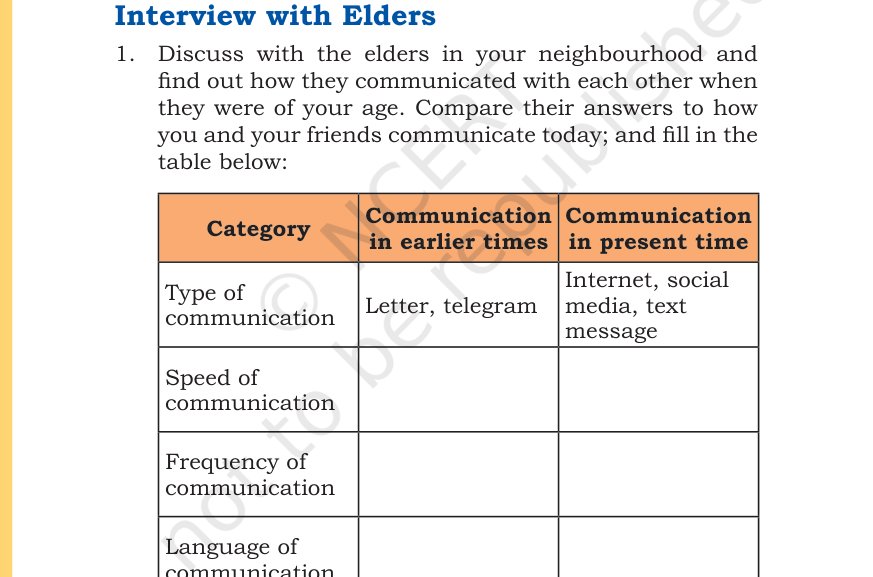
Discuss with the elders in your neighbourhood and find out how they communicated with each other when they were of your age. Compare their answers to how you and your friends communicate today; and fill in the table below: Category | Communication in earlier times | Communication in present time Type of communication | Letter, telegram | Internet, social media, text message Speed of communication | | Frequency of communication | | Language of communication | | Challenges faced | |
Original NCERT question visual - PDF page 4
Answer
Type: earlier — letters, telegrams, messengers; now — internet, social media, text messages, phone and video calls.
Speed: earlier — slow, letters took days or weeks; now — very fast, messages reach in seconds.
Frequency: earlier — rarely, once in a few weeks; now — many times every day.
Language: earlier — long, formal written language in letters; now — short messages, emojis, voice notes, often a mix of languages.
Challenges: earlier — letters got delayed or lost, telegrams were costly; now — need a phone and network, and false news can spread fast.
Question 1NCERT PDF page 5
Letters took a long time to reach other persons. How do you think it affected communication between people in the past?
Original NCERT question visual - PDF page 5
Answer
People had to wait a long time for news. Urgent news reached late, and people felt more anxious and missed each other more.
Question 2NCERT PDF page 5
How is it different from the way people communicate now?
Original NCERT question visual - PDF page 5
Answer
Now we communicate instantly by phone calls, messages and video calls, even with people far away.
Question 3NCERT PDF page 5
Today quick messages make sharing the news easier, but sometimes wrong information spreads very quickly too. How can we ensure the news we share is true?
Original NCERT question visual - PDF page 5
Answer
Check the news from trusted sources like newspapers, official websites or elders, and do not forward messages without checking.
Question 1NCERT PDF page 6
Which mode of transportation do you use the most?
Original NCERT question visual - PDF page 6
Answer
(sample answer) I use the school bus the most. On weekends I ride my bicycle.
Question 2NCERT PDF page 6
Can you identify the structures in the pictures, and explain how they have made travel faster and connectivity better?
Bridge — lets people and vehicles cross a river easily.
Metro train — carries many people quickly across a city.
Aeroplane on a runway — covers very long distances in a few hours.
High-speed (bullet) train — travels very fast between cities.
Ropeway (cable car) — carries people up and across hills and valleys quickly.
Question 3NCERT PDF page 7
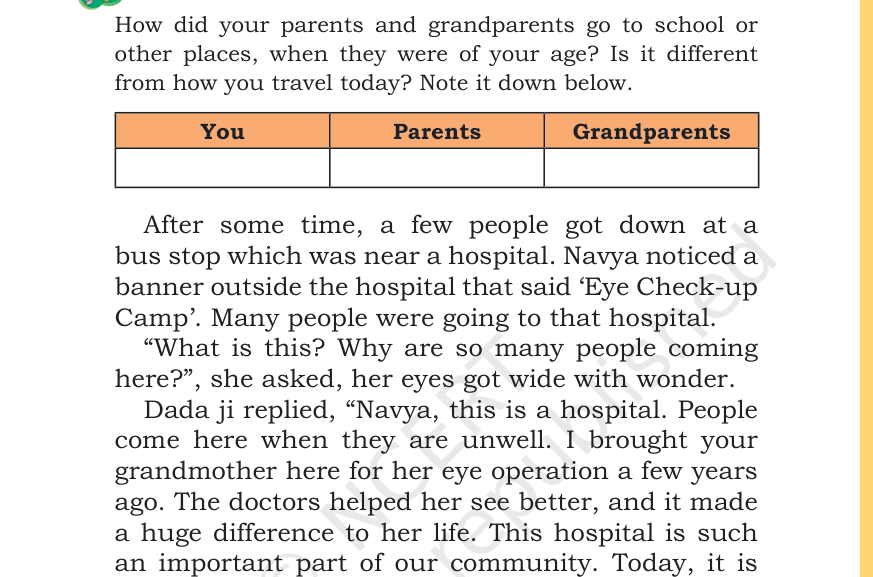
How did your parents and grandparents go to school or other places, when they were of your age? Is it different from how you travel today? Note it down below. You | Parents | Grandparents
Original NCERT question visual - PDF page 7
Answer
(sample answer) You — school bus or e-rickshaw. Parents — bicycle or a crowded bus. Grandparents — walked several kilometres or went by bullock cart. Yes, it is different: travel today is faster and more comfortable.
Question 4Fill in the blanksNCERT PDF page 7
List the people who work at a hospital or a health centre, and write down their role in the following table. One example has been given. People | Role in the Hospital/Health Centre Doctor | Treats patients and prescribes medicines. Nurse | ____
Answer
Nurse — looks after patients, gives medicines and injections, and checks temperature and blood pressure.
Pharmacist — gives out medicines as written by the doctor.
Lab technician — tests blood and other samples.
Ward attendant — helps patients move and keeps the wards clean.
Ambulance driver — brings patients to the hospital quickly.
Receptionist — registers patients and guides them.
Question 4NCERT PDF page 8
What is an ATM? Why do we keep our money in the bank?
Original NCERT question visual - PDF page 8
Answer
An ATM (Automated Teller Machine) is a machine that lets us take out money from our bank account at any time. We keep money in the bank because it is kept safe there, and the bank helps us save money for our future needs.
Question 5NCERT PDF page 9
If you had to send money to someone, which method would you choose — using a phone, Money Order or some other mode? Why?
Original NCERT question visual - PDF page 9
Answer
(sample answer) I would use a phone to send money online, because the money reaches within seconds and I do not have to stand in a queue. A Money Order through the post office takes days to reach.
Question 1NCERT PDF page 9
If you get pocket money, do you save it? If yes, where do you put your savings?
Original NCERT question visual - PDF page 9
Answer
(sample answer) Yes, I save some of my pocket money in a piggy bank. When it is full, my parents help me deposit it in my bank account.
Question 2NCERT PDF page 9
Why do you think it is important to save money?
Original NCERT question visual - PDF page 9
Answer
Saving money helps us in emergencies and lets us buy useful things later.
Question 3NCERT PDF page 9
What are some things you could do to save more money?
Original NCERT question visual - PDF page 9
Answer
Avoid buying junk food and unnecessary toys, save a part of every gift of money and use things carefully.
Question 4NCERT PDF page 9
Request one of your family members to show you their bank passbook. Note the important elements given on the first page of the passbook.
Original NCERT question visual - PDF page 9
Answer
The first page of a passbook shows: bank name, CIF number, account number, IFSC code, customer name, name of father/husband (D/S/O, W/H/O), address, date of birth, e-mail, PAN number, account opening date, mobile number, branch code, branch location and branch e-mail.
Question 1NCERT PDF page 10
Visit a bank in your locality or find out from your elders about how it works. After that, answer the following questions:
Original NCERT question visual - PDF page 10
Answer
(a) People use banks to deposit and withdraw money, send money, take loans and keep valuables in lockers. (b) An ATM gives cash at any time using a bank card and PIN, even when the bank is closed.
Question (a)NCERT PDF page 10
Other than saving money, what else do people use banks for?
Original NCERT question visual - PDF page 10
Answer
People use banks to deposit and withdraw money, take loans, send money, get passbooks and cheque books, and keep valuables in lockers.
Question (b)NCERT PDF page 10
What is an ATM and how does it help people?
Original NCERT question visual - PDF page 10
Answer
An ATM is a machine that gives cash using a bank card and PIN at any time, even when the bank is closed.
Question 2NCERT PDF page 10
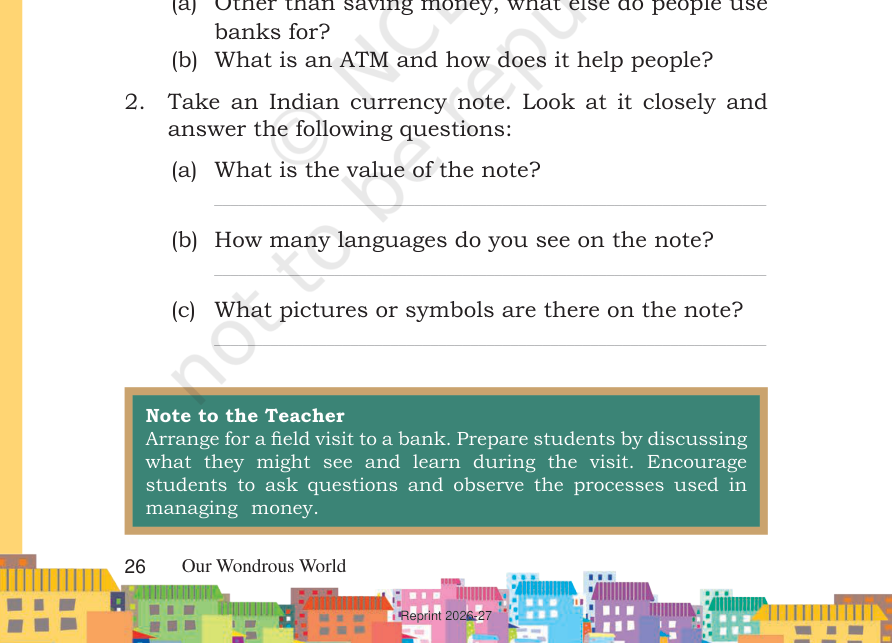
Take an Indian currency note. Look at it closely and answer the following questions:
Original NCERT question visual - PDF page 10
Answer
(sample answer for a ₹100 note) (a) ₹100. (b) 17 languages — Hindi and English, plus 15 other Indian languages in the language panel. (c) Mahatma Gandhi’s picture, the Ashoka Pillar emblem, the ₹ symbol, the RBI Governor’s signature, a picture of a monument and a security thread.
Question (a)NCERT PDF page 10
What is the value of the note?
Original NCERT question visual - PDF page 10
Answer
(sample answer) ₹100 (one hundred rupees).
Question (b)NCERT PDF page 10
How many languages do you see on the note?
Original NCERT question visual - PDF page 10
Answer
The note has Hindi and English on the front and 15 other Indian languages on the back — 17 languages in all.
Question (c)NCERT PDF page 10
What pictures or symbols are there on the note?
Original NCERT question visual - PDF page 10
Answer
Mahatma Gandhi's picture, the Ashoka Pillar emblem, the RBI Governor's signature, a monument picture, numbers and a security thread.
Question 1NCERT PDF page 12
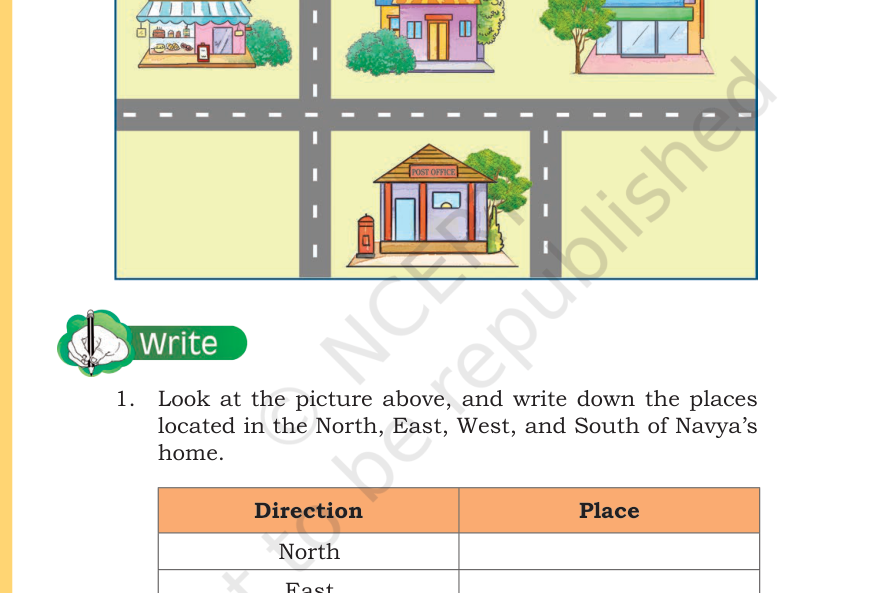
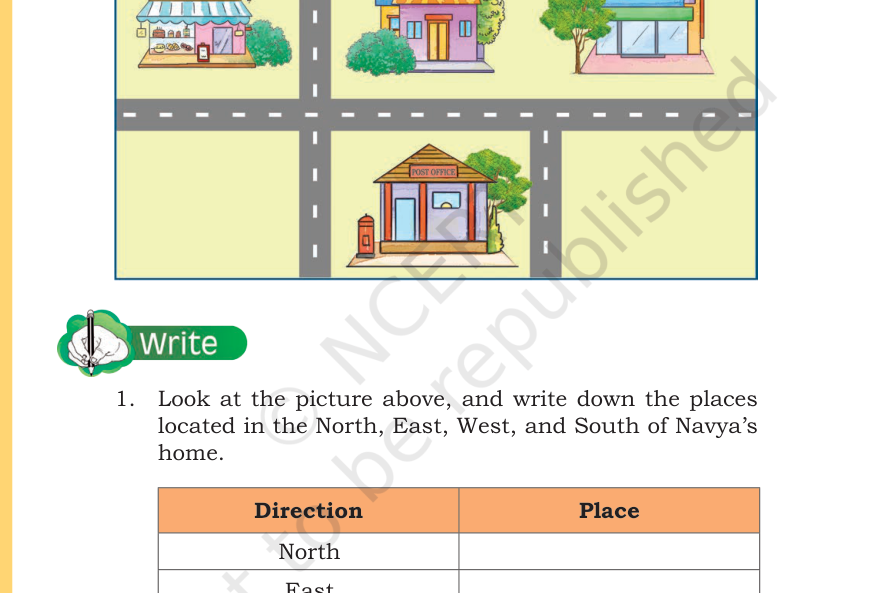
Look at the picture of Navya’s neighbourhood map, and write down the places located in the North, East, West, and South of Navya’s home. Direction | Place North | East | West | South |
Original NCERT question visual - PDF page 12
Answer
North — Hospital
East — Chemist shop
West — Bakery
South — Post office
Question 2NCERT PDF page 12
Look at the picture (a school in the centre with arrows to North, South, East and West), and imagine your school at the centre. Name the buildings or areas near your school and write the direction they are situated in the given spaces.
Original NCERT question visual - PDF page 12
Answer
(sample answer) North — temple; East — park; West — market; South — bus stop.
Question 3NCERT PDF page 13
Imagine you are giving directions to a friend to visit your favourite place near your school. How would you explain it using directions (left, right, forward, backward, etc.) and landmarks? Place: ____ Instruction: ____
Original NCERT question visual - PDF page 13
Answer
(sample answer) Place: the park. Instruction: Come out of the school gate and turn right. Walk straight past the bakery. Turn left at the bus stop. Walk forward a little — the park is on your right, opposite the post office.
Question 4NCERT PDF page 14
Draw a map showing the route from your school to the public library or any such place near your school. Identify landmarks like parks, shops, hospitals, bus stops, etc. on the map.
Original NCERT question visual - PDF page 14
Answer
(sample answer) Draw your school at the bottom of the page and the library at the top. Draw the road between them as a line with arrows. Mark landmarks along the way: a sweet shop next to the school gate, a bus stop where the road turns right, a park on the left and a hospital just before the library. Add N at the top of the page.
Question 1NCERT PDF page 15
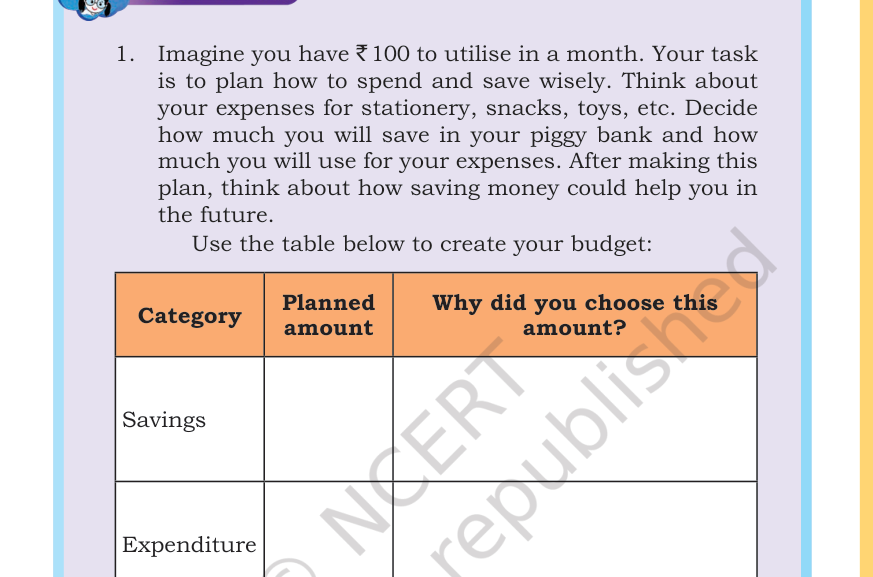
Imagine you have ₹100 to utilise in a month. Your task is to plan how to spend and save wisely. Think about your expenses for stationery, snacks, toys, etc. Decide how much you will save in your piggy bank and how much you will use for your expenses. After making this plan, think about how saving money could help you in the future. Category | Planned amount | Why did you choose this amount? Savings | | Expenditure | |
Original NCERT question visual - PDF page 15
Answer
(sample answer)
Savings — ₹40 — so that I can buy a storybook or help in an emergency later.
Expenditure — ₹60 (stationery ₹30, snacks ₹20, small toy ₹10) — these are the things I need this month.
Total: ₹40 + ₹60 = ₹100. Saving a little every month will help me buy bigger things in the future without asking for money.
Question 2NCERT PDF page 15
Imagine that your group is in charge of making your neighbourhood better. Discuss what new services or facilities you would add or improve. Present how these changes would help everyone in the community.
Original NCERT question visual - PDF page 15
Answer
(sample answer) We would add more dustbins, street lights, a public library and a playground, and repair broken roads. These would keep the area clean, make it safer at night, help children read and play, and make travel easier for everyone.
Question 3NCERT PDF page 15
As a class, take help of the elders around you to list people in your neighbourhood who helped the community during COVID-19. These could include doctors, nurses, garbage collectors, shopkeepers, teachers and others. Discuss how they made the community safer and why it is important to thank them.
Original NCERT question visual - PDF page 15
Answer
Doctors and nurses treated the sick and gave vaccines; garbage collectors and sweepers kept streets clean; shopkeepers and delivery workers supplied food and medicines; police kept order; teachers taught online. They worked even when it was risky for them, so it is important to thank and respect them.