If you had to organise a food festival in your school, which dishes would you like to include? Make a list.
Original NCERT question visual - PDF page 5
Answer
(sample answer) Idli-sambhar, poha, dhokla, litti-chokha, ragi laddu, jowar upma, sprouts salad, fruit chaat, dal-rice and kheer.
Question 2NCERT PDF page 5
Ugadi Pachadi is a traditional food of Andhra Pradesh, Karnataka and Telangana. Which six taste elements is it made with?
Original NCERT question visual - PDF page 5
Answer
Ugadi Pachadi is made with six tastes — sweet (meetha), sour (khatta), salty (namkeen), pungent (teekha), bitter (karva) and astringent (kasaila). In Ayurveda these six tastes are called ‘shad rasa’.
Question 3NCERT PDF page 6
Can you think of at least five ingredients or food items that match each of the tastes listed below? Write them down in the spaces provided. See the example given below: Taste: Sweet | Sour | Salty | Pungent | Bitter | Astringent Ingredients: Jaggery | Tamarind | Salt | Green chilli | Neem | Raw mango Discuss in small groups and identify the food items having at least three different tastes.
Original NCERT question visual - PDF page 6
Answer
Sweet — jaggery, sugar, honey, banana, ripe mango
Sour — tamarind, lemon, curd, raw tomato, kokum
Salty — salt, pickle, papad, salted chips, black salt
Pungent — green chilli, ginger, black pepper, garlic, mustard
Astringent — raw mango, amla, unripe banana, pomegranate, guava
Food items with at least three tastes: Ugadi Pachadi, pani puri (sweet, sour, salty, pungent), bhel puri and mango pickle.
Question 4NCERT PDF page 7
Find out more about a millet-based food prepared at your home. Why do we need to eat different kinds of food items?
Original NCERT question visual - PDF page 7
Answer
(sample answer) At home we make ragi dosa. Ragi (finger millet) is ground into flour, mixed with water and salt into a batter and cooked on a tawa. Ragi is rich in calcium, which keeps bones strong.
We need to eat different kinds of food because no single food contains all the nutrients our body needs. A variety of foods gives us energy, helps the body grow and protects us from diseases.
Question 5NCERT PDF page 9
What will happen if we eat food from a single group of foods everyday?
Original NCERT question visual - PDF page 9
Answer
We will not get all the nutrients our body needs. For example, if we eat only energy-giving foods like rice and potato, our muscles will not grow strong (no body-building food) and we will fall sick more often (no protective food). So we must eat from all three food groups.
Question 1NCERT PDF page 10
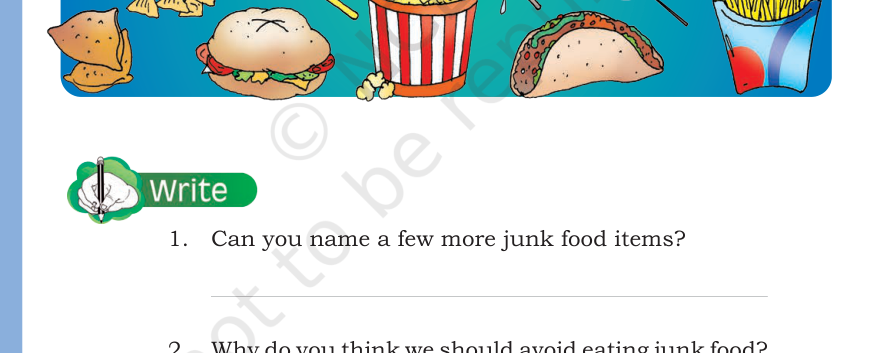
Can you name a few more junk food items?
Original NCERT question visual - PDF page 10
Answer
Chips, burgers, pizza, cold drinks, noodles, candies and fried snacks.
Question 2NCERT PDF page 10
Why do you think we should avoid eating junk food?
Original NCERT question visual - PDF page 10
Answer
Junk food has too much oil, salt and sugar and very few nutrients. It can cause obesity, tooth decay and illness.
Question 3NCERT PDF page 10
List the junk food items that you will avoid.
Original NCERT question visual - PDF page 10
Answer
(sample answer) I will avoid soft drinks, chips, bread pakoda, burgers, pizza, packaged noodles and too many sweets.
Question 1NCERT PDF page 11
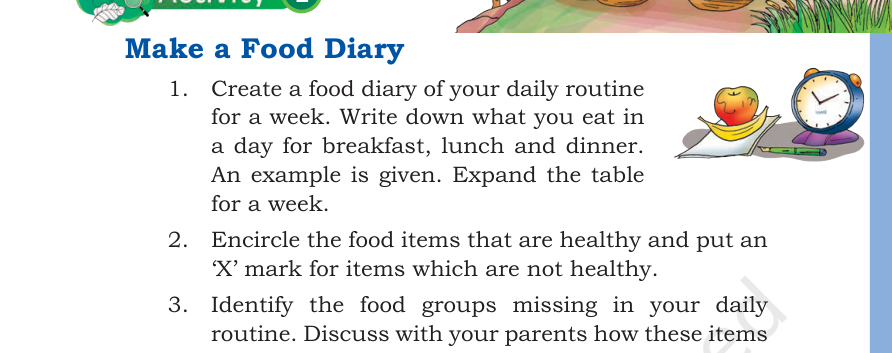
Make a Food Diary: Create a food diary of your daily routine for a week. Write down what you eat in a day for breakfast, lunch and dinner. An example is given. Expand the table for a week. Days | Time | Food eaten Day 1 | Breakfast | Idli, Sambhar, Chutney Day 1 | Lunch | Day 1 | Dinner |
Original NCERT question visual - PDF page 11
Answer
(sample answer)
Day 1 — Breakfast: idli, sambhar, chutney; Lunch: rice, dal, cabbage sabzi, curd; Dinner: roti, paneer curry, salad.
Encircle the food items that are healthy and put an ‘X’ mark for items which are not healthy.
Original NCERT question visual - PDF page 11
Answer
Circle healthy foods like fruits, dal, roti and curd; put an X on chips, cold drinks and fried snacks.
Question 3NCERT PDF page 11
Identify the food groups missing in your daily routine. Discuss with your parents how these items can be included in the daily routine.
Original NCERT question visual - PDF page 11
Answer
(sample answer) My diary has plenty of energy-giving food (rice, roti, poha) but very little protective food. With my parents I planned to add one fruit every day (banana, guava or orange) and a green vegetable like spinach at dinner, and to drink a glass of milk for body-building food.
Question 4NCERT PDF page 12
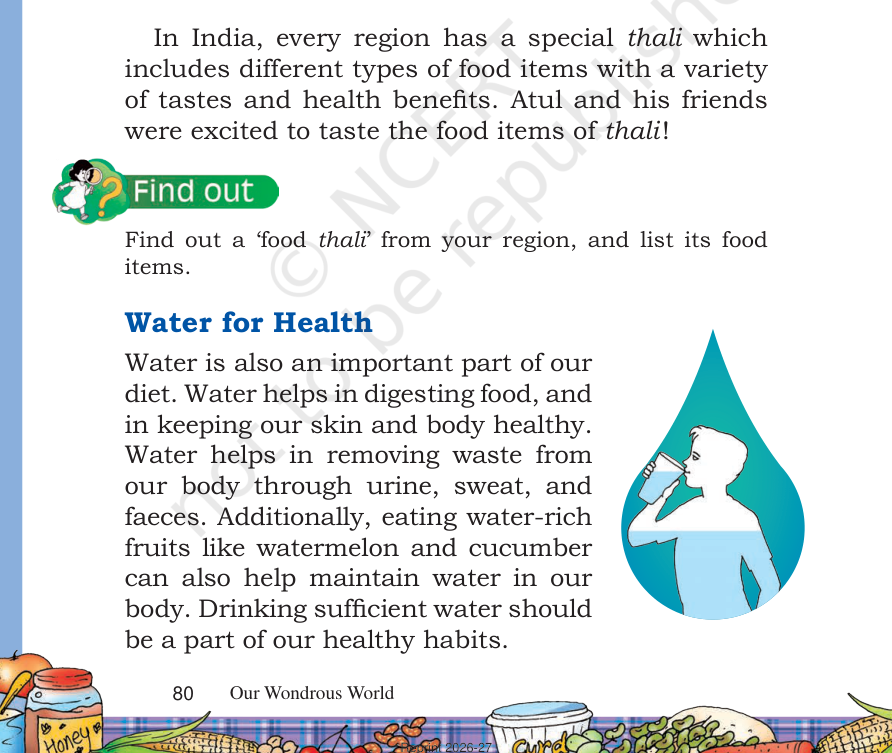
In India, every region has a special thali which includes different types of food items with a variety of tastes and health benefits. Find out a ‘food thali’ from your region, and list its food items.
Original NCERT question visual - PDF page 12
Answer
(sample answer) Gujarati thali — roti, dal, rice, kadhi, two vegetables (sabzi), dhokla, salad, pickle, papad, buttermilk and a sweet like shrikhand.
Question 5NCERT PDF page 13
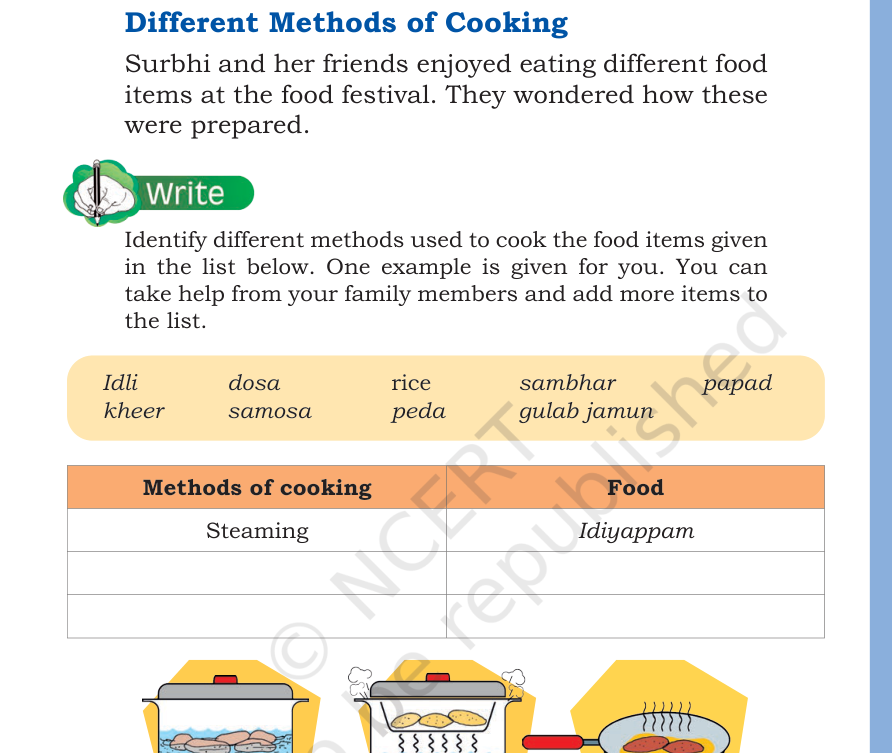
Identify different methods used to cook the food items given in the list below. One example is given for you. You can take help from your family members and add more items to the list. Food items: idli, dosa, rice, sambhar, papad, kheer, samosa, peda, gulab jamun Methods of cooking: Steaming (example: Idiyappam), Boiling, Roasting, Grilling, Frying, Baking
Original NCERT question visual - PDF page 13
Answer
Steaming — idiyappam, idli
Boiling — rice, sambhar, kheer, peda (milk is boiled down to make khoa)
Roasting — dosa (on a tawa), papad
Frying — samosa, gulab jamun (fried, then soaked in sugar syrup)
Grilling — paneer tikka, corn on the cob (added item)
Baking — bread, cake (added item)
Question 1NCERT PDF page 14
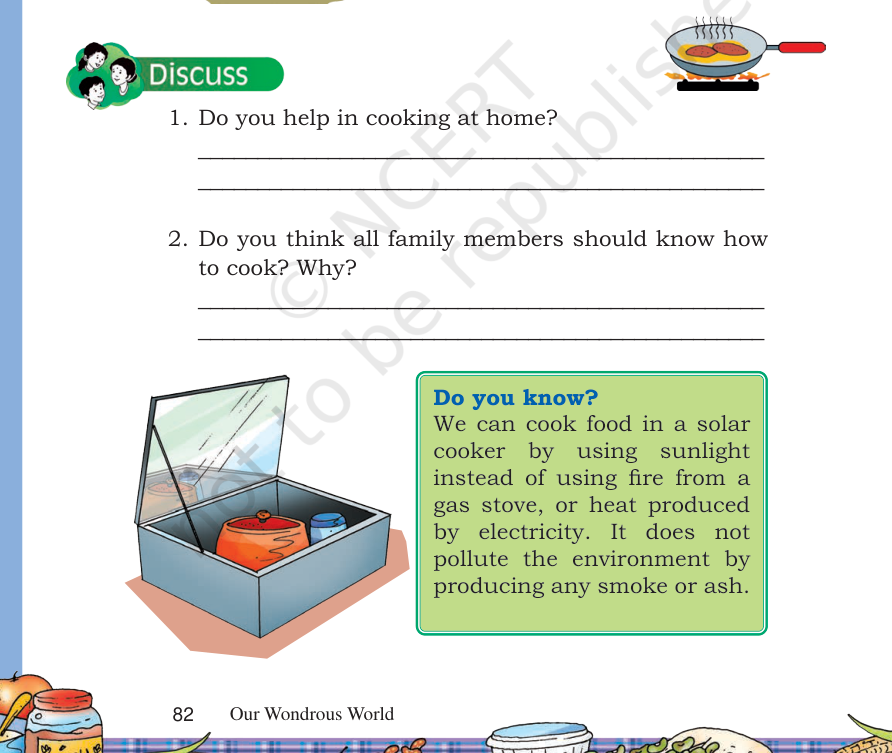
Do you help in cooking at home?
Original NCERT question visual - PDF page 14
Answer
(sample answer) Yes, I help my mother wash vegetables, knead dough, set the table and clear the plates after meals.
Question 2NCERT PDF page 14
Do you think all family members should know how to cook? Why?
Original NCERT question visual - PDF page 14
Answer
Yes, everyone should know how to cook so they can take care of themselves and share the work at home.
Question 1NCERT PDF page 15
Hands-on activity — food collage. Materials: Old magazines, newspapers, scissors, glue, and a blank sheet of paper. Cut out pictures of food items and create a collage with three sections: energy-giving foods, body-building foods, and protective foods.
Check the label. (Example label: Honey — All Natural, No Sugar Added, Pure and Delicious; Net weight: 400 gram; Packed on: 08.03.2025; Best before: 07.03.2026.) (a) At home, pick up any one packaged food item from your kitchen. Check the label and note down the expiry date, and also two main ingredients.
Original NCERT question visual - PDF page 15
Answer
For the honey label shown: packed on 08.03.2025, best before (expiry) 07.03.2026, net weight 400 g; it is pure honey with no sugar added.
(sample answer) My kitchen item — a packet of biscuits: best before 15.06.2026; main ingredients: wheat flour and sugar.
Question (b)NCERT PDF page 15
(b) Why is it important to check labels before buying or eating packaged food items?
Original NCERT question visual - PDF page 15
Answer
Labels tell us the expiry date, ingredients and how to store the food, so we can eat safe, fresh food and avoid things we are allergic to.
Question 3NCERT PDF page 16
Organise a food festival: Students may bring home-made food and organise a food festival at school. Parents may be encouraged to participate in the food festival.
Original NCERT question visual - PDF page 16
Answer
(sample answer) Our class set up stalls for different regions — dhokla and thepla (Gujarat), litti-chokha (Bihar), idli and dosa (Tamil Nadu), ragi laddu (Karnataka). Each stall had a card showing the food group and tastes of the dish, and parents were invited to taste and vote for the healthiest dish.
Question 4NCERT PDF page 16
Find and circle: Circle the words related to food in the grid below. One example (POTATO) is given. K O Q L C I S A B U E S E B T E P E P T O M A N G O A M U I O J L G T N A Y A N R H O A S F V S G A O N T R S W O A T E R O T N T A M L A V F E L G T J A U G U W