Skip to content

Ch 10 · Sing and Play

Activities

Exercise 1 of 2

Activities

Question 1NCERT PDF page 4
The chapter begins with the prayer song ‘Itni Shakti Hame Dena Daata’. In which language is it, and what do we ask for in this song?
Answer

It is a prayer song in Hindi. It asks God to give us strength, so that our faith never wavers and we walk the path of goodness. It also asks God to remove the darkness of ignorance with the light of knowledge, and to keep us free of enmity and revenge.
Question 2NCERT PDF page 5
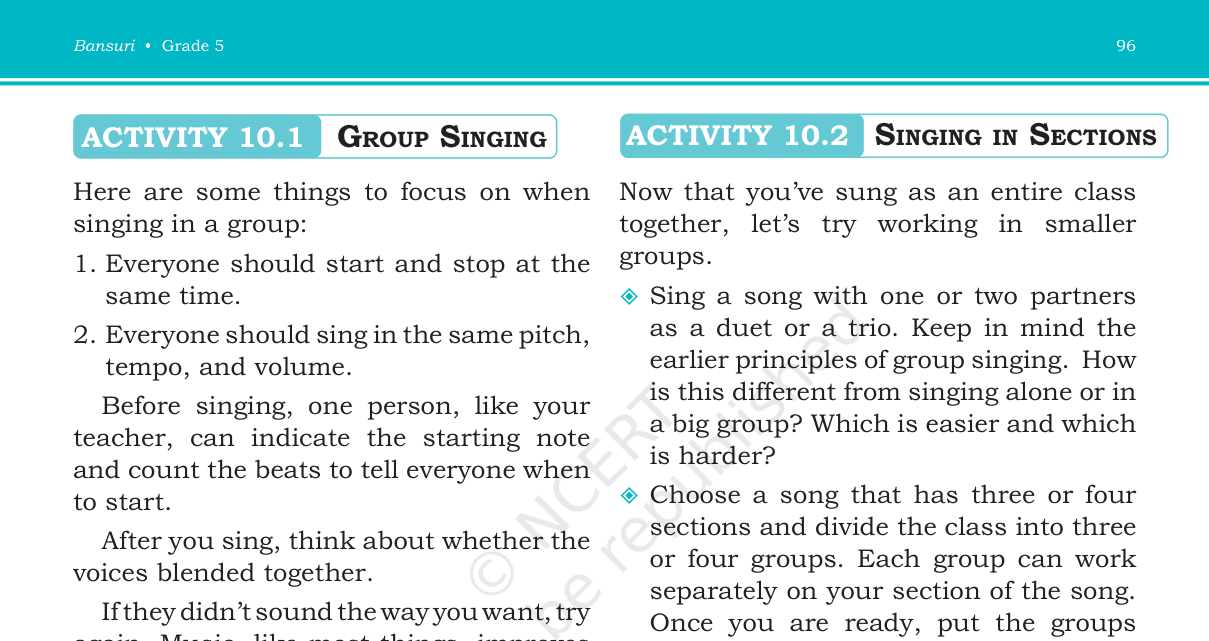
Activity 10.1 Group Singing and Activity 10.2 Singing in Sections
What two things should you focus on when singing in a group? What can one person do before the group starts singing?
Sing a song with one or two partners as a duet or a trio. How is this different from singing alone or in a big group? Which is easier and which is harder?
Choose a song with three or four sections. Divide the class into groups, let each group practise its own section, and then put the groups together to sing the entire song.
NCERT Class 5 arts chapter 10, page 5
Original NCERT question visual - PDF page 5
Answer
  • 1. Everyone should start and stop at the same time. 2. Everyone should sing in the same pitch, tempo and volume. Before singing, one person, like the teacher, can give the starting note and count the beats to tell everyone when to start. After singing, think whether the voices blended together; if not, try again, because music improves with practice.
  • (sample answer) In a duet I can hear my partner’s voice clearly, so we must listen to each other closely. It is easier than singing alone because my partner helps me remember the words, but harder than a big group because any mistake is easy to hear.
  • (sample answer) Our class sang ‘Itni Shakti Hame Dena Daata’ in four groups, one for each verse. When we joined together, we all sang the first line together to finish.
Question 3NCERT PDF page 6
The Marathi folk song ‘Mi Dolkara’ is about people of a traditional occupation. Who are they, and what does the song say about them?
Answer

It is a lively, energetic Marathi folk song about the fisherfolk and the sea. It calls them the ‘Kings of the Sea’ (daryaacha raaja) and shows their pride, freedom and deep connection to the ocean.

Question 4NCERT PDF page 7
Activity 10.3 Clap Along, Activity 10.4 Sing with Accompaniment and Activity 10.5 Cup Song
With a partner or another group, one side sings a song while the other claps to keep its time.
Sing a song you know well (solo, duet or group) with live accompaniment on an instrument or with a karaoke track. What must you take care of while singing with accompaniment?
What is a cup song? Learn its rhythmic pattern and try it with a song of your choice.
NCERT Class 5 arts chapter 10, page 7
Original NCERT question visual - PDF page 7
Answer
  • (sample answer) I sang ‘Mi Dolkara’ and my friend clapped on every beat. We kept the same speed from start to end.
  • Stay in the same time (tempo) and pitch as the accompaniment, and balance the volume of the voice(s) with the accompaniment so that neither is too loud.
  • A cup song is a fun activity where you tap out the rhythm of a song by clapping your hands and tapping and rotating cups. The pattern fits any song in eight beats. (sample answer) I practised it with a video for a few classes and then did it with ‘Itni Shakti Hame Dena Daata’.
Question 5NCERT PDF page 8
Activity 10.6 Beatboxing Exercises and Activity 10.7 Experimenting with A cappella
What is beatboxing? How do you practise it with the words “Boots ‘n Cats ‘n”?
What is a cappella? How can your group turn a song you know into an a cappella song?
Answer
  • Making the sounds of drums with your mouth is called beatboxing (vocal percussion). Say “Boots ‘n Cats ‘n” again and again in rhythm, then stress the consonants (B, T, C, T) and cut down the vowels so it sounds like “Buh Tt Cc Tt”. ‘Buh’ is a low sound like a low drum; ‘Cc’ and ‘Tt’ copy higher-pitched drums. Then add the pattern as a layer in a song.
  • A cappella is a style where all the vocal and instrumental parts are sung by voices. Listen carefully to the song and count its parts, divide the parts among yourselves, try each part separately, then put them together, with someone keeping time and giving the starting pitch. Don’t be discouraged if it does not work the first time.