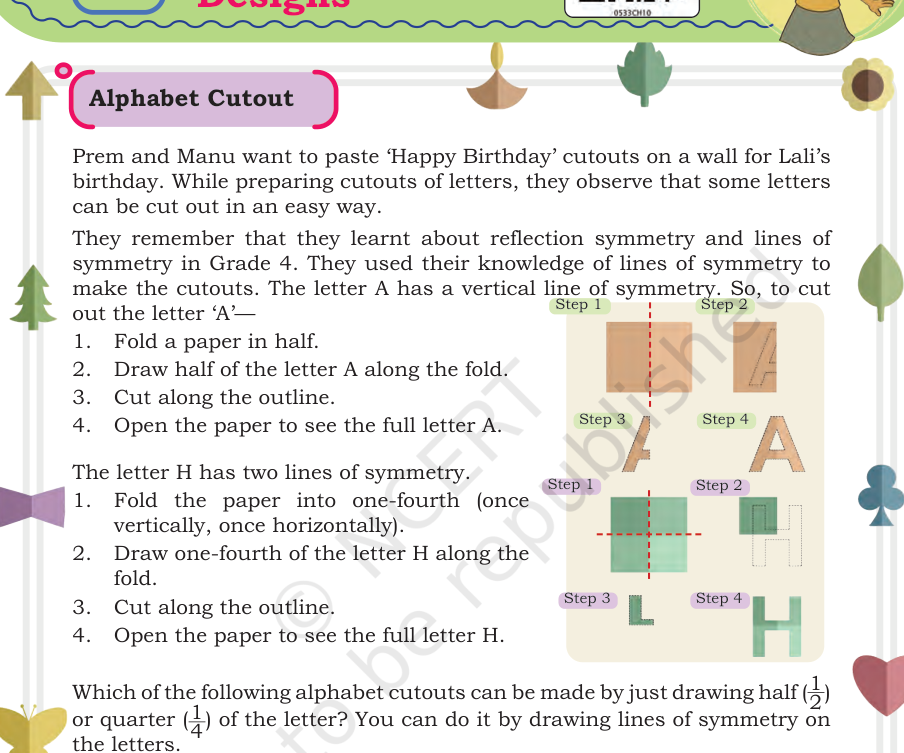
Use lines of symmetry to make paper cutouts of diya, boat, and other designs. Look along the border of the page to find the pictures.
Original NCERT question visual - PDF page 1
Solution
The diya, boat, leaf, heart, kite and umbrella on the border all have a vertical line of symmetry. Fold the paper, draw half of the shape with its middle line on the fold, cut along the outline and open it to get the full shape.
Question 2NCERT PDF page 2
Let Us Make a Windmill Firki: Lali makes firkis for her friends. What steps should you follow to make your own firki?
Original NCERT question visual - PDF page 2
Solution
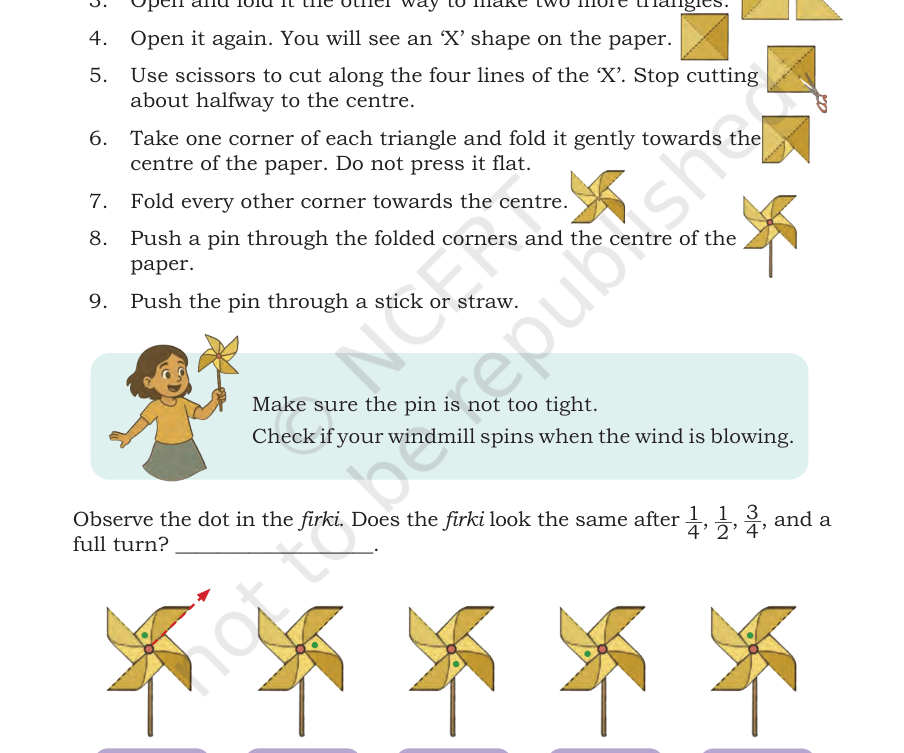
Take a square paper.
Fold it in half diagonally to make two triangles.
Open and fold it the other way to make two more triangles.
Open it again to see an ‘X’ shape.
Cut along the four lines of the ‘X’, stopping about halfway to the centre.
Fold one corner of each triangle gently towards the centre (every other corner). Do not press it flat.
Push a pin through the folded corners and the centre.
Push the pin through a stick or straw (not too tight) and check that it spins in the wind.
Question 3NCERT PDF page 2
Observe the dot in the firki. Does the firki look the same after a 1/4, 1/2, 3/4 and a full turn?
Original NCERT question visual - PDF page 2
Solution
Yes. Only the dot moves; the firki shape looks the same after a 1/4, 1/2, 3/4 and a full turn. So a firki has rotational symmetry.
Question 4NCERT PDF page 3
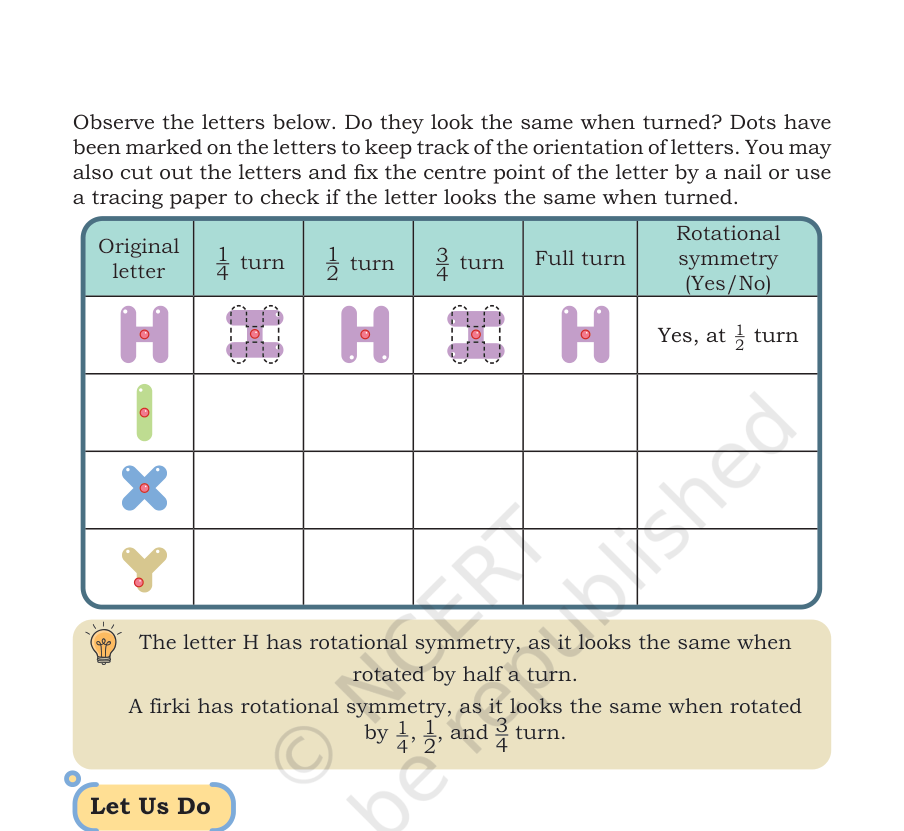
Observe the letters H, I, X and Y. Do they look the same when turned by a 1/4, 1/2, 3/4 and full turn? Fill the table and say whether each letter has rotational symmetry. (H is done: Yes, at 1/2 turn.)
Original NCERT question visual - PDF page 3
Solution
H: same after 1/2 turn and full turn. Rotational symmetry: Yes, at 1/2 turn.
I: same after 1/2 turn and full turn. Yes, at 1/2 turn.
X: same after 1/4, 1/2, 3/4 and full turn. Yes, at every 1/4 turn.
Y: same only after a full turn. No rotational symmetry.
Question 11NCERT PDF page 3
Find symmetry in the digits 1 2 3 4 5 6 7 8 9 0. Which digit(s) have reflection symmetry? Which digit(s) have rotational symmetry? Which digit(s) have both rotational and reflection symmetries? Do the numbers 11 and 1001 have rotational symmetry, reflection symmetry or both? Give examples of 2-, 3- and 4-digit numbers which have rotational symmetry, reflection symmetry, or both.
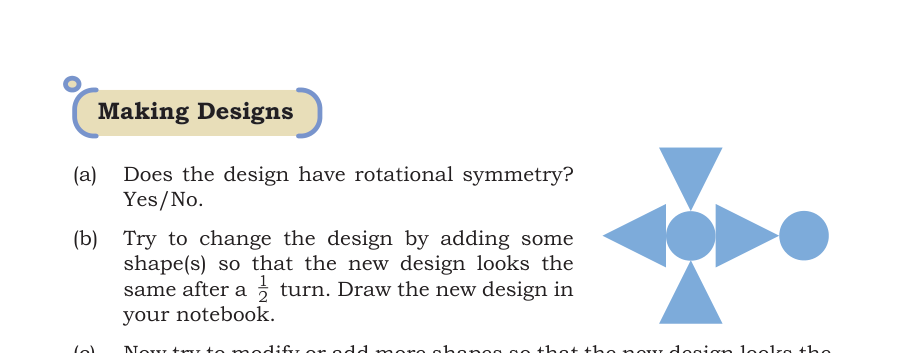
Making Designs: The design has triangles on the top and bottom pointing towards the centre circle, triangles on the left and right pointing outwards, and one extra circle on the right. Does the design have rotational symmetry? Yes/No.
Original NCERT question visual - PDF page 4
Solution
No. Because of the extra circle on the right side, the design does not look the same until a full turn.
Question (b)NCERT PDF page 4
Try to change the design by adding some shape(s) so that the new design looks the same after a 1/2 turn. Draw the new design in your notebook.
Original NCERT question visual - PDF page 4
Solution
Add one more circle at the left end, next to the left triangle. Now the left and right sides match, and so do the top and bottom, so the design looks the same after a 1/2 turn.
Question (c)NCERT PDF page 4
Now try to modify or add more shapes so that the new design looks the same after a 1/4 turn. Draw the new design in your notebook.
Original NCERT question visual - PDF page 4
Solution
(sample answer) Turn the top and bottom triangles so that they also point outwards, like the left and right ones, and put a circle at the end of all four triangles. All four arms are now the same, so the design looks the same after every 1/4 turn.
Question (d)NCERT PDF page 4
Do the new designs have reflection symmetry? If yes, draw the lines of symmetry.
Original NCERT question visual - PDF page 4
Solution
Yes. The 1/2-turn design has 2 lines of symmetry (the horizontal and vertical lines through the centre). The 1/4-turn design has 4 lines of symmetry (horizontal, vertical and the two diagonals).
Question 5NCERT PDF page 4
Cut out squares and equilateral triangles with the same side length. Make different symmetrical designs by using these two shapes.
Original NCERT question visual - PDF page 4
Solution
(sample answer) Put a square in the middle and a triangle on each of its 4 sides to make a star. It looks the same after every 1/4 turn and has 4 lines of symmetry. A triangle on top of a square (a house shape) has only reflection symmetry, about the vertical line through its middle.
Question 6NCERT PDF page 5
The shape is made of 4 squares (2 by 2) with a triangle on each side of the left and right ends. Does this shape have reflection symmetry? If yes, draw its line(s) of symmetry. Does it have rotational symmetry? If yes, at which turn? Does it have both symmetries? Now make your designs and sort them into 3 categories: only rotational symmetry, only reflection symmetry, and both.
Original NCERT question visual - PDF page 5
Solution
Reflection symmetry: Yes, 2 lines – the horizontal line and the vertical line through the centre.
Rotational symmetry: Yes, it looks the same after a 1/2 turn.
So it has both symmetries.
(sample answer) Only rotational: a firki/pinwheel. Only reflection: a house shape (triangle on a square). Both: a square with a triangle on every side.
Question 7NCERT PDF page 6
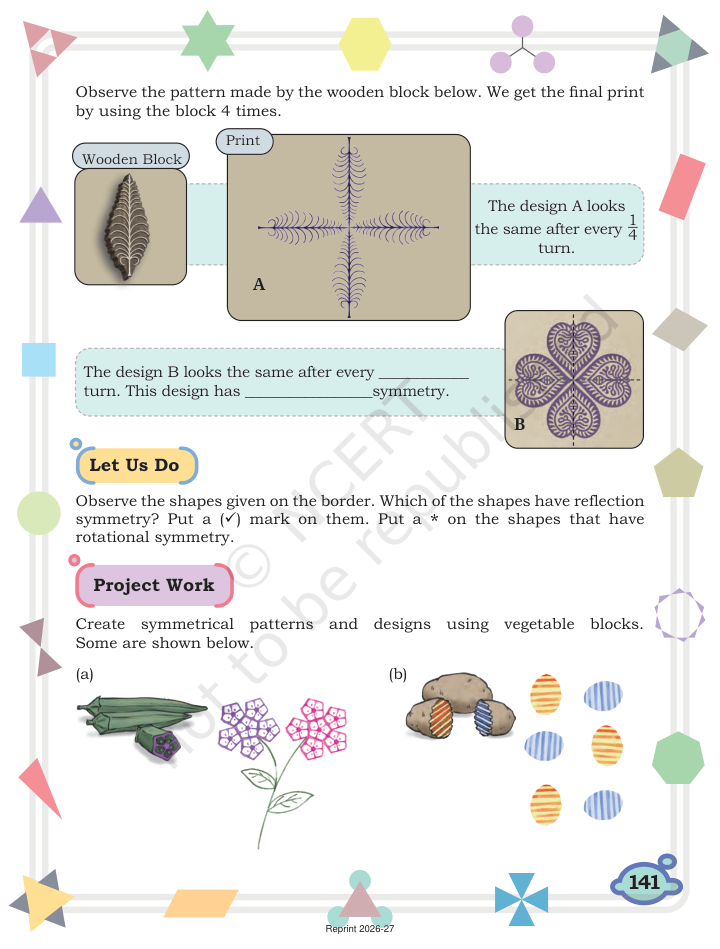
Observe the shapes given on the border. Which of the shapes have reflection symmetry? Put a () mark on them. Put a * on the shapes that have rotational symmetry.
Original NCERT question visual - PDF page 6
Solution
(✓) Reflection symmetry: equilateral triangle, six-pointed star, hexagon, square, rhombus, pentagon, heptagon, circle, rectangle and the three-circle shape. (*) Rotational symmetry: six-pointed star, hexagon, square, rhombus, rectangle, pentagon, heptagon, circle, triangle, the three-circle shape and the four-triangle pinwheel. The parallelogram has rotational symmetry (1/2 turn) but no reflection symmetry.
Project Work
Create symmetrical patterns and designs using vegetable blocks.
Some are shown below.
Project WorkNCERT PDF page 6
Project Work: Create symmetrical patterns and designs using vegetable blocks, for example
(a)flowers printed with the cut end of a lady’s finger (bhindi),
(b)striped prints made with a cut potato.
NCERT textbook page 6
Solution
(sample answer) Cut a lady’s finger across; its cut end is a star shape that looks the same after small turns. Print it many times in a circle to make a flower. Cut a potato in half, carve stripes, and print it in rows, turning it by a 1/2 turn each time to make a pattern with rotational symmetry.