Skip to content

Ch 13 · Animal Jumps

Let Us Do

Exercise 2 of 3

Let Us Do

Question 1NCERT PDF page 2
Make different arrays for the following numbers. Identify the factors in each case.
10
14
13
20
25
32
37
46
54 Numbers like 13 and 37 are called prime numbers. Why?
NCERT Class 5 maths chapter 13, page 2
Original NCERT question visual - PDF page 2
Solution
  • (a) 10: 1 × 10, 2 × 5 → factors 1, 2, 5, 10
  • (b) 14: 1 × 14, 2 × 7 → 1, 2, 7, 14
  • (c) 13: 1 × 13 → 1, 13
  • (d) 20: 1 × 20, 2 × 10, 4 × 5 → 1, 2, 4, 5, 10, 20
  • (e) 25: 1 × 25, 5 × 5 → 1, 5, 25
  • (f) 32: 1 × 32, 2 × 16, 4 × 8 → 1, 2, 4, 8, 16, 32
  • (g) 37: 1 × 37 → 1, 37
  • (h) 46: 1 × 46, 2 × 23 → 1, 2, 23, 46
  • (i) 54: 1 × 54, 2 × 27, 3 × 18, 6 × 9 → 1, 2, 3, 6, 9, 18, 27, 54

13 and 37 can only be arranged in one line (1 row), so they have only two factors, 1 and the number itself. Such numbers are prime numbers.
Animal JumpsNCERT PDF page 2
Animal Jumps: A rabbit takes a jump of 4 each time. A frog takes a jump of 3 each time. Both start from 0. 12 is the first number both touch (the first common multiple of 3 and 4). What are some other common multiples of 3 and 4? What do you notice about them?
Original NCERT question visual, chapter 13, page 2
Original NCERT question visual - PDF page 2
Solution

Multiples of 3: 3, 6, 9, 12, 15, 18, 21, 24, … Multiples of 4: 4, 8, 12, 16, 20, 24, … Common multiples of 3 and 4: 12, 24, 36, 48, 60, … They are all multiples of 12 (the first common multiple).

Question 4NCERT PDF page 3
A spider takes a jump of 3 every time. A grasshopper takes a jump of 6 each time. 6 and 12 are two common multiples of 3 and 6. What do you notice about the common multiples of 3 and 6? Also list a few more common multiples of 4 and 6 (12 and 24 are two of them).
NCERT Class 5 maths chapter 13, page 3
Original NCERT question visual - PDF page 3
Solution
  • Common multiples of 3 and 6: 6, 12, 18, 24, 30, … Every multiple of 6 is also a multiple of 3, so the common multiples are just the multiples of 6.
  • Common multiples of 4 and 6: 12, 24, 36, 48, 60, …
Question 1NCERT PDF page 3
Find 5 common multiples of the following pairs of numbers.
2 and 3
5 and 8
2 and 4
3 and 9
5 and 10
9 and 12
8 and 12
6 and 8
6 and 9 What do you notice about the common multiples of different pairs of numbers?
NCERT Class 5 maths chapter 13, page 3
Original NCERT question visual - PDF page 3
Solution
  • 2 and 3: 6, 12, 18, 24, 30
  • 5 and 8: 40, 80, 120, 160, 200
  • 2 and 4: 4, 8, 12, 16, 20
  • 3 and 9: 9, 18, 27, 36, 45
  • 5 and 10: 10, 20, 30, 40, 50
  • 9 and 12: 36, 72, 108, 144, 180
  • 8 and 12: 24, 48, 72, 96, 120
  • 6 and 8: 24, 48, 72, 96, 120
  • 6 and 9: 18, 36, 54, 72, 90

All the common multiples are multiples of the smallest common multiple. When one number is a multiple of the other (like 2 and 4), the common multiples are the multiples of the bigger number.

Question 2NCERT PDF page 4
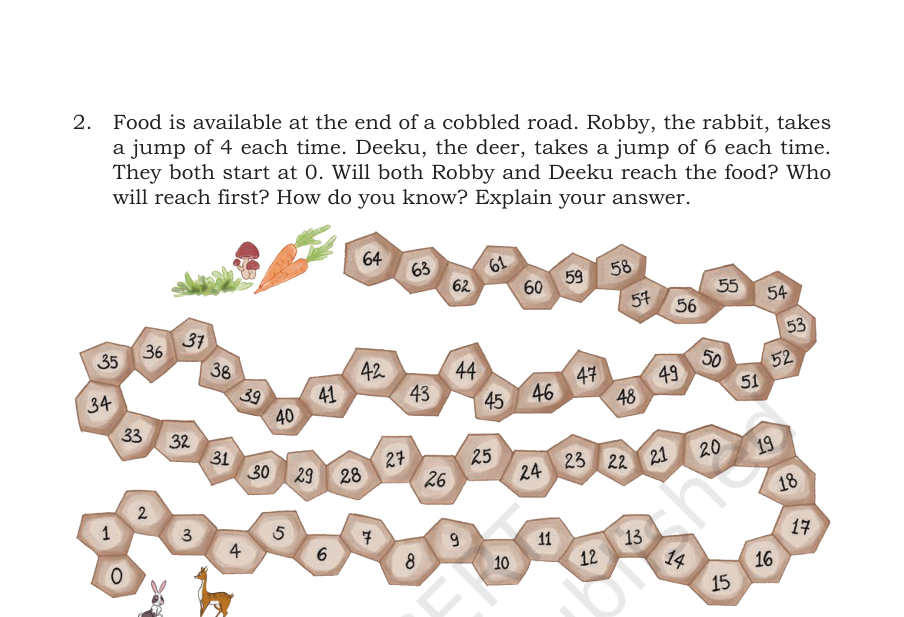
Food is available at the end of a cobbled road, on stone number 64. Robby, the rabbit, takes a jump of 4 each time. Deeku, the deer, takes a jump of 6 each time. They both start at 0. Will both Robby and Deeku reach the food? Who will reach first? How do you know? Explain your answer.
NCERT Class 5 maths chapter 13, page 4
Original NCERT question visual - PDF page 4
Solution

64 = 4 × 16, so Robby lands exactly on 64 after 16 jumps. 64 is not a multiple of 6: Deeku lands on 60 and then jumps to 66, so he cannot land on the food stone. Only Robby reaches the food (Deeku jumps past it).

Question 3NCERT PDF page 4
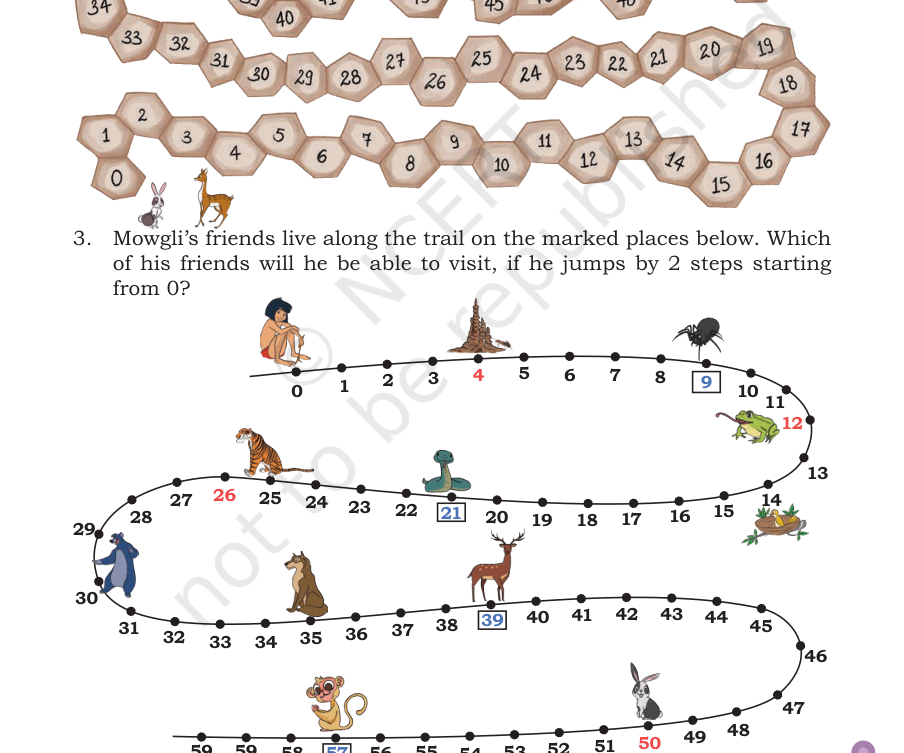
Mowgli’s friends live along the trail at 4 (ant), 9 (spider), 12 (frog), 14 (bird), 21 (Kaa the snake), 26 (tiger), 30 (Baloo the bear), 35 (Akela the wolf), 39 (deer), 50 (rabbit) and 57 (monkey). Which of his friends will he be able to visit if he jumps by 2 steps starting from 0?
NCERT Class 5 maths chapter 13, page 4
Original NCERT question visual - PDF page 4
Solution

Jumping by 2 he lands only on even numbers: 4 (ant), 12 (frog), 14 (bird), 26 (tiger), 30 (Baloo) and 50 (rabbit).

Question 4Fill in the blanksNCERT PDF page 5
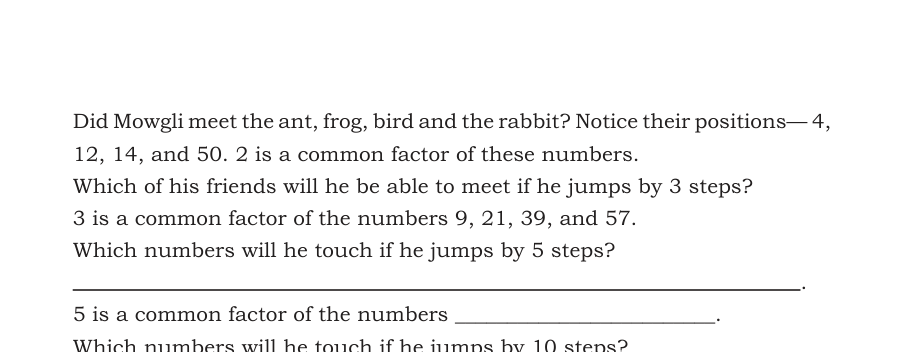
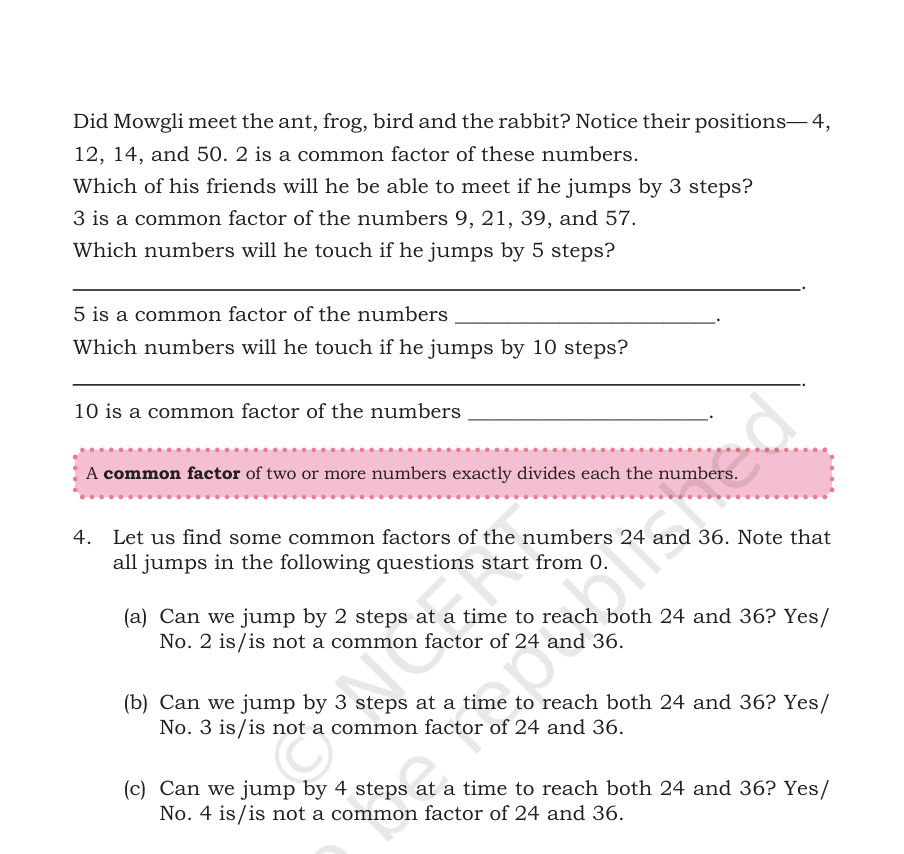
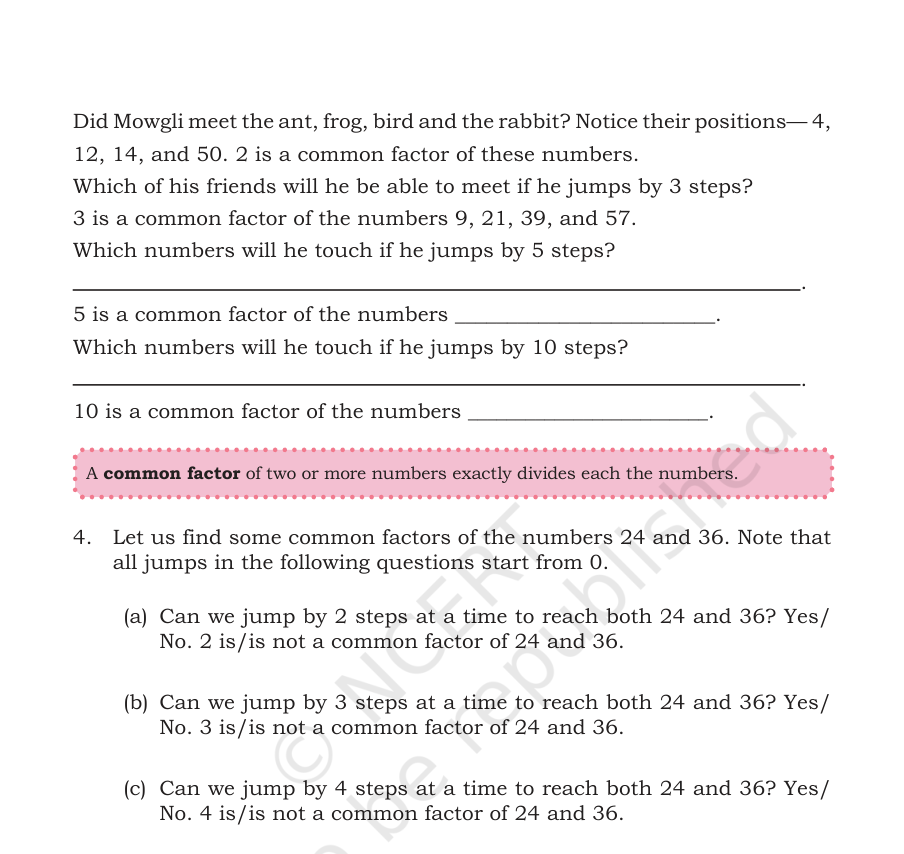
Did Mowgli meet the ant, frog, bird and the rabbit (at 4, 12, 14 and 50)? 2 is a common factor of these numbers.
Which of his friends will he be able to meet if he jumps by 3 steps?
Which numbers will he touch if he jumps by 5 steps? 5 is a common factor of the numbers ____.
Which numbers will he touch if he jumps by 10 steps? 10 is a common factor of the numbers ____.
NCERT Class 5 maths chapter 13, page 5
Original NCERT question visual - PDF page 5
Solution
  • Yes, he meets the ant, frog, bird and rabbit.
  • Jumps of 3: spider (9), frog (12), snake (21), Baloo (30), deer (39) and monkey (57). 3 is a common factor of 9, 21, 39 and 57.
  • Jumps of 5: 5, 10, 15, 20, 25, 30, 35, 40, 45, 50, 55. He meets Baloo (30), Akela (35) and the rabbit (50). 5 is a common factor of 30, 35 and 50.
  • Jumps of 10: 10, 20, 30, 40, 50. He meets Baloo (30) and the rabbit (50). 10 is a common factor of 30 and 50.
Question 4NCERT PDF page 5
Let us find some common factors of the numbers 24 and 36. Note that
all jumps in the following questions start from 0.
NCERT Class 5 maths chapter 13, page 5
Original NCERT question visual - PDF page 5
Solution

The common factors of 24 and 36 are 1, 2, 3, 4, 6 and 12 (6 common factors). Parts (a) to (f) work this out.

Question (a)NCERT PDF page 5
Can we jump by 2 steps at a time to reach both 24 and 36? Yes/
No. 2 is/is not a common factor of 24 and 36.
NCERT Class 5 maths chapter 13, page 5
Original NCERT question visual - PDF page 5
Solution

Yes. 2 is a common factor of 24 and 36.

Question (b)NCERT PDF page 5
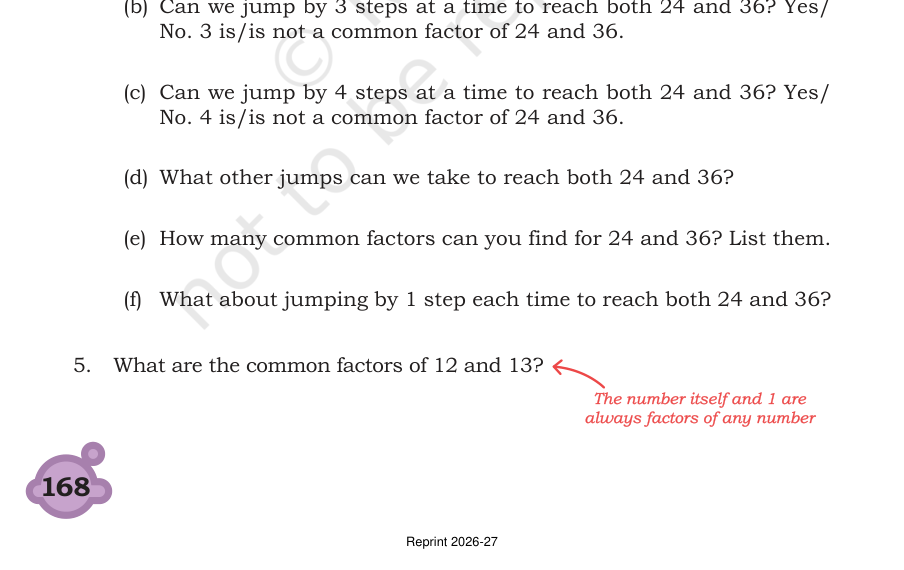
Can we jump by 3 steps at a time to reach both 24 and 36? Yes/
No. 3 is/is not a common factor of 24 and 36.
NCERT Class 5 maths chapter 13, page 5
Original NCERT question visual - PDF page 5
Solution

Yes. 3 is a common factor of 24 and 36.

Question (c)NCERT PDF page 5
Can we jump by 4 steps at a time to reach both 24 and 36? Yes/
No. 4 is/is not a common factor of 24 and 36.
NCERT Class 5 maths chapter 13, page 5
Original NCERT question visual - PDF page 5
Solution

Yes. 4 is a common factor of 24 and 36.

Question (d)NCERT PDF page 5
What other jumps can we take to reach both 24 and 36?
NCERT Class 5 maths chapter 13, page 5
Original NCERT question visual - PDF page 5
Solution

Jumps of 1, 6 and 12.

Question (e)NCERT PDF page 5
How many common factors can you find for 24 and 36? List them.
NCERT Class 5 maths chapter 13, page 5
Original NCERT question visual - PDF page 5
Solution

6 common factors: 1, 2, 3, 4, 6, 12.

Question (f)NCERT PDF page 5
What about jumping by 1 step each time to reach both 24 and 36?
NCERT Class 5 maths chapter 13, page 5
Original NCERT question visual - PDF page 5
Solution

Yes — 1 is a factor of every number.

Question 5NCERT PDF page 5
What are the common factors of 12 and 13? (The number itself and 1 are always factors of any number.)
NCERT Class 5 maths chapter 13, page 5
Original NCERT question visual - PDF page 5
Solution

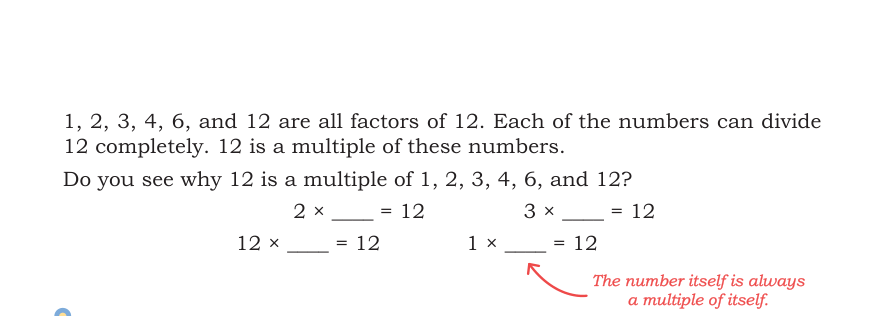
Factors of 12: 1, 2, 3, 4, 6, 12. Factors of 13: 1, 13. The only common factor is 1.

Question 6Fill in the blanksNCERT PDF page 6
Find which of the following numbers can be reached by jumps of 4 steps: 0, 10, 16, 27, 36, 48. 4 is a common factor of the numbers ____.
NCERT Class 5 maths chapter 13, page 6
Original NCERT question visual - PDF page 6
Solution

0, 16, 36, 48. 4 is a common factor of 16, 36 and 48.

Question 7NCERT PDF page 6
Find the common factors of the following pairs of numbers.
12 and 16
8 and 12
4 and 16
2 and 9
3 and 5
12 and 15
20 and 5
9 and 21
6 and 27 What do you notice about the common factors of different pairs of numbers?
NCERT Class 5 maths chapter 13, page 6
Original NCERT question visual - PDF page 6
Solution
  • 12 and 16: 1, 2, 4
  • 8 and 12: 1, 2, 4
  • 4 and 16: 1, 2, 4
  • 2 and 9: 1
  • 3 and 5: 1
  • 12 and 15: 1, 3
  • 20 and 5: 1, 5
  • 9 and 21: 1, 3
  • 6 and 27: 1, 3

1 is a common factor of every pair. When one number is a factor of the other (like 4 and 16, or 5 and 20), all factors of the smaller number are common factors.