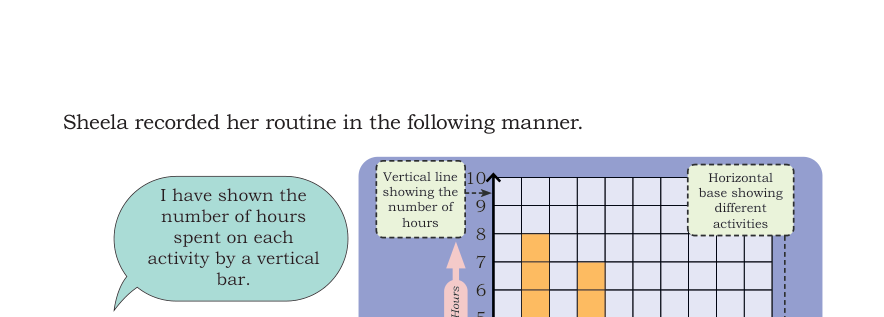
Recording a Day: Raman recorded his routine in a table (1 icon = 1 hour): sleeping 9 icons, time in school 6, studying 2, eating and playing 6, other activities 1. Sheela showed her routine as a bar graph: sleeping 8 hours, school 7, studying 4, eating and playing 3, other activities 2. How many hours does each of them spend on each activity?
Original NCERT question visual - PDF page 5
Solution
Raman: sleeping 9 h, school 6 h, studying 2 h, eating and playing 6 h, other 1 h (total 24 h)
Sheela: sleeping 8 h, school 7 h, studying 4 h, eating and playing 3 h, other 2 h (total 24 h)
Question 2NCERT PDF page 5
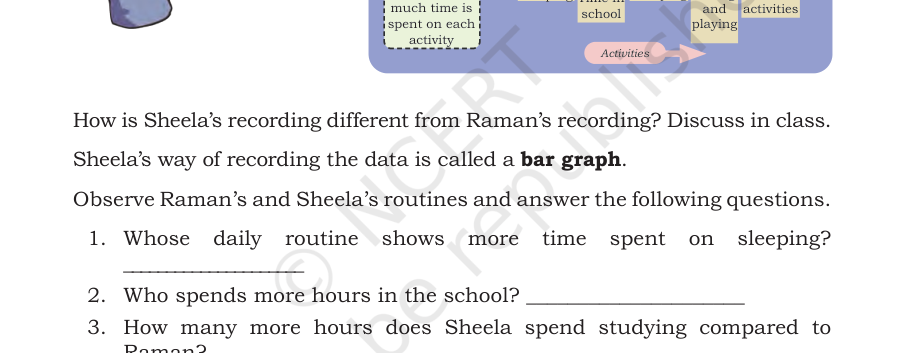
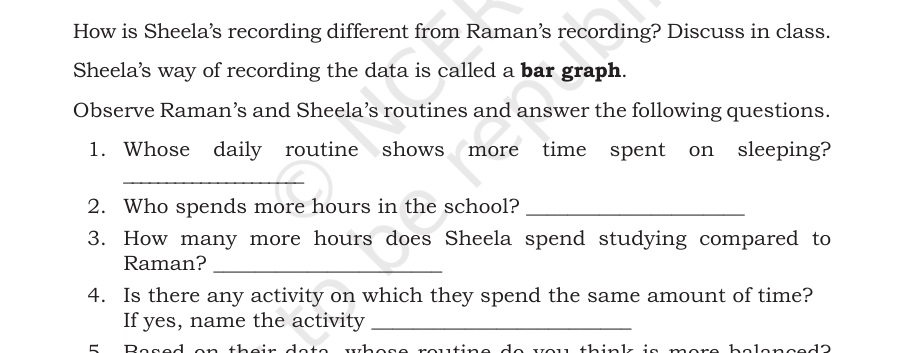
How is Sheela’s recording different from Raman’s recording? Discuss in class. Sheela’s way of recording the data is called a bar graph. Observe Raman’s and Sheela’s routines and answer the following questions.
Original NCERT question visual - PDF page 5
Solution
Raman used pictures (one icon for each hour) in a table. Sheela drew a vertical bar for each activity; the height of the bar on the hours scale shows the time. This is called a bar graph.
Question 1Fill in the blanksNCERT PDF page 5
Whose daily routine shows more time spent on sleeping? _____________________
Original NCERT question visual - PDF page 5
Solution
Raman’s (9 hours, Sheela sleeps 8 hours).
Question 2Fill in the blanksNCERT PDF page 5
Who spends more hours in the school? _____________________
Original NCERT question visual - PDF page 5
Solution
Sheela (7 hours, Raman 6 hours).
Question 3Fill in the blanksNCERT PDF page 5
How many more hours does Sheela spend studying compared to Raman? ______________________
Original NCERT question visual - PDF page 5
Solution
4 − 2 = 2 more hours.
Question 4Fill in the blanksNCERT PDF page 5
Is there any activity on which they spend the same amount of time? If yes, name the activity _________________________
Original NCERT question visual - PDF page 5
Solution
No. They spend different amounts of time on every activity.
Question 5NCERT PDF page 5
Based on their data, whose routine do you think is more balanced? Why?
Original NCERT question visual - PDF page 5
Solution
(possible answer) Raman’s routine looks more balanced: he gets 9 hours of sleep and 6 hours to eat and play, and still studies for 2 hours. Sheela studies more (4 hours) but has only 3 hours to eat and play. (Other answers with good reasons are also fine.)
Question 6NCERT PDF page 6
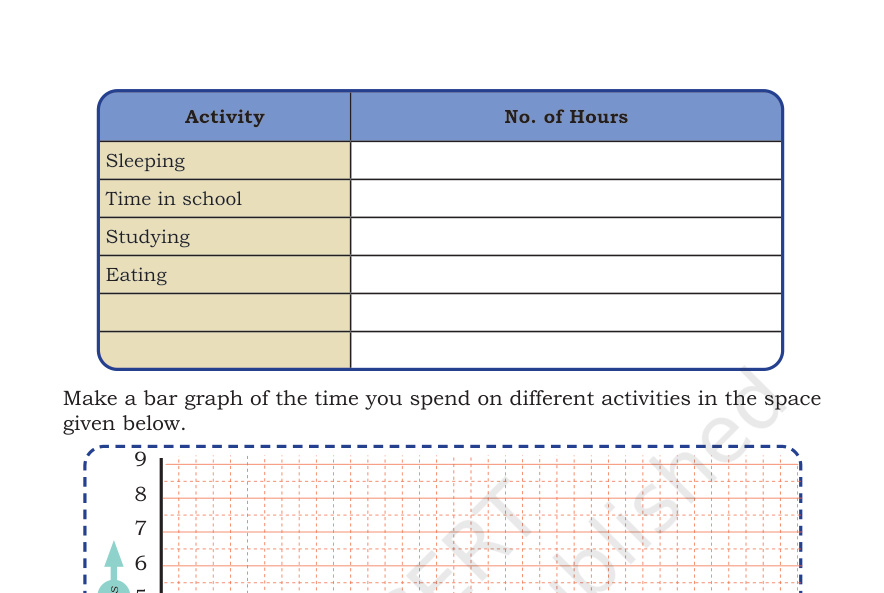
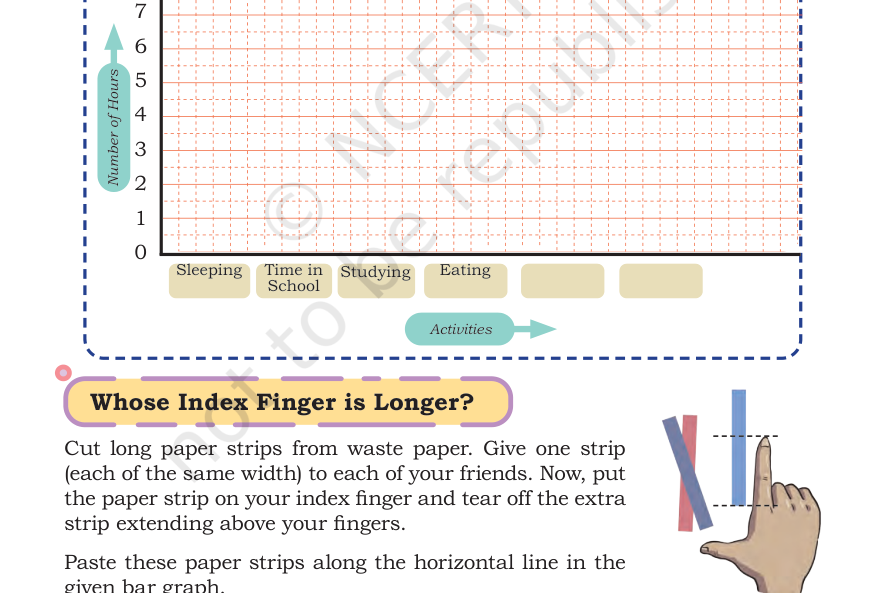
Day in My Life: Record your daily routine (24 hours). Make a bar graph of the time you spend on different activities (sleeping, time in school, studying, eating and playing, others).
Original NCERT question visual - PDF page 6
Solution
(sample answer) Sleeping 9 h, school 6 h, studying 3 h, eating and playing 4 h, other activities 2 h (total 24 h). Draw a bar for each activity up to 9, 6, 3, 4 and 2 on the hours scale.
Question 7NCERT PDF page 6
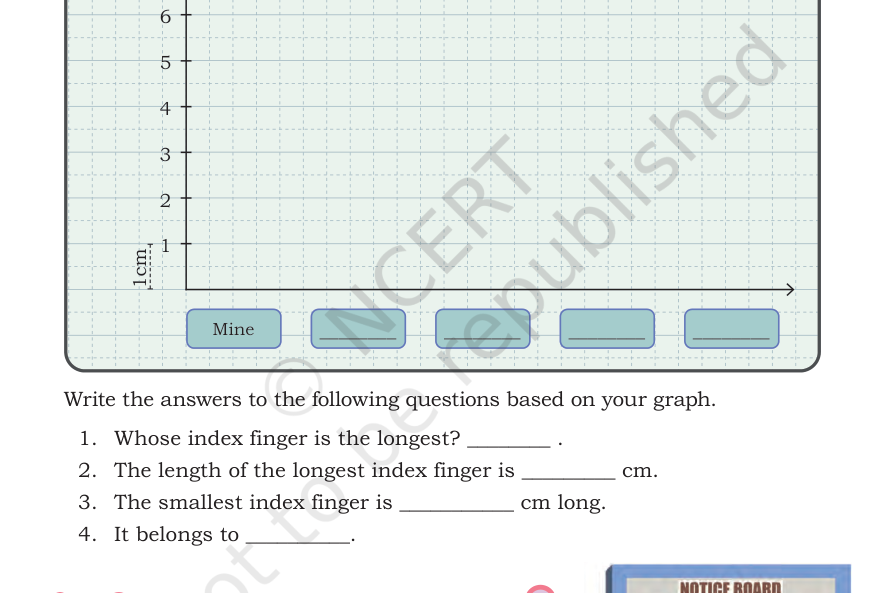
Whose Index Finger is Longer? Cut long paper strips from waste paper. Give one strip (each of the same width) to each of your friends. Now, put the paper strip on your index finger and tear off the extra strip extending above your fingers. Paste these paper strips along the horizontal line in the given bar graph.
Original NCERT question visual - PDF page 6
Solution
(sample answer) Strips pasted side by side: Asha 6 cm, Ravi 7 cm, Meena 5½ cm, Arjun 6½ cm, me 6 cm. Each strip is a bar, so together they make a bar graph of index finger lengths.
Question 8NCERT PDF page 7
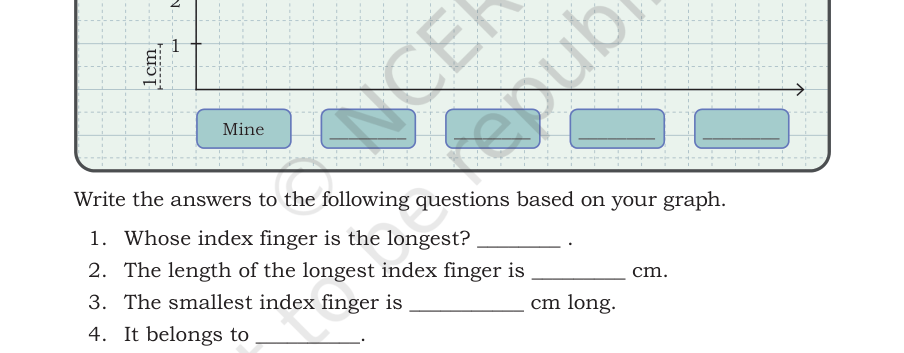
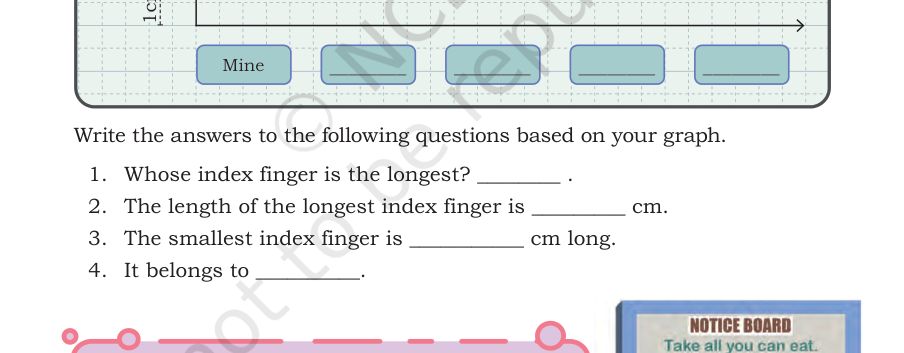
Write the answers to the following questions based on your graph.
Original NCERT question visual - PDF page 7
Solution
(sample answer, from the strips above) Longest: Ravi, 7 cm. Shortest: Meena, 5½ cm.
Question 1Fill in the blanksNCERT PDF page 7
Whose index finger is the longest? ________ .
Original NCERT question visual - PDF page 7
Solution
(sample answer) Ravi’s index finger is the longest.
Question 2Fill in the blanksNCERT PDF page 7
The length of the longest index finger is _________ cm.
Original NCERT question visual - PDF page 7
Solution
(sample answer) 7 cm.
Question 3Fill in the blanksNCERT PDF page 7
The smallest index finger is ___________ cm long.
Original NCERT question visual - PDF page 7
Solution
(sample answer) 5½ cm.
Question 4Fill in the blanksNCERT PDF page 7
The smallest index finger belongs to ______.
Original NCERT question visual - PDF page 7
Solution
(sample answer) Meena.
Question 5NCERT PDF page 8
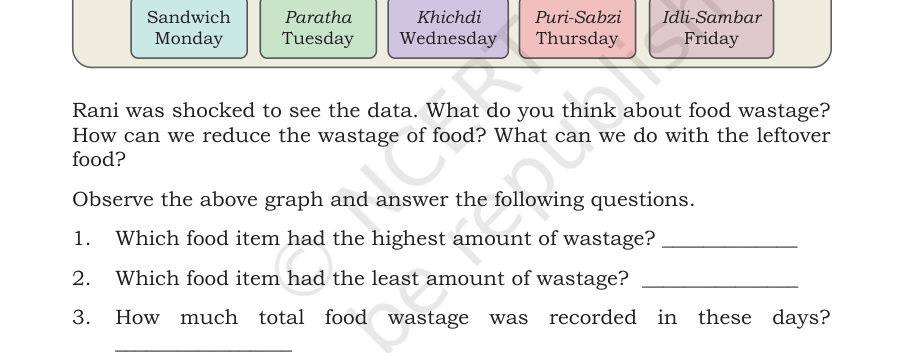
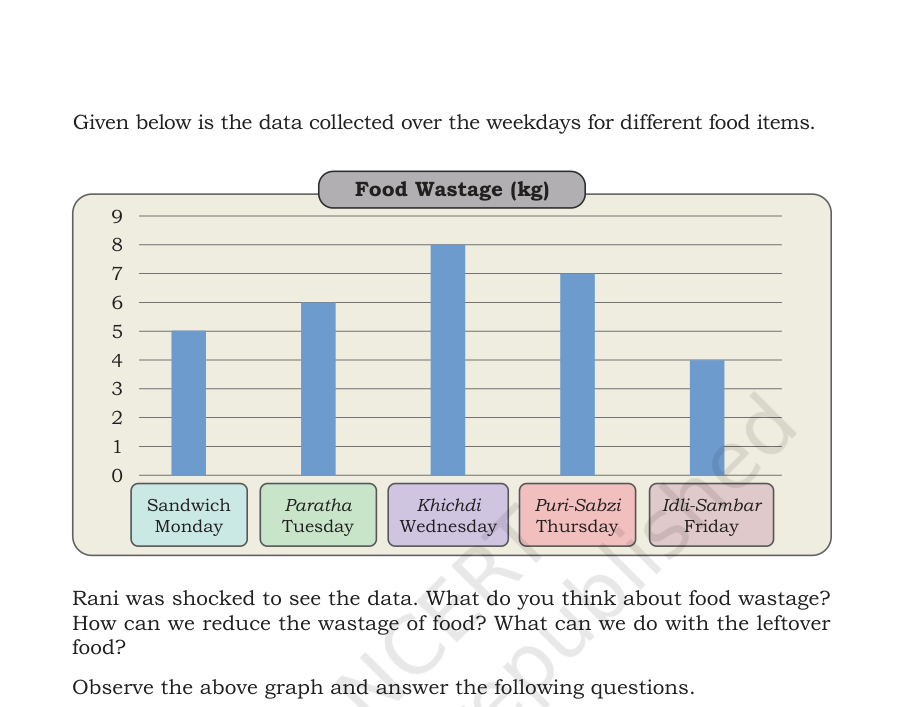
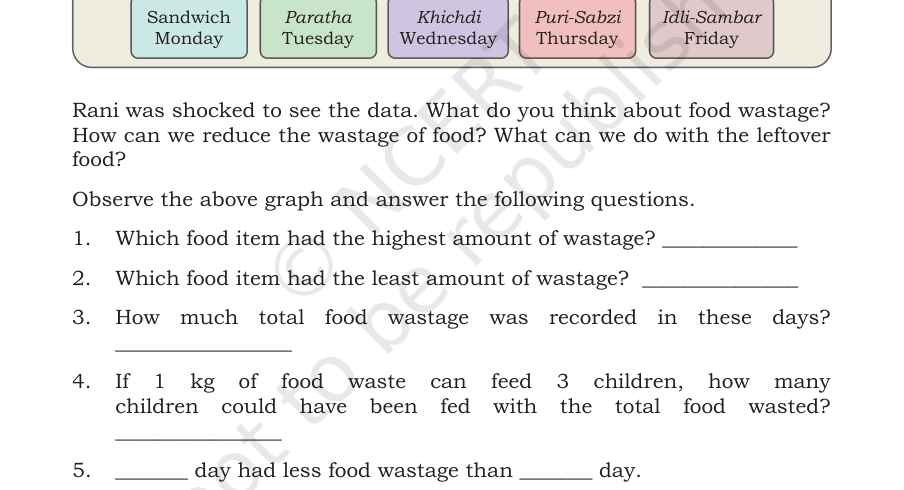
Food Wastage in the School Canteen: Rani’s school records the food wasted each weekday. Bar graph: Sandwich (Monday) 5 kg, Paratha (Tuesday) 6 kg, Khichdi (Wednesday) 8 kg, Puri-Sabzi (Thursday) 7 kg, Idli-Sambar (Friday) 4 kg. What do you think about food wastage? How can we reduce it? What can we do with the leftover food?
Original NCERT question visual - PDF page 8
Solution
Wasting food is wrong, because many people do not get enough to eat. We can take only as much as we can eat, ask for a second helping instead of a big first helping, and tell the cook which dishes are left over. Clean leftover food can be shared with people in need or given to animals, and peels and scraps can be used for compost.
Question 1Fill in the blanksNCERT PDF page 8
Which food item had the highest amount of wastage? _____________
Original NCERT question visual - PDF page 8
Solution
Khichdi (8 kg, on Wednesday).
Question 2Fill in the blanksNCERT PDF page 8
Which food item had the least amount of wastage? _______________
Original NCERT question visual - PDF page 8
Solution
Idli-Sambar (4 kg, on Friday).
Question 3Fill in the blanksNCERT PDF page 8
How much total food wastage was recorded in these days? _________________
Original NCERT question visual - PDF page 8
Solution
5 + 6 + 8 + 7 + 4 = 30 kg.
Question 4Fill in the blanksNCERT PDF page 8
If 1 kg of food waste can feed 3 children, how many children could have been fed with the total food wasted? ________________
Original NCERT question visual - PDF page 8
Solution
30 × 3 = 90 children could have been fed.
Question 5Fill in the blanksNCERT PDF page 8
______ day had less food wastage than ______ day.
Original NCERT question visual - PDF page 8
Solution
For example, Friday (4 kg) had less food wastage than Wednesday (8 kg). Also Monday (5 kg) had less than Tuesday (6 kg).
Question 6NCERT PDF page 8
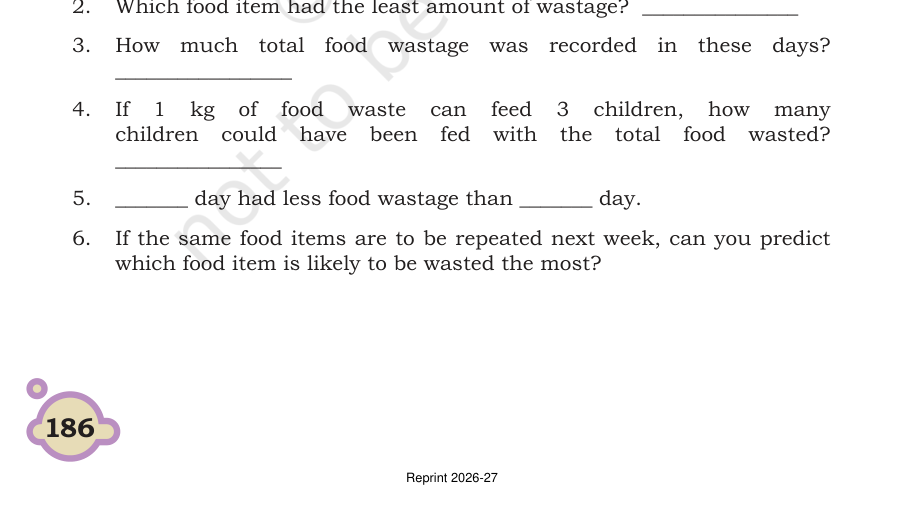
If the same food items are to be repeated next week, can you predict which food item is likely to be wasted the most?
Original NCERT question visual - PDF page 8
Solution
Khichdi is likely to be wasted the most, because it had the highest wastage (8 kg) this week.
Question 7True / FalseNCERT PDF page 9
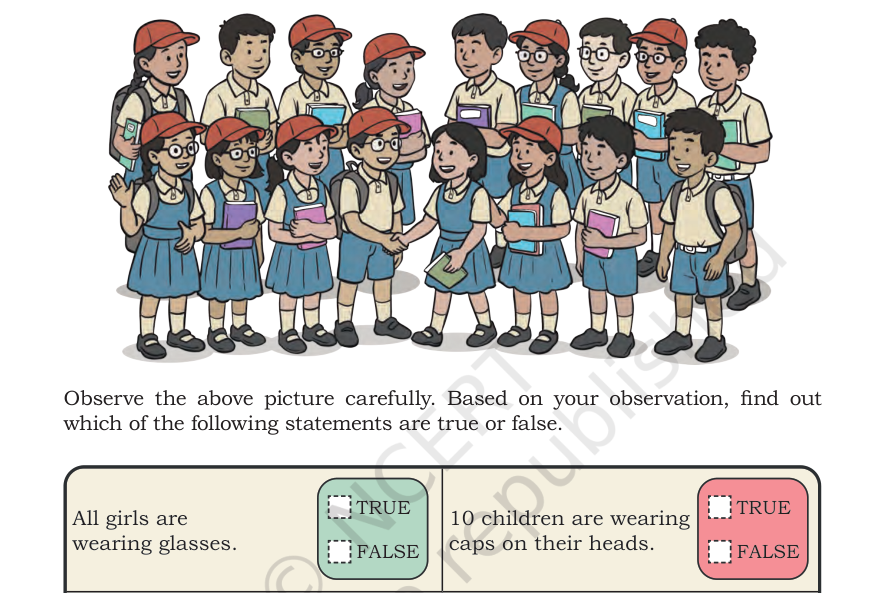
True or False: Observe the picture of 17 school children carefully and decide whether each statement is true or false. All girls are wearing glasses. 10 children are wearing caps on their heads. More boys are holding books than girls. More than half of the children are wearing glasses. The number of children holding books is greater than the number of children wearing caps. The number of boys wearing glasses is greater than the number of girls wearing glasses. Some children are wearing both glasses and caps. There is no child who has all three items—a cap, a book and a backpack.
Original NCERT question visual - PDF page 9
Solution
(a) False – several girls have no glasses.
(b) True – 10 children wear caps.
(c) False – 7 boys and 7 girls hold books.
(d) False – only 7 of the 17 children wear glasses.
(e) True – 14 children hold books, 10 wear caps.
(f) True – 4 boys and 3 girls wear glasses.
(g) True – for example, the boy shaking hands wears both.
(h) False – the girl at the back on the left has a cap, a book and a backpack.