In groups of 3 or 4, find different ways of making a whole with different fraction pieces from your kit. Write the equivalent fractions for the following that you may find in the process.
(a)1/3 = ___ = ___ = ___
(b)1/4 = ___ = ___ = ___
(c)1/5 = ___ = ___ = ___
(d)1/6 = ___ = ___ = ___ Do you see how to generate equivalent fractions for any given fraction? Discuss in class.
Original NCERT question visual - PDF page 3
Solution
(a) 1/3 = 2/6 = 3/9 = 4/12 (b) 1/4 = 2/8 = 3/12 = 4/16 (c) 1/5 = 2/10 = 3/15 = 4/20 (d) 1/6 = 2/12 = 3/18 = 4/24. Multiply the numerator and denominator by the same number.
Question 1Fill in the blanksNCERT PDF page 6
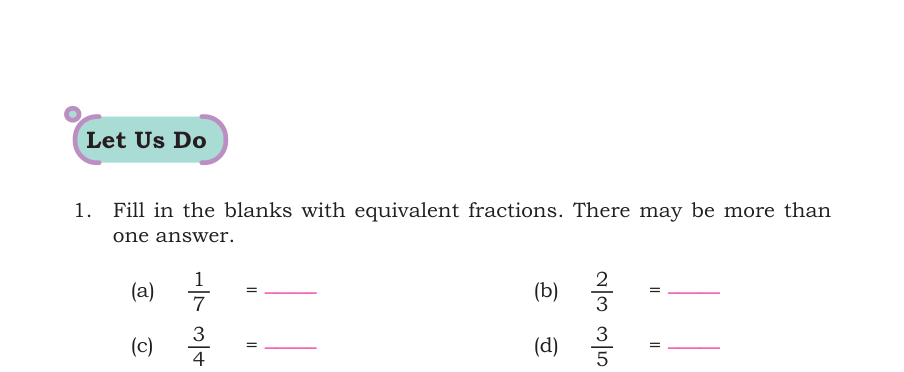
Fill in the blanks with equivalent fractions. There may be more than one answer.
(a)1/7 = ___
(b)2/3 = ___
(c)3/4 = ___
(d)3/5 = ___
Original NCERT question visual - PDF page 6
Solution
(a) 1/7 = 2/14 (or 3/21) (b) 2/3 = 4/6 (or 6/9) (c) 3/4 = 6/8 (or 9/12) (d) 3/5 = 6/10 (or 9/15). Multiply the numerator and the denominator by the same number.
Question 2NCERT PDF page 6
Put a tick (✓) against the fractions that are equivalent.
(a)2/3 and 3/4
(b)3/5 and 6/10
(c)4/12 and 2/6
(d)6/9 and 1/3
Original NCERT question visual - PDF page 6
Solution
(a) Not equivalent: 2/3 = 8/12 but 3/4 = 9/12.
(b) ✓ Equivalent: 3/5 = 6/10.
(c) ✓ Equivalent: 4/12 = 2/6 = 1/3.
(d) Not equivalent: 6/9 = 2/3, not 1/3.
Question 3NCERT PDF page 6
Fill in the boxes such that the fractions become equivalent.
(a)2/5 = □/10
(b)3/4 = □/16
(c)4/7 = 8/□
(d)5/9 = 25/□ Comparing Fractions — Same Denominator: Sevi and Shami divided a piece of chikki between themselves. Sevi ate 1/3 and Shami ate the rest, that is, 2/3. Who ate more?
Shami ate more. 2 pieces of 1/3 are more than 1 piece of 1/3, so 2/3 > 1/3.
Question 1NCERT PDF page 7
Compare the fractions given below using < and > signs.
(a)1/4 ___ 3/4
(b)3/5 ___ 4/5
(c)5/7 ___ 2/7
(d)7/8 ___ 3/8
(e)5/10 ___ 6/10
(f)2/6 ___ 1/6 Comparing Fractions — Same Numerator: One child says, “I ate 4/6 paratha yesterday evening.” The other says, “I ate 4/5 paratha yesterday evening.” Between Sevi and Shami, can you tell who ate more? Use your fraction kit.
Original NCERT question visual - PDF page 7
Solution
(a) 1/4 < 3/4 (b) 3/5 < 4/5 (c) 5/7 > 2/7 (d) 7/8 > 3/8 (e) 5/10 < 6/10 (f) 2/6 > 1/6. With the same denominator, the fraction with more pieces is bigger.
A 1/6 piece is smaller than a 1/5 piece, so 4/6 < 4/5. The child who ate 4/5 paratha ate more.
Question 1NCERT PDF page 7
Compare the following fractions using < and > signs.
(a)3/8 ___ 3/7
(b)4/9 ___ 4/10
(c)2/7 ___ 2/5
(d)5/7 ___ 5/6
(e)6/9 ___ 6/10
(f)7/9 ___ 7/11
Original NCERT question visual - PDF page 7
Solution
(a) 3/8 < 3/7 (b) 4/9 > 4/10 (c) 2/7 < 2/5 (d) 5/7 < 5/6 (e) 6/9 > 6/10 (f) 7/9 > 7/11. With the same numerator, the fraction with the smaller denominator (bigger pieces) is bigger.
Question 2NCERT PDF page 8
Fractions Greater Than 1: Raman's father cuts parathas into halves or fourths before serving them. Maa took 5 pieces of 1/2 paratha. How many parathas did she eat? Show it on a number line.
Original NCERT question visual - PDF page 8
Solution
1/2 + 1/2 + 1/2 + 1/2 + 1/2 = 5/2 parathas = 2 + 1/2 = 2 1/2 parathas. On the number line, divide each unit into 2 equal parts; 5 jumps of 1/2 from 0 reach 5/2, which is halfway between 2 and 3.
Question 3NCERT PDF page 9
Raman's sister Radhika took 6 pieces of 1/2 paratha: 6/2 = 3 parathas. Dadiji had 7 pieces of 1/2 paratha. How many parathas did she eat? Raman ate 6 pieces of 1/2 paratha, Dadaji ate 7 pieces of 1/2 paratha and Baba ate 5 pieces of 1/2 paratha. How many parathas did each of them eat? Use the number line to find the answer.
How many parathas were made on this day? (Maa ate 5, Radhika 6, Dadiji 7, Raman 6, Dadaji 7 and Baba 5 pieces of 1/2 paratha.) Another day, Raman's father cut all the parathas in 1/4. Dadaji took 9 pieces of 1/4 paratha. How many parathas did he eat?
Dadaji: 9/4 = 2 + 1/4 = 2 1/4 parathas (4 one-fourths make 1, so 8 one-fourths make 2, and 1 more one-fourth).
Question 5NCERT PDF page 11
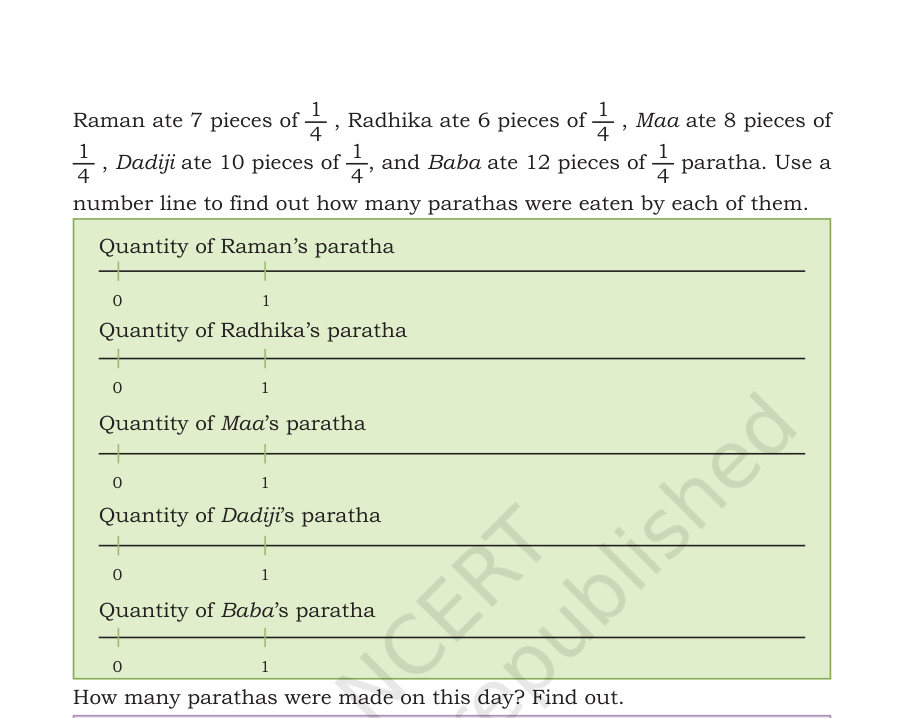
Raman ate 7 pieces of 1/4, Radhika ate 6 pieces of 1/4, Maa ate 8 pieces of 1/4, Dadiji ate 10 pieces of 1/4, and Baba ate 12 pieces of 1/4 paratha. Use a number line to find out how many parathas were eaten by each of them. How many parathas were made on this day? (Dadaji ate 9 pieces of 1/4.)
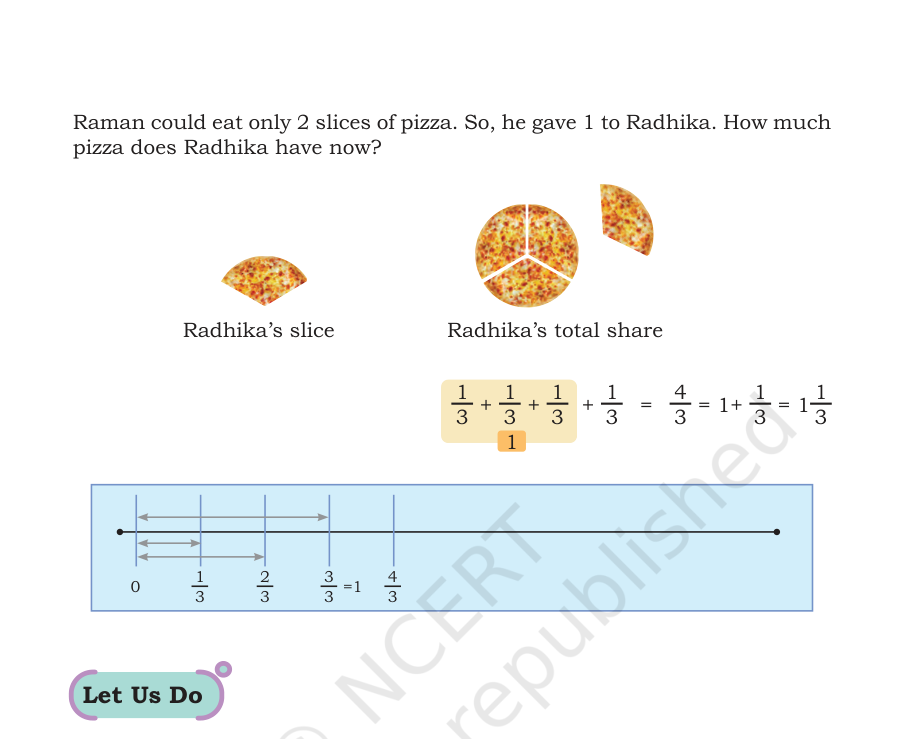
Raman's family of 6 members ordered 2 pizzas and cut each pizza into 3 equal slices so that each family member had one slice. Dadiji and Dadaji gave their slices to Raman; Maa and Baba gave theirs to Radhika. How much pizza does each of them have after this? Raman could eat only 2 slices of pizza. So, he gave 1 to Radhika. How much pizza does Radhika have now?
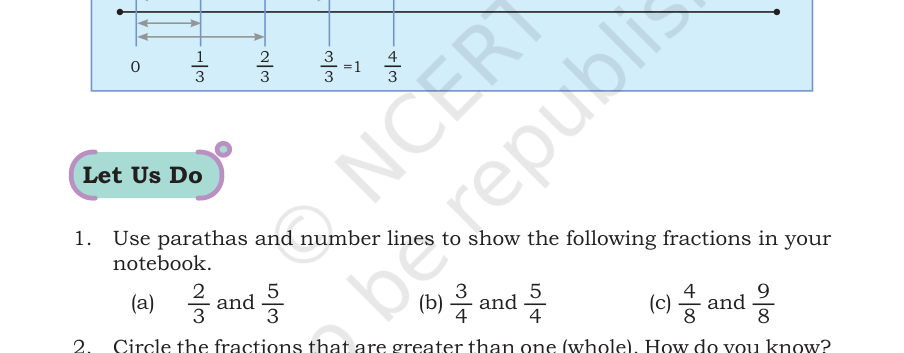
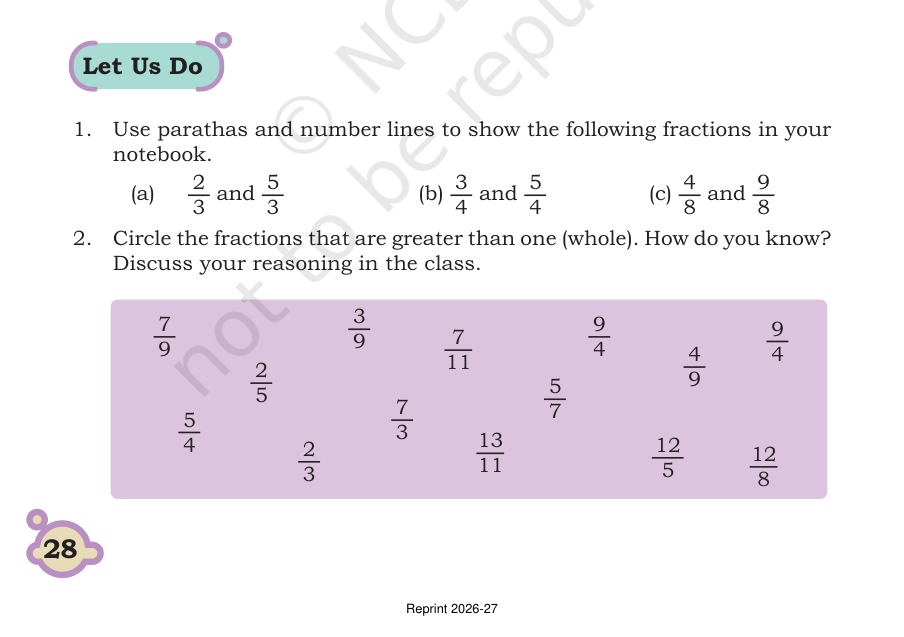
Use parathas and number lines to show the following fractions in your notebook.
(a)2/3 and 5/3
(b)3/4 and 5/4
(c)4/8 and 9/8
Original NCERT question visual - PDF page 12
Solution
(a) Divide each unit into 3 equal parts. 2/3 is 2 jumps of 1/3 (before 1); 5/3 = 1 2/3 is 5 jumps (after 1). One paratha cut in 3 with 2 pieces taken, and 1 whole paratha + 2 pieces of 1/3.
(b) Divide each unit into 4 equal parts. 3/4 is before 1; 5/4 = 1 1/4 is after 1.
(c) Divide each unit into 8 equal parts. 4/8 = 1/2 is halfway to 1; 9/8 = 1 1/8 is just after 1.
Question 2NCERT PDF page 12
Circle the fractions that are greater than one (whole). How do you know? Discuss your reasoning in the class. 7/9, 3/9, 7/11, 9/4, 9/4, 2/5, 4/9, 5/7, 5/4, 7/3, 13/11, 2/3, 12/5, 12/8
Original NCERT question visual - PDF page 12
Solution
Circle 9/4, 9/4, 5/4, 7/3, 13/11, 12/5 and 12/8. In each of these the numerator is greater than the denominator, so there are more pieces than are needed to make one whole. The others (7/9, 3/9, 7/11, 2/5, 4/9, 5/7, 2/3) are less than 1.
Question 1NCERT PDF page 13
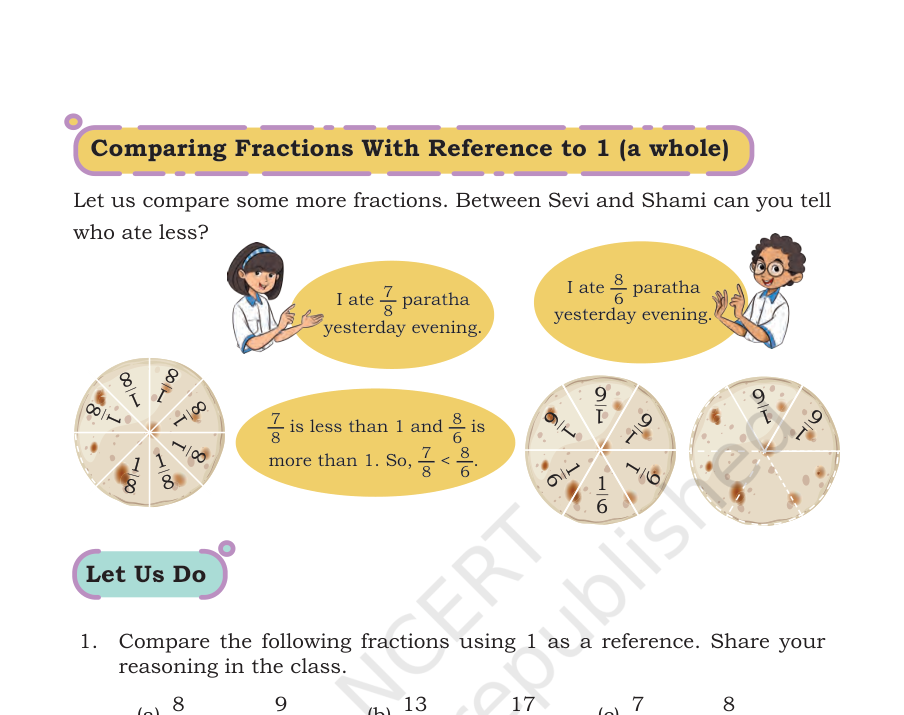
Compare the following fractions using 1 as a reference. Share your reasoning in the class.
(a)8/7 ___ 9/15
(b)13/20 ___ 17/15
(c)7/6 ___ 8/8
(d)6/6 ___ 19/12
(e)12/9 ___ 4/5
(f)15/5 ___ 16/4
Original NCERT question visual - PDF page 13
Solution
(a) 8/7 > 9/15 (8/7 is more than 1; 9/15 is less than 1)
(b) 13/20 < 17/15 (13/20 is less than 1; 17/15 is more than 1)
(c) 7/6 > 8/8 (8/8 = 1; 7/6 is more than 1)
(d) 6/6 < 19/12 (6/6 = 1; 19/12 is more than 1)
(e) 12/9 > 4/5 (12/9 is more than 1; 4/5 is less than 1)
(f) 15/5 < 16/4 (15/5 = 3 and 16/4 = 4)
Question 1NCERT PDF page 14
Comparing Fractions with Reference to 1/2 (4/8 = 1/2 and 3/6 = 1/2). Circle the fractions below that are equal to 1/2. 2/4, 3/5, 5/7, 7/14, 5/10, 8/16, 5/9, 6/12, 10/20, 6/8
Solution
Circle 2/4, 7/14, 5/10, 8/16, 6/12 and 10/20. In each of these the denominator is exactly double the numerator. 3/5, 5/7, 5/9 and 6/8 are not equal to 1/2.
Question 2NCERT PDF page 14
Some fractions are written in the box below. Circle the fractions that are less than half. How do you know? Discuss your reasoning in the class. 3/9, 2/4, 12/15, 8/15, 11/12, 3/15, 4/8, 1/3, 7/11, 11/16, 15/31, 6/18 Now let us compare fractions using 1/2. One child ate 5/8 paratha and the other ate 3/6 paratha yesterday evening. Who do you think ate more paratha?
Original NCERT question visual - PDF page 14
Solution
Circle 3/9, 3/15, 1/3, 15/31 and 6/18. In each, double the numerator is less than the denominator (for example 2 × 3 = 6 < 9), so the fraction is less than half. 2/4 and 4/8 are exactly half; 12/15, 8/15, 11/12, 7/11 and 11/16 are more than half.
3/6 is exactly half, but 5/8 is more than half (4/8 is half). So 5/8 > 3/6; the child who ate 5/8 paratha ate more.
Question 3NCERT PDF page 15
Compare the following fractions. Where possible, compare the fractions with 1/2. 2/9 and 4/7; 11/14 and 7/20; 5/7 and 3/9; 6/7 and 4/10; 9/17 and 3/15; 7/12 and 3/11; 1/3 and 5/9; 3/9 and 4/7
Original NCERT question visual - PDF page 15
Solution
2/9 < 4/7 (2/9 is less than 1/2, 4/7 is more than 1/2)
11/14 > 7/20 (11/14 is more than 1/2, 7/20 is less)
5/7 > 3/9
6/7 > 4/10
9/17 > 3/15 (9/17 is a little more than 1/2 because 18 > 17)
7/12 > 3/11
1/3 < 5/9
3/9 < 4/7
Try ThisNCERT PDF page 15
If the length of an ant is 1/4 cm, what is the total length of 16 such ants walking in a line? Use the number line. Fun with Relations: If the only brother of your father's sister had a child, what would be the child's relationship with you?
Solution
16 × 1/4 cm = 16/4 cm = 4 cm (4 ants make 1 cm, so 16 ants make 4 cm).
The only brother of your father's sister is your father himself. So his child is you, or your own brother or sister.