What are gross motor skills and fine motor skills? Which five key motor movements does Unit 1 focus on?
Original NCERT question visual - PDF page 1
Answer
Gross motor skills use our large muscles for movements such as jumping, throwing, catching, kicking and hitting. They help in everyday tasks, sports and staying fit.
Fine motor skills use the small muscles of our hands and fingers for precise actions like writing, drawing, picking up small items and gripping objects.
The five key motor movements are throwing, catching, kicking, receiving and striking.
Question 1NCERT PDF page 3
How should you grip the ball before throwing it?
Original NCERT question visual - PDF page 3
Answer
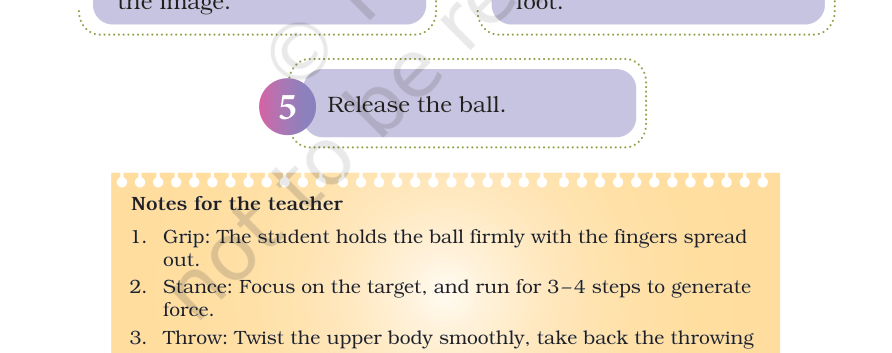
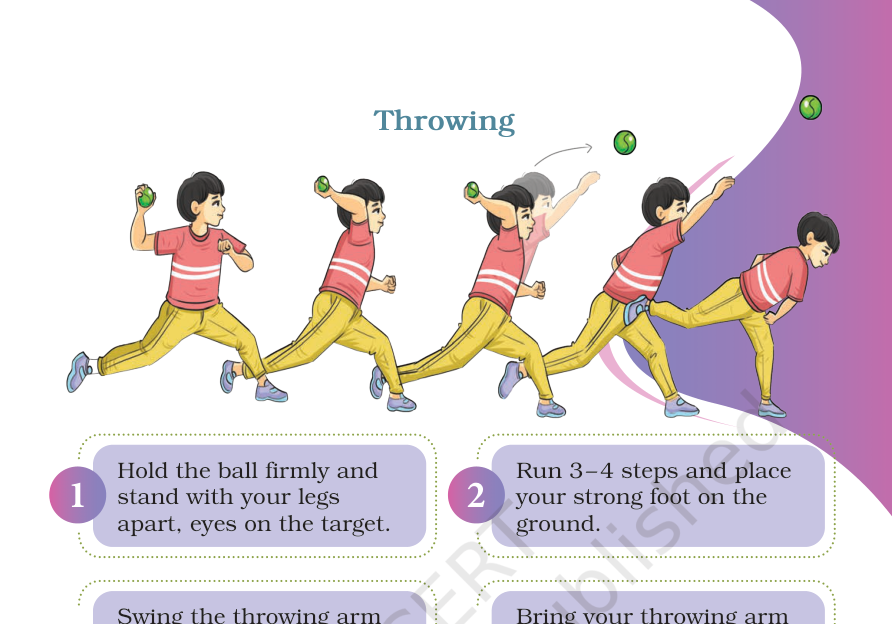
Hold the ball firmly with the fingers spread out.
Question 2NCERT PDF page 3
What should your stance and run-up be like when you throw?
Original NCERT question visual - PDF page 3
Answer
Stand with your legs apart and your eyes on the target. Run 3–4 steps to build up force and place your strong foot on the ground.
Question 3NCERT PDF page 3
How is the throwing action done?
Original NCERT question visual - PDF page 3
Answer
Swing the throwing arm backwards while twisting your waist (upper body) smoothly, then bring the arm forward and release the ball.
Question 4NCERT PDF page 3
What is the follow-through after a throw?
Original NCERT question visual - PDF page 3
Answer
Bring the throwing arm forward and follow it through with your other foot. The follow-through should be smooth and without any jerk.
Question 1NCERT PDF page 4
How should you hold the ball when you catch it?
Original NCERT question visual - PDF page 4
Answer
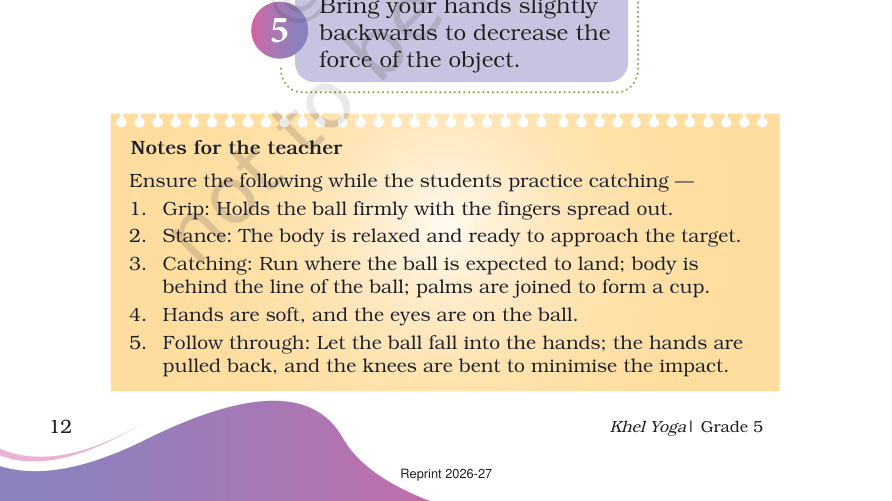
Hold the ball firmly with the fingers spread out.
Question 2NCERT PDF page 4
What should your stance be like before catching a ball?
Original NCERT question visual - PDF page 4
Answer
Stand comfortably with the body relaxed and ready to move towards the ball, and keep your eyes on the ball.
Question 3NCERT PDF page 4
Where should your body and palms be while catching a ball?
Original NCERT question visual - PDF page 4
Answer
Run to where the ball is expected to land, keep your body behind the line of the ball and join your palms to form a cup.
Question 4NCERT PDF page 4
How do you catch a ball over your head?
Original NCERT question visual - PDF page 4
Answer
Stand with knees slightly bent, as if getting ready to jump.
Join your palms above your head to form a reverse cup; keep your head still and eyes up on the ball.
Catch the ball softly over your head, keeping your hands soft.
Hold the ball firmly and bend your elbows back towards your body.
Question 5NCERT PDF page 4
What is the follow-through after catching a ball?
Original NCERT question visual - PDF page 4
Answer
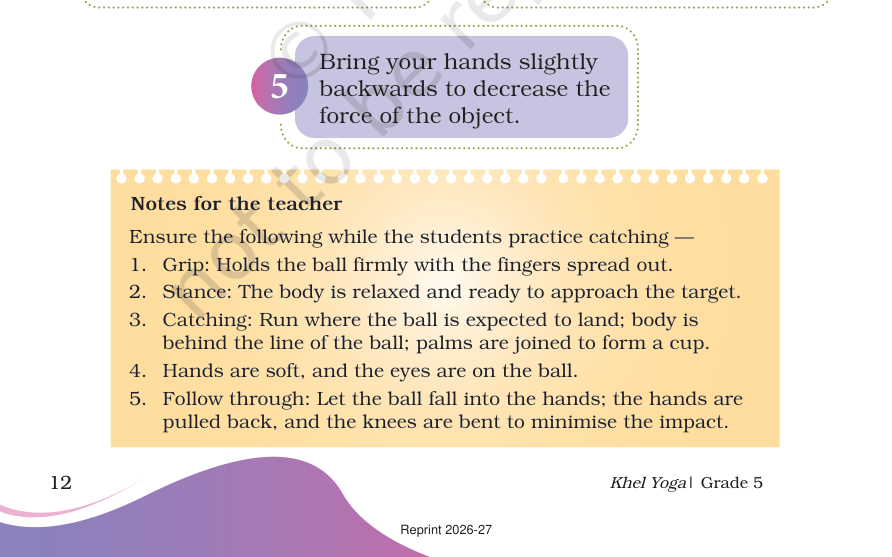
Let the ball come softly into your hands, then pull the hands slightly back and bend the knees. This reduces the force (impact) of the ball.
Question 6NCERT PDF page 6
Hush Hush Throw (BM 1): What material is needed, and how are the teams arranged?
Original NCERT question visual - PDF page 6
Answer
Material: a soft ball.
Form several teams. Each team stands in a circle marked on the ground.
Question 7NCERT PDF page 6
Hush Hush Throw (BM 1): Where does the defender stand?
Original NCERT question visual - PDF page 6
Answer
One defender stands at the centre of each team's circle.
Question 8NCERT PDF page 6
Hush Hush Throw (BM 1): Who holds the ball at the start?
Original NCERT question visual - PDF page 6
Answer
Any one student standing in the circle holds the ball at the start.
Question 9NCERT PDF page 6
Hush Hush Throw (BM 1): How do the students throw the ball, and why is the game called 'Hush Hush'?
Original NCERT question visual - PDF page 6
Answer
At the whistle, the students throw the ball to each other randomly, without any signal or noise. Because they pass silently (hush hush), the defender cannot guess where the ball will go.
Question 10NCERT PDF page 6
Hush Hush Throw (BM 1): How long can a student hold the ball? How can you measure this time while playing?
Original NCERT question visual - PDF page 6
Answer
A student may not hold the ball for more than three seconds.
You can measure it by counting silently in your head, 'one-and, two-and, three' (sample answer).
Question 11NCERT PDF page 6
Hush Hush Throw (BM 1): What happens when the defender intercepts the ball?
Original NCERT question visual - PDF page 6
Answer
The defender tries to intercept (catch or stop) the ball. If the ball is intercepted, the thrower becomes the new defender and the game continues.
Question 12NCERT PDF page 7
Hush Hush Throw (BM 1): What factors will you consider when deciding to whom to throw the ball?
Original NCERT question visual - PDF page 7
Answer
I would see where the defender is standing, choose a teammate who is free and not near the defender, check the distance, and decide whether to throw low or high (sample answer).
Question 13NCERT PDF page 7
Hush Hush Throw (BM 1): What is the purpose of this game, and what variations can be tried?
Original NCERT question visual - PDF page 7
Answer
Purpose: to develop agility and coordination with quick decision-making skills.
Variations:
Change the size of the ball.
Use more balls and more defenders to make it harder.
Make rules to throw the ball below or over the head.
Use different throws like underarm, overhead and sidearm.
Question 14NCERT PDF page 8
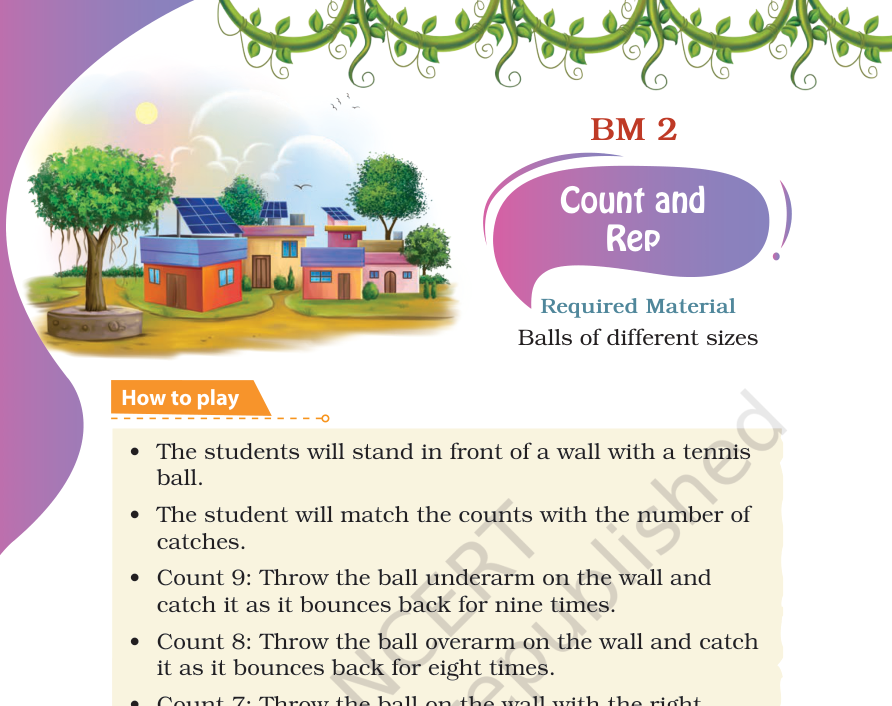
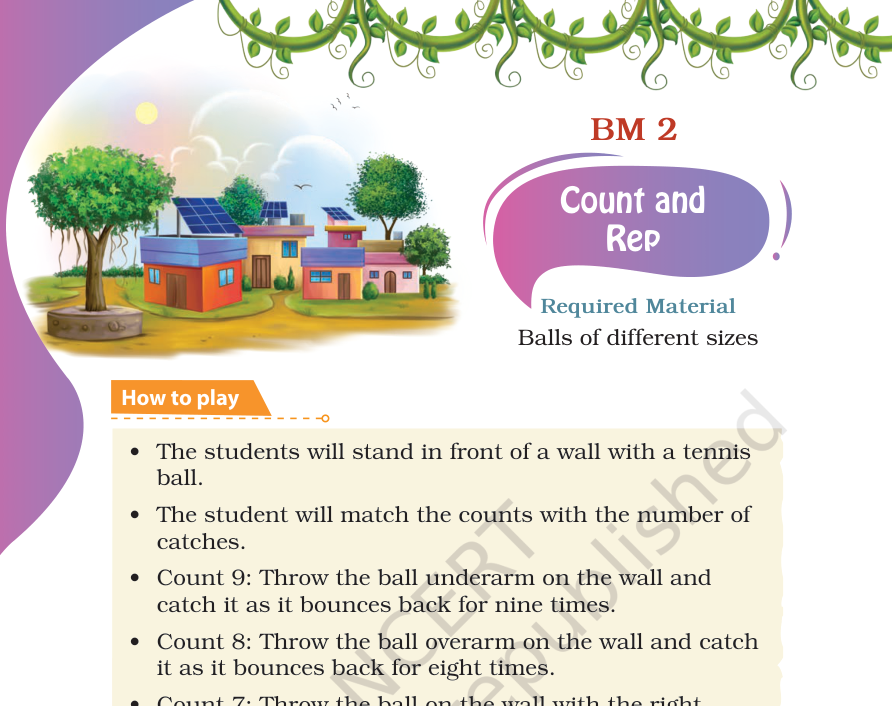
Count and Rep (BM 2): What material is needed, and where do the students stand?
Original NCERT question visual - PDF page 8
Answer
Material: balls of different sizes.
Each student stands in front of a wall with a tennis ball.
Question 15NCERT PDF page 8
Count and Rep (BM 2): What does 'match the counts with the number of catches' mean?
Original NCERT question visual - PDF page 8
Answer
The count number tells you how many catches to do. For example, at Count 9 you catch the ball nine times, at Count 8 eight times, and so on, down to Count 1.
Question 16NCERT PDF page 8
Count and Rep (BM 2): What do you do at Count 9?
Original NCERT question visual - PDF page 8
Answer
Throw the ball underarm on the wall and catch it as it bounces back — nine times.
Question 17NCERT PDF page 8
Count and Rep (BM 2): What do you do at Count 8?
Original NCERT question visual - PDF page 8
Answer
Throw the ball overarm on the wall and catch it as it bounces back — eight times.
Question 18NCERT PDF page 8
Count and Rep (BM 2): What do you do at Count 7?
Original NCERT question visual - PDF page 8
Answer
Throw the ball on the wall with the right hand and catch it with the left hand — seven times.
Question 19NCERT PDF page 8
Count and Rep (BM 2): What do you do at Count 6?
Original NCERT question visual - PDF page 8
Answer
Throw the ball on the wall with the left hand and catch it with the right hand — six times.
Question 20NCERT PDF page 8
Count and Rep (BM 2): What do you do at Count 5?
Original NCERT question visual - PDF page 8
Answer
Throw the ball on the ground so that it bounces up to the wall and back, then catch it — five times.
Question 21NCERT PDF page 8
Count and Rep (BM 2): What do you do at Count 4?
Original NCERT question visual - PDF page 8
Answer
Throw the ball on the wall and clap twice before catching it. Repeat this four times.
Question 22NCERT PDF page 8
Count and Rep (BM 2): What do you do at Count 3?
Original NCERT question visual - PDF page 8
Answer
Throw the ball on the wall, clap once behind your back, and catch the ball — three times.
Question 23NCERT PDF page 8
Count and Rep (BM 2): What do you do at Count 2?
Original NCERT question visual - PDF page 8
Answer
Throw the ball high on the wall and jump to catch it over your head. Repeat this twice.
Question 24NCERT PDF page 8
Count and Rep (BM 2): What do you do at Count 1?
Original NCERT question visual - PDF page 8
Answer
Throw the ball on the wall, turn right, and move backwards to catch it as it bounces back — once.
Question 25NCERT PDF page 9
Count and Rep (BM 2): What is the purpose and what are the variations? Which throw did you find difficult, and what did you do to complete it?
Original NCERT question visual - PDF page 9
Answer
Purpose: to develop coordination, concentration and reaction time.
Variations: change the size of the ball; change the count, the reps and the throwing skill.
I found Count 3 (clapping behind the back) difficult. I threw the ball higher on the wall to get more time before catching it (sample answer).
Question 26NCERT PDF page 10
Pass and Score (BM 3): What material is needed, and how are the playing area and teams set up?
Original NCERT question visual - PDF page 10
Answer
Material: balls of different sizes.
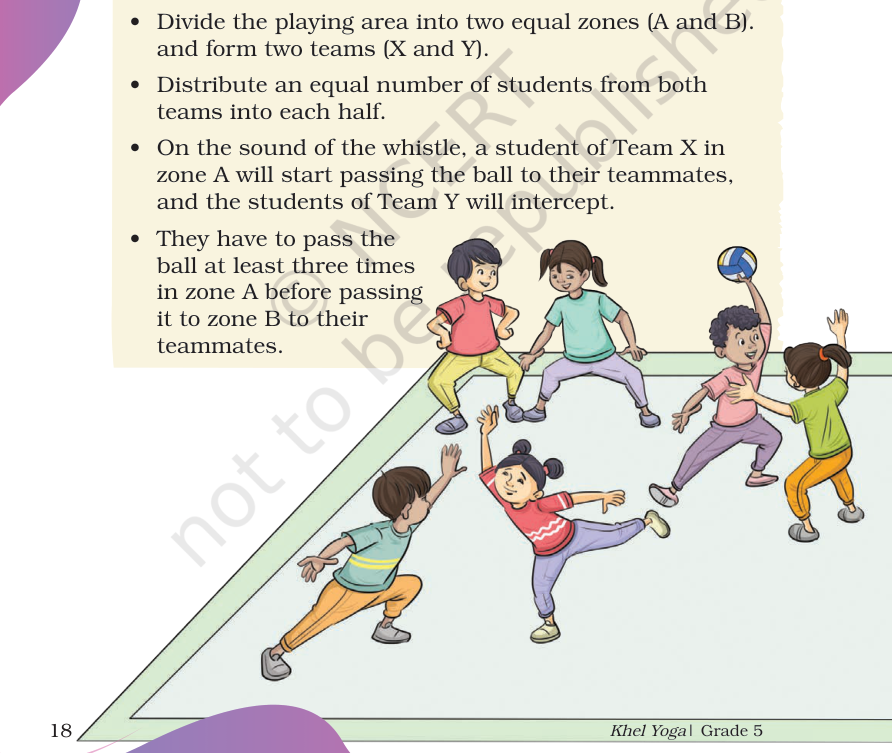
The playing area is divided into two equal zones, A and B, and the students form two teams, X and Y.
Question 27NCERT PDF page 10
Pass and Score (BM 3): How are the players of the two teams placed in the zones?
Original NCERT question visual - PDF page 10
Answer
An equal number of students from both teams is placed in each half (zone A and zone B).
Question 28NCERT PDF page 10
Pass and Score (BM 3): How does the game start?
Original NCERT question visual - PDF page 10
Answer
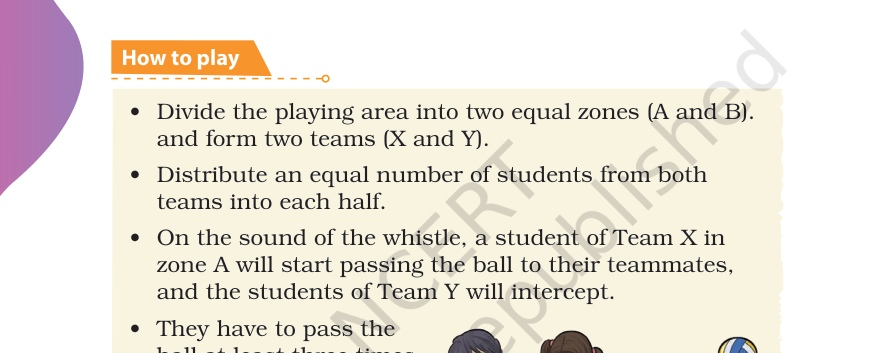
At the whistle, a student of Team X in zone A starts passing the ball to teammates, while the students of Team Y try to intercept it.
Question 29NCERT PDF page 10
Pass and Score (BM 3): How many passes must be made in zone A before the ball goes to zone B?
Original NCERT question visual - PDF page 10
Answer
The team must pass the ball at least three times in zone A before passing it to their teammates in zone B.
Question 30NCERT PDF page 11
Pass and Score (BM 3): How does a team score a point?
Original NCERT question visual - PDF page 11
Answer
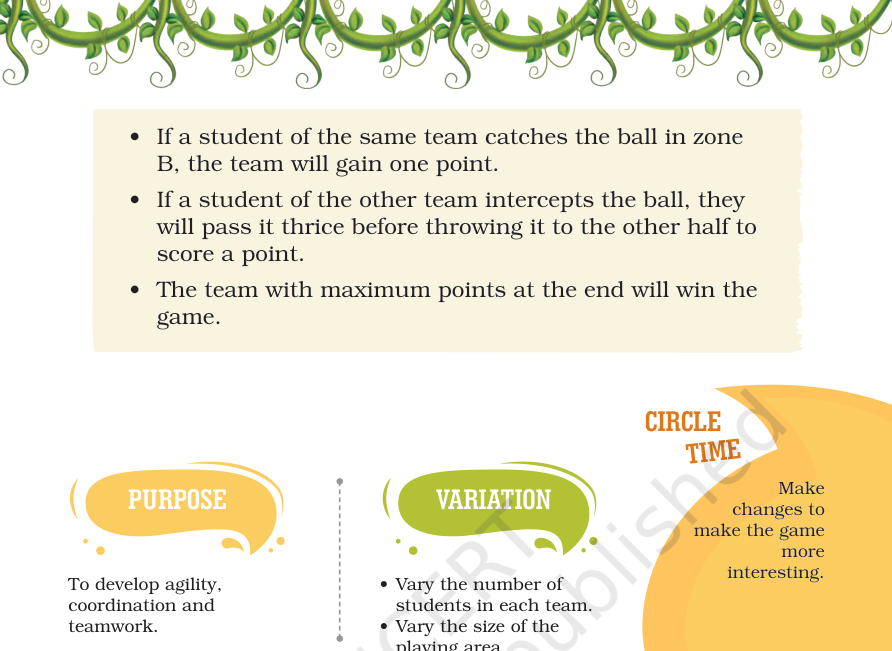
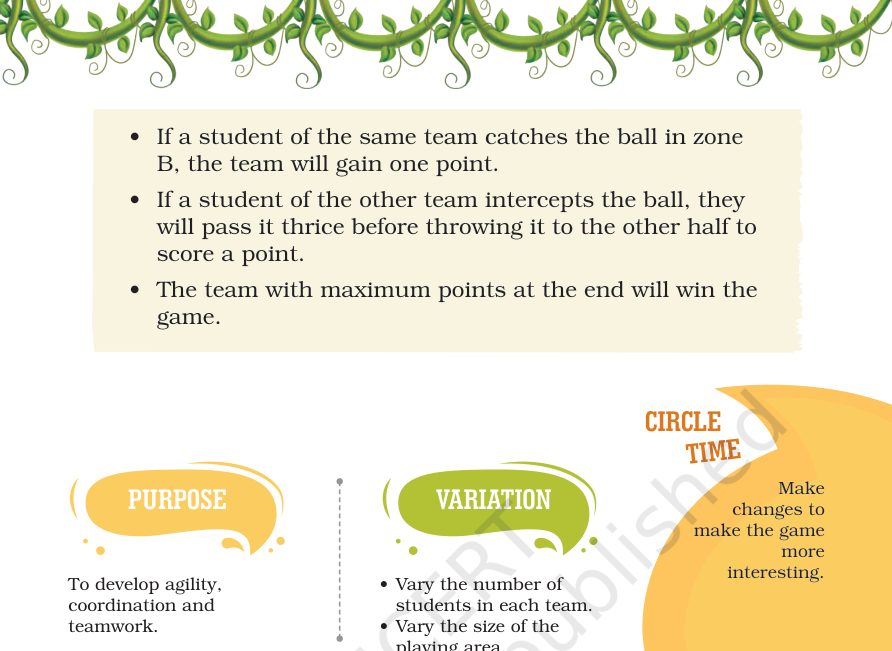
If a student of the same team catches the ball in zone B, the team gains one point.
Question 31NCERT PDF page 11
Pass and Score (BM 3): What happens if a student of the other team intercepts the ball?
Original NCERT question visual - PDF page 11
Answer
The intercepting team now gets the ball. They must pass it three times before throwing it to their teammates in the other half to score a point.
Question 32NCERT PDF page 11
Pass and Score (BM 3): Who wins? What is the purpose of the game, its variations, and what change would you make to make it more interesting?
Original NCERT question visual - PDF page 11
Answer
The team with the maximum points at the end wins.
Purpose: to develop agility, coordination and teamwork.
Variations: change the number of students in each team; change the size of the playing area.
Change: every player must touch the ball before it is passed to zone B (sample answer).
Question 33NCERT PDF page 12
Hand the Ball (BM 4): What material is needed, and how are the students divided?
Original NCERT question visual - PDF page 12
Answer
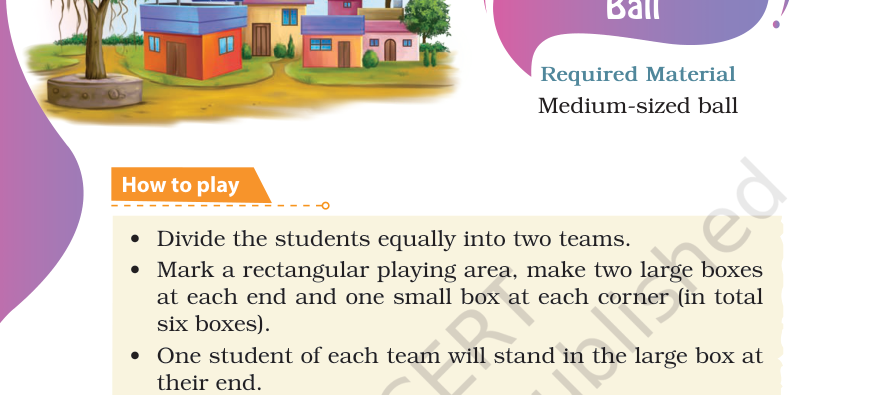
Material: a medium-sized ball.
The students are divided equally into two teams.
Question 34NCERT PDF page 12
Hand the Ball (BM 4): How is the playing area marked?
Original NCERT question visual - PDF page 12
Answer
Mark a rectangular playing area with two large boxes (one at each end) and one small box at each corner — six boxes in total.
Question 35NCERT PDF page 12
Hand the Ball (BM 4): Who stands in the large boxes?
Original NCERT question visual - PDF page 12
Answer
One student of each team stands in the large box at their end.
Question 36NCERT PDF page 12
Hand the Ball (BM 4): What is the aim when the game starts?
Original NCERT question visual - PDF page 12
Answer
The game starts from one end. The students aim to pass the ball to their teammate standing in the box at the other end.
Question 37NCERT PDF page 12
Hand the Ball (BM 4): How many points does a catch in the large box earn?
Original NCERT question visual - PDF page 12
Answer
Every successful catch (reception) inside the larger box earns one point.
Question 38NCERT PDF page 12
Hand the Ball (BM 4): How many points does a catch in a small box earn?
Original NCERT question visual - PDF page 12
Answer
Every successful catch in a smaller (corner) box earns two points.
Question 39NCERT PDF page 13
Hand the Ball (BM 4): Who can catch the ball in a small box?
Original NCERT question visual - PDF page 13
Answer
Any student of the same team can move into the small box on their side and catch the ball there.
Question 40NCERT PDF page 13
Hand the Ball (BM 4): What happens after a pass is completed?
Original NCERT question visual - PDF page 13
Answer
After completing the pass, the ball is handed over to the other team.
Question 41NCERT PDF page 13
Hand the Ball (BM 4): How is the winner decided? How will you help the students of the losing team overcome the feeling of defeat?
Original NCERT question visual - PDF page 13
Answer
The game goes on for a fixed time; the team with the maximum points at the end wins.
I would shake hands with them, praise their good catches and tell them we can all practise and do better next time (sample answer).
Question 42NCERT PDF page 13
Hand the Ball (BM 4): How did you anticipate the correct place to receive the ball?
Original NCERT question visual - PDF page 13
Answer
I watched the thrower's arm and the path of the ball, and moved early to the box where it was going to land (sample answer).
Question 43NCERT PDF page 13
Hand the Ball (BM 4): What is the purpose of this game, and what variations can be tried?
Original NCERT question visual - PDF page 13
Answer
Purpose: to develop spatial understanding and cooperation.
Variations: change the number of students in each team; change the size of the playing area.
Question 44NCERT PDF page 14
Catch and Hit (BM 5): What material is needed, and how are the students grouped?
Original NCERT question visual - PDF page 14
Answer
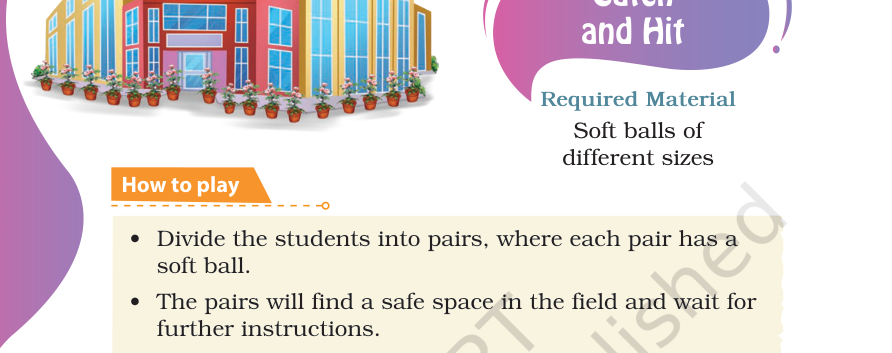
Material: soft balls of different sizes.
The students are divided into pairs, and each pair has one soft ball.
Question 45NCERT PDF page 14
Catch and Hit (BM 5): What do the pairs do before the game starts?
Original NCERT question visual - PDF page 14
Answer
Each pair finds a safe space in the field and waits for further instructions.
Question 46NCERT PDF page 14
Catch and Hit (BM 5): What do the students do when the teacher calls 'catch'?
Original NCERT question visual - PDF page 14
Answer
On the call of 'catch', the partners start passing the ball to each other.
Question 47NCERT PDF page 14
Catch and Hit (BM 5): What happens when the teacher calls 'throw'?
Original NCERT question visual - PDF page 14
Answer
On the call of 'throw', the student without the ball runs away from the partner.
Question 48NCERT PDF page 14
Catch and Hit (BM 5): What do the two partners try to do after 'throw' is called?
Original NCERT question visual - PDF page 14
Answer
The student with the ball tries to hit the partner with the soft ball, and the partner tries to dodge it.
Question 49NCERT PDF page 15
Catch and Hit (BM 5): What did you do to make your throws more accurate?
Original NCERT question visual - PDF page 15
Answer
I kept my eyes on my partner, threw a little ahead of where they were running, and used a quick, controlled throw instead of a very hard one (sample answer).
Question 50NCERT PDF page 15
Catch and Hit (BM 5): What is the purpose and variation of this game? What strategies do students use while dodging and hitting?
Original NCERT question visual - PDF page 15
Answer
Purpose: to develop accuracy in throwing and reaction time.
Variation: change the size, weight and shape of the ball.
Strategies: the dodger keeps watching the ball, changes direction suddenly and bends or jumps; the hitter aims low, throws quickly and aims where the partner is moving (sample answer).
Question 51NCERT PDF page 16
Bull's Eye (BM 6): What material is needed, and how big is each team?
Original NCERT question visual - PDF page 16
Answer
Material: tennis balls, cones and a hula-hoop.
Form teams of 4–5 students.
Question 52NCERT PDF page 16
Bull's Eye (BM 6): What are Spots A, B and C?
Original NCERT question visual - PDF page 16
Answer
Spot A — where the students line up.
Spot B — 5 metres from Spot A, where the tennis balls are placed.
Spot C — the target: a hula-hoop, tyre or circle marked on the wall.
Question 53NCERT PDF page 16
Bull's Eye (BM 6): What do the students do when the whistle blows?
Original NCERT question visual - PDF page 16
Answer
Students run from Spot A to Spot B, pick up a ball and throw it hard at the target.
Question 54NCERT PDF page 17
Bull's Eye (BM 6): What happens after the throw? Give the purpose and variations of the game.
Original NCERT question visual - PDF page 17
Answer
After throwing, the student runs to collect the ball and places it back at Spot B.
Purpose: to develop power in the throw and a quick response.
Variations: change the number of students in each team; change the size of the playing area and the distance between the spots.
Did you know? Focus and concentration are the key to hitting a target precisely.