Striking with a bat/racquet/stick: What is the correct stance before hitting?
Original NCERT question visual - PDF page 33
Answer
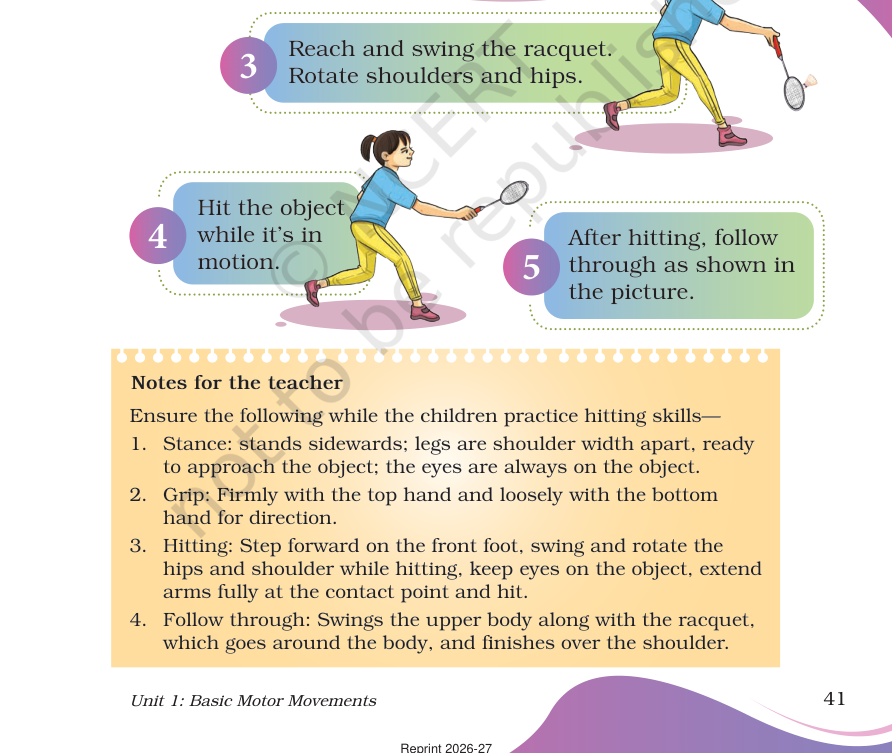
Stand sideways with the legs shoulder-width apart and the knees slightly bent, ready to move towards the object. Keep your eyes on the object all the time.
Question 2NCERT PDF page 33
Striking: How should you grip the bat or racquet?
Original NCERT question visual - PDF page 33
Answer
Hold it firmly with the top hand and loosely with the bottom hand, which gives the direction.
Question 3NCERT PDF page 33
Striking: How is the hitting action done?
Original NCERT question visual - PDF page 33
Answer
Step forward on the front foot, swing and rotate the hips and shoulders, keep your eyes on the object, extend the arms fully at the point of contact and hit.
Question 4NCERT PDF page 33
Striking: What is the follow-through after hitting?
Original NCERT question visual - PDF page 33
Answer
Swing the upper body along with the racquet so that it goes around the body and finishes over the shoulder.
Question 1NCERT PDF page 34
Receiving with a racquet: What is the correct stance?
Original NCERT question visual - PDF page 34
Answer
Keep the feet shoulder-width apart, knees slightly bent, and the body facing the object, ready to move towards it. The racquet faces the direction of the incoming object.
Question 2NCERT PDF page 34
Receiving with a racquet: How should you hold the racquet?
Original NCERT question visual - PDF page 34
Answer
Hold the racquet gently with both hands, bending forward slightly.
Question 3NCERT PDF page 34
Receiving with a racquet: What does it mean to anticipate the object?
Original NCERT question visual - PDF page 34
Answer
It means to predict the path of the object, move towards it, and keep the body low and in line with it.
Question 4NCERT PDF page 34
Receiving with a racquet: How do you receive the object?
Original NCERT question visual - PDF page 34
Answer
Get in line with the approaching object and receive it with gentle (soft) hands, so that it does not bounce away on impact.
Question 5NCERT PDF page 35
Handle with Care (BM 13): What material is needed, and how far apart are the start and finish lines?
Original NCERT question visual - PDF page 35
Answer
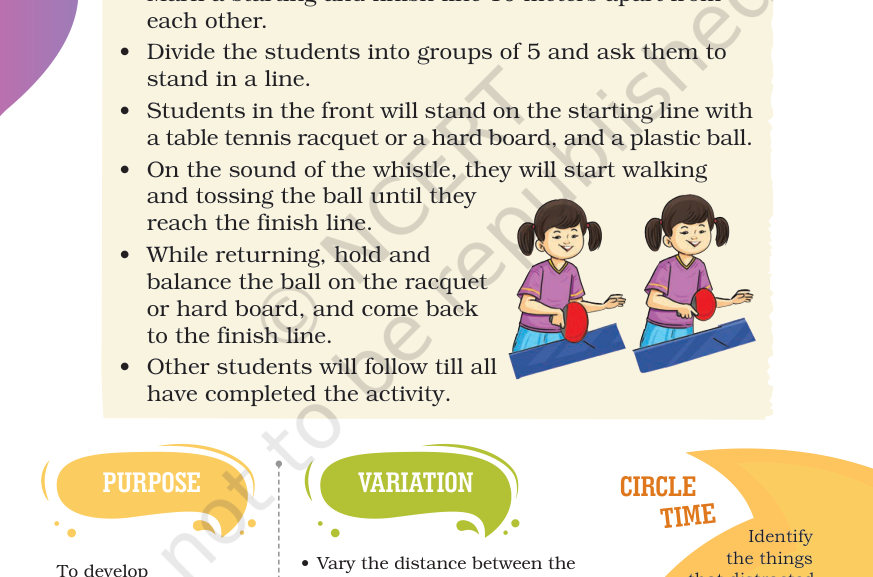
Material: racquets and tennis balls (a table tennis racquet or a hard board with a plastic ball can be used). The start and finish lines are 10 metres apart.
Question 6NCERT PDF page 35
Handle with Care (BM 13): How are the students grouped?
Original NCERT question visual - PDF page 35
Answer
Students are divided into groups of 5, and each group stands in a line.
Question 7NCERT PDF page 35
Handle with Care (BM 13): What does the student at the front of each line hold?
Original NCERT question visual - PDF page 35
Answer
The student in front stands on the starting line with a table tennis racquet or a hard board and a plastic ball.
Question 8NCERT PDF page 35
Handle with Care (BM 13): What do students do on the way to the finish line?
Original NCERT question visual - PDF page 35
Answer
When the whistle blows, they walk and keep tossing the ball on the racquet until they reach the finish line.
Question 9NCERT PDF page 35
Handle with Care (BM 13): What do students do on the way back?
Original NCERT question visual - PDF page 35
Answer
On the way back they hold and balance the ball on the racquet or hard board (without tossing it) and walk back.
Question 10NCERT PDF page 35
Handle with Care (BM 13): When does the activity end, and what is its purpose?
Original NCERT question visual - PDF page 35
Answer
The other students follow one by one until everyone has completed the activity. Its purpose is to develop concentration and balance.
Question 11NCERT PDF page 35
Handle with Care (BM 13): Give the variations of this activity.
Original NCERT question visual - PDF page 35
Answer
Change the distance between the start and finish lines.
Change the actions, such as balancing more than one ball.
Change the tapping: forehand, backhand or mixed.
Question 12NCERT PDF page 35
Handle with Care (Circle Time): What distracted you from concentrating on the task, and what did you do to overcome it?
Original NCERT question visual - PDF page 35
Answer
Noise from other students and looking at the finish line distracted me. I kept my eyes only on the ball and walked slowly and steadily. (sample answer)
Question 13NCERT PDF page 36
Balloon Strike (BM 14): What material is needed, and how is the playing area marked?
Original NCERT question visual - PDF page 36
Answer
Material: balloons or a small-sized ball. A rectangular playing area is marked with a goal at both ends.
Question 14NCERT PDF page 36
Balloon Strike (BM 14): How many teams are there and how many players are in each?
Original NCERT question visual - PDF page 36
Answer
There are two teams of 4–5 students each.
Question 15NCERT PDF page 36
Balloon Strike (BM 14): What is the aim of the team with the balloon?
Original NCERT question visual - PDF page 36
Answer
One balloon is given to a team, and they must put the balloon into the opponent's goal.
Question 16NCERT PDF page 36
Balloon Strike (BM 14): How must the balloon be passed to teammates?
Original NCERT question visual - PDF page 36
Answer
Every time, the student must toss the balloon and strike it (hit it with the hand) to pass it to a teammate.
Question 17NCERT PDF page 36
Balloon Strike (BM 14): Who wins the match?
Original NCERT question visual - PDF page 36
Answer
The team that scores the most goals wins the match.
Question 18NCERT PDF page 37
Balloon Strike (BM 14): What is the purpose of this game and what are its variations?
Original NCERT question visual - PDF page 37
Answer
Purpose: to develop coupling movements (hitting while running) with cooperation among teammates.
Change the size of the playing area.
Replace the balloon with soft balls.
Question 19NCERT PDF page 37
Balloon Strike (Did You Know and Circle Time): Why is spatial sense important? How does the path of the balloon change when you hit it at different points (very high above the head, just above the head, in front, or to the right of the head)?
Original NCERT question visual - PDF page 37
Answer
Spatial sense helps us recognise space, shapes, sizes, positions, directions and movements, and how objects relate to us and to others.
Hit very high above the head, the balloon goes up high and travels a short distance; hit just above the head or in front, it goes forward towards a teammate; hit at the right of the head, it moves off to the side. (sample answer)
Question 20NCERT PDF page 38
Catch to Win (BM 15): What material is needed, and how are the teams formed?
Original NCERT question visual - PDF page 38
Answer
Material: a cricket bat and a tennis ball. The students are divided into two teams, A and B.
Question 21NCERT PDF page 38
Catch to Win (BM 15): Where does Team A stand?
Original NCERT question visual - PDF page 38
Answer
A square is marked on the ground and Team A takes position inside the square.
Question 22NCERT PDF page 38
Catch to Win (BM 15): Where does Team B stand?
Original NCERT question visual - PDF page 38
Answer
Team B stands ten metres from the square, with one student holding the bat and one holding the ball.
Question 23NCERT PDF page 39
Catch to Win (BM 15): How is the ball bowled to the batter?
Original NCERT question visual - PDF page 39
Answer
When the whistle blows, a student from Team B throws an underarm ball to the student with the bat.
Question 24NCERT PDF page 39
Catch to Win (BM 15): Where does the batter try to hit the ball?
Original NCERT question visual - PDF page 39
Answer
The batter hits the ball into the square where Team A is standing.
Question 25NCERT PDF page 39
Catch to Win (BM 15): How are points scored?
Original NCERT question visual - PDF page 39
Answer
If Team A catches the ball, Team A scores one point. If the ball falls on the ground, Team B scores one point.
Question 26NCERT PDF page 39
Catch to Win (BM 15): How many times does each student bat before the teams change places?
Original NCERT question visual - PDF page 39
Answer
Students bat one by one, and each student hits the ball at least 5 times before Team B changes positions with Team A.
Question 27NCERT PDF page 39
Catch to Win (BM 15): Who wins, and what is the purpose of the game?
Original NCERT question visual - PDF page 39
Answer
The team with the maximum points wins the match. The purpose is to develop hand-eye coordination, accuracy and range of striking with a sense of force.
Question 28NCERT PDF page 39
Catch to Win (BM 15): Give the variations. In Circle Time, discuss the difference between hitting the ball high, straight or low.
Original NCERT question visual - PDF page 39
Answer
Change the size of the square and the distance between students.
Change the size of the ball or the hitting apparatus (bat).
Hit the ball high, straight or low.
A high hit stays in the air longer, so it is easier to catch; a straight hit travels fast and flat; a low hit stays close to the ground and is hard to catch. (sample answer)
Question 29NCERT PDF page 40
Corner Tennis (BM 16): What material is needed, and how is the court marked?
Original NCERT question visual - PDF page 40
Answer
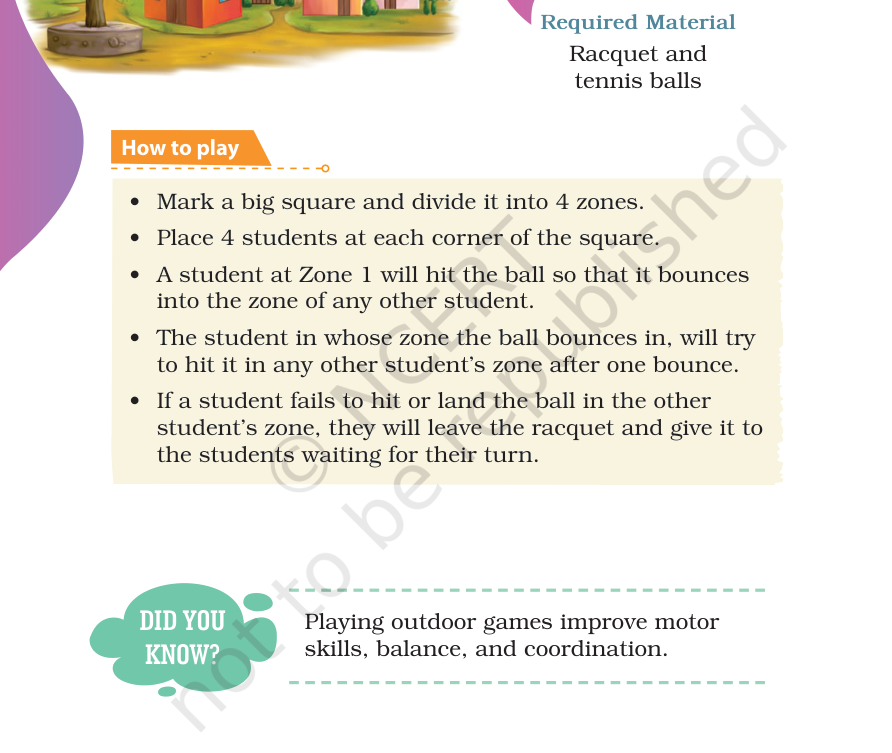
Material: a racquet and tennis balls. A big square is marked and divided into 4 zones.
Question 30NCERT PDF page 40
Corner Tennis (BM 16): Where do the players stand?
Original NCERT question visual - PDF page 40
Answer
4 students stand, one at each corner (zone) of the square.
Question 31NCERT PDF page 40
Corner Tennis (BM 16): How does the game start?
Original NCERT question visual - PDF page 40
Answer
The student in Zone 1 hits the ball so that it bounces into the zone of any other student.
Question 32NCERT PDF page 40
Corner Tennis (BM 16): What does the student in whose zone the ball bounces do?
Original NCERT question visual - PDF page 40
Answer
That student hits the ball after one bounce into any other student's zone.
Question 33NCERT PDF page 40
Corner Tennis (BM 16): What happens if a student fails to hit the ball or to land it in another zone? What does the Did You Know box say?
Original NCERT question visual - PDF page 40
Answer
The student leaves the game and gives the racquet to a student waiting for a turn.
Did You Know: playing outdoor games improves motor skills, balance and coordination.
Question 34NCERT PDF page 41
Corner Tennis (BM 16): What is the purpose of this game?
Original NCERT question visual - PDF page 41
Answer
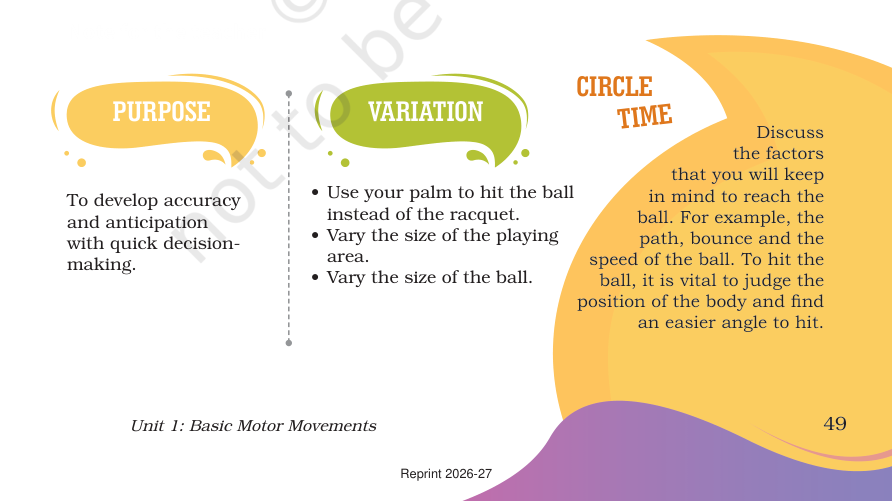
To develop accuracy and anticipation with quick decision-making.
Question 35NCERT PDF page 41
Corner Tennis (BM 16): Give the variations of this game.
Original NCERT question visual - PDF page 41
Answer
Use your palm to hit the ball instead of the racquet.
Change the size of the playing area.
Change the size of the ball.
Question 37NCERT PDF page 41
Corner Tennis (Circle Time): What factors will you keep in mind to reach the ball and hit it?
Original NCERT question visual - PDF page 41
Answer
Keep in mind the path, bounce and speed of the ball. To hit it, judge the position of your body and find an easier angle to hit.
Question 38NCERT PDF page 42
Hit and Cover (BM 17): What material is needed, and how is the field marked?
Original NCERT question visual - PDF page 42
Answer
Material: a long stick or bat and tennis balls. The students are divided into equal teams and a 10 × 10 metre square is marked with three bases and a smaller square at one corner.
Question 39NCERT PDF page 42
Hit and Cover (BM 17): What do the two teams do?
Original NCERT question visual - PDF page 42
Answer
One team bats and the other team fields.
Question 40NCERT PDF page 42
Hit and Cover (BM 17): How many balls does the batter hit, and from where?
Original NCERT question visual - PDF page 42
Answer
Three balls are placed in the smaller square, and the batter hits all three quickly.
Question 41NCERT PDF page 42
Hit and Cover (BM 17): When does the batter start running, and what is the aim?
Original NCERT question visual - PDF page 42
Answer
After hitting the third ball, the batter runs and tries to cover as many bases as possible.
Question 42NCERT PDF page 42
Hit and Cover (BM 17): What do the fielders do?
Original NCERT question visual - PDF page 42
Answer
The fielders gather the balls and quickly put them back in the small square.
Question 43NCERT PDF page 42
Hit and Cover (BM 17): How does the batting team score points?
Original NCERT question visual - PDF page 42
Answer
The batting team gets points equal to the number of bases the batter covers.
Question 44NCERT PDF page 42
Hit and Cover (BM 17): What happens after one batter's turn?
Original NCERT question visual - PDF page 42
Answer
The next batter comes in, and their points are added to the team's score.
Question 45NCERT PDF page 42
Hit and Cover (BM 17): When do the teams change roles?
Original NCERT question visual - PDF page 42
Answer
Once everyone in the batting team has batted, the roles are reversed (the fielding team bats).
Question 46NCERT PDF page 42
Hit and Cover (BM 17): Which team wins?
Original NCERT question visual - PDF page 42
Answer
The team with the maximum score at the end wins the game.
Question 47NCERT PDF page 43
Hit and Cover (BM 17): What is the purpose of this game?
Original NCERT question visual - PDF page 43
Answer
To develop upper body strength, speed and hand-eye coordination.