How do you do Padanguli Naman (toe bending)? Write the steps.
Original NCERT question visual - PDF page 32
Answer
Sit comfortably with your legs extended and feet together. Place the hands slightly behind the buttocks to support the back.
Keep the back straight.
Become aware of the toes and slowly move them back and forth. Repeat 10 times.
Then relax the ankles.
Question 2NCERT PDF page 32
How do you do Gulpha Chakra Chalana and Gulpha Naman (ankle rotation and ankle bending)? Write the steps.
Original NCERT question visual - PDF page 32
Answer
Sit comfortably with your legs extended and feet together. Place the hands slightly behind the buttocks to support the back. Keep the back straight.
Slowly rotate the right ankle clockwise and then anticlockwise, about 10 times each. Relax for a while, then repeat with the left ankle.
Keeping the legs extended, move both ankles up and down. Feel the stretch as you bend the feet forward and backwards. Repeat 10 times.
Question 3NCERT PDF page 33
How do you do Ardha Titali Sthiti (half butterfly)? Write the steps.
Original NCERT question visual - PDF page 33
Answer
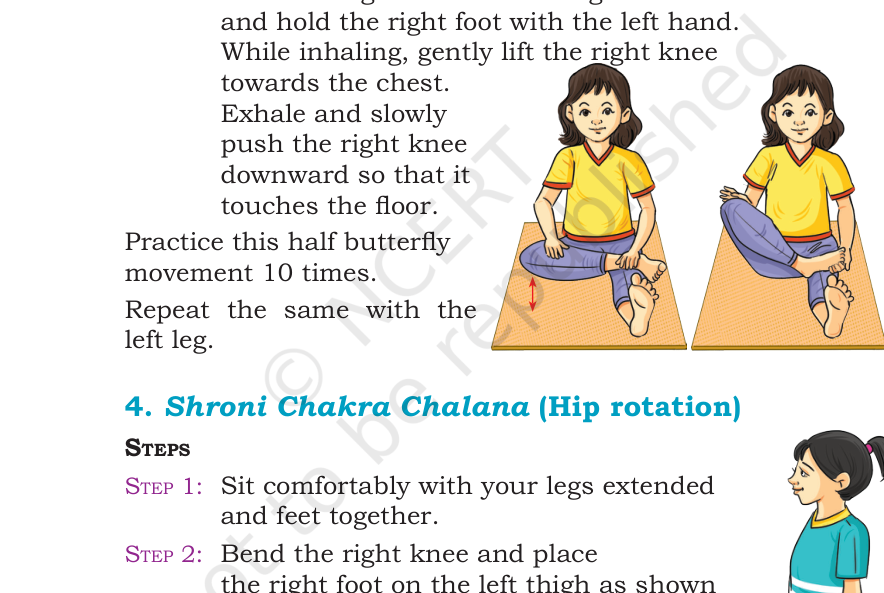
Sit comfortably with your legs extended and feet together.
Bend your right knee and place your right foot on top of your left thigh.
Place the right hand on the right knee and hold the right foot with the left hand.
While inhaling, gently lift the right knee towards the chest. While exhaling, slowly push the right knee down so that it touches the floor.
Do this half butterfly movement 10 times, then repeat with the left leg.
Question 4NCERT PDF page 33
How do you do Shroni Chakra Chalana (hip rotation)? Write the steps.
Original NCERT question visual - PDF page 33
Answer
Sit comfortably with your legs extended and feet together.
Bend the right knee and place the right foot on the left thigh.
Place the right hand on the right knee and hold the right foot with the left hand for balance.
Shift your body weight towards the left buttock and gently rotate the right hip joint — 10 times clockwise, then 10 times anticlockwise, focusing on the movement at the hip.
Repeat the same steps with the left leg.
Question 5NCERT PDF page 34
How do you do Gatyatmak Meru Vakra Sthiti (dynamic spinal twist)? Write the steps.
Original NCERT question visual - PDF page 34
Answer
Sit with your legs stretched wide apart.
Extend your arms straight out at shoulder level.
Exhale and twist the trunk to the right, bringing the left hand to touch the right foot while swinging the right arm behind you. Look over the right shoulder.
Inhale and return to the centre.
Exhale and repeat on the other side — right hand to the left foot, left arm swings back, look over the left shoulder.
Keep alternating sides 10 times.
Question 6NCERT PDF page 35
How do you do Chakki Chalana (churning the mill)? Write the steps.
Original NCERT question visual - PDF page 35
Answer
Sit with your legs stretched wide apart.
Interlock the fingers and stretch the arms straight out in front at shoulder height.
Rotate the hands and upper body in a large circle, moving clockwise.
While bending forward, exhale and try to touch the toes. While bending backwards, inhale and keep the elbows straight.
Do 10 rounds clockwise, then 10 rounds anticlockwise.
You feel the stretch in the hands, legs, lower back and abdomen.
Question 7NCERT PDF page 36
How do you do Bhu Namana (spinal twist)? Write the steps.
Original NCERT question visual - PDF page 36
Answer
Sit straight with your legs extended in front and hands by the sides.
Exhale, twist the trunk to the left and place both palms on the floor. Legs and body stay in a line.
Bend the arms and lower the forehead to touch the floor between the hands. Keep the buttocks close to the floor.
Inhale and slowly return to the centre. Repeat on the right side.
Practise 10 times on each side.
Question 8NCERT PDF page 36
How do you do Pada Sanchalana (cycling)? Write the steps.
Original NCERT question visual - PDF page 36
Answer
Lie on your back with the legs together and arms by the sides.
Raise both legs and make cycling movements, as if pedalling a bicycle.
Do 10 forward rotations and 10 backward rotations, breathing normally.
Slowly lower the legs and relax in Shavasana.
Question 9NCERT PDF page 37
How do you do Jangha Shakti Vikasaka (strengthening the thigh and calf muscles)? Write the steps.
Original NCERT question visual - PDF page 37
Answer
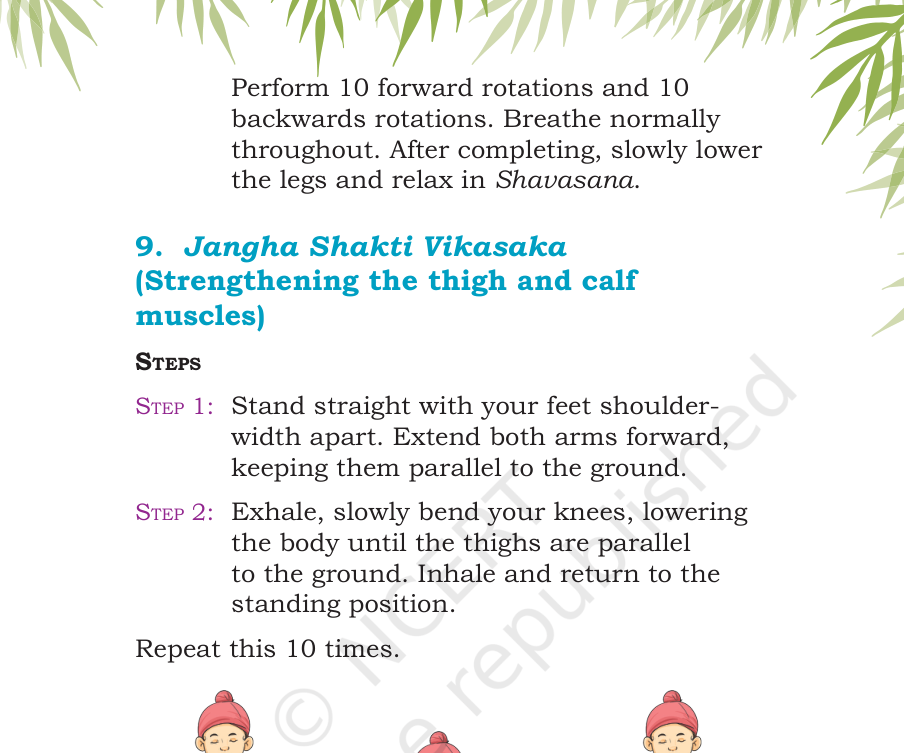
Stand straight with your feet shoulder-width apart. Extend both arms forward, parallel to the ground.
Exhale and slowly bend your knees, lowering the body until the thighs are parallel to the ground.
Inhale and come back to standing.
Repeat 10 times.
Question 10NCERT PDF page 40
Why should we practise asanas, according to the Hatha Pradipika?
Original NCERT question visual - PDF page 40
Answer
The shloka “Kuryaattadaasanam sthairyamaarogyam chaanga-laaghavam” (Hatha Pradipika) says asanas should be practised to get a steady posture, good health (freedom from diseases) and lightness of the body (flexible limbs).
Question 1NCERT PDF page 40
How does practising asanas daily help your body's fitness?
Original NCERT question visual - PDF page 40
Answer
It improves physical fitness, flexibility and balance.
Question 2NCERT PDF page 40
How do daily asanas help with body weight?
Original NCERT question visual - PDF page 40
Answer
They help us maintain a healthy, proper body weight.
Question 3NCERT PDF page 40
How do daily asanas help our sleep and immunity?
Original NCERT question visual - PDF page 40
Answer
They improve the quality of sleep and boost immunity to fight diseases.
Question 4NCERT PDF page 40
Which asanas will you learn in Grade 5? Name them by type.
Original NCERT question visual - PDF page 40
Answer
Standing: Hasta Uttanasana
Balancing: Utkatasana, Virabhadrasana
Sitting: Parvatasana, Janushirshasana, Gomukhasana, Simha Garjana Asana (a variation of Simhasana)
Daily asana practice also increases self-confidence.
Question 1NCERT PDF page 41
When should yoga practices be done — on a full or an empty stomach?
Original NCERT question visual - PDF page 41
Answer
Always practise on an empty stomach.
Question 2NCERT PDF page 41
What kind of mat or surface should you use for yoga?
Original NCERT question visual - PDF page 41
Answer
A clean, non-slippery mat or surface.
Question 3NCERT PDF page 41
How should asanas be performed to avoid injuries?
Original NCERT question visual - PDF page 41
Answer
Perform them slowly and mindfully.
Question 4NCERT PDF page 41
What should be done after each asana?
Original NCERT question visual - PDF page 41
Answer
A complementary asana (one that bends the body the opposite way) should be performed after each asana.
Question 5NCERT PDF page 41
What should you do if you feel uncomfortable or unwell during practice?
Original NCERT question visual - PDF page 41
Answer
Inform the teacher immediately.
Question 6NCERT PDF page 41
What should children with medical conditions do before yoga practice? What are the three stages of asana practice?
Original NCERT question visual - PDF page 41
Answer
Children with conditions such as epilepsy, asthma or bronchitis should inform the teacher before beginning practice.
The three stages of asana practice are: Initial position (Prarambhika Sthiti) → Asana performance → Relaxation (Vishranti).
Question 1NCERT PDF page 42
What does Hasta Uttanasana mean, and how is it done?
Original NCERT question visual - PDF page 42
Answer
Hasta means arms and Uttana means raised. Both arms are lifted above the head and the body is gently bent backwards.
Prarambhika Sthiti: Stand with the feet slightly apart and hands by the sides.
Step 1: Inhale and stretch both arms above the head, biceps touching the ears and elbows straight.
Step 2: Gently bend the trunk and head backwards, making a slight arch in the upper back. Hold for a few seconds with normal breathing.
Vishranti: Straighten the back, slowly lower the arms and relax.
Question 1NCERT PDF page 43
What are the benefits of Hasta Uttanasana?
Original NCERT question visual - PDF page 43
Answer
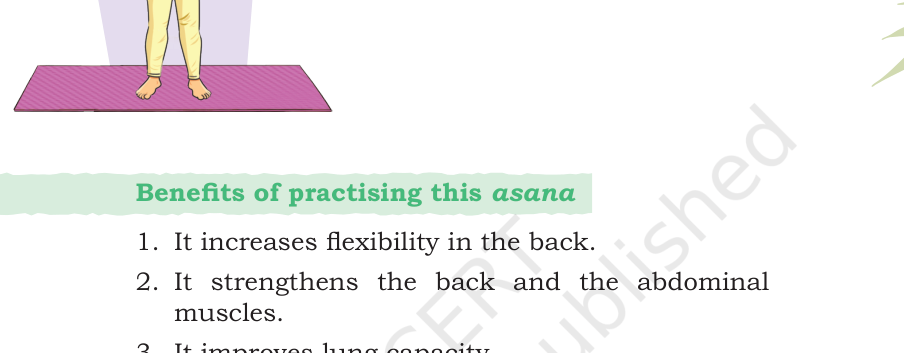
It increases flexibility in the back.
It strengthens the back and abdominal muscles.
It improves lung capacity.
Question 4NCERT PDF page 43
Which preparatory practices should be done before Hasta Uttanasana, and which asana is its complementary posture?
Original NCERT question visual - PDF page 43
Answer
Do Jangha Shakti Vikasaka and Gatyatmak Meru Vakra Sthiti first. Pada Hastasana is practised as the complementary posture.
Question 2NCERT PDF page 73
How do you do Apana Mudra, and what is its benefit?
Original NCERT question visual - PDF page 73
Answer
Sit in Padmasana.
Place your hands on the knees. Touch the tips of the middle and ring fingers to the thumb; keep the index and little fingers straight.
Close your eyes and focus on your breathing.
Hold for 5 minutes.
Benefit: It improves digestion and helps reduce problems such as constipation and stomach pain.
Question 3NCERT PDF page 73
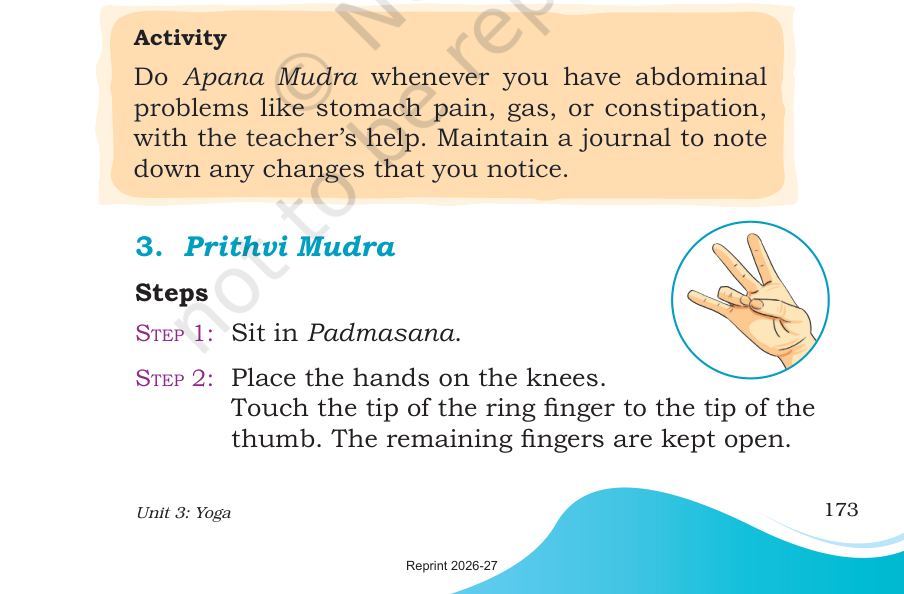
How do you do Prithvi Mudra, and what are its benefits?
Original NCERT question visual - PDF page 73
Answer
Sit in Padmasana.
Place the hands on the knees. Touch the tip of the ring finger to the tip of the thumb; keep the other fingers open.
Close the eyes and focus on the breath.
Hold for 5 minutes.
Benefits: It helps overcome laziness, increases energy, and improves focus, memory and concentration.
KriyaNCERT PDF page 74
What is Bindu Trataka? How do you practise it? Write the steps.
Answer
Bindu Trataka is a Kriya (cleansing technique) that means staring at a small dot without blinking. It cleanses the eyes and prepares us for Dharana. Remove your spectacles and wristwatch first.
Draw a small black dot, about 1 cm across, at the centre of an A4 sheet of white paper.
Sit in Sukhasana and put the dot on a wall 2 to 3 feet away, at eye level (one dot for each child).
Look at the dot without blinking for 30 seconds to 1 minute.
When the eyes feel a little watery, close them and try to see the dot in your mind.
After a few seconds, rub your palms to make them warm and place them gently on your closed eyes for half a minute. This is palming, which reduces eye strain.
Repeat the whole practice 2 to 3 times along with palming.
Question 4NCERT PDF page 76
How do you practise Om Dhyana? Write the steps.
Original NCERT question visual - PDF page 76
Answer
Sit comfortably in Padmasana.
Place the hands on the knees in Chin Mudra.
Gently close your eyes and focus on the natural flow of your breath.
Inhale, and while exhaling, slowly chant ‘Om’. Feel the vibration in your body.
Repeat for five rounds in a calm, steady rhythm.
After chanting, sit quietly and observe the stillness, silence and breath.
Stay in this silence for a few minutes.
It is done after Bindu Trataka.
Question 5NCERT PDF page 76
Om Dhyana reflection: Were you able to feel any sensations or vibrations in your body while chanting ‘Om’?
Original NCERT question visual - PDF page 76
Answer
Yes, I felt a gentle vibration in my chest, throat and head while chanting ‘Om’. (sample answer)
Question 6NCERT PDF page 76
Om Dhyana reflection: What was your state of mind after the chanting and during the silence?
Original NCERT question visual - PDF page 76
Answer
My mind felt calm and quiet, with fewer thoughts. (sample answer)
Question 7NCERT PDF page 76
Om Dhyana reflection: Did you experience a sense of peace or lightness in your body? Share your experience.
Original NCERT question visual - PDF page 76
Answer
Yes, I felt peaceful and my body felt light and relaxed. I shared this with my class after the practice. (sample answer)
Question 1NCERT PDF page 77
Krida Yoga – Self-help (Swa-sahayata): What is the purpose of this game?
Original NCERT question visual - PDF page 77
Answer
It promotes physical activity, attention and strategy. (Krida Yoga is not part of classical yoga; it is included to make yoga class playful and joyful.)
Question 2NCERT PDF page 77
Self-help: How do the players stand at the start?
Original NCERT question visual - PDF page 77
Answer
All participants stand in a big circle, facing inwards.
Question 3NCERT PDF page 77
Self-help: Who is the Chaser and where does the Chaser stand?
Original NCERT question visual - PDF page 77
Answer
One player is chosen as the Chaser (X) and stands in the centre of the circle.
Question 4NCERT PDF page 77
Self-help: Who else is chosen besides the Chaser?
Original NCERT question visual - PDF page 77
Answer
Another player is chosen as the Runner.
Question 5NCERT PDF page 77
Self-help: What happens on the signal?
Original NCERT question visual - PDF page 77
Answer
The Chaser (X) starts chasing the Runner inside the circle.
Question 6NCERT PDF page 77
Self-help: How does the Runner try to escape?
Original NCERT question visual - PDF page 77
Answer
The Runner runs in any direction within the circle to avoid being caught.
Question 7NCERT PDF page 77
Self-help: What must the Runner do when about to be caught?
Original NCERT question visual - PDF page 77
Answer
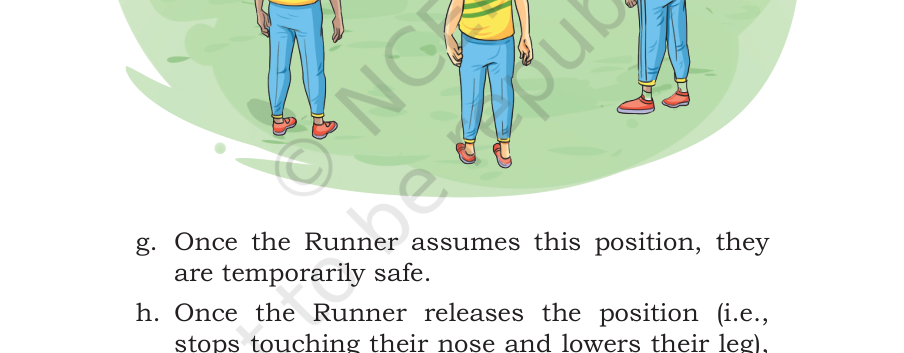
The Runner quickly stops, lifts the right leg by bending it at the knee, puts the hand behind the bent knee and touches the nose with the same hand.
Question 8NCERT PDF page 78
Self-help: What happens once the Runner takes this position?
Original NCERT question visual - PDF page 78
Answer
The Runner is temporarily safe and cannot be caught.
Question 9NCERT PDF page 78
Self-help: When can the Chaser start chasing again?
Original NCERT question visual - PDF page 78
Answer
As soon as the Runner releases the position (stops touching the nose and lowers the leg). The Runner then runs again in any direction within the circle.
Question 10NCERT PDF page 78
Self-help: When is the Runner “Out”?
Original NCERT question visual - PDF page 78
Answer
When the Chaser (X) touches the Runner.
Question 11NCERT PDF page 79
Self-help: What happens after the Runner is out?
Original NCERT question visual - PDF page 79
Answer
The Runner becomes the new Chaser (X), and the game continues with a new Runner.
Question 2NCERT PDF page 79
Krida Yoga – Yama, Niyama, Asana: What is the purpose of this game?
Original NCERT question visual - PDF page 79
Answer
To learn and remember the basic principles of yoga (Yama, Niyama and Asana) in a fun and interactive way.
Question 3NCERT PDF page 79
Yama, Niyama, Asana: How do the players arrange themselves?
Original NCERT question visual - PDF page 79
Answer
All players stand or sit in a circle.
Question 4NCERT PDF page 79
Yama, Niyama, Asana: What does the leader do? Give an example.
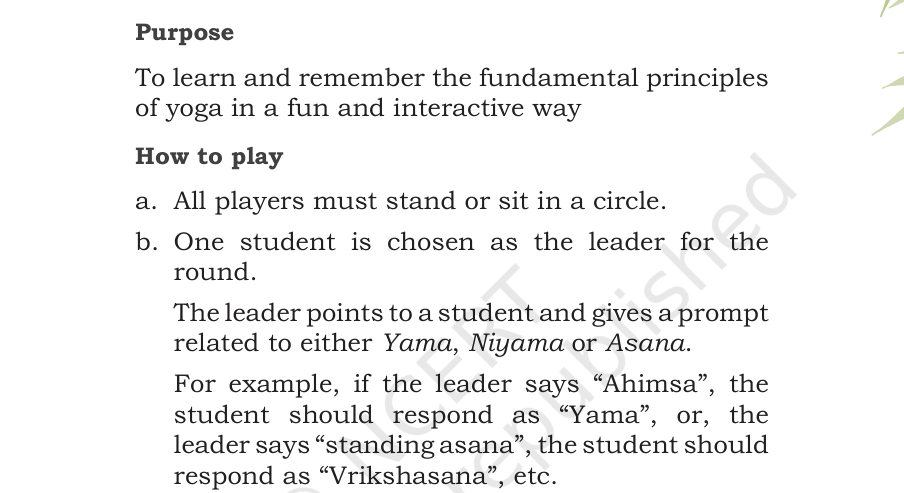
Original NCERT question visual - PDF page 79
Answer
One student is the leader for the round. The leader points to a student and gives a prompt about a Yama, Niyama or Asana.
Example: if the leader says “Ahimsa”, the student answers “Yama”; if the leader says “standing asana”, the student answers “Vrikshasana”.
Question 5NCERT PDF page 79
Yama, Niyama, Asana: How must the students respond?
Original NCERT question visual - PDF page 79
Answer
Quickly, by calling out the name of a Yama, Niyama or Asana.
Question 6NCERT PDF page 79
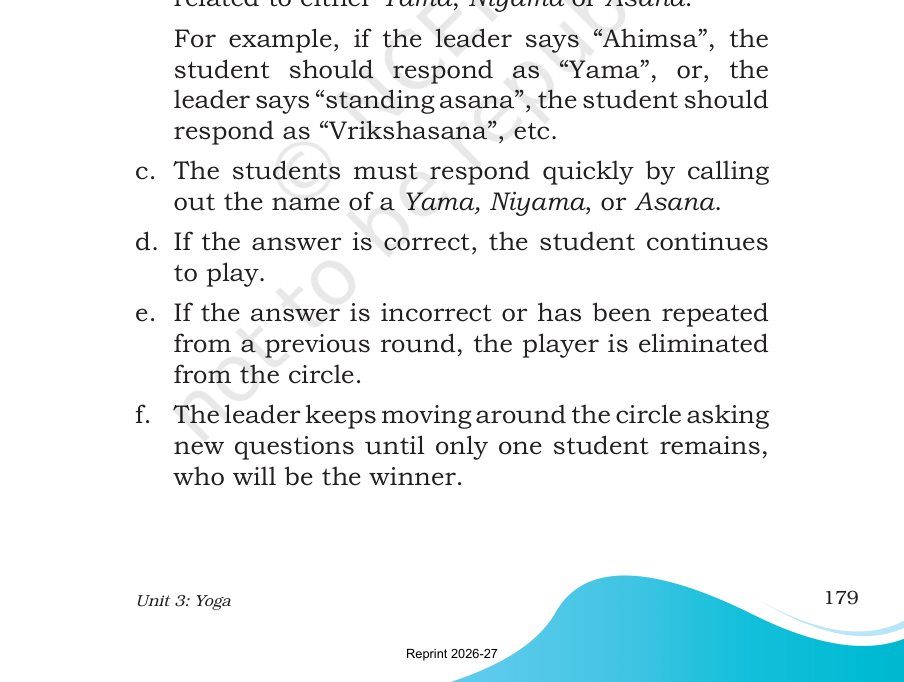
Yama, Niyama, Asana: What happens if a student's answer is correct?
Original NCERT question visual - PDF page 79
Answer
The student continues to play.
Question 7NCERT PDF page 79
Yama, Niyama, Asana: When is a player eliminated?
Original NCERT question visual - PDF page 79
Answer
If the answer is wrong or has already been said in an earlier round, the player is eliminated from the circle.
Question 8NCERT PDF page 79
Yama, Niyama, Asana: Who wins the game?
Original NCERT question visual - PDF page 79
Answer
The leader keeps asking new questions around the circle until only one student remains — that student is the winner.
Question 3NCERT PDF page 80
Krida Yoga – Akkad, Bakkad, Akkad Bakkad: What is the purpose of this game?
Original NCERT question visual - PDF page 80
Answer
To improve awareness, concentration and mental quickness by saying ‘akkad’, ‘bakkad’ and ‘akkad bakkad’ in place of certain numbers.
Question 4NCERT PDF page 80
Akkad Bakkad: How do the players arrange themselves?
Original NCERT question visual - PDF page 80
Answer
The players sit or stand in a circle.
Question 5NCERT PDF page 80
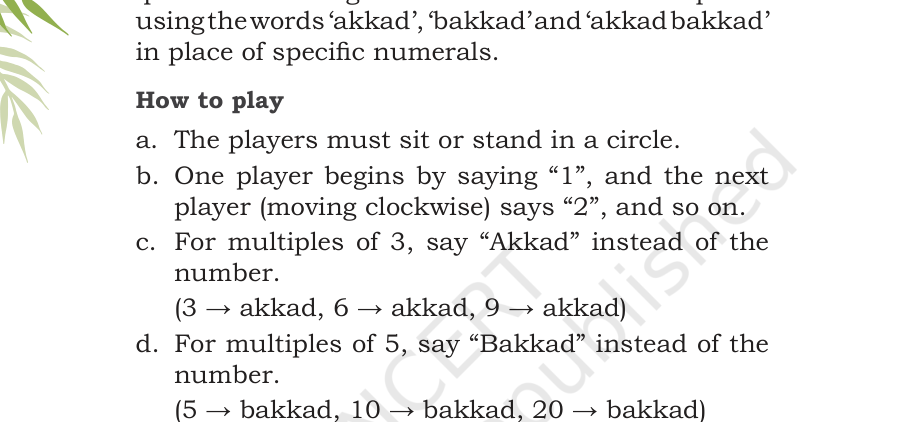
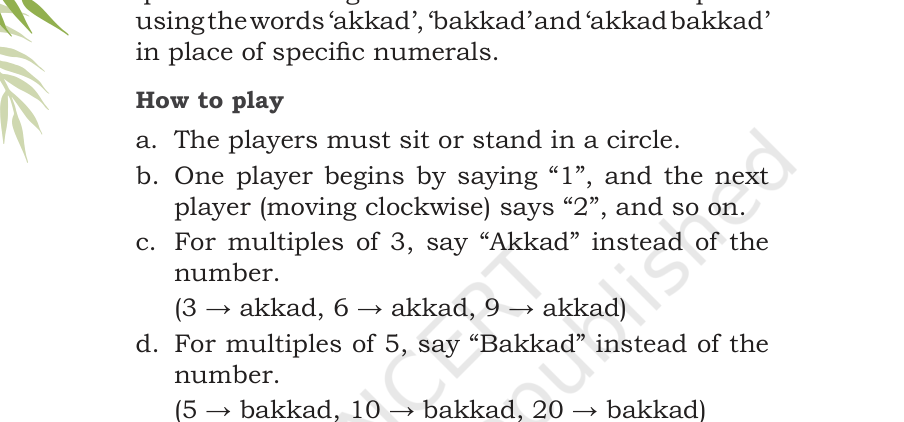
Akkad Bakkad: How does the counting go around the circle?
Original NCERT question visual - PDF page 80
Answer
One player says “1”, the next player clockwise says “2”, and so on.
Question 6NCERT PDF page 80
Akkad Bakkad: What do you say for multiples of 3?
Original NCERT question visual - PDF page 80
Answer
Say “Akkad” instead of the number (3, 6, 9 → akkad).
Question 7NCERT PDF page 80
Akkad Bakkad: What do you say for multiples of 5?
Original NCERT question visual - PDF page 80
Answer
Say “Bakkad” instead of the number (5, 10, 20 → bakkad).
Question 8NCERT PDF page 80
Akkad Bakkad: What do you say for numbers that are multiples of both 3 and 5?
Original NCERT question visual - PDF page 80
Answer
Say “Akkad Bakkad” (15, 30 → akkad bakkad).
Question 9NCERT PDF page 80
Akkad Bakkad: When is a player eliminated?
Original NCERT question visual - PDF page 80
Answer
If the player says the wrong word or says the number instead of the correct word. A delayed answer is also not accepted.
Question 10NCERT PDF page 80
Akkad Bakkad: Write the calling sequence from 1 to 20.
Karma Yoga self-check: How often do you do acts of kindness such as helping with household chores without being asked? (Always 4, Often 3, Sometimes 2, Rarely 1)
Original NCERT question visual - PDF page 81
Answer
Often (3) — I help my mother lay the table and fold clothes without being asked. (sample answer)
Question 1NCERT PDF page 81
Karma Yoga self-check: Do you help others even when they don't ask, and do you take care of your own duties like keeping your books and uniform clean and doing homework?
Original NCERT question visual - PDF page 81
Answer
Often (3) — I help my friends when they drop things, and I pack my own bag and finish my homework daily. (sample answer)
Question 2NCERT PDF page 83
Jnana Yoga self-check: How often do you ask your teacher questions, explore new things, and follow good lessons from stories?
Original NCERT question visual - PDF page 83
Answer
Sometimes (2) — I enjoy exploring new things, and I am trying to ask more questions in class. (sample answer)
Question 3NCERT PDF page 84
Bhakti Yoga self-check: How often do you take blessings from elders, pray when you wake up and before meals and sleep, and sit quietly observing your breath?
Original NCERT question visual - PDF page 84
Answer
Always (4) — I touch my grandparents' feet every morning and pray before sleeping. (sample answer)
Question 1NCERT PDF page 84
Which asanas are assessed under Yoga Sadhana in Grade 5, and what does “Excellent” mean for demonstrating them?
Original NCERT question visual - PDF page 84
Answer
Hasta Uttanasana, Utkatasana, Virabhadrasana, Parvatasana, Janushirshasana, Gomukhasana, Simha Garjana Asana, Trikonasana variation, Ardha Matsyendrasana, Matsyasana, Sarpasana and Tiryaka Bhujangasana.
Excellent means you perform all the asanas correctly. (Good = correct but needs minor corrections; Scope for improvement = needs repeated guidance.)
Question 2NCERT PDF page 85
Which skills are checked in the Mudra and Pranayama assessment?
Original NCERT question visual - PDF page 85
Answer
Om chanting — Excellent if it is rhythmic.
Identifying and showing Mudras — Excellent if you can identify and perform them.
Identifying and showing different Pranayamas — Excellent if you can identify and perform them.
Question 3NCERT PDF page 86
How much time does NCF-SE 2023 suggest for Physical Education and Well-being in a year?
Original NCERT question visual - PDF page 86
Answer
A minimum of 90 hours, which is about 135 periods of 40 minutes each. (The Grade 5 annual plan uses 150 periods.)
Question 4NCERT PDF page 87
How do we begin (and end) a yoga session? Write the steps.
Original NCERT question visual - PDF page 87
Answer
Sit comfortably in Sukhasana with the spine upright.
Close your eyes, relax the face and become aware of the breath.
Place the hands in Chin Mudra and watch the natural rhythm of the breath for a few moments.
Take a deep, slow breath in and gently chant “Om” as you breathe out.
Bring the hands to Namaskara Mudra and chant the prayer.
Notice any changes or sensations after chanting.
Rub your palms softly, place them over the closed eyes and gently open the eyes into the warmth of the hands.
Question 10NCERT PDF page 87
Which prayer is recited to open a yoga session, and why?
Original NCERT question visual - PDF page 87
Answer
The opening prayer is “Om Saha Naavavatu | Saha Nau Bhunaktu | Saha Viryam Karavaavahai | Tejasvi Naavadhitamastu Maa Vidvishaavahai | Om Shantih Shantih Shantih ||”
It expresses gratitude to Maharishi Patanjali for his teachings that promote a healthy mind, clear speech and a healthy body. It means: May we both (teacher and student) be protected and nourished; may we practise with energy; may our studies be fruitful; may we not hate each other.
Question 11NCERT PDF page 88
Which prayer is chanted to close a yoga session, and what does it mean?
Original NCERT question visual - PDF page 88
Answer
The closing prayer is “Om Sarve Bhavantu Sukhinah | Sarve Santu Niraamayaah | Sarve Bhadraani Pashyantu | Maa Kashchid Duhkhabhaag Bhavet | Om Shantih Shantih Shantih ||”
Meaning: May all be happy. May all be free from illness. May all see what is good. May no one suffer. Let there be peace everywhere.
It helps students absorb the day's learning in a positive and happy way.