Where can we find freshwater? Identify the different freshwater sources from the images given below and write their names.
Original NCERT question visual - PDF page 5
Answer
The pictures show: pond, sea, glacier (ice), lake in the mountains, groundwater (water under the soil), river, well and rain (clouds).
Freshwater sources: pond, glacier, lake, groundwater, river, well and rain. The sea is not a freshwater source — its water is salty.
Question (a)NCERT PDF page 6
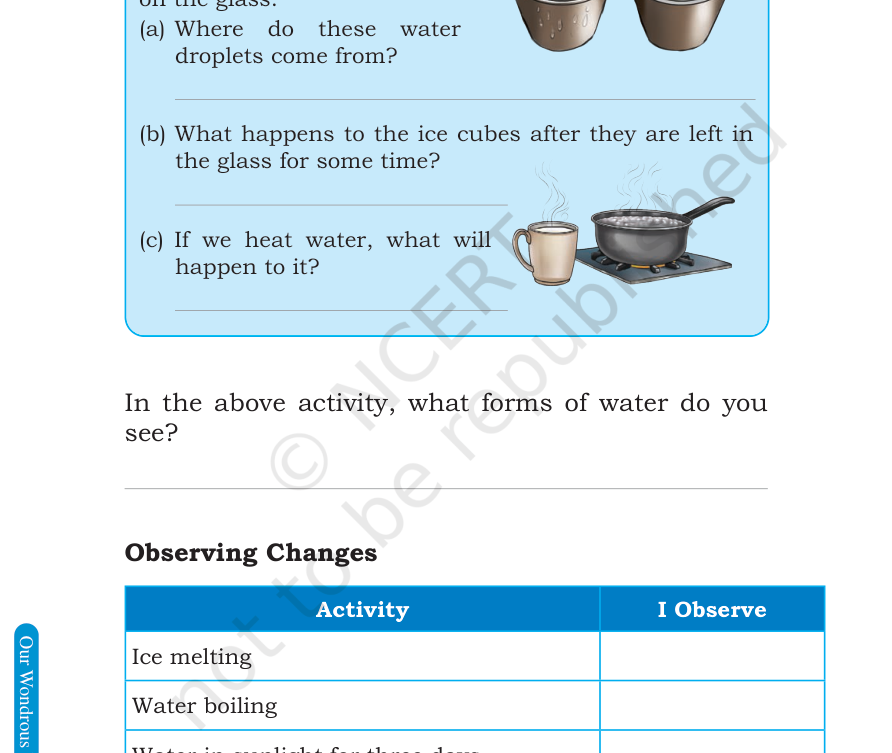
Where do these water droplets come from?
Original NCERT question visual - PDF page 6
Answer
They form when water vapour in the air touches the cold glass and turns into liquid water (condensation).
Question (b)NCERT PDF page 6
What happens to the ice cubes after they are left in the glass for some time?
Original NCERT question visual - PDF page 6
Answer
The ice cubes melt and turn into water.
Question (c)NCERT PDF page 6
If we heat water, what will happen to it? In the above activity, what forms of water do you see?
Original NCERT question visual - PDF page 6
Answer
Heated water turns into steam (water vapour). The activity shows solid (ice), liquid (water) and vapour (steam).
Activity 3NCERT PDF page 7
Take a transparent bag and draw the sun, clouds, trees and arrows on it with a marker. Fill one-third of it with coloured water, seal it tightly and place it in sunlight. After a few hours, observe the changes inside the bag. What do you observe, and why does it happen?
Original NCERT question visual - PDF page 7
Answer
Water droplets form on the inside of the bag near the top and slowly trickle down. Sunlight heats the water, so it turns into water vapour. The vapour cools and forms droplets, which fall back down like rain. This is a small model of the water cycle.
Activity 4NCERT PDF page 9
Take a transparent glass and fill half of it with soil. Slowly pour water into the soil using a spoon. Observe what happens.
Original NCERT question visual - PDF page 9
Answer
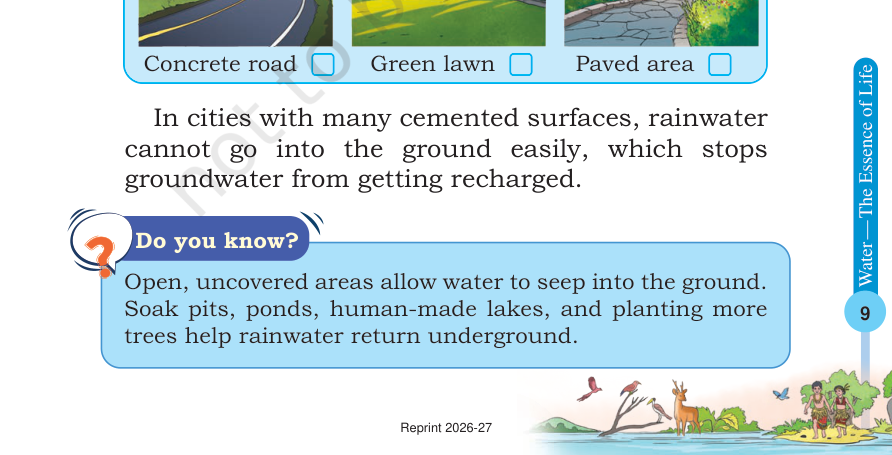
The water soaks into the soil and moves down through it. In the same way, rainwater sinks through layers of soil and rocks and is stored deep underground as groundwater, which we draw out using wells, borewells, tube wells and handpumps.
Activity 5NCERT PDF page 9
Tick the image that will help in groundwater recharge: Concrete road, Green lawn, Paved area.
Original NCERT question visual - PDF page 9
Answer
Green lawn ✓. Its open soil lets rainwater seep into the ground. A concrete road and a paved area are covered surfaces, so rainwater cannot soak in and runs off instead.
Question 12NCERT PDF page 10
Do you ever wonder how a river flows? Where does a river often begin its journey?
Original NCERT question visual - PDF page 10
Answer
A river often begins its journey up in the mountains and flows down across the land, following the slope, until it reaches a sea or lake.
Question 1NCERT PDF page 10
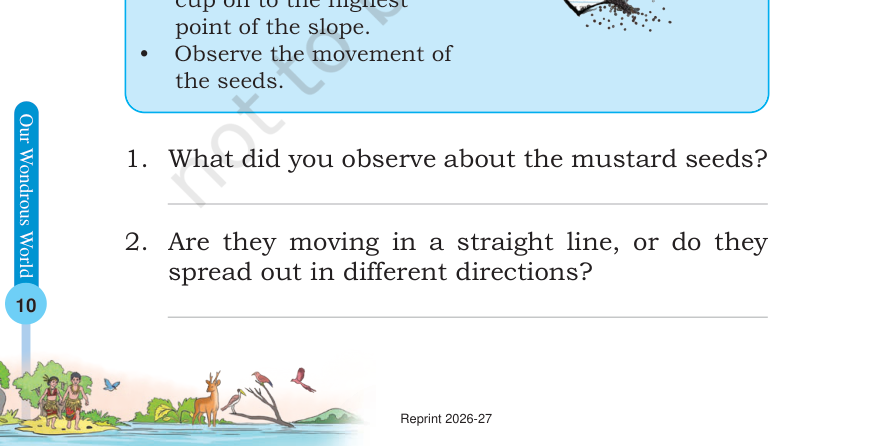
Activity 6: Crumple a newspaper sheet, place another sheet over it and press it down to make gentle slopes. Slowly pour mustard seeds from a cup on to the highest point and observe the seeds. 1. What did you observe about the mustard seeds?
Original NCERT question visual - PDF page 10
Answer
The mustard seeds rolled down from the highest point along the slopes and settled in the lower areas, just like water flowing downhill.
Question 2NCERT PDF page 10
Are they moving in a straight line, or do they spread out in different directions?
Original NCERT question visual - PDF page 10
Answer
They spread out in different directions, following the slopes — not in a straight line.
Question 3NCERT PDF page 11
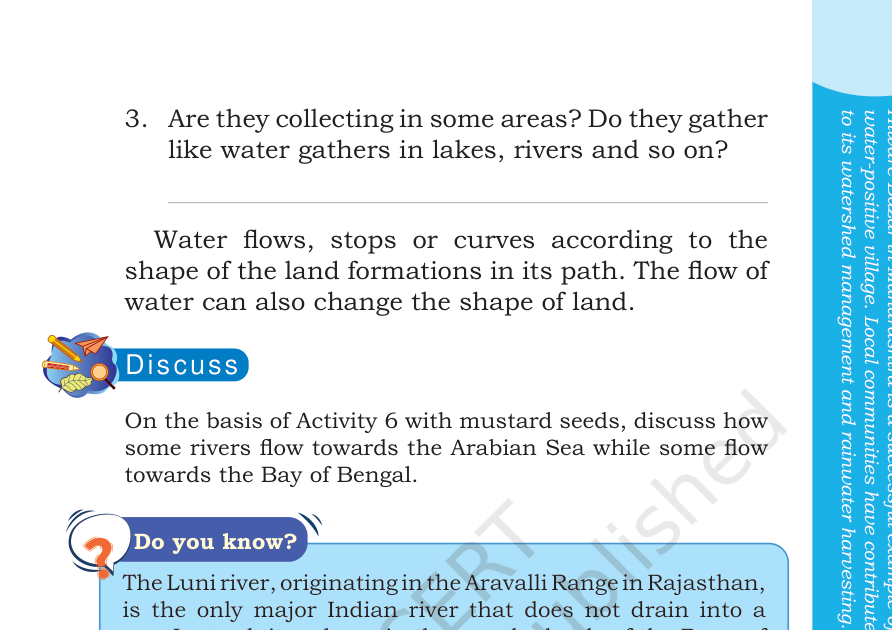
Are they collecting in some areas? Do they gather like water gathers in lakes, rivers and so on?
Original NCERT question visual - PDF page 11
Answer
Yes. The seeds collect in the low areas and hollows, just as water gathers in lakes and rivers. Water flows, stops or curves according to the shape of the land in its path.
DiscussNCERT PDF page 11
On the basis of Activity 6 with mustard seeds, discuss how some rivers flow towards the Arabian Sea while some flow towards the Bay of Bengal.
Answer
Like the seeds, rivers always flow downhill along the slope of the land. Most of the land of peninsular India slopes from the Western Ghats towards the east, so rivers like the Godavari, Krishna and Kaveri flow east into the Bay of Bengal; the Ganga and Brahmaputra also flow east from the Himalayas. The Narmada and Tapi flow west through their valleys, so they reach the Arabian Sea.
Activity 7Fill in the blanksNCERT PDF page 13
Follow the Flow! Look at the map of rivers in India. Some rivers flow into the Bay of Bengal and some into the Arabian Sea. Observe and fill in the table (Name of the river / Moves towards the Bay of Bengal / Moves towards the Arabian Sea).
Original NCERT question visual - PDF page 13
Answer
Moves towards the Bay of Bengal: Ganga (with its tributary Yamuna), Brahmaputra, Godavari, Krishna, Kaveri.
Moves towards the Arabian Sea: Narmada, Tapi.
Question 5NCERT PDF page 14
How are animals living in water different from those living on land? Complete the table (Animals on Land / Animals in Water) with your peers. Example: Cannot breathe in water / Have fins to swim.
Original NCERT question visual - PDF page 14
Answer
Cannot breathe in water — Have fins to swim.
Breathe air through lungs — Fish breathe through gills.
Have legs to walk, run or hop — Have fins and tails to swim.
Bodies covered with fur, hair or feathers — Smooth, slippery, streamlined bodies.
Feet with toes or hooves — Ducks and frogs have webbed feet; turtles have flippers.
Activity 8NCERT PDF page 17
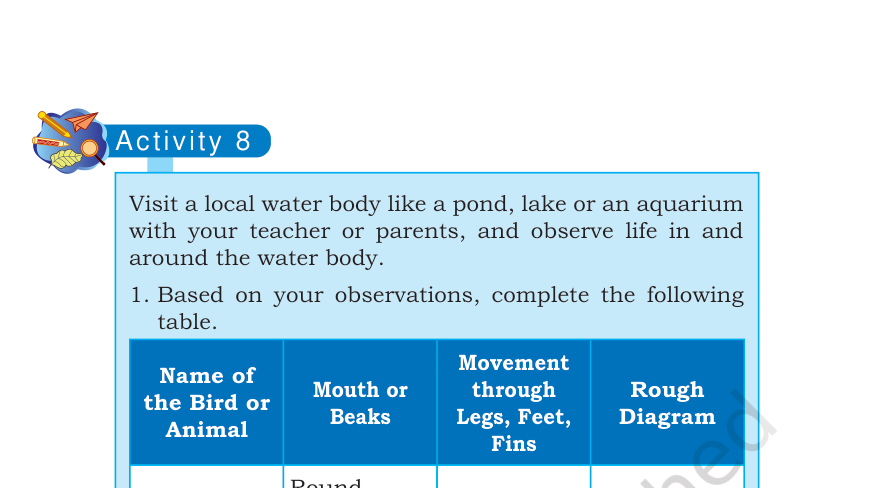
Visit a local water body like a pond, lake or an aquarium with your teacher or parents, and observe life in and around it. 1. Based on your observations, complete the table (Name of the bird or animal / Mouth or beak / Movement through legs, feet, fins / Rough diagram). Examples given: Fish — round mouth facing upwards — fins; Pond heron — long and pointed beak — thin legs.
Original NCERT question visual - PDF page 17
Answer
Fish — round mouth facing upwards — fins.
Pond heron — long and pointed beak — thin legs.
Duck — broad, flat beak — webbed feet.
Frog — wide mouth — strong webbed hind legs to jump and swim.
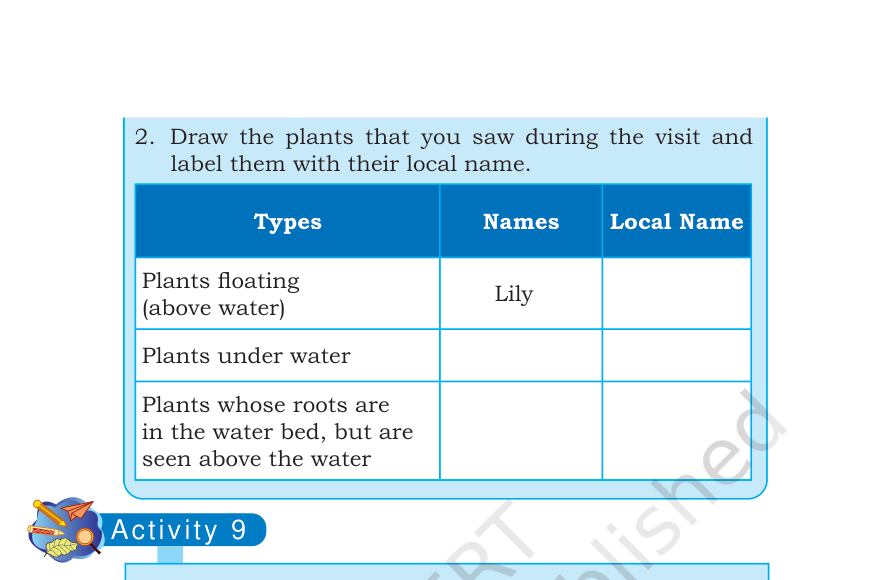
2. Draw the plants that you saw during the visit and label them with their local name. Fill the table: Plants floating (above water) — e.g. Lily; Plants under water; Plants whose roots are in the water bed, but are seen above the water.
Original NCERT question visual - PDF page 18
Answer
Plants floating (above water): water lily, water hyacinth (jalkumbhi).
Plants under water: hydrilla, eelgrass.
Roots in the water bed but seen above the water: lotus (kamal), reeds.
(sample answer — local names differ from place to place)
Question 1NCERT PDF page 18
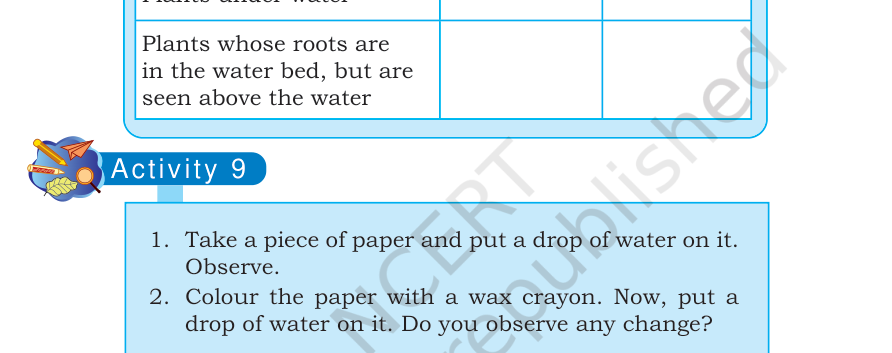
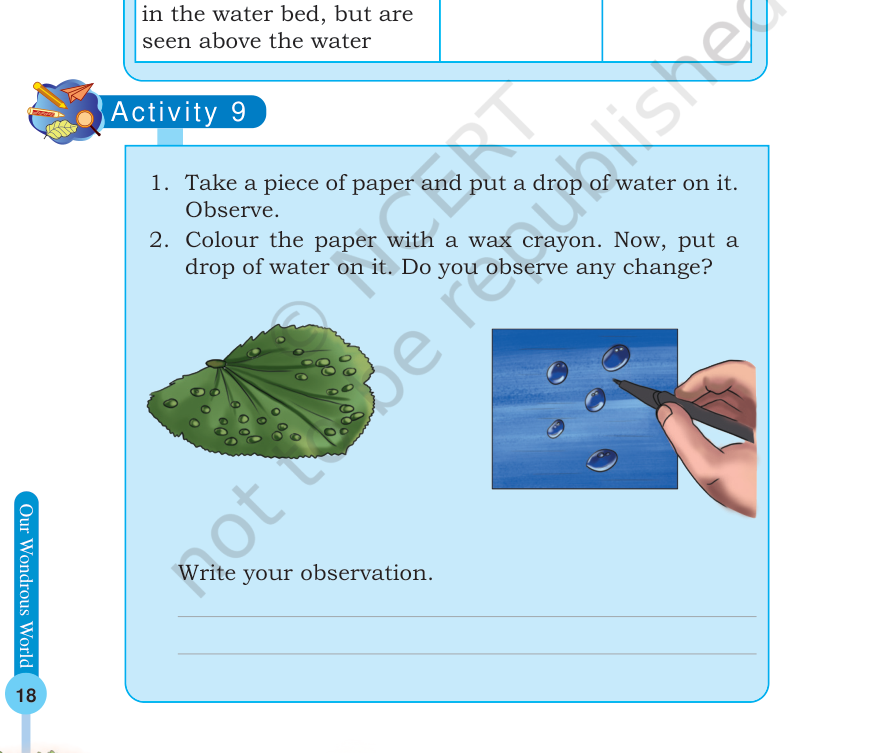
Take a piece of paper and put a drop of water on it. Observe.
Original NCERT question visual - PDF page 18
Answer
The water drop soaks into the paper and spreads.
Question 2NCERT PDF page 18
Colour the paper with a wax crayon. Now, put a drop of water on it. Do you observe any change? Write your observation.
Original NCERT question visual - PDF page 18
Answer
On the waxed paper the drop stays round and does not soak in. Wax makes the surface waterproof, like the waxy coating on lotus leaves.
Activity 10NCERT PDF page 19
Who Eats Whom? — A River Food Chain Game. Each student chooses to be a living being of the river (small fish, big fish, frog, bird, human, crocodile, otter, etc.), thinks about what they eat and who eats them, and a string is used to connect those who depend on each other for food. Show one such chain. What would happen if all the fish are gone?
Original NCERT question visual - PDF page 19
Answer
Example chain: water plants → small fish → big fish → crocodile/otter/bird (or human). Another: insects → frog → water snake → bird.
If all the fish are gone, the animals that eat fish (big fish, otters, crocodiles, herons, people) would not get enough food and their numbers would fall, while the plants and insects that fish eat would grow too much. One missing link disturbs the whole food chain.
Question 1Match the followingNCERT PDF page 20
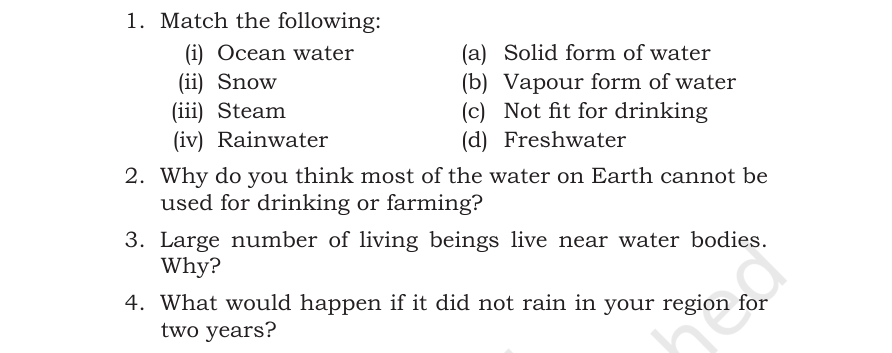
Match the following:
(i)Ocean water
(ii)Snow
(iii)Steam
(iv)Rainwater
(a)Solid form of water
(b)Vapour form of water
(c)Not fit for drinking
(d)Freshwater
Original NCERT question visual - PDF page 20
Answer
(i) Ocean water — (c) Not fit for drinking
(ii) Snow — (a) Solid form of water
(iii) Steam — (b) Vapour form of water
(iv) Rainwater — (d) Freshwater
Question 2NCERT PDF page 20
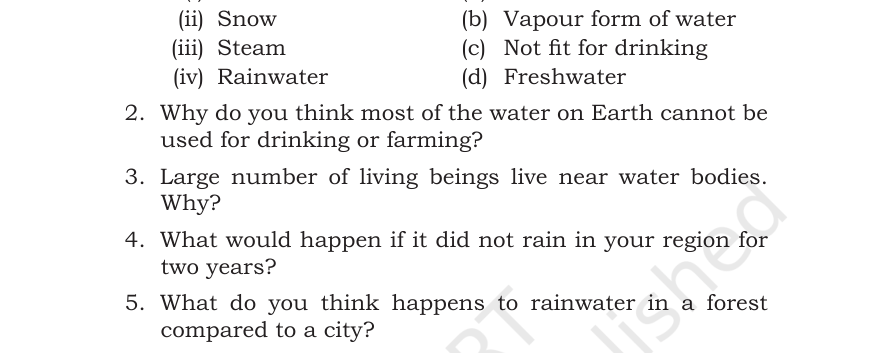
Why do you think most of the water on Earth cannot be used for drinking or farming?
Original NCERT question visual - PDF page 20
Answer
Most water on Earth is salty ocean water, and much of the freshwater is frozen as ice. So only a little is available for drinking and farming.
Question 3NCERT PDF page 20
Large number of living beings live near water bodies. Why?
Original NCERT question visual - PDF page 20
Answer
Water bodies give drinking water, food, shelter and moist land for plants, so many living beings live near them.
Question 4NCERT PDF page 20
What would happen if it did not rain in your region for two years?
Original NCERT question visual - PDF page 20
Answer
There would be drought — wells, ponds and rivers would dry up, crops would fail, and people and animals would suffer from lack of water and food.
Question 5NCERT PDF page 20
What do you think happens to rainwater in a forest compared to a city?
Original NCERT question visual - PDF page 20
Answer
In a forest, rainwater soaks into the soil and recharges groundwater. In a city, concrete and roads stop it seeping in, so it flows into drains and can cause waterlogging.
Question 6NCERT PDF page 20
Can you design a house or school that conserves water wisely? What would it include?
Original NCERT question visual - PDF page 20
Answer
Yes — rooftop rainwater harvesting, soak pits, water-saving taps, reuse of washing water for plants, and open green areas.
Question 7NCERT PDF page 20
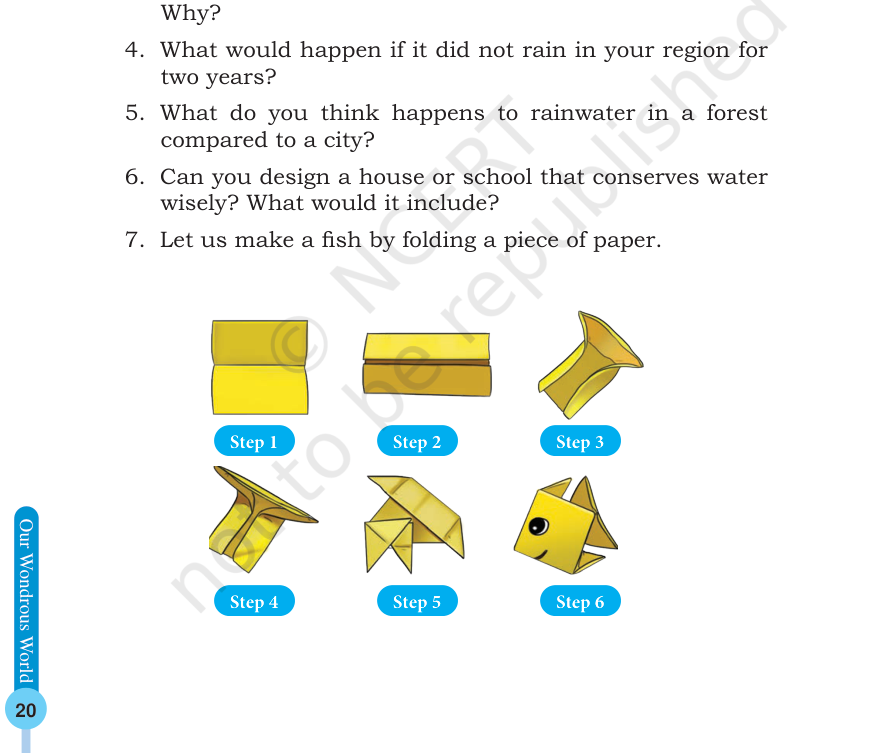
Let us make a fish by folding a piece of paper (Steps 1 to 6 shown in the book).
Original NCERT question visual - PDF page 20
Answer
Fold a rectangular sheet in half along its length (Step 1) and fold the edges in to make a long strip (Step 2). Fold the strip into a V-shape and open out one end to make the tail (Steps 3–4). Fold the other end into small triangles for the fins and face (Step 5). Draw an eye and a mouth — your paper fish is ready (Step 6).