Ask your parents or elders about the condition of water bodies near your home when they were your age. What is the status of those water bodies today?
Original NCERT question visual - PDF page 8
Answer
My grandmother says the village pond had clean water, lotus flowers and fish, and children swam in it. Today it is smaller, full of plastic and covered with weeds, and nobody uses its water. (sample answer)
Question 1NCERT PDF page 15
Imagine your day without water. What would you do if you had no water in your home for an entire day?
Original NCERT question visual - PDF page 15
Answer
I would use the water stored in buckets and bottles only for drinking and cooking, skip washing clothes, use a wet cloth instead of a bath, and ask neighbours for some water. (sample answer)
Question 2NCERT PDF page 15
What if there was no water for a week? How would you bath, drink, cook or clean? Where would you go to find water?
Original NCERT question visual - PDF page 15
Answer
I would bathe with one small bucket, reuse water from washing vegetables to clean the floor, and keep the cleanest water for drinking and cooking. I would fetch water from a community tap, hand pump, well or a water tanker. (sample answer)
Question 3NCERT PDF page 16
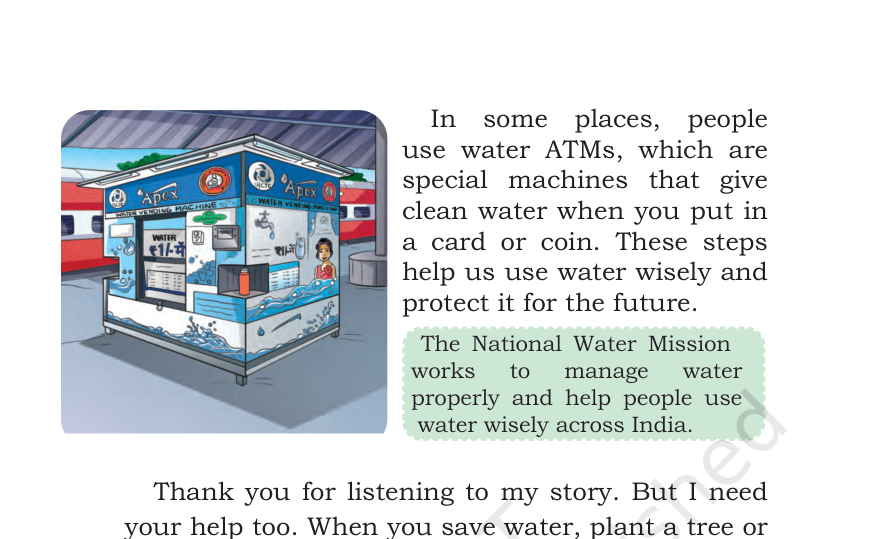
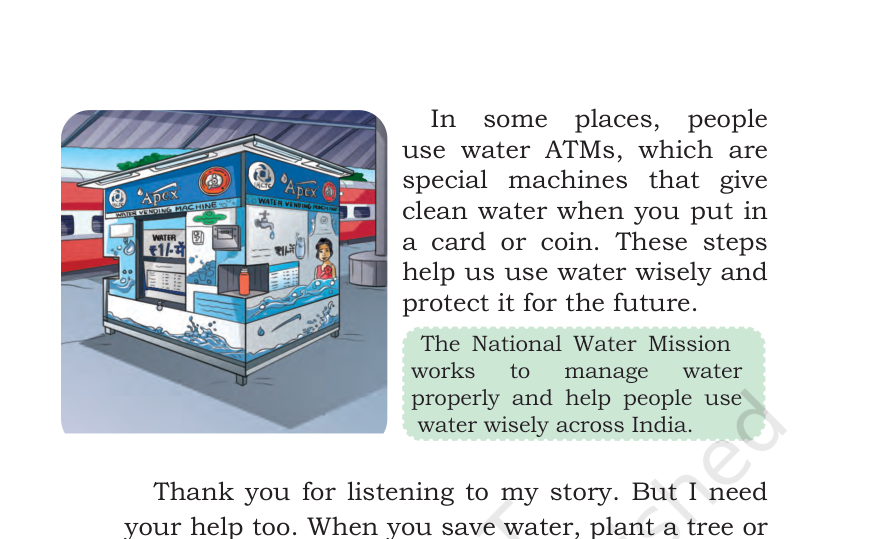
What are water ATMs? How do they help?
Original NCERT question visual - PDF page 16
Answer
Water ATMs are special machines that give clean water when you put in a card or coin. They help people get safe drinking water and use water wisely, without wasting it.
Question 4NCERT PDF page 16
What small things can each one of us do every day to save water?
Original NCERT question visual - PDF page 16
Answer
Use water efficiently and do not waste it, especially drinking water.
Turn off the tap while brushing your teeth.
Fix leaking taps with the help of adults.
Reuse clean water left from washing fruits or vegetables for watering plants.
Remind family and friends to save water too — every drop counts!
Question 1NCERT PDF page 17
Find out which river(s) flow through your state. (a) What are they used for?
Original NCERT question visual - PDF page 17
Answer
In Punjab, the Sutlej, Beas and Ravi flow. They are used for irrigating fields through canals, for drinking water, for fishing and for making electricity. (sample answer)
Question (b)NCERT PDF page 17
(b) Are there any dams on them?
Original NCERT question visual - PDF page 17
Answer
Yes. The Bhakra Nangal Dam is on the Sutlej, the Pong Dam is on the Beas and the Ranjit Sagar Dam is on the Ravi. (sample answer)
Question 2NCERT PDF page 17
Ask your grandparents or parents to share any story or festival related to rivers in your region and present it in the class.
Original NCERT question visual - PDF page 17
Answer
In Bihar, families celebrate Chhath Puja. They stand in the river at sunset and sunrise and offer prayers and fruits to the Sun God, and keep the riverbank clean for the festival. (sample answer)
Question 3NCERT PDF page 17
Ask an elder in your family: (a) What was the condition of rivers when you were a child?
Original NCERT question visual - PDF page 17
Answer
My grandfather says the river was clean, deep and full of fish, and people drank its water and swam in it. (sample answer)
Question (b)NCERT PDF page 17
What has changed since then?
Original NCERT question visual - PDF page 17
Answer
Now the river has less water, plastic and sewage flow into it, there are fewer fish, and its water is not safe to drink. (sample answer)
Question 4NCERT PDF page 17
Why do you think people built houses and cities near rivers in the past? Are rivers still important today in the same way?
Original NCERT question visual - PDF page 17
Answer
In the past, rivers gave people water for drinking and farming, fertile soil, fish for food, and a way to travel and trade by boat. Rivers are still very important for drinking water, irrigation and fishing. Today they are also used to make electricity at dams and supply water to factories, but we use pipes, roads and railways more than boats.
Question 5NCERT PDF page 17
If you could create one new rule to protect rivers in your city or village, what would it be?
Answer
No one may throw garbage, plastic or untreated dirty water into the river; anyone who does must pay a fine and help clean the riverbank. (sample answer)
Question 6NCERT PDF page 17
Think about a time when you wasted water. What could you have done differently?
Original NCERT question visual - PDF page 17
Answer
I once left the tap running while brushing my teeth. I should have turned it off and used a mug of water instead. (sample answer)
Question 7NCERT PDF page 17
Can you design a simple water filter using everyday materials? What would you include and why?
Original NCERT question visual - PDF page 17
Answer
Yes. Cut a plastic bottle and turn it upside down. Put a cotton cloth at the neck, then layers of charcoal, fine sand, coarse sand and pebbles. The pebbles and sand trap mud and dirt, the charcoal removes smell and colour, and the cloth stops small particles. (The water should still be boiled before drinking.)
Question 8NCERT PDF page 17
Imagine you are planning a new city near a river. What steps would you take to:
(a)keep the river clean.
(b)prevent floods during heavy rains.
(c)ensure there is always enough water for everyone, even during summers.
Original NCERT question visual - PDF page 17
Answer
(a) Treat all sewage and factory water before it reaches the river, ban dumping of waste and plastic, and plant trees along the banks.
(b) Do not build on the river’s floodplain, keep drains clean, plant many trees and make ponds and open green areas where rainwater can collect and soak in.
(c) Make rooftop rainwater harvesting compulsory, recharge groundwater, store water in tanks and lakes, fix leaks and teach people not to waste water.