How much is the total distance travelled by the athlete between the starting and stopping positions?
Answer
Let us now think about the distance between the starting and the stopping positions of the athlete.
4.4: Reference point and positions of athlete at different instants of time Total distance travelled Displacement 0 m O B A 20 m t = 0 s t = 4 s t = 10 s t = 16 s 40 m 60 m 80 m 100 m An instant of time and a time interval are not the same thing.
4.4, between t = 0 s and t = 16 s, the total distance travelled by the athlete is 160 m, but her displacement is 40 m in the positive direction.
example NCERT PDF page 4example
Can these quantities ever be equal?
Answer
Earlier, you learnt about some physical quantities, such as distance, time and speed.
A complete description of physical quantities like displacement requires specifying both a direction and its numerical value (with units).
Note Ready to Go Beyond Physical quantities which can be specified by just their numerical value are called scalars.
exampleNCERT PDF page 4example
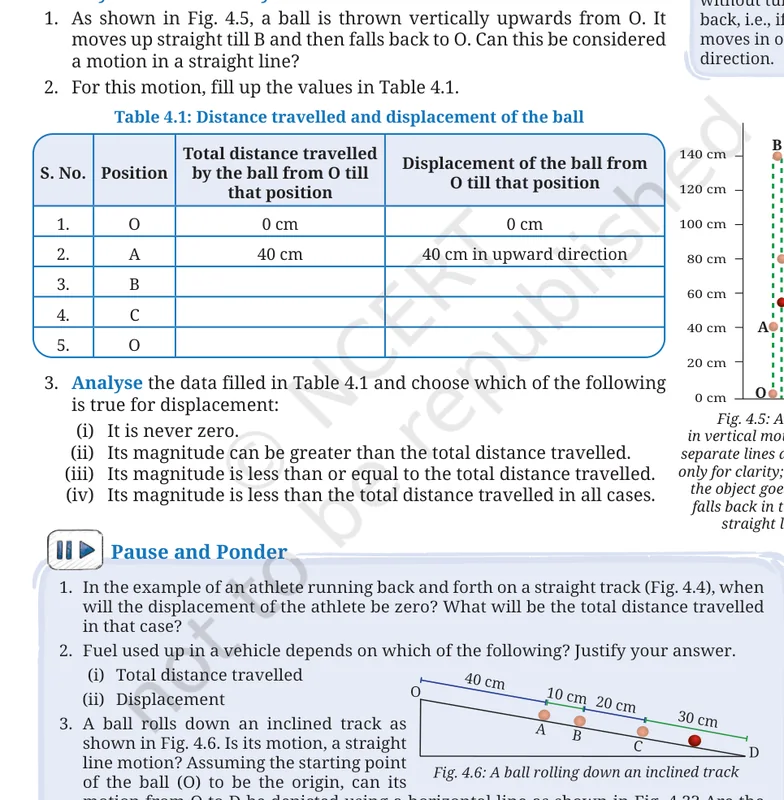
1. As shown in Fig. 4.5, a ball is thrown vertically upwards from O. It moves up straight till B and then falls back to O. Can this be considered a motion in a straight line?
Original NCERT figure
Answer
4.1 Motion in a Straight Line You have learnt that when an object moves in a straight line, its motion is called linear motion.
It moves up straight till B and then falls back to O.
4.5: A ball in vertical motion (two separate lines are shown only for clarity; in reality, the object goes up and falls back in the same straight line) 0 cm 20 cm 40 cm 60 cm 80 cm 100 cm 120 cm 140 cm A C B A O For motion in a straight line, the total distance travelled and the magnitude of displacement are equal if the object moves without turning back, i.e., if it moves in one direction.
Example 4NCERT PDF page 6Example 4
How do we associate direction with velocity when the motion is in a straight line?
Answer
4.7: Swimming pool 25 m Note For motion in a straight line, the average speed and the magnitude of average velocity in a time interval are equal if the object moves in one direction.
For motion in a straight line, if the magnitude of velocity is increasing in a given time interval, the average acceleration is in the direction of velocity (Fig.
While using kinematic equations for motion in a straight line in one direction, remember that distance travelled and magnitude of displacement are equal, and speed and magnitude of velocity are also equal.
Example 4NCERT PDF page 6Example 4
(i) magnitude of average velocity of an object equal to its aver age speed?
Answer
4.7: Swimming pool 25 m Note For motion in a straight line, the average speed and the magnitude of average velocity in a time interval are equal if the object moves in one direction.
For an object moving in a straight line in the same direction, if the magnitude of its velocity increases or decreases by equal amounts in equal intervals of time (for all possible choices of time intervals), the acceleration of the object is constant.
By extracting values of time t1 and t2, and distances s1 and s2 from the graph, the magnitude of average velocity can be calculated as 1v −−= = =− 80 m 40 m 40 m 20 m s4 s 2 s 2 s From a position-time graph, by finding the positions of the object at two instants of time, you can calculate the average velocity by using Eq.
Example 4NCERT PDF page 6Example 4
(ii) magnitude of average velocity of an object zero while its aver age speed is not zero?
Answer
Total distance travelled by Sarang in 50 s = 50 m displacement of Sarang in 50 s = 0 m 1total distance travelled 50 maverage speed = = = 1 m stime interval 50 s − 1displacement 0 maverage velocity = = = 0 m stime interval 50 s − During the 50 s time interval, the average speed of Sarang is approximately 1 m s –1 while his average velocity is 0 m s –1.
4.7: Swimming pool 25 m Note For motion in a straight line, the average speed and the magnitude of average velocity in a time interval are equal if the object moves in one direction.
4.8: Direction of average acceleration when magnitude of velocity is (a) increasing, and (b) decreasing Car is speeding up Car is slowing down The reading of the speedometer of a vehicle is nearly (but not exactly) the same as the magnitude of the velocity at an instant while the direction of tyres gives the direction of velocity at that instant.
Example 4NCERT PDF page 7Example 4
How can we express the change in velocity of an object?
Answer
The average velocity of an object in a time interval is the change in the position (or displacement) divided by the time interval in which the change in position (or displacement) occurs.
So, we can say that average velocity is the average rate of change of position of an object with respect to time.
Next Level Up The velocity of an object can be constant or it can change with time.
Example 4NCERT PDF page 9Example 4
What is the direction of this average acceleration?
Answer
For motion in a straight line, if the magnitude of velocity is increasing in a given time interval, the average acceleration is in the direction of velocity (Fig.
Whereas, the average acceleration is opposite to the direction of velocity if the magnitude of velocity is decreasing.
4.8: Direction of average acceleration when magnitude of velocity is (a) increasing, and (b) decreasing Car is speeding up Car is slowing down The reading of the speedometer of a vehicle is nearly (but not exactly) the same as the magnitude of the velocity at an instant while the direction of tyres gives the direction of velocity at that instant.
Example 4NCERT PDF page 9Example 4
4.10, we chose the origin at the point from where the object is dropped?
Answer
The distance and direction of the object with respect to the reference point, at any instant of time, describes the position of the object at that instant of time.
Note that apart from the distance, we also specify the direction from the reference point in which the object is located to describe its position.
On the other hand, the object is said to be at rest if its position with respect to the reference point does not change with time.
Example 4NCERT PDF page 13Example 4
The magnitude of average velocity of which object is higher?
Answer
Grade 7 Curiosity Chapter 8 Describing Motion Around Us 53 Let us define another physical quantity, average velocity, which describes how fast the position of an object is changing and in which direction.
4.7: Swimming pool 25 m Note For motion in a straight line, the average speed and the magnitude of average velocity in a time interval are equal if the object moves in one direction.
By extracting values of time t1 and t2, and distances s1 and s2 from the graph, the magnitude of average velocity can be calculated as 1v −−= = =− 80 m 40 m 40 m 20 m s4 s 2 s 2 s From a position-time graph, by finding the positions of the object at two instants of time, you can calculate the average velocity by using Eq.
Example 4NCERT PDF page 14Example 4
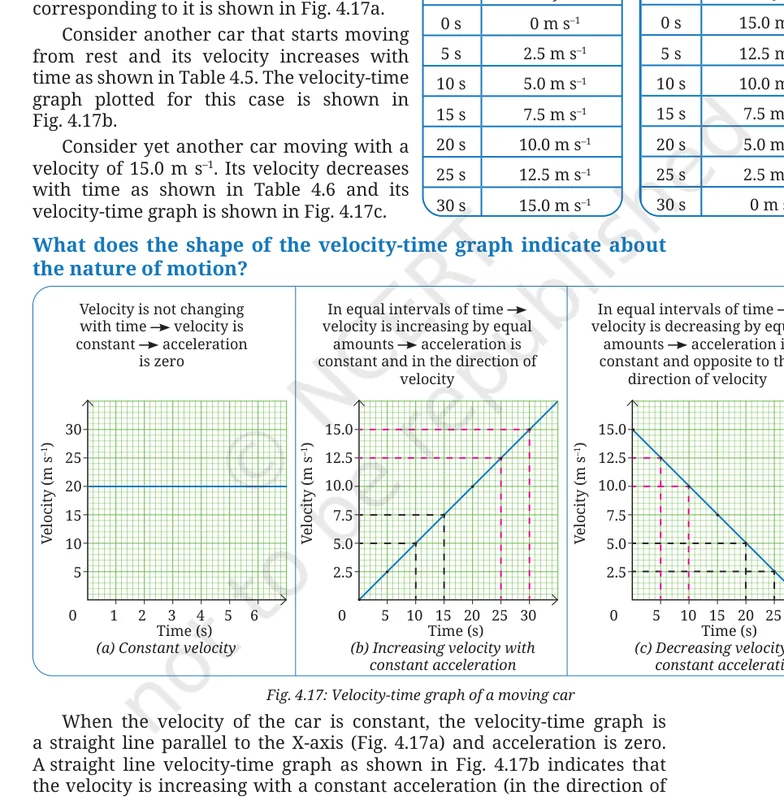
What does the shape of the velocity-time graph indicate about the nature of motion?
Original NCERT figure
Answer
4.15: Position-time graph of a vehiclePosition (m) Time (s) 0 Describing Motion Around Us 61 4.2.3 Velocity-time graphs The velocity-time graph of an object in motion represents the change in its velocity with time.
4.17(e): Calculating acceleration from a velocity-time graph Time (s) 0 C Au t1 t2 v B Velocity (m s–1) 5 10 15 20 25 30 1 2 3 4 5 6 4.18(a): Velocity-time graph of an object moving with constant velocity Time (s) 0 A B CO Describing Motion Around Us 63 This is the displacement of the car from the origin in 6 seconds.
We learnt that by finding the slope and area from velocity-time graph for motion with constant acceleration, we can determine acceleration and displacement, respectively.
Example 4NCERT PDF page 18Example 4
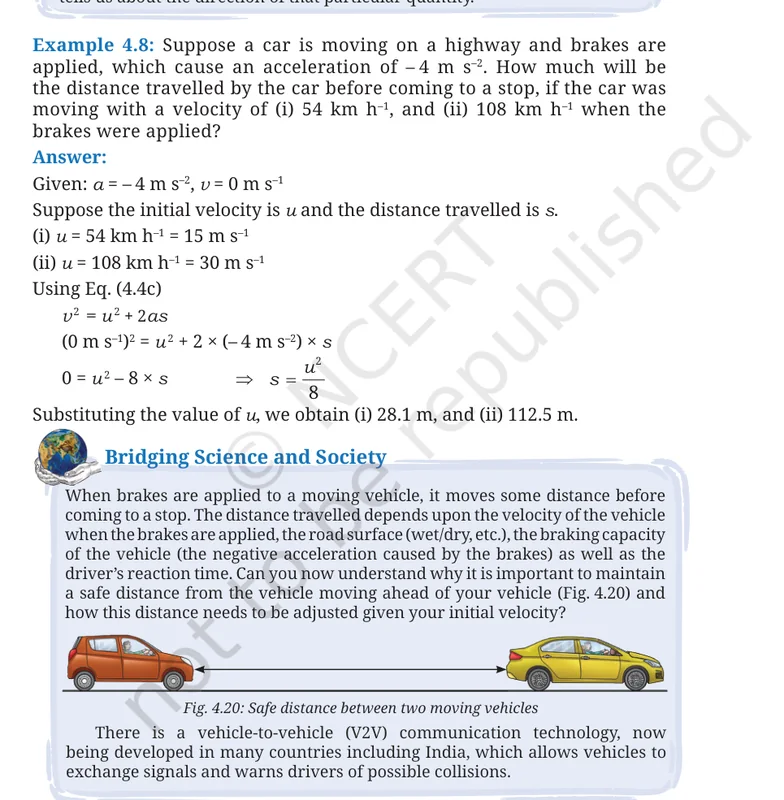
(ii) 112.5 m. Bridging Science and Society When brakes are applied to a moving vehicle, it moves some distance before coming to a stop. The distance travelled depends upon the velocity of the vehicle when the brakes are applied, the road surface (wet/dry, etc.), the braking capacity of the vehicle (the negative acceleration caused by the brakes) as well as the driver’s reaction time. Can you now understand why it is important to maintain a safe distance from the vehicle moving ahead of your vehicle (Fig. 4.20) and how this distance needs to be adjusted given your initial velocity?
Original NCERT figure
Answer
Bridging Science and Society When brakes are applied to a moving vehicle, it moves some distance before coming to a stop.
The distance travelled depends upon the velocity of the vehicle when the brakes are applied, the road surface (wet/dry, etc.), the braking capacity of the vehicle (the negative acceleration caused by the brakes) as well as the driver’s reaction time.
Can you now understand why it is important to maintain a safe distance from the vehicle moving ahead of your vehicle (Fig.
Example 4NCERT PDF page 19Example 4
4.21: Motion in a plane 4.4.1 Uniform circular motion Do you remember learning about circular motion in an earlier grade?
Answer
Such types of motion are linear, circular, and oscillatory about which you learnt in earlier grades.
Exploration|Grade 9 66 4.4 Motion in a Plane Motion in a plane, such as a vehicle overtaking another, the path of a kicked ball or a satellite moving in a circular path, is called motion in two dimensions (Fig.
Exploration|Grade 9 68 In real world, the conditions for uniform circular motion — constant speed and a circular path — are often not met.
Example 4NCERT PDF page 19Example 4
What is the distance travelled by the child?
Answer
4.1.2 Distance travelled and displacement Suppose an athlete starts running from point O at time t = 0 s, reaches point B at t = 4 s, then reaches point A at t = 10 s, then runs back along the same path till point B reaching there at t = 16 s (Fig.
It is OB = 40 m, which is different from the total distance travelled by the athlete.
So, if the radius of the circular path is R, the distance travelled by the child in making one revolution is 2 R.
Example 4NCERT PDF page 19Example 4
What is their displacement from their original position?
Answer
Displacement is the net change in the position of an object between the two given instants of time.
The direction of displacement is specified from the position at the first instant towards the position at the second instant.
On the other hand, the displacement is zero, since the child comes back to its original position after making one revolution.
Example 4NCERT PDF page 19Example 4
What is the distance travelled by the child in making one revolution (going round the circle once)?
Answer
4.5: A ball in vertical motion (two separate lines are shown only for clarity; in reality, the object goes up and falls back in the same straight line) 0 cm 20 cm 40 cm 60 cm 80 cm 100 cm 120 cm 140 cm A C B A O For motion in a straight line, the total distance travelled and the magnitude of displacement are equal if the object moves without turning back, i.e., if it moves in one direction.
So, if the radius of the circular path is R, the distance travelled by the child in making one revolution is 2 R.
On the other hand, the displacement is zero, since the child comes back to its original position after making one revolution.
Example 4NCERT PDF page 19Example 4
0. Let us now consider a particular case of circular motion where the speed of the object is constant. When an object moves in a circular path with constant (uniform) speed, its motion is called uniform circular motion. In case of uniform circular motion, the speed is constant but what about the direction of velocity at an instant?
Answer
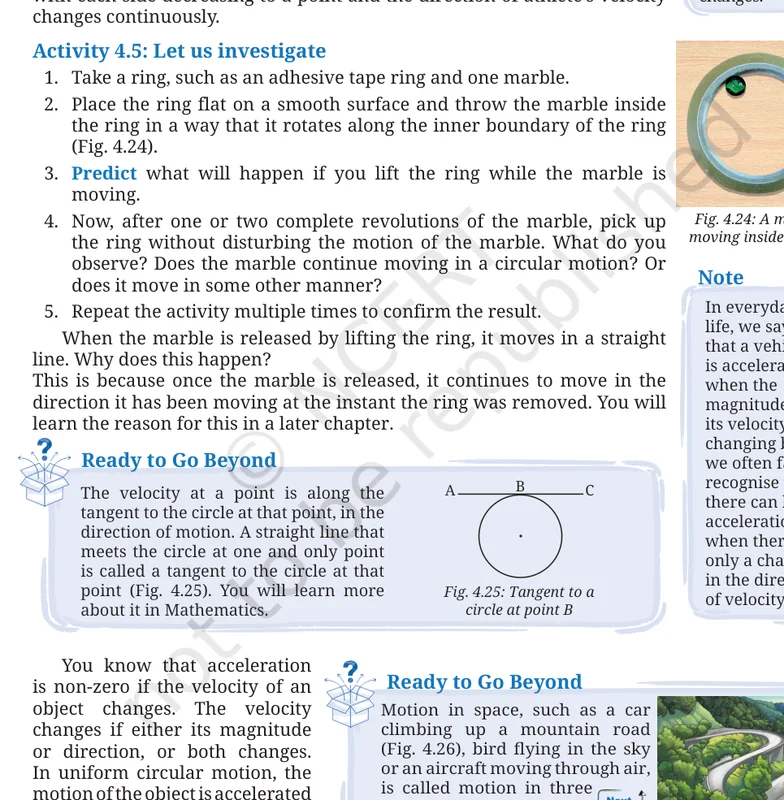
Let us now consider a particular case of circular motion where the speed of the object is constant.
When an object moves in a circular path with constant (uniform) speed, its motion is called uniform circular motion.
4.24: A marble moving inside a ring Note In uniform circular motion, the speed is constant at every point on the circle, it is only the direction of velocity that changes.
Example 4NCERT PDF page 19Example 4
Is it changing?
Answer
Grade 7 Curiosity Chapter 8 Describing Motion Around Us 53 Let us define another physical quantity, average velocity, which describes how fast the position of an object is changing and in which direction.
Acceleration depends not on how fast an object is moving, but on how quickly its velocity is changing.
Note Exploration|Grade 9 56 The average acceleration during different time intervals can either be constant or changing.
Example 4NCERT PDF page 20Example 4
What happens if we go on increasing the number of sides indefinitely?
Answer
In this case, the object moves with increasing speed or decreasing speed, or a combination of both.
If the distances travelled in the successive intervals of times are increasing, its speed is increasing.
To describe how fast or slow a change in a physical quantity happens, we use the idea of a rate of change.
Example 4NCERT PDF page 20Example 4
4. Now, after one or two complete revolutions of the marble, pick up the ring without disturbing the motion of the marble. What do you observe?
Original NCERT figure
Answer
4.5: A ball in vertical motion (two separate lines are shown only for clarity; in reality, the object goes up and falls back in the same straight line) 0 cm 20 cm 40 cm 60 cm 80 cm 100 cm 120 cm 140 cm A C B A O For motion in a straight line, the total distance travelled and the magnitude of displacement are equal if the object moves without turning back, i.e., if it moves in one direction.
Till now, in this chapter, we have been discussing about motion in a straight line which is also called motion in one dimension.
Now, after one or two complete revolutions of the marble, pick up the ring without disturbing the motion of the marble.