Question 4NCERT PDF page 20Revise, Reflect, Refine
4. Solve the following problems: (i) A cake recipe uses dry ingredients, namely 75 g of sugar for 420 g of all-purpose flour and 5 g of sodium hydrogencarbonate. Express the concentration of each component in the mixture using an appropriate method. (ii) A brass alloy contains 70% copper by mass. Calculate the quantities of copper and zinc present in 120 g of brass.
Answer
Solve the following problems: (i) A cake recipe uses dry ingredients, namely 75 g of sugar for 420 g of all-purpose flour and 5 g of sodium hydrogencarbonate.
Express the concentration of each component in the mixture using an appropriate method.
Calculate the quantities of copper and zinc present in 120 g of brass.
Question 5NCERT PDF page 20Revise, Reflect, Refine
5. The label on a cooking oil pack says one litre (910 g). If this oil is mixed with water, will it form a separate layer? If so, which substance will be on top? How will you separate the two layers? Also, draw the diagram of the apparatus used.
Original NCERT figure
Answer
You will see the formation of two separate layers of mustard oil and water (Fig.
By improving the methods for separating waste and recycling materials, you can help make the world cleaner, healthier and more sustainable. y Mixtures are classified as homogeneous or heterogeneous and also as solutions, suspensions, or colloids. y Separation of mixtures is a crucial process for obtaining pure substances. y Crystallization is a technique used to get a pure solid from its saturated solution. y Distillation is used to separate two miscible liquids with a minimum difference of 25 °C in boiling points.
The label on a cooking oil pack says one litre (910 g).
Question 6Assertion–ReasonNCERT PDF page 20Revise, Reflect, Refine
6. Assertion (A): Solutions do not exhibit the Tyndall effect. Reason (R): The particles in solutions are larger than 100 nm, so they cannot scatter light. Choose the correct option: (i) Both A and R are true, and R is the correct explanation of A. (ii) Both A and R are true, but R is not the correct explanation of A. (iii) A is true, but R is false. (iv) A is false, but R is true.
Answer
Assertion (A): Solutions do not exhibit the Tyndall effect.
Reason (R): The particles in solutions are larger than 100 nm, so they cannot scatter light.
Choose the correct option: (i) Both A and R are true, and R is the correct explanation of A.
Question 7NCERT PDF page 20Revise, Reflect, Refine
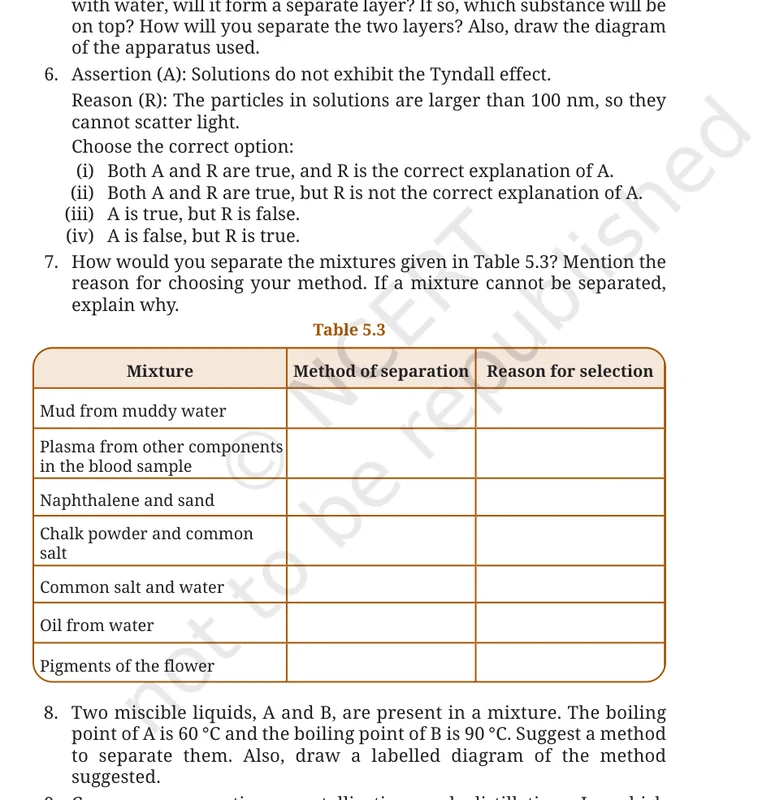
7. How would you separate the mixtures given in Table 5.3? Mention the reason for choosing your method. If a mixture cannot be separated, explain why. Table 5.3 Mixture Method of separation Reason for selection Mud from muddy water Plasma from other components in the blood sample Naphthalene and sand Chalk powder and common salt Common salt and water Oil from water Pigments of the flower
Original NCERT figure
Answer
5.21: Process of coagulation (c) Impurities settle at the bottom (a) Adding powdered alum to suspended impurities in water Powdered alum (b) Alum coagulates the suspended impurities Muddy water Settled impurities Exploring Mixtures and their Separation 87 Donate Blood Bridging Science and Society Plasma Platelets and white blood cells Blood sample Test tube stand Fig.
Words and Phrases Large-sized particles; Particles remain evenly distributed; Small-sized particles (less than 1 nm diameter); Moderate-sized particles (1 – 1000 nm); Settles down when left undisturbed (more than 1000 nm in diameter); Does not settle down; Scatters light; Separates by filtration; Transparent; Salt solution; Milk; Sand in water; Smoke; Heterogeneous mixture; Cannot be separated by filtration; Mud; Butter; Brass.
Table 5.3 Mixture Method of separation Reason for selection Mud from muddy water Plasma from other components in the blood sample Naphthalene and sand Chalk powder and common salt Common salt and water Oil from water Pigments of the flower 8.
Question 8NCERT PDF page 20Revise, Reflect, Refine
8. Two miscible liquids, A and B, are present in a mixture. The boiling point of A is 60 °C and the boiling point of B is 90 °C. Suggest a method to separate them. Also, draw a labelled diagram of the method suggested.
Original NCERT figure
Answer
By improving the methods for separating waste and recycling materials, you can help make the world cleaner, healthier and more sustainable. y Mixtures are classified as homogeneous or heterogeneous and also as solutions, suspensions, or colloids. y Separation of mixtures is a crucial process for obtaining pure substances. y Crystallization is a technique used to get a pure solid from its saturated solution. y Distillation is used to separate two miscible liquids with a minimum difference of 25 °C in boiling points.
It can also be used to obtain a liquid from a mixture of a liquid and a solid. y Paper chromatography can be used to separate compounds by taking advantage of differences in their rates of movement on the paper. y A separating funnel is used to separate two immiscible liquids based on their different densities. y The transition of a solid directly into a vapour (below its melting point) without passing through the liquid state is called sublimation.
Also, draw a labelled diagram of the method suggested.
Question 9NCERT PDF page 20Revise, Reflect, Refine
9. Compare evaporation, crystallization and distillation. In which situation, would you prefer each of these over the others?
Answer
5.11: Distillation process India’s Scientific Contributions Crystallization of salt was an ancient process used by the local communities of the coastal areas in India.
(i) Salt can be separated from a salt solution by evaporation or distillation.
Compare evaporation, crystallization and distillation.
Question 10NCERT PDF page 20Revise, Reflect, Refine
10. Blood is an example of a colloidal mixture. (i) What would happen if blood behaved like a true suspension inside the body? (ii) In a blood sample, identify the dispersed phase and the dispersion medium.
Answer
The components of a colloid are called the dispersed phase and the dispersion medium.
The solute-like component or the dispersed particles, in a colloid form the dispersed phase and the component in which the dispersed phase is suspended is known as the dispersion medium.
Some common colloids we encounter in our daily lives have both the dispersed phase and the dispersion medium as liquids.
Question 11NCERT PDF page 21Revise, Reflect, Refine
11. You are given a mixture of sand, common salt and naphthalene (Fig. 5.25a). The Fig. 5.25b depicts various steps used to separ ate the components of this mixture. Identify and write down the correct sequence of separation techniques. 1 2 3 Fig. 5.25: (b) Fig. 5.25: (a)
Original NCERT figure
Answer
Table 5.3 Mixture Method of separation Reason for selection Mud from muddy water Plasma from other components in the blood sample Naphthalene and sand Chalk powder and common salt Common salt and water Oil from water Pigments of the flower 8.
5.25b depicts various steps used to separ ate the components of this mixture.
Identify and write down the correct sequence of separation techniques.
Question 13NCERT PDF page 21Revise, Reflect, Refine
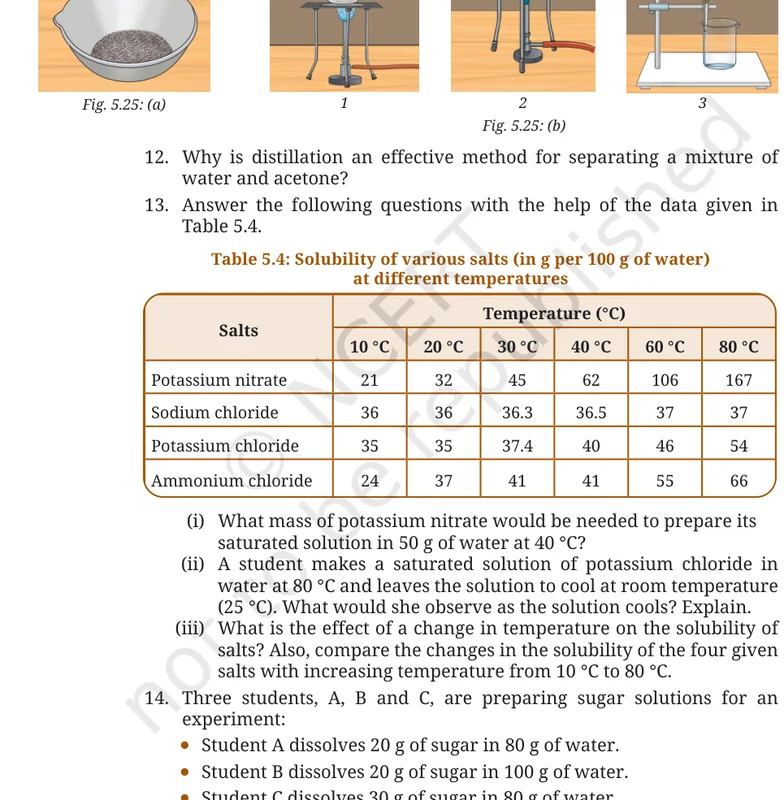
13. Answer the following questions with the help of the data given in Table 5.4. Table 5.4: Solubility of various salts (in g per 100 g of water) at different temperatures Salts Temperature (°C) 10 °C 20 °C 30 °C 40 °C 60 °C 80 °C Potassium nitrate 21 32 45 62 106 167 Sodium chloride 36 36 36.3 36.5 37 37 Potassium chloride 35 35 37.4 40 46 54 Ammonium chloride 24 37 41 41 55 66 (i) What mass of potassium nitrate would be needed to prepare its saturated solution in 50 g of water at 40 °C? (ii) A student makes a saturated solution of potassium chloride in water at 80 °C and leaves the solution to cool at room temperature (25 °C). What would she observe as the solution cools? Explain. (iii) What is the effect of a change in temperature on the solubility of salts? Also, compare the changes in the solubility of the four given salts with increasing temperature from 10 °C to 80 °C.
Original NCERT figure
Answer
Mass of salt (solute) = 10 g Mass of water (solvent) = 90 g Total mass of solution = Mass of solute + Mass of solvent = 10 g + 90 g = 100 g ×Mas sb ym assp ercentage Mas so fsolution Mas so fsolute 100= ×% /g g mm100 10 100 10== B.
If a hot, saturated solution of copper sulfate is cooled rapidly in ice-cold water, smaller and less well-formed crystals will form than if it is cooled slowly at room temperature.
Answer the following questions with the help of the data given in Table 5.4.
Question 14NCERT PDF page 21Revise, Reflect, Refine
14. Three students, A, B and C, are preparing sugar solutions for an experiment: y Student A dissolves 20 g of sugar in 80 g of water. y Student B dissolves 20 g of sugar in 100 g of water. y Student C dissolves 30 g of sugar in 80 g of water. (i) Calculate the mass percentage (% m/m) concentration of sugar in each student’s solution. (ii) Whose solution is the most concentrated? Explain why.
Answer
Mathematically, ×Mas sb yv olum ep ercentage Volume of solution Mas sofsolute 100= (5.2) Example 5.2: If 5 g of glucose is dissolved in water to make 100 mL of solution, calculate its concentration in mass by volume percentage.
Three students, A, B and C, are preparing sugar solutions for an experiment: y Student A dissolves 20 g of sugar in 80 g of water. y Student B dissolves 20 g of sugar in 100 g of water. y Student C dissolves 30 g of sugar in 80 g of water.
(i) Calculate the mass percentage (% m/m) concentration of sugar in each student’s solution.