Can you think of some other heterogeneous mixtures?
Answer
You have learnt about mixtures and some simple methods to separate them.
Other examples of homogeneous mixtures are vinegar (acetic acid in water), aerated drinks like soda (carbon dioxide in water), etc.
On the other hand, smoke (solid particles suspended in air), fog (tiny liquid water droplets present in air) and dust in the air are some heterogeneous mixtures with gas as one of the components.
exampleNCERT PDF page 2example
4. Are the particles visible in each mixture?
Answer
The sand particles are easily visible in the water and settle with time.
Each group prepares a mixture in a colourless, transparent glass tumbler or a 100 mL beaker by following these steps: 1.
In mixture C too, the path of light was visible, indicating that the particles scattered the light, though the mixture appeared homogeneous.
exampleNCERT PDF page 3example
Can you think of other such examples?
Answer
Other examples of homogeneous mixtures are vinegar (acetic acid in water), aerated drinks like soda (carbon dioxide in water), etc.
You can also perform this activity using any other sublimable substance, such as naphthalene, in place of camphor.
Common examples of alloys include brass — a mixture of approximately 80% copper and 20% zinc; bronze — a mixture of approximately 80% copper and 20% tin; stainless steel — usually a mixture of iron and other elements, such as carbon (about 0.03 – 0.8%), chromium (16 – 18%), nickel (10.0 –14.0%) and molybdenum (2.0 – 3.0%).
exampleNCERT PDF page 3example
5.2.2 How do we express concentration?
Answer
The three main ways to express the concentration of a solution in terms of percentage are given below.
Mass by mass percentage (% m/m or % w/w) This method is commonly used to express the concentration of homogeneous mixtures.
Express the concentration of each component in the mixture using an appropriate method.
exampleNCERT PDF page 5example
1. A common talcum powder contains 4 % m/m zinc oxide, which acts as an antiseptic. How much zinc oxide is present in 300 g of the talcum powder?
Answer
It is also used to label the composition of packaged foods, showing how much salt, sugar, or protein is present in them.
A common talcum powder contains 4 % m/m zinc oxide, which acts as an antiseptic.
Common examples of alloys include brass — a mixture of approximately 80% copper and 20% zinc; bronze — a mixture of approximately 80% copper and 20% tin; stainless steel — usually a mixture of iron and other elements, such as carbon (about 0.03 – 0.8%), chromium (16 – 18%), nickel (10.0 –14.0%) and molybdenum (2.0 – 3.0%).
Example 5NCERT PDF page 5Example 5
2. Your mother gives you a bottle of orange juice concentrate to mix with water and serve it to your visiting friends. She asks you to mix two tablespoons of the concentrate with water in a glass tumbler. If each tablespoon measures 15 mL and you make 150 mL of juice per person, what is the % v/v of orange juice concentrate in the mixture you prepared?
Answer
Each group prepares a mixture in a colourless, transparent glass tumbler or a 100 mL beaker by following these steps: 1.
Your mother gives you a bottle of orange juice concentrate to mix with water and serve it to your visiting friends.
She asks you to mix two tablespoons of the concentrate with water in a glass tumbler.
Example 5NCERT PDF page 5Example 5
3. Vinegar, used as a food preservative and additive, contains 5 % v/v acetic acid. Glacial acetic acid is a liquid, i.e., 100% acetic acid. If you want to make vinegar from glacial acetic acid, how would you proceed?
Answer
Other examples of homogeneous mixtures are vinegar (acetic acid in water), aerated drinks like soda (carbon dioxide in water), etc.
Vinegar, used as a food preservative and additive, contains 5 % v/v acetic acid.
Glacial acetic acid is a liquid, i.e., 100% acetic acid.
Example 5NCERT PDF page 5Example 5
Why do we mention the temperature?
Answer
A solution that cannot dissolve any more solute at that temperature is called a saturated solution.
On the other hand, in the case of gases dissolved in liquids, their solubility generally decreases with an increase in temperature.
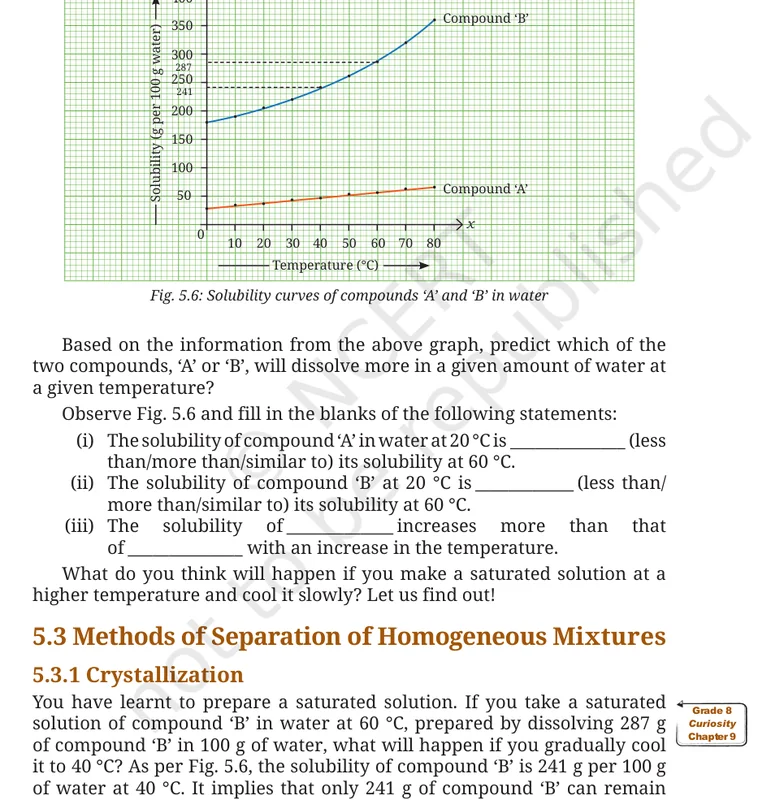
A graph of solubility versus temperature is called a solubility curve .
Example 5NCERT PDF page 6Example 5
5.6: Solubility curves of compounds ‘A’ and ‘B’ in water 0 400 y x 350 300 250 241 200 100 150 50 10 20 30 40 50 60 70 80 Temperature (°C) Solubility (g per 100 g water) Compound ‘A’ Compound ‘B’ 287 Based on the information from the above graph, predict which of the two compounds, ‘A’ or ‘B’, will dissolve more in a given amount of water at a given temperature?
Original NCERT figure
Answer
The x-axis shows temperature (°C), whereas the y-axis indicates the solubility of the solute in grams per 100 g of water.
5.6 and fill in the blanks of the following statements: (i) The solubility of compound ‘A’ in water at 20 °C is ______________ (less than/more than/similar to) its solubility at 60 °C.
5.6, the solubility of compound ‘B’ is 241 g per 100 g of water at 40 °C.
exampleNCERT PDF page 12example
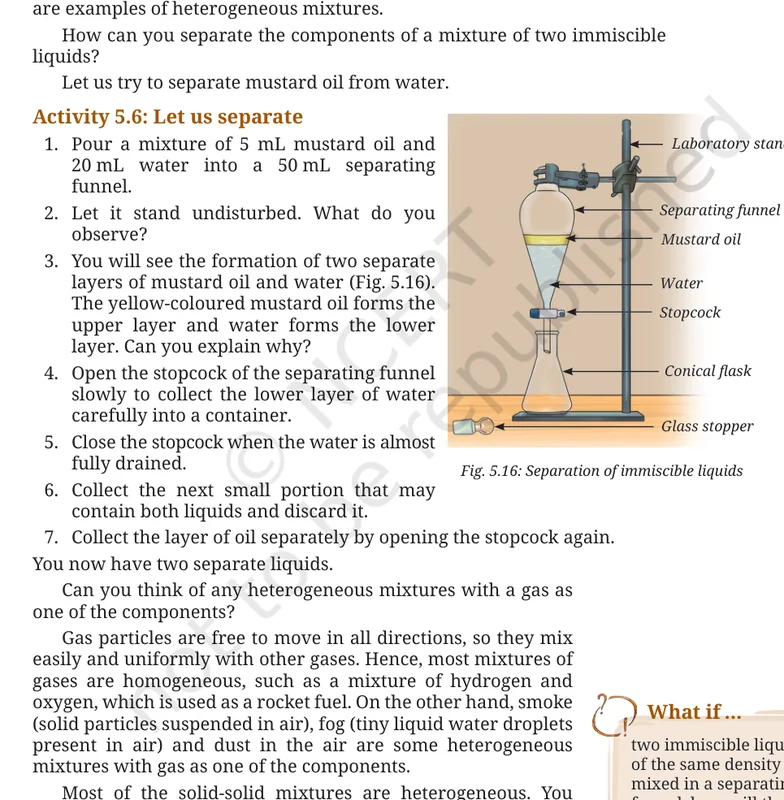
2. Let it stand undisturbed. What do you observe?
Original NCERT figure
Answer
Predict what you would observe in each of the beakers if you leave them undisturbed for a few minutes.
Pause and Ponder Activity 5.4: Let us describe a process Observe Fig.
Let it stand undisturbed.
exampleNCERT PDF page 14example
If the muddy water is still not clear even after keeping for some time, how can it be cleaned?
Answer
On the other hand, a stirred mixture of sand and water is not uniform.
The sand particles are easily visible in the water and settle with time.
Words and Phrases Large-sized particles; Particles remain evenly distributed; Small-sized particles (less than 1 nm diameter); Moderate-sized particles (1 – 1000 nm); Settles down when left undisturbed (more than 1000 nm in diameter); Does not settle down; Scatters light; Separates by filtration; Transparent; Salt solution; Milk; Sand in water; Smoke; Heterogeneous mixture; Cannot be separated by filtration; Mud; Butter; Brass.
exampleNCERT PDF page 14example
Do you feel as if you are being pulled outwards?
Answer
During centrifugation, the tubes become horizontal and the centrifugal force (outward force acting on a body moving in circular motion) causes the heavier particles to move outwards, where they settle at the bottom of the tube, while the lighter liquid remains at the top.
You will be able to see how the heavier particles move outwards.
This also reduces the greasy feeling of the liquid medicine.
exampleNCERT PDF page 14example
What is this called in your local language?
Answer
Such a mixture is called a homogeneous mixture (Fig.
Such a mixture is called a heterogeneous mixture (Fig.
A solution that cannot dissolve any more solute at that temperature is called a saturated solution.
exampleNCERT PDF page 15example
Which mixture would you like to separate using this mini centrifuge?
Answer
The pure liquid is collected in a separate vessel, while the solid or other liquid from the mixture remains in the distillation flask.
It actually means ‘writing with colour’ because it was first used to separate coloured substances like dyes and inks.
By spinning the blood samples at a very high speed, the paperfuge separates heavier components from lighter ones, just like a laboratory centrifuge.
exampleNCERT PDF page 17example
9. Clouds are made up of tiny water droplets or ice crystals floating in the air. Based on what you know about solutions, suspensions and colloids, what type of mixture do you think clouds are and why?
Answer
On the other hand, smoke (solid particles suspended in air), fog (tiny liquid water droplets present in air) and dust in the air are some heterogeneous mixtures with gas as one of the components.
Clouds are made up of tiny water droplets or ice crystals floating in the air.
By improving the methods for separating waste and recycling materials, you can help make the world cleaner, healthier and more sustainable. y Mixtures are classified as homogeneous or heterogeneous and also as solutions, suspensions, or colloids. y Separation of mixtures is a crucial process for obtaining pure substances. y Crystallization is a technique used to get a pure solid from its saturated solution. y Distillation is used to separate two miscible liquids with a minimum difference of 25 °C in boiling points.
exampleNCERT PDF page 17example
10. Wh y do cities with a lot of smoke and dust in the air often look hazy?
Answer
On the other hand, smoke (solid particles suspended in air), fog (tiny liquid water droplets present in air) and dust in the air are some heterogeneous mixtures with gas as one of the components.
5.23: (a) Solution, (b) suspension, and (c) colloid (a) (b) (c) Exploration|Grade 9 88 the dust and smoke particles in the air.
(i) Air — Hm, Milk — Ht, Sugar solution — Hm, Smoke — Hm (ii) Brass — Ht, Fog — Ht, Vinegar — Ht, Muddy water — Hm (iii) Copper sulfate solution — Hm, Salt solution — Hm, Milk — Hm, Bronze — Hm (iv) Muddy water — Ht, Milk — Ht, Blood — Ht, Brass — Hm 2.
exampleNCERT PDF page 19example
1. Which of the following mixtures are correctly classified as homogeneous (Hm) and heterogeneous (Ht)?
Answer
Other examples of homogeneous mixtures are vinegar (acetic acid in water), aerated drinks like soda (carbon dioxide in water), etc.
5.2 Solutions You have learnt that solutions are homogeneous mixtures.
By improving the methods for separating waste and recycling materials, you can help make the world cleaner, healthier and more sustainable. y Mixtures are classified as homogeneous or heterogeneous and also as solutions, suspensions, or colloids. y Separation of mixtures is a crucial process for obtaining pure substances. y Crystallization is a technique used to get a pure solid from its saturated solution. y Distillation is used to separate two miscible liquids with a minimum difference of 25 °C in boiling points.
exampleMCQNCERT PDF page 19example
2. Choose the correct options, and explain the reason for the correct and incorrect options. Which among the following mixtures show the Tyndall Effect?
Answer
5.5 Tyndall Effect Let us go back to Activity 5.1.
5.24: Demonstration of Tyndall effect in a sports stadium Exploring Mixtures and their Separation 89 We use various properties, such as size, density and solubility to separate mixtures.
Choose the correct options, and explain the reason for the correct and incorrect options.
example NCERT PDF page 21example
12. Why is distillation an effective method for separating a mixture of water and acetone?
Answer
5.12: Distillation set-up Thermometer Water outlet Water condenser Water inlet Conical flask Acetone Distillation flask Mixture of acetone and water Tripod stand Wire gauze Burner Laboratory stand Liquid Vapour Liquid (Distillate) Heating Cooling Fig.
Exploring Mixtures and their Separation 81 A mixture of acetone and water can be separated by distillation because their boiling points differ sufficiently.
Fractional distillation is the process of separating components of a mixture with relatively small differences (less than 25 °C) in their boiling points.
example NCERT PDF page 21example
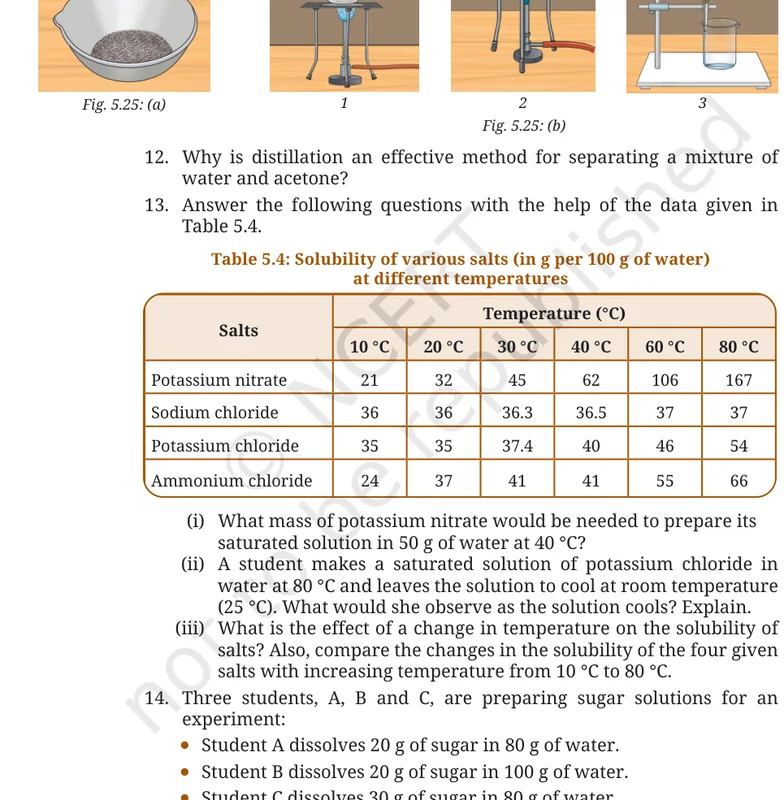
(i) What mass of potassium nitrate would be needed to prepare its saturated solution in 50 g of water at 40 °C?
Answer
When farmers spray pesticides on their crops, they must mix the right amount of pesticide with a fixed amount of water to prepare a solution.
Example 5.1: If 10 g of salt is dissolved in 90 g of water, calculate the mass by mass percentage of the solution formed.
Answer: Mass of salt (solute) = 10 g Mass of water (solvent) = 90 g Total mass of solution = Mass of solute + Mass of solvent = 10 g + 90 g = 100 g ×Mas sb ym assp ercentage Mas so fsolution Mas so fsolute 100= ×% /g g mm100 10 100 10== B.
example NCERT PDF page 21example
(ii) A student makes a saturated solution of potassium chloride in water at 80 °C and leaves the solution to cool at room temperature (25 °C). What would she observe as the solution cools?
Original NCERT figure
Answer
A solution that cannot dissolve any more solute at that temperature is called a saturated solution.
(a) Preparing the saturated solution (b) Filtering the hot saturated solution (c) Cooling down the filtrate (d) Crystals of copper sulfate Fig.
If a hot, saturated solution of copper sulfate is cooled rapidly in ice-cold water, smaller and less well-formed crystals will form than if it is cooled slowly at room temperature.
example NCERT PDF page 21example
(iii) What is the effect of a change in temperature on the solubility of salts?
Answer
On the other hand, in the case of gases dissolved in liquids, their solubility generally decreases with an increase in temperature.
A graph of solubility versus temperature is called a solubility curve .
(iii) The solubility of _____________ increases more than that of ______________ with an increase in the temperature.
example NCERT PDF page 21example
(ii) Whose solution is the most concentrated?
Answer
A solution alwa ys remains homogeneous.
If we change the amount of salt or sugar added to the same volume of water, or change the volume of water for the specified amounts of salt and sugar, we will get a solution of salt and sugar in water, but that will not be ORS.
When farmers spray pesticides on their crops, they must mix the right amount of pesticide with a fixed amount of water to prepare a solution.
example NCERT PDF page 22example
(iii) Which of the following mixtures can be separated by the technique identified above?
Answer
Crystallization is a common technique for separating pure substances (crystals) from homogeneous mixtures.
Exploring Mixtures and their Separation 81 A mixture of acetone and water can be separated by distillation because their boiling points differ sufficiently.
(iii) In paper chromatography, the solvent level should be above the sample spot at the beginning of the experiment.