When the ball is released from a greater height, this energy creates a deeper depression.
7.17: Depressions created by a ball in sand dropped from different heights Fig.
(ii) Assume that the average resistive force of sand is 3000 N and all of the coconut’s energy is used to create the depression in the sand.
Activity 7.1NCERT PDF page 10Activity 7.1
3. Now, raise the ball to the height of 2 m and release it at a slightly different position over the sand bed such that the depressions do not overlap. Repeat this step one more time. Compare the depths of the depressions. Is there any difference?
Answer
Method and observation
Raise the ball over the sand bed to a height of about 1 m and drop it (Fig.
Now, raise the ball to the height of 2 m and release it at a slightly different position over the sand bed such that the depressions do not overlap.
Repeat this step one more time.
Activity 7.1NCERT PDF page 10Activity 7.1
In which case is the depression deepest and in which case the shallowest?
Answer
Method and observation
In this case, the work done on the object by the force is equal to the area of the shaded rectangle in the graph which is 10 N × 1 m = 10 J Even when the force is not constant, work done can still be calculated by finding the area under the force-displacement graph between the initial and the final positions.
So, in each case, the ball or the pot has acquired a capacity to do some work.
Then by the work-energy theorem, the work done by the force will equal to the energy gained by the object, which is the kinetic energy of the object in this case.
Activity 7.1NCERT PDF page 11Activity 7.1
How much potential energy does the ball have when the ball reaches its maximum height?
Answer
Method and observation
7.16: Earth ball system Gravitational Force Ground Work, Energy, and Simple Machines 125 Gravitational Potential Energy Among the various types of possible ways in which objects can have potential energy, we will look at the simplest case of the gravitational potential energy of Earth-ball system.
Thus, the greater the height of the ball above the Earth’s surface, the greater is its potential energy.
(ii) If the ball reaches a height of 19.4 m, how much work was done by air resistance (assume g = 10 m s–2).
Activity 7.2NCERT PDF page 13Activity 7.2
Exploration|Grade 9 128 Example 7.8: What will be the magnitude of velocity of the child on reaching the bottom of the slide of height h ?
Answer
Method and observation
7.2: Lifting bags to a height (a) (b) (c) (d) Work = 3 W Work = W Work = 3 W Work = 3 W s = 3 m s = 1 m 3 m F 2 m 1 m 0 m 3FFF F F mg mg mg 3mg mg mg Exploration|Grade 9 118 The SI unit of work done is joule which is represented by J.
7.18: Raising an object to a height Ground F = mg h Exploration|Grade 9 126 Example 7.7: After taking a catch, a fielder threw the cricket ball of mass 200 g high up in the air about 10 m above the ground in celebration.
Thus, equating the two, we obtain 21 2 =mv mgh ( )= 2v gh As this velocity of the child at the bottom of the slide depends only upon the height h , the shape of the slide or the mass of the child should not matter.
Activity 6.3NCERT PDF page 17Activity 6.3
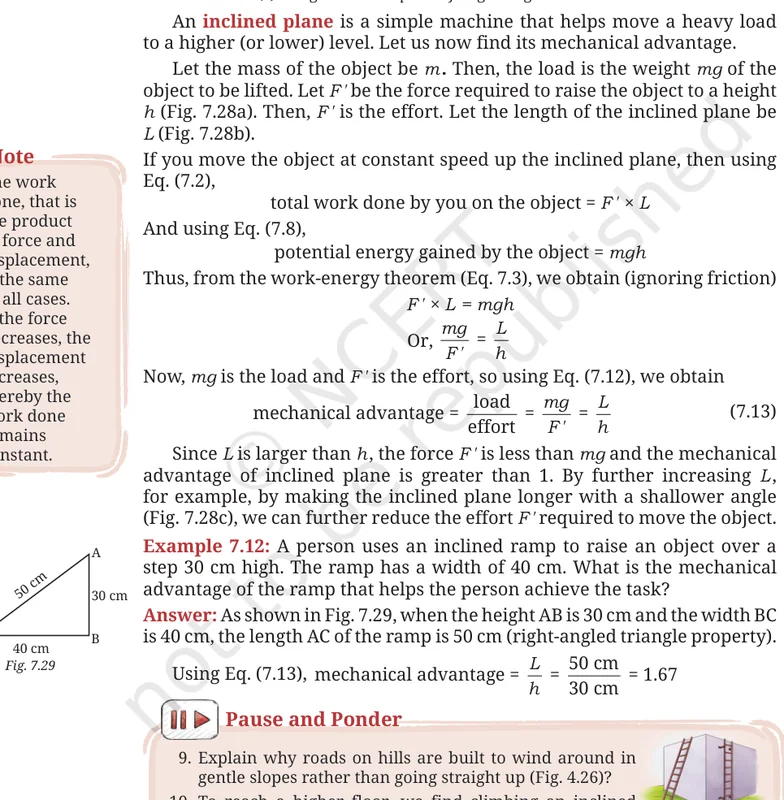
1. By further increasing L , for example, by making the inclined plane longer with a shallower angle (Fig. 7.28c), we can further reduce the effort F ′ required to move the object. Example 7.12: A person uses an inclined ramp to raise an object over a step 30 cm high. The ramp has a width of 40 cm. What is the mechanical advantage of the ramp that helps the person achieve the task?
Original NCERT figure
Answer
Method and observation
By further increasing L , for example, by making the inclined plane longer with a shallower angle (Fig.
7.28c), we can further reduce the effort F ′ required to move the object.
Example 7.12: A person uses an inclined ramp to raise an object over a step 30 cm high.
Activity 7.4NCERT PDF page 18Activity 7.4
(iii) Effort: the force applied. The distance of the load from the fulcrum is called the load arm, and the distance of the effort from the fulcrum is called the effort arm. By applying a small force at one end of the lever, a larger force can be applied on the object on the other end of the lever. How is this possible?
Answer
Method and observation
7.32): (i) Fulcrum: a fixed point about which the lever rotates, (ii) Load: the force to be overcome, and (iii) Effort: the force applied.
By applying a small force at one end of the lever, a larger force can be applied on the object on the other end of the lever.
(7.1) F1 × d1 = F2 × d2 (7.14) Thus, by increasing the effort arm, the lever applies a larger force F2 to the load compared to the applied effort F1.
Activity 7.5NCERT PDF page 19Activity 7.5
On which seats should children of masses 15 kg and 30 kg sit to make the seesaw balanced?
Answer
Method and observation
Example 7.13: For a seesaw having four seats A, B, D, E and fulcrum at C (Fig.
On a seesaw with sliding seats, a child is sitting on one side and an adult on the other side.