Question 5NCERT PDF page 20Revise, Reflect, Refine
5. Explain and arrange the following statements in the correct chronological order to show how atomic models have evolved over time. (i) Bohr’s model proposed that electrons move in fixed orbits around the nucleus, each with a definite energy. (ii) Thomson’s model depicted the atom as a ʻplum puddingʼ with electrons embedded in a sphere of positive charge. (iii) Rutherford’s model proposed that atoms have a dense central nucleus. (iv) Dalton’s model described atoms as indivisible particles.
Answer
Explain and arrange the following statements in the correct chronological order to show how atomic models have evolved over time.
(i) Bohr’s model proposed that electrons move in fixed orbits around the nucleus, each with a definite energy.
(ii) Thomson’s model depicted the atom as a ʻplum puddingʼ with electrons embedded in a sphere of positive charge.
Question 6NCERT PDF page 20Revise, Reflect, Refine
6. Electrons move around the nucleus in orbits. Why do they not fly away from the atom? Explain what keeps them attracted to the nucleus.
Answer
According to Bohr: y Electrons do not move randomly around the nucleus but follow fixed circular paths called stationary states, orbits, or shells.
He was curious about how atoms exist because the old models could not explain why electrons stay around the nucleus without collapsing.
In notation, it would be written as — 12 6 C So far, you know that protons and neutrons are located in the nucleus of an atom, while electrons move around the nucleus.
Question 7Assertion–ReasonNCERT PDF page 20Revise, Reflect, Refine
7. Assertion (A): The discovery of subatomic particles helped in understanding the atomic structure. Reason (R): The number of electrons is equal to the number of protons in an atom. Choose the correct option: (i) Both A and R are true, and R is the correct explanation of A. (ii) Both A and R are true, but R is not the correct explanation of A. (iii) A is true, but R is false. (iv) A is false, but R is true.
Answer
Choose the correct option: (i) Both A and R are true, and R is the correct explanation of A.
Assertion (A): The discovery of subatomic particles helped in understanding the atomic structure.
Reason (R): The number of electrons is equal to the number of protons in an atom.
Question 8NCERT PDF page 20Revise, Reflect, Refine
8. Magnesium is essential for many biological processes, including muscle contraction. For an atom of magnesium with a mass number of 24 and atomic number 12, determine the number of (i) protons, (ii) neutrons, (iii) electrons, and also illustrate the arrangement of electrons in a magnesium atom.
Answer
Magnesium is essential for many biological processes, including muscle contraction.
For an atom of magnesium with a mass number of 24 and atomic number 12, determine the number of (i) protons, (ii) neutrons, (iii) electrons, and also illustrate the arrangement of electrons in a magnesium atom.
What effect will this replacement have on the atom’s: (i) Atomic number (ii) Atomic mass (iii) Mass number (iv) Overall charge 161 Journey Inside the Atom y Create an ‘Atomic Prediction Board’ game based on atomic number, mass number, number of electrons, protons, neutrons and valency.
Question 9NCERT PDF page 20Revise, Reflect, Refine
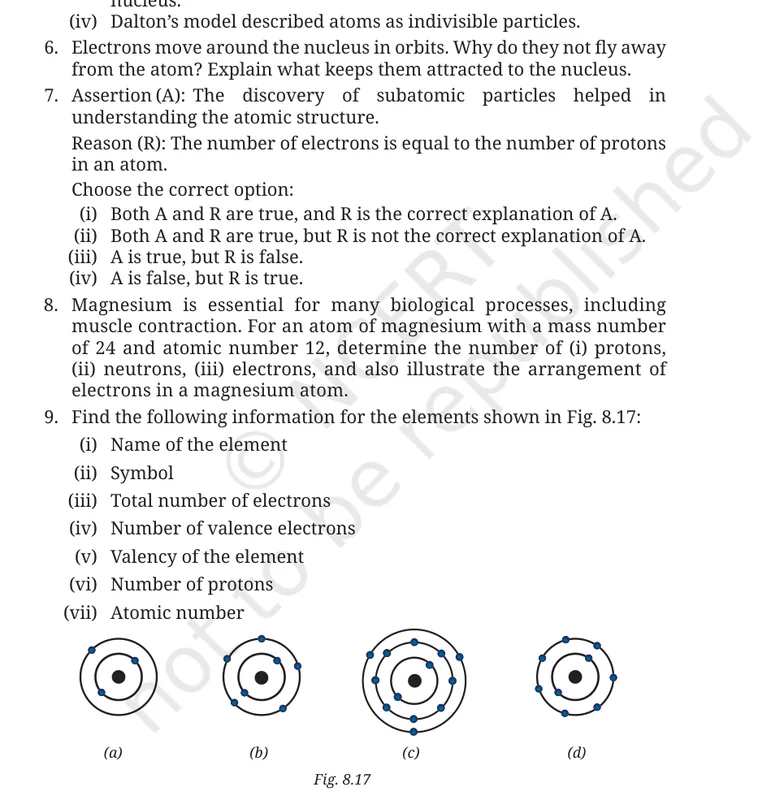
9. Find the following information for the elements shown in Fig. 8.17: (i) Name of the element (ii) Symbol (iii) Total number of electrons (iv) Number of valence electrons (v) Valency of the element (vi) Number of protons (vii) Atomic number Fig. 8.17 (a) (b) (c) (d)
Original NCERT figure
Answer
Find the following information for the elements shown in Fig.
8.17: (i) Name of the element (ii) Symbol (iii) Total number of electrons (iv) Number of valence electrons (v) Valency of the element (vi) Number of protons (vii) Atomic number Fig.
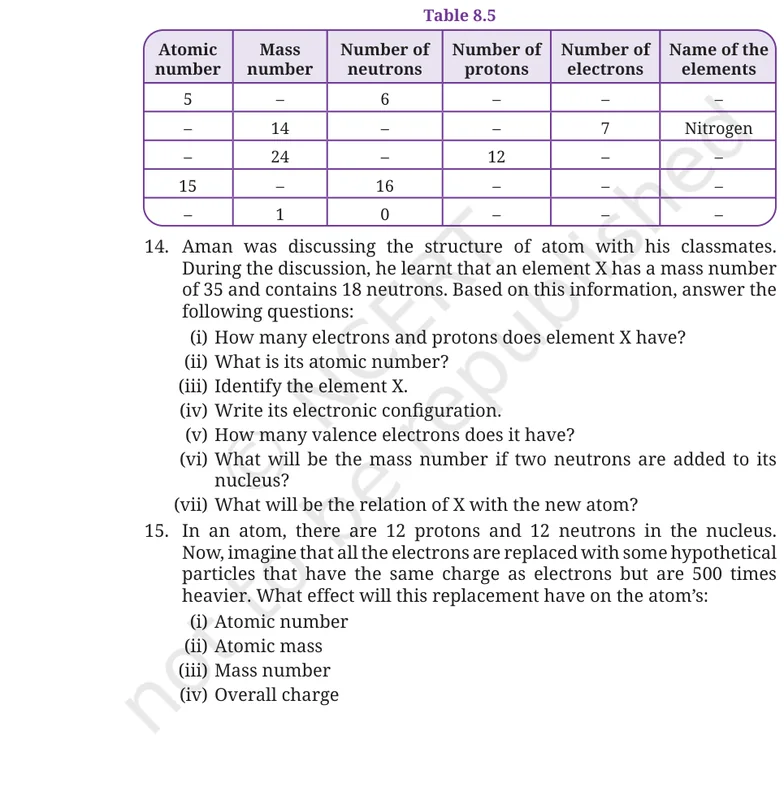
Complete the Table 8.5: Table 8.5 Atomic number Mass number Number of neutrons Number of protons Number of electrons Name of the elements 5 – 6 – – – – 14 – – 7 Nitrogen – 24 – 12 – – 15 – 16 – – – – 1 0 – – – 14.
Question 10NCERT PDF page 21Revise, Reflect, Refine
10. Both Rutherford’s and Bohr’s models have electrons orbiting the nucleus. Why did Rutherford’s model fail to explain atomic stability, while Bohr’s model succeeded?
Answer
Limitations of Rutherford’s model While the idea of a central nucleus was a major step forward, Rutherford’s model could not explain why atoms are stable.
He was curious about how atoms exist because the old models could not explain why electrons stay around the nucleus without collapsing.
Both Rutherford’s and Bohr’s models have electrons orbiting the nucleus.
Question 11NCERT PDF page 21Revise, Reflect, Refine
11. An atom 70 X has 31 electrons. How many neutrons are there in its nucleus?
Answer
So, heavier atoms need many more neutrons to hold everything in the nucleus tightly bound.
In notation, it would be written as — 12 6 C So far, you know that protons and neutrons are located in the nucleus of an atom, while electrons move around the nucleus.
In an atom, there are 12 protons and 12 neutrons in the nucleus.
Question 12NCERT PDF page 21Revise, Reflect, Refine
12. An atom has 79 protons and a mass number of 197. Calculate (i) the number of neutrons, and (ii) the number of electrons.
Answer
For an atom of magnesium with a mass number of 24 and atomic number 12, determine the number of (i) protons, (ii) neutrons, (iii) electrons, and also illustrate the arrangement of electrons in a magnesium atom.
Complete the Table 8.5: Table 8.5 Atomic number Mass number Number of neutrons Number of protons Number of electrons Name of the elements 5 – 6 – – – – 14 – – 7 Nitrogen – 24 – 12 – – 15 – 16 – – – – 1 0 – – – 14.
What effect will this replacement have on the atom’s: (i) Atomic number (ii) Atomic mass (iii) Mass number (iv) Overall charge 161 Journey Inside the Atom y Create an ‘Atomic Prediction Board’ game based on atomic number, mass number, number of electrons, protons, neutrons and valency.
Question 13NCERT PDF page 21Revise, Reflect, Refine
13. Complete the Table 8.5: Table 8.5 Atomic number Mass number Number of neutrons Number of protons Number of electrons Name of the elements 5 – 6 – – – – 14 – – 7 Nitrogen – 24 – 12 – – 15 – 16 – – – – 1 0 – – –
Original NCERT figure
Answer
Table 8.3: Mass number of different elements Element Protons ( p+) Neutrons ( n0) Mass number ( A) Hydrogen 1 0 1 Helium 2 2 4 Lithium 3 4 7 The electron, in comparison, has almost negligible mass, and hence, can be ignored in calculations.
Table 8.4 lists the symbols, atomic numbers, number of protons, number of neutrons, number of electrons, and the electron distribution in the shells of the first eighteen elements.
Complete the Table 8.5: Table 8.5 Atomic number Mass number Number of neutrons Number of protons Number of electrons Name of the elements 5 – 6 – – – – 14 – – 7 Nitrogen – 24 – 12 – – 15 – 16 – – – – 1 0 – – – 14.
Question 14NCERT PDF page 21Revise, Reflect, Refine
14. Aman was discussing the structure of atom with his classmates. During the discussion, he learnt that an element X has a mass number of 35 and contains 18 neutrons. Based on this information, answer the following questions: (i) How many electrons and protons does element X have? (ii) What is its atomic number? (iii) Identify the element X. (iv) Write its electronic configuration. (v) How many valence electrons does it have? (vi) What will be the mass number if two neutrons are added to its nucleus? (vii) What will be the relation of X with the new atom?
Answer
8.17: (i) Name of the element (ii) Symbol (iii) Total number of electrons (iv) Number of valence electrons (v) Valency of the element (vi) Number of protons (vii) Atomic number Fig.
During the discussion, he learnt that an element X has a mass number of 35 and contains 18 neutrons.
What effect will this replacement have on the atom’s: (i) Atomic number (ii) Atomic mass (iii) Mass number (iv) Overall charge 161 Journey Inside the Atom y Create an ‘Atomic Prediction Board’ game based on atomic number, mass number, number of electrons, protons, neutrons and valency.
Question 15NCERT PDF page 21Revise, Reflect, Refine
15. In an atom, there are 12 protons and 12 neutrons in the nucleus. Now, imagine that all the electrons are replaced with some hypothetical particles that have the same charge as electrons but are 500 times heavier. What effect will this replacement have on the atom’s: (i) Atomic number (ii) Atomic mass (iii) Mass number (iv) Overall charge
Answer
But scientists later discovered that there were atoms of the same element that could have the same number of protons (atomic number, Z) yet could have different numbers of neutrons, and thus, different mass numbers (A = p + + n 0).
Now, imagine that all the electrons are replaced with some hypothetical particles that have the same charge as electrons but are 500 times heavier.
What effect will this replacement have on the atom’s: (i) Atomic number (ii) Atomic mass (iii) Mass number (iv) Overall charge 161 Journey Inside the Atom y Create an ‘Atomic Prediction Board’ game based on atomic number, mass number, number of electrons, protons, neutrons and valency.