Chapter 4: Early Humans and Beginning of Civilisation
History · In-text Questions & Activities · Official NCERT Grade 9 · First Edition 2026–27
10 solved promptsPDF source orderHistory
Question 1NCERT PDF page 1In-text Questions
1. How did humans live on Earth before the beginning of civilisation?
Answer
Early Humans and Beginning of Civilisation 1.
67 4 – Early Humans and Beginning of Civilisation Fig.
71 4 – Early Humans and Beginning of Civilisation The Neolithic Revolution As hunter–gatherers gained adequate familiarity with seasons and different types of food resources, there was a gradual transition to a food-producing way of life, also known as the Neolithic revolution.
Conclusion: Relate the evidence directly to every part of the question.
Question 2NCERT PDF page 1In-text Questions
2. How did humans communicate before writing was invented?
Answer
The period before the development of writing is understood mainly through archaeological evidence, as written languages emerged at different times in different parts of the world.
Middle Palaeolithic tools Later, humans invented the bow and arrow, as well as parallel-sided blade and microblade tools made from rocks with glassy texture (very sharp when freshly made).
Early Humans and Beginning of Civilisation 1.
Conclusion: Relate the evidence directly to every part of the question.
Question 3NCERT PDF page 1In-text Questions
3. How is archaeology helpful in understanding our past?
Answer
Living humans, or the Homo sapiens, are the only human species living today on earth. a b d c Fossil: The preserved remains, traces, or impressions of plants, animals, or humans from the distant past.
Conclusion: Relate the evidence directly to every part of the question.
Question 4NCERT PDF page 1In-text Questions
4. How did early civilisations interact with each other?
Answer
Other early writing systems include the cuneiform script of the Sumerians in Mesopotamia and the hieroglyphic script of ancient Egypt, both of which flourished around the same time as the Harappan Civilisation.
Some other developments, such as building a perimeter wall around the settlement, the use of seals, and even the Harappan writings/script, probably had their beginnings in the Early Harappan stage.
In this section, we will explore the main features of other Bronze Age civilisations that were contemporary with the Harappans.
Conclusion: Relate the evidence directly to every part of the question.
Question 5NCERT PDF page 21Don’t Miss Out
Do you think our understanding of a civilisation changes when its script is deciphered compared to when it is not?
Answer
Observe this seal carefully and discuss why the script has not yet been deciphered.
However, it has not yet been deciphered.
As a result, we still do not understand the Harappan script, also referred to as Sindhu lipi.
Conclusion: Relate the evidence directly to every part of the question.
Question 6NCERT PDF page 25Don’t Miss Out
(winter) and shemu harvest (summer). It is based on the rising of Sirius (Dog Star), where, Year = 365 days (12 months × 30 days + 5 extra days). This is quite accurate, but lost time since the real year is about ¼ day longer. THINK ABOUT IT Why do you think there is a scale with a heart on one side and a feather on the other (fig. 4.29)?
Answer
It is based on the rising of Sirius (Dog Star), where, Year = 365 days (12 months × 30 days + 5 extra days).
This is quite accurate, but lost time since the real year is about ¼ day longer.
Inundation (autumn), Peret growing (winter) and shemu harvest (summer).
Conclusion: Relate the evidence directly to every part of the question.
Question 7NCERT PDF page 26Don’t Miss Out
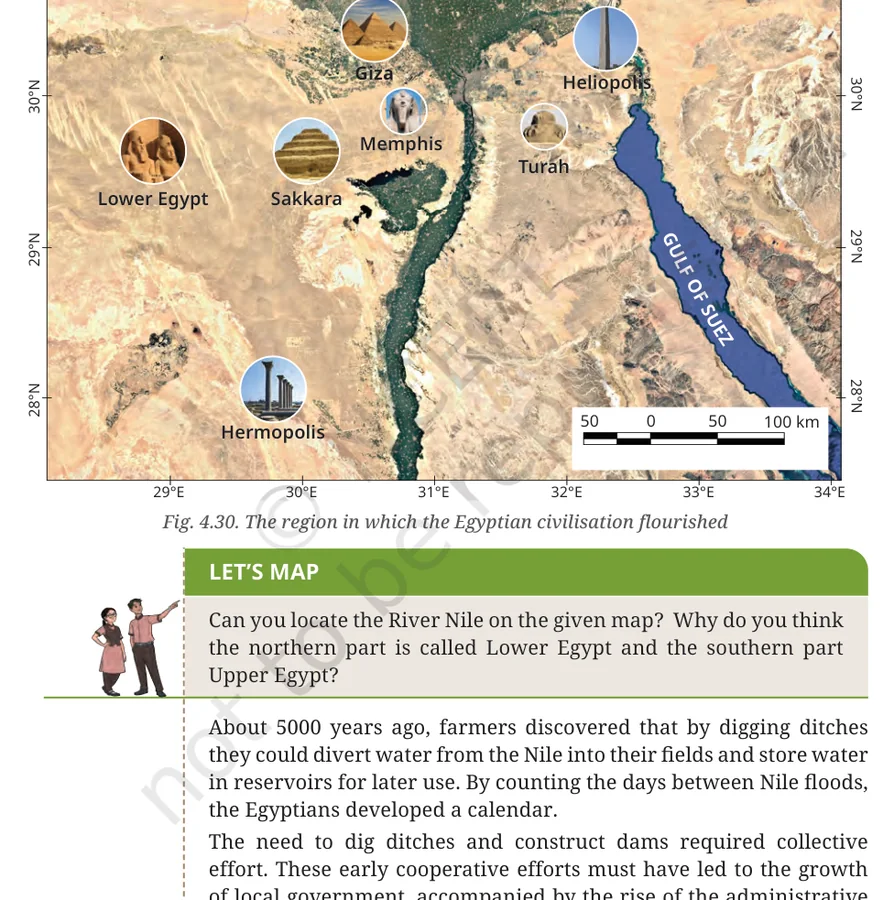
Grade 9 – Part 1 LET’S MAP Can you locate the River Nile on the given map?
Original NCERT cropped visual (source page 26)
Answer
Grade 9 – Part 1 LET’S EXPLORE You have studied about the Harappan script in your previous grades.
4.3 Grade 9 – Part 1 Hominin: Hominins are a group that includes modern humans and our early human-like ancestors.
Grade 9 – Part 1 A distinctive type of stone tool, known as a burin or engraver, was also used to engrave symbolic features on bones and shells (such as ostrich eggs).
Conclusion: Relate the evidence directly to every part of the question.
Question 8NCERT PDF page 29Don’t Miss Out
Can you recall how they supported people’s lives?
Answer
Both material remains and written documents are sources for reconstructing the lives of people and society.
Lives of the People It is generally difficult to understand the thoughts and ideas of people.
Temples played an important role in people’s lives, and each city built a grand temple called a ziggurat for its chief god, and the city grew around this main temple (Fig.
Conclusion: Relate the evidence directly to every part of the question.
Question 9NCERT PDF page 30Don’t Miss Out
How do we know what we know about China?
Answer
However, the earliest source of information about China are the ‘oracles’, which were symbols made on pieces of animal bones and tortoise shells.
It is through such findings that we know that the Homo habilis (handy man) lived in Africa, especially in the Olduvai Gorge in Tanzania and Kenya.
It is important to note that four early world civilisations emerged in river plains—the Harappan civilisation along the Sindhu and Sarasvatī rivers, the Mesopotamian civilisation in the region around the Euphrates and Tigris rivers in West Asia, the Egyptian civilisation along the Nile River, and the Chinese civilisation in the Huang He basin in northern China.
Conclusion: Relate the evidence directly to every part of the question.
Question 10NCERT PDF page 32Don’t Miss Out
Grade 9 – Part 1 THINK ABOUT IT What could have been the other reasons for building the Great Wall of China?
Answer
Grade 9 – Part 1 LET’S EXPLORE You have studied about the Harappan script in your previous grades.
These tools have been found in other parts of Asia and Europe, indicating their origin in Africa and their dispersion beyond the continent between 2 and 0.5 million years ago.
Sanganakallu Neolithic site on top of a granite hill, dating 2000 BCE Grade 9 – Part 1 Sindhu–Sarasvatī Civilisation In the previous section, you have seen how the Neolithic way of life that emerged around 7000 BCE at Mehrgarh in the foothills of Baluchistan, spread in the middle and upper Indus valley and further east.
Conclusion: Relate the evidence directly to every part of the question.